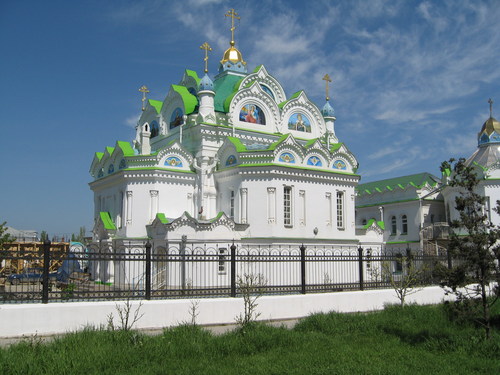
Location: Feodosiya
Russian Orthodox Church of Saint Catherine in Feodosiya is one of the most beautiful and unique Ukrainian/ Russian churches. Its construction began on 21st of April, 1892, which is a day of anniversary of birthday of Russian Empress Catherine II the Great. The church was dedicated to Saint Catherine, heavenly protector of a famous 18th century Russian empress. In 1901 father Andrew Kosovsky became the head of the Russian Orthodox church. After Revolution atheist campaign started closing churches and killing Christians. Father Andrew was not an exception. He was arrested in 1920 ironically on a feast day of martyr Saint Catherine. After long captivity he was executed, while this beautiful Feodosiya church was closed. It was re- opened by occupational German troops. It was opened every since.
The foundation of St. Catherine's Church in Feodosia, Crimea, was
laid on April 21, 1892, coinciding with the anniversary of Empress
Catherine II's birth. Dedicated to Saint Catherine, the structure was
funded primarily through voluntary contributions from local residents.
Notably, the chief prosecutor contributed around 3,000 rubles, while
prominent mathematician Dr. V. I. Lapshin provided substantial financial
support. City merchants supplied essential building materials, and
laborers volunteered their time on weekends to aid the project. The
oversight committee featured influential figures such as Mikhail
Ivanovich Altukhov, Nikolai Alexandrovich Ivanitsky, and Vasily
Ksenofontovich Vinogradov. Additional key contributors included the
aforementioned Vasily Ivanovich Lapshin and Nikolai Pavlovich Mezhenin,
an engineer credited with establishing the railway system in Feodosia.
This collaborative effort exemplifies the community's devotion and
highlights the church's role as a symbol of local pride and religious
commitment.
Architecturally, St. Catherine's Church embodies classic
Russian Orthodox design, faithfully adhering to 17th-century traditions
despite being constructed in the late 19th century. Its layout follows a
Greek cross plan, with walls elevated on a prominent plinth and accented
by corner columns. The western entrance features a grand portico topped
by a graceful bell tower. Surrounding the upper structure is an
intricate arrangement of kokoshniks—semi-circular or pointed decorative
arches—while the roof is crowned by five modest domes, painted in a
striking blue hue and adorned with golden stars to evoke the heavens.
The portico's columns are distinctively squat and flared in the middle,
enhancing the entrance's welcoming yet majestic appearance. The
kokoshniks vary in size and are embellished with elaborate carvings,
adding to the building's ornate facade. This design not only pays homage
to historical Russian ecclesiastical styles but also incorporates
elements that reflect Byzantine influences, common in Orthodox
architecture, making it a standout example in the region.
In 1901,
Father Andrei Kosovsky became the church's rector, serving faithfully
until the turbulent 1920s when he was arrested mid-service on
allegations of anti-Soviet agitation. Tragically, he was later executed.
In recognition of his martyrdom, he was canonized as Saint Andrei of
Feodosia in 2000 by the Russian Orthodox Church, honoring his enduring
legacy of faith under persecution.
The church faced significant
challenges in the Soviet era; in 1937, it was shuttered and repurposed
as a storage facility, stripping it of its sacred function. However,
during World War II in 1941, occupying German forces initiated
restoration efforts, allowing services to resume. This marked a turning
point, positioning St. Catherine's as one of the rare operational
Orthodox churches in Crimea during the postwar period. Among its postwar
clergy was Father Macarius, whose tenure is referenced in the writings
of Russian author Anastasia Tsvetaeva, sister of the famous poet Marina
Tsvetaeva, providing a literary glimpse into the church's resilience
amid historical upheaval.
In the late 1990s, the church complex expanded with the addition of a
chapel dedicated to St. John the Baptist, which included facilities for
a Sunday school and a baptistery. A comprehensive renovation in 2002
further enhanced the site, resulting in a multifaceted complex that now
encompasses dedicated spaces for education and hospitality: a Sunday
school classroom, a library, a methodologist's office, and even a small
hotel for pilgrims and visitors exploring Feodosia's scenic attractions,
such as its Black Sea coastline and historic sites.
More recently, a
new chapel was constructed on the grounds, featuring a full-immersion
baptistery to accommodate traditional Orthodox baptism rites. The
on-site hotel continues to serve as a convenient lodging option for
tourists and devotees alike, blending spiritual retreat with the town's
tourism appeal. For over 25 years, Father Aleksey Svitansky led the
parish as rector, guiding its growth until 2015, when Archpriest Vadim
Sinichkin assumed the role, bringing fresh leadership to ongoing
initiatives.
The church maintains an active Sunday school program,
including one tailored specifically for the Cossack community in
Feodosia, fostering cultural and religious education among younger
generations. A notable milestone occurred on June 19, 2016, when the
inaugural session of the Sunday school for the City Cossack Society "The
Village of Feodosia" was held on the church premises, strengthening ties
between the parish and local Cossack traditions, which have deep roots
in Crimean history.
Further enriching the site, on February 6, 2018,
the Chapel of Blessed Xenia of St. Petersburg was inaugurated within the
Feodosia Bishops' Metochion of the Holy Great Martyr Catherine. This
addition came in response to persistent requests from local Orthodox
faithful and with the approval of Metropolitan Platon. At the time, it
marked the first such dedication to Saint Xenia in the Feodosia-Kerch
diocese, addressing a spiritual gap and drawing more pilgrims seeking
her intercession for matters like marriage, family, and mental health,
as per her hagiography.
Today, St. Catherine's Church remains a
vibrant center of Orthodox worship in Crimea, blending its rich
historical legacy with modern community outreach. It stands as a
testament to enduring faith, having survived political shifts, wars, and
restorations, and continues to attract visitors interested in Russian
architectural heritage and religious history.