Location: Feodosiya
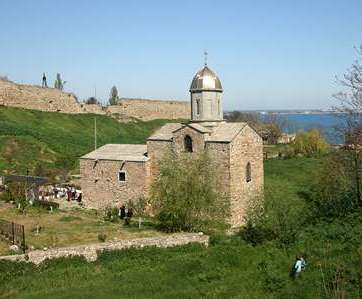
The Church of St. John the Baptist (also known as the Church of the Iveron Icon of the Mother of God or the Armenian Church of St. Hovhannes Mkrtch) is one of the oldest Christian churches in Crimea, located in Feodosia, Republic of Crimea, Russia. Built in the 13th–14th centuries in the Armenian style, the church is an outstanding monument of medieval architecture and reflects the history of Armenian settlements in the region. Situated in the area of the former Armenian fortress of Hayots Berd (now known as Karantin), next to the Genoese Fortress, it is listed as a cultural heritage site of federal significance. The church, which is active and belongs to the Feodosia Diocese of the Russian Orthodox Church (ROC), attracts tourists with its history, architecture, and preserved decorative elements.
The temple was built by Armenian architects in 1348 (or
earlier, according to some versions) as the Armenian Church
of St. John the Baptist (Hovhannes Mkrtch), dedicated to one
of the most important Christian saints and symbolizing the
peaceful future of Armenian settlers in the new land.
Armenians appeared in Crimea as early as the 1st century BC,
but large-scale settlements began in the 10th–11th
centuries. By the 14th century, they constituted the
majority of the population of the southern coast and
two-thirds of the inhabitants of Kaffa (the ancient name of
Feodosia). The temple was built in the fortified Armenian
district of Hayots Berd, where there were five Armenian
churches.
The temple was first mentioned in Armenian
sources in 1438. It was renovated in the 17th century, as
evidenced by colophons in manuscripts from 1641, 1657, and
1661. In 1475, after the conquest of Kaffa by the Turks, the
church fell into disrepair and was renamed the Quarantine
Church. In 1778, by order of Catherine II, Armenians were
resettled in the Azov Governorate, leading to further
decline. After Crimea was annexed by Russia in 1783, the
area was converted into a sanitary quarantine zone, and in
1875, the church was handed over to the Russian Orthodox
Church and consecrated in honor of the Iveron Icon of the
Mother of God.
During the revolutionary years,
approximately 7,000 people were executed near the church; in
2005, a memorial cross was erected there to commemorate the
victims of the Bolshevik terror of 1918–1920. Under Soviet
rule, the church was closed in the 1920s; it served as a
store and fell into disrepair. In 1927, an expedition led by
I. Grabar examined the frescoes, attributing them to
Theophanes the Greek. Archaeological work was conducted
between 1978 and 1980. A full restoration was completed in
1996 under the direction of Valery Zamekhovsky: the ground
level was lowered, the courtyard was paved, and the dome was
restored. Additional work was carried out on the site in
2021 and 2022.
The temple is built in the Armenian style as a simplified version of the domed halls of the 12th–14th centuries (similar in Armenia to Spitakavor and Noravank). It consists of two parts: the ancient square (9.35 × 7 m) with an octagonal drum, loophole windows, and a dome, and a later extension—an elongated rectangular narthex on the western side, divided by pillars into three naves with semicircular vaults. The walls are made of roughly hewn stone with lime mortar, plastered, and have an ascetic appearance: smooth facades without unnecessary decoration, enlivened by a portal and a dome. The interior is 12.5 meters high, with lofty proportions, pointed arches, and vaulted ceilings. Lighting comes from arched windows on three sides and four narrow windows in the dome (unique among Crimean Armenian churches). The entrances are: the western one with a carved portal (frames with plant motifs, a "Seljuk chain," a niche with a cross and cherubs), and the northern one with an architrave slab and khachkars. The narthex is two-pillared, with a gable roof, consoles, and windows.
The interior is austere, but with unique elements. The horseshoe-shaped apse features a frieze titled "Communion" (Eucharist)—a relief of Christ and the 12 apostles, each with individualized figures. Along the edges are full-length reliefs of saints (John the Baptist and Gregory the Illuminator). Below are two ornamented fonts (half-palmettoes, shoots). In the center of the dome is a relief of the Virgin Mary Oranta. Fragments of frescoes (figures of saints in bright colors) discovered in 1927 remain, but many have been lost. Near the entrance are khachkars and ancient Armenian tombstones from a former cemetery. In the past, there were stone statues of John the Baptist and St. Nicholas the Wonderworker, but they have disappeared.
The church is a testament to Armenian culture in Crimea, one of the few surviving medieval Armenian monuments. It reflects the influence of Armenian architecture and art, with unique reliefs not typical of other faiths. In 1906, the artist K. F. Bogaevsky and J. Durante were married here. It is a cultural heritage site (registration number 911510363240066).
The church is active; services are held on Sundays and holidays eve at 5:00 PM, and on Sundays and holidays at 8:00 AM. Following restoration in 1996 and renovations in 2021–2022, it is in good condition, although some elements (like murals) have been lost.
The church is located at 16 Portovaya Street (or Starokarantinnaya Street), Feodosia, coordinates: 45°01′21″ N 35°24′05″ E. You can walk from the center of Feodosia or take public transportation to the Genoese Fortress. Admission is free, but respect for services is recommended. A visit takes 30–60 minutes; a memorial cross and garden are nearby. Ideal for history and architecture buffs.