OPERATING MODE
Daily from 8:00 to 18:00. Please see the text
below for information on the schedule of services.
TICKET
PRICE
Free.
PHONE (PHONE)
8(4932) 30-87-66
PHONE FAX)
8(4932) 30-06-48
OFFICIAL SITE OF THE CHURCH OF THE
TRANSFORMATION IN IVANOVO
http://sobor-ivanovo.prihod.ru
Email:
ivsobor@gmail.com
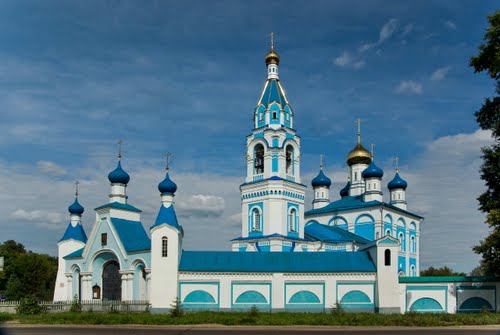
The Transfiguration Cathedral, also known as the Transfiguration of the Saviour Eparchial Cathedral or affectionately the "White Church" by locals, is a prominent Russian Orthodox landmark in Ivanovo, Russia. Situated at 44 Kolotilova Street, it stands as a striking example of late 19th-century Russian revival architecture and serves as the eparchial cathedral for the Ivanovo Metropolitanate. Its bright white facade accented with blue domes gives it a cheerful, ethereal appearance that contrasts with the industrial heritage of the surrounding city, often called the "Russian Manchester" for its textile history.
The cathedral's origins trace back to the late 19th century, a period
when Russian architecture sought to revive pre-Petrine styles as a nod
to national identity and spirituality. Construction began in 1889 and
was completed in 1893, with consecration following that year. The
project was funded by Methodius N. Garelin, a wealthy local textile
manufacturer and philanthropist whose family played a key role in
Ivanovo's industrial development. Garelin's grave, along with that of
his wife, remains in the cathedral's yard, serving as a tangible link to
its founding patrons.
The architect, Alexander S. Kaminsky, was a
Moscow-based designer renowned for his work on the original Tretyakov
Gallery building and the Nikolo-Ugreshsky Monastery. Kaminsky drew
inspiration from 17th-century Russian ecclesiastical traditions, which
had been interrupted by Peter the Great's Westernizing reforms, viewing
them as the pinnacle of national artistic expression.
The cathedral's
history reflects the turbulent 20th century in Russia. In 1940, under
Soviet rule, it was closed, and its interior was completely devastated,
with valuables looted or destroyed. Remarkably, services resumed by 1944
amid World War II, making it the only functioning church in the entire
Ivanovo Region for the next 45 years—a period when most religious sites
were shuttered or repurposed. During this time, it also functioned as
the primary temple for the local diocese. Post-war restoration efforts
began almost immediately, including the installation of a new main
iconostasis, and the building has remained active ever since. Today, it
stands as one of the few preserved examples of this architectural style
in Ivanovo, having survived both Soviet suppression and urban
development.
Designed in the Russian revival style, the cathedral emulates the
ornate, spiritual aesthetics of 17th-century Russian churches,
emphasizing intricate details and a sense of historical continuity. The
structure is a five-domed edifice, with each dome mounted on tall,
slender tholobates (cylindrical drums) that enhance its verticality and
grandeur. These domes are painted a vibrant blue, topped with Orthodox
crosses, creating a vivid contrast against the predominantly white
exterior walls.
The main building is large and elaborately decorated,
with fine embellishments covering all outer walls—kokoshniki
(semi-circular or pointed arches), pilasters, and patterned friezes that
evoke ancient Russian motifs. Attached to the front is a prominent bell
tower, adding to the complex's silhouette. The entire ensemble includes
stone gates with pallid blue accents, outbuildings, and a surrounding
fence that unifies the site into a cohesive architectural compound. This
white-and-blue palette not only justifies its "White Church" nickname
but also imparts a light, uplifting atmosphere, making it a visual
standout in Ivanovo's landscape.
While the exterior draws from historical revivalism, the interior has been restored to reflect traditional Orthodox opulence. The main iconostasis, replaced during post-war renovations, features intricate carvings and icons that guide worshippers through liturgical spaces. The cathedral houses several revered shrines, including the relics of St. Basil of Kineshma (a local saint canonized for his resistance to Soviet atheism), fragments from the venerated saints Leontius of Rostov, Macarius of Unzha, and Blessed Simon of Yurievets, and the miraculous Inexhaustible Chalice Icon of the Mother of God, which is believed to aid in healing addictions. These relics attract pilgrims and underscore the cathedral's role as a spiritual center.
Beyond its architectural beauty, the Transfiguration Cathedral holds deep cultural and religious importance. As the sole survivor of widespread church closures in the region, it symbolizes resilience and the revival of Orthodox faith in post-Soviet Russia. It remains a key site for the Ivanovo diocese, hosting services, festivals, and community events. For visitors, it offers a glimpse into Russia's architectural heritage and the interplay between industry, philanthropy, and religion in the late imperial era. The cathedral is open to the public, with services held daily, and it's recommended to check local schedules for major feasts like the Transfiguration on August 19.
The cathedral is located in the center of Ivanovo, on Sovetskaya
Square (formerly Revolution Square), opposite the House of Soviets. This
is the central part of the city, where fairs and public events have
historically taken place. Notable Events
The cathedral has witnessed
key events: in 1913, the 300th anniversary of the Romanov dynasty was
celebrated here. During the Great Patriotic War, the church was closed
but escaped complete destruction. In the post-Soviet period, it hosted
significant services, including the visit of Patriarch Alexy II in 2000.
Today, the cathedral is a place of pilgrimage and hosts festivals such
as the Nutcracker Music Festival.
The cathedral is designated a federal cultural heritage site. It can accommodate up to 3,000 people and is equipped with modern lighting for evening services. The Ivanovo History Museum is located next to the cathedral, making it a popular tourist destination in the city. Thousands of tourists and believers visit the cathedral annually, interested in its role in the history of Russia's textile hub.