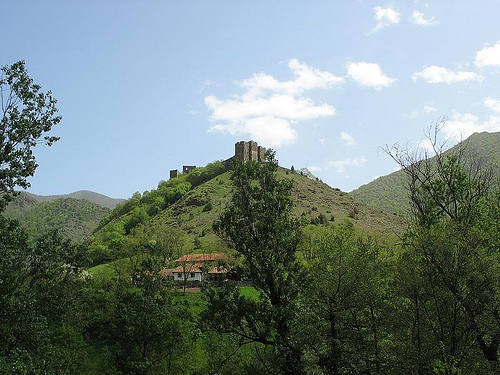
Location: 20 km South of Kraljevo Map
Constructed: 13th century
Maglič Castle is located 20 km South of Kraljevo in the gorge of Ibar river. The fortress of Maglič was constructed in the 13th century by Stephen I as a defensive measure to protect nearby monasteries of Studenica and Zica. In the 14th century served as a seat of Archbishop Danilo II, who was also famous as a historian and an author of biographies of Serbian rulers. Ottoman Turks captured the Maglič citadel in 1459 and occupied it. During the Great Turkish War (1683–1699) the Serbs briefly retook the possession of the castle, but soon lost it to Turks. Due to military advancements Maglic Castle lost its military importance and its walls were abandoned by permanent garrison of soldiers. During the Second Serbian Uprising (1815-1817) crumbled walls served the Serbs under leadership of Voivod (military leader) Radoslav Jelečanin as a site for ambushes. The citadel was build on top of a strategic location. Seven towers defended Maglič Castle. It also contained a palace, church and military barracks those ruins in different level of preservation are still visible. Two restorations took place in Maglič Castle. One was in 1920's and another one in 1980's.
Construction and Origins
The exact date of Maglič's construction
remains uncertain, but historical evidence points to its erection in the
first half of the 13th century. It is widely attributed to either Stefan
the First-Crowned (reigned 1196–1228), the founder of the Serbian
Nemanjić dynasty, or his son, King Uroš I (reigned 1243–1276). Some
sources suggest it was built by Uroš I specifically in response to the
Mongol invasions of the 1240s, aiming to fortify the Ibar gorge against
further incursions. Archaeological findings indicate that an earlier
fortification may have existed on the site as far back as the 12th
century during Byzantine rule under the Komnin dynasty, possibly a
small, naturally defended castle that suffered fire damage and was later
renewed. However, its fate during Serbian-Byzantine conflicts is
unclear, with potential destruction from another fire.
The primary
phase of construction likely coincided with renovations at the nearby
Žiča Monastery in the late 13th century, possibly under King Milutin
(reigned 1282–1321), to defend against threats like the Cumans and
Tatars. The builders' identities are unknown, but their architectural
style echoes Roman and Byzantine influences, suggesting origins from
Greek regions or the Serbian coast where such traditions were familiar.
No specific master builder is identified in historical records.
Purpose and Defensive Role
Maglič was strategically designed to
control and protect vital routes in medieval Serbia. It guarded the only
road linking the Great Morava Valley and Kosovo Polje, a critical
caravan path for trade and military movements. Its primary role was to
safeguard prominent monasteries, including Studenica (founded by Stefan
Nemanja), Sopoćani, and Žiča, which were central to Serbian Orthodox
heritage and royal endowments. Positioned on a hill with steep,
inaccessible sides and a rock-cut trench on the northeastern end, it
served as a formidable barrier against invasions from the north and
east, including Mongol raids. Beyond defense, it functioned as a refuge
and fortified court, particularly linked to the protection of Žiča
Monastery.
Key Figures and Historical Events
During the height
of the Serbian Empire in the 14th century, Maglič became the seat of
Archbishop Danilo II (served 1324–1337), a prominent figure and close
advisor to Serbian rulers. Danilo resided there to compose his renowned
hagiographies and regiographies, including biographies of early Serbian
rulers. He oversaw a major restoration between 1324 and 1337, rebuilding
the town, the Church of St. George, and other structures, equipping them
with books and essentials, transforming it into his fortified court.
This is documented in Danilo's biography, the only primary historical
source mentioning the fortress's early construction.
The fortress
fell to the Ottoman Empire following the capture of Smederevo on June
20, 1459, and was occupied by Turkish forces until recaptured by Serbs
during the Great Turkish War (1683–1699). It was retaken by the Ottomans
after the suppression of a Serbian uprising and abandoned as a military
site after 1572. During the Austro-Turkish War (1688–1690), it was noted
as a Turkish stronghold by Austrian forces. In the Second Serbian
Uprising (1815), Voivod Radoslav Jelečanin ambushed Turkish soldiers
from the fortress, halting their advance from Novi Pazar and playing a
role in battles around Karanovac (modern Kraljevo). Archaeological
evidence suggests no major sieges before the Turkish conquest, which
likely occurred without significant resistance.
Architecture and
Layout
Maglič's design exemplifies medieval Balkan fortifications,
featuring an elongated polygonal base approximately 120 meters long and
20–40 meters wide, enclosing about 2,190 square meters. It includes
seven towers and one dungeon (keep) tower, connected by 270-meter-long
ramparts that are 2 meters thick and up to 7 meters high, with a 55 cm
parapet and a path protected by a wooden fence. Three towers in the
southern section are closely positioned for enhanced defense. Access is
via a northern gate and a small sally port in a southeastern tower.
Internally, remnants include a palace adhering to the northwest rampart,
barracks, two water cisterns, a large reservoir, and a deep well. The
Church of St. George, dedicated and restored by Danilo II, stands as a
key structure. The walls feature three solid stone sides with wooden
fences on the inner side.
Restorations and Modern Significance
Maglič fell into ruins over centuries but underwent partial restoration
after World War I. Major work occurred in the late 1980s, including
wooden floors in towers and fences along walls, though some elements
have since deteriorated, posing safety risks. In 2010, further
restoration was announced, funded by local donations and Italian
support. The eastern rampart was fully rebuilt during Danilo's era,
while the western and northern sections were partially destroyed but
retained intact paths.
Today, Maglič attracts visitors for its
historical allure and serves as the starting point for the annual "Merry
Ride" (Veseli spust) in July, a festive river voyage down the Ibar to
Kraljevo involving over 3,000 participants, including politicians, on
various vessels.
Legends and Cultural Significance
Maglič is
steeped in folklore, enhancing its romantic and mysterious reputation.
One legend attributes its construction to Irina Kantakuzina (Jerina),
wife of Despot Đurađ Branković (reigned 1427–1456), known as "Prokleta
Jerina" (The Damned Jerina), who allegedly built it and disposed of
lovers in its deep well; locals sometimes call it "Jerina's Town."
However, this is historically inconsistent, as it would date the
fortress to the 15th century.
More endearing tales link it to the
Valley of Lilacs. One claims King Uroš I planted vast lilac undergrowth
to declare his love for Queen Helen of Anjou, a French Catholic
noblewoman, helping her acclimate to Serbia. Another attributes the
lilacs to their son, King Milutin, for his young Byzantine wife,
Simonida, daughter of Emperor Andronicus II, to please her before
marriage. These white and blue blooms still flourish annually along the
Ibar Valley, symbolizing enduring love and tying the fortress to
Serbia's medieval soul.
Overall Layout and Site Adaptation
The fortress features an
irregular, elongated polygonal base, extending in a southwest-northeast
direction and measuring roughly 120 meters in length and 20 to 40 meters
in width, covering an interior area of about 2,190 square meters. This
shape is meticulously adapted to the natural contours of the hilltop,
maximizing defensive advantages by leveraging the steep slopes and the
river below as natural barriers. On the northeastern end, where the
river does not provide protection, a deep trench is cut into the rock to
form an additional obstacle. The entire structure is inaccessible by
motor vehicles, emphasizing its isolated, elevated position that would
have deterred attackers in medieval times.
Walls, Towers, and
Defensive Elements
At the core of Maglič's architecture are its
robust ramparts and towers. The perimeter walls stretch 270 meters in
total length, with a uniform width of 2 meters and a parapet (a low
protective wall along the edge) approximately 55 cm wide, allowing
defenders to fire upon assailants while remaining shielded. These walls
connect seven cylindrical or semi-cylindrical towers plus one prominent
dungeon tower, forming a continuous defensive line that exemplifies
typical Serbian medieval fortification techniques. In the southern
section, three towers are clustered closely together, enhancing
protection against assaults from that direction by providing overlapping
fields of fire and structural reinforcement.
Access to the interior
is controlled through two entrances: a primary gate on the northern side
and a smaller sally port (a concealed exit for surprise counterattacks)
integrated into one of the southeastern towers. The towers themselves
are designed for both surveillance and combat, with heights and
positions optimized to overlook the surrounding gorge and river valley.
Stone construction predominates, with the walls and towers built to
withstand sieges, incorporating features like battlements for archers.
Internal Structures and Facilities
Within the fortified
enclosure, the layout includes several key buildings that supported both
military and residential functions. Remnants of a palace suggest it
served as a command center or residence for nobility, while barracks
provided housing for garrison troops. A dedicated Church of Saint
George, a common feature in Serbian medieval architecture, indicates the
fortress's cultural and religious significance, blending spiritual
elements with defensive ones. For self-sufficiency during prolonged
sieges, the site includes a large water reservoir and a well, ensuring a
reliable supply of fresh water.
The internal arrangement reflects a
practical division: defensive structures along the perimeter, with
utilitarian and living spaces clustered inward for protection. Though
much of the interior remains in ruins today, archaeological evidence
points to a well-planned space that could sustain a garrison while
offering panoramic views of the surrounding landscape.
Preservation and Architectural Significance
As one of Serbia's
best-preserved medieval fortifications, Maglič's architecture highlights
the ingenuity of 13th-century builders in harmonizing with natural
defenses. Its stonework, tower configurations, and integrated facilities
underscore its role not just as a military outpost but as a symbol of
medieval Serbian resilience. The fortress's inaccessibility and dramatic
setting continue to evoke its historical majesty, often likened to a
"Serbian Camelot" for its imposing, crown-like silhouette against the
mountainous backdrop.