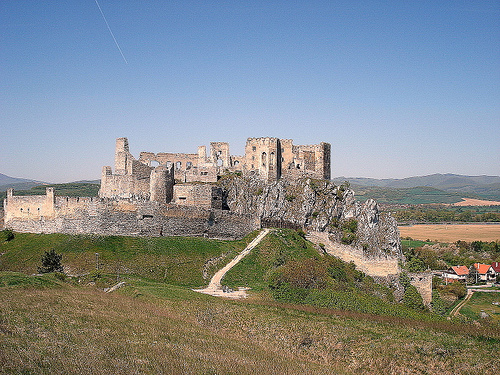
Location: 20 km (12 mi) Southwest of Trechin, Trenčín Region Map
Open: May- Oct 9am-6pm Tue-Sun
Tel. +421 (0)32/777 71 25
Constructed: 13th century
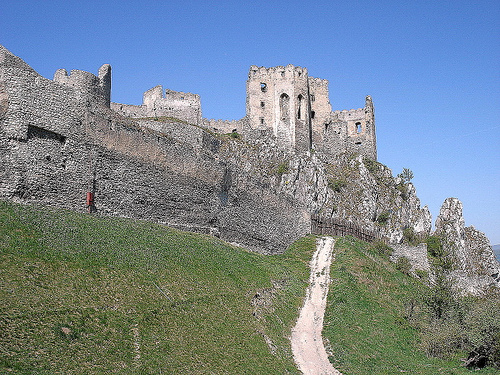
Beckov Castle, known in Slovak as Beckovský hrad and in Hungarian as Beckói vár, stands dramatically on a 50-60 meter limestone cliff overlooking the village of Beckov and the Váh River in the Trenčín Region of western Slovakia. This strategic position made it a key defensive stronghold throughout its history, guarding trade routes, river crossings, and the northwestern borders of the Kingdom of Hungary. The castle's ruins today are a national cultural monument, blending Gothic and Renaissance elements, and have been partially restored since the late 20th century. Archaeological evidence reveals human activity on the site dating back to the Early Stone Age (around 270,000–190,000 BCE), with later Celtic settlements from the Early Iron Age (late 400 BCE) and a Great Moravian wooden fort from the 9th–10th centuries AD. The name "Beckov" derives from the village below, possibly from a personal name "Beck," while early records refer to it as "Blundus" or "Blundix," potentially meaning "labyrinth" due to the meandering river and challenging terrain.
Early History and Construction (9th–13th Centuries)
The site's
defensive potential was recognized during the Great Moravian Empire,
when a wooden fort was established in the second half of the 9th
century to protect the north-south trade route along the Váh River.
Following the invasion by Old Hungarian tribes around the late 9th
century, the area came under Hungarian control. The first written
mention of the castle appears in an anonymous chronicle from the
court of King Béla III of Hungary at the turn of the 12th and 13th
centuries, describing it as "castrum Blundus" during the conquest of
Great Moravia. In 1208, it is documented as "Blundix" in a deed by
Nitra zupan (comes) Tomáš, marking it as a royal castle.
The
stone castle was constructed in the first half of the 13th century,
likely under King Béla IV, to fortify the kingdom's borders after
the Mongol invasions. Its location proved crucial in 1241, when it
withstood the Mongol (Tartar) assault that devastated much of
Hungary, remaining uncaptured due to its steep escarpments and
natural defenses. Architecturally, the early Romanesque phase
included an irregular oval perimeter wall (about 100 meters long and
up to 35 meters wide) made of erratic limestone, a palace-like
residential building in the northern section (trapezoidal, 16-23 x
10 meters), and circular rock-carved water cisterns (5.5–6.5 meters
in diameter). An economic outer bailey with wood-earth ramparts and
a ditch protected the southern approach. By the mid-13th century, it
served as the seat of zupans (royal administrators), with the zupan
of Beckov mentioned in 1229. In the second half of the 13th century,
amid feudal anarchy under the last Árpád kings, the zupan's office
dissolved.
The Era of Oligarchs and Royal Administration
(Late 13th–14th Centuries)
At the end of the 13th century, Beckov
fell under the control of Matthew III Csák (Matúš Čák Trenčiansky),
a powerful Hungarian oligarch who seized nearby Trenčín in 1296 and
likely extended his influence to Beckov. Under Csák, the castle
underwent its first major reconstruction at the turn of the 13th and
14th centuries, including expansion of the outer bailey (55 x 30
meters) with crenellated walls, a new southern gate to the upper
ward, and a bergfrit-type refuge tower in the southeastern upper
castle. Csák fortified it extensively, adding fence walls on
vulnerable sides to enhance defenses. After Csák's death in 1321,
the castle reverted to royal ownership under King Charles Robert of
Anjou and was administered by castellans, such as Michal son of
Merchard (1328), Štefan Lackfi (1330s), and Mikuláš Kont (1360s).
During the Anjou period, the castle's significance grew, with its
estates expanding to include 14 villages and the towns of Beckov and
Nové Mesto nad Váhom by the mid-14th century. Further fortifications
in the 14th century included a foregate with a small gatehouse,
drawbridge, and four-sided tower in the southwestern outer bailey,
along with posterns and extensions to protect a northeastern well.
Economic buildings like stables and granaries were added along the
walls. In 1379, King Louis I granted it to Miklós Bánffy as a reward
for military service in the Balkans and Italy, though ownership
shifted again soon after.
Peak Under Stibor and the Bánffy
Family (Late 14th–16th Centuries)
In 1388, King Sigismund of
Luxembourg donated Beckov to Stibor of Stiborice, a loyal Polish
magnate and adviser who styled himself "master of the entire Váh
River" and made it his primary residence. Stibor transformed it into
a Gothic aristocratic seat between the late 14th and early 15th
centuries, expanding the upper ward with a three-winged residential
complex (northern, eastern with chapel, and southern wings), wooden
porches, gable roofs, latrines, and bay windows. A new eastern
reservoir was added, and the chapel featured rib vaults, polychrome
paintings, tracery windows, and carved consoles depicting human
heads with floral motifs. A massive four-sided main tower (possibly
a bergfried) was built at the southern end, and a low four-sided
tower at the northern corner. The castle and town reached their
zenith under Stibor in the late 14th and early 15th centuries.
Upon Stibor's death in 1414, it passed to his son Stibor II and then
daughter Catherine. In 1437, after returning to the crown, it was
granted to Pál Bánffy, Catherine's husband, and remained with the
Bánffy family until their extinction. The Bánffys rebuilt it in
Renaissance style during the 16th century, adding a horseshoe tower
(Stibor's Tower) in the second half of the 15th century, extending
the foregate with a two-story building and third gate, a barbican,
and an artillery bastion on the eastern escarpment. These
enhancements proved vital against Ottoman threats; in 1599, Turks
burned the settlement but failed to capture the castle. Ján Bánffy,
the last male heir, died in battle against the Turks in 1594.
Decline and Abandonment (17th–18th Centuries)
In the early
17th century, during the Bocskay Uprising, the castle served as a
refuge for local nobility from hajduks and marauding Turks. After
the Bánffy line ended in 1644 (with the death of the last descendant
from the second line), the property was divided among heirs, leading
to neglect despite repairs in 1658. In 1663, during another Ottoman
war, its defenses deterred an attack. As the Turkish threat waned by
the late 17th century, the castle lost strategic importance. Urgent
repairs occurred at the turn of the 17th and 18th centuries, but
after the defeat of the Rákóczi Uprising in 1708, the imperial
garrison withdrew.
A devastating fire in 1729, originating in the
town, spread to the castle, destroying interiors and roofs, after
which it was abandoned and fell into ruin. Ownership passed to
various noble families, but no significant restoration occurred.
Modern Preservation and Cultural Legacy (19th Century–Present)
Interest in the ruins revived in the 1970s, with archaeological
excavations and conservation efforts securing the site until 1976.
Further renovations began in the last quarter of the 20th century
and continued after 2002, preserving remnants like the Gothic
staircase, chapel, water tanks, and Renaissance decorations. Today,
it is open to the public, evoking the Middle Ages and Renaissance
through its architecture and hosted events.
Legends add to its
allure, such as the tale of Duke Stibor building the castle for his
jester Becko, who saved his life, or stories tied to the chapel and
other features. These narratives, while apocryphal, highlight its
cultural significance as a symbol of medieval luxury, strength, and
Slovak heritage.
Upper Castle Core
The heart of Beckov Castle is the upper castle,
occupying the northern and highest part of the cliff. This area was the
most secure and residential, accessible only via a series of gates and
wards.
Main Tower (Bergfried): The dominant feature is the tall,
cylindrical main tower in the southern section, originally Romanesque
but heightened during Gothic phases. It served as a lookout and last
refuge, with walls up to 2 meters thick. Adjacent is the southern
courtyard, enclosed by walls with a wicket gate for secondary access.
Palaces and Residential Wings: The western palace, built on the oldest
stone walls (dated to the 12th century), features Gothic elements like
ribbed vaults and ornate windows. Stibor of Stiboricz added a
multi-story west palace with luxurious rooms. The north range includes
remnants of a Romanesque palace, later overlaid with Gothic additions.
These spaces housed noble living quarters, with rich stucco and fresco
decorations visible in ruins.
Chapel: A standout Gothic element is
the castle chapel in the northern courtyard, featuring a preserved
staircase with intricate stonework, pointed arches, and vaulted
ceilings. It was richly decorated, reflecting the era's ecclesiastical
architecture, and integrated into the residential complex for private
worship.
Courtyards: The northern courtyard, inspired by royal
designs, was a magnificent open space surrounded by arcades and
buildings. The southern courtyard provided access to the main tower and
included economic structures. Both feature stone paving remnants and
defensive walls crowned with battlements.
Water Management: A deep
well (over 50 meters) and a rock-carved circular cistern (5.5-6.5 meters
diameter) ensured self-sufficiency during sieges, showcasing practical
engineering integrated into the cliff.
Outer Wards and Defenses
The castle expands southward into three outer wards (south-west,
south-east, north-east), protected by layered fortifications that
descend the slope.
Gates and Entrances: Access involved multiple
gates for security. The first gatehouse with a foregate leads to the
south-west ward. A second gate accesses the south-east ward, and a third
with a bastion guards the upper castle. The 16th-century entrance
included a drawbridge over a moat and a barbican complex for added
defense; today, it's replaced by a wooden bridge. The gates feature
towers, such as the Powder Tower and Stibor's Tower (a pentagonal
bastion-like structure).
Walls and Towers: The perimeter walls, up to
1.5 meters thick, are Romanesque at the base with Gothic crenellations.
Renaissance additions include artillery bastions (e.g., west bastion)
for cannon defense against Ottoman incursions. The walls incorporate the
cliff's escarpments, making northern and eastern sides nearly
impregnable.
Economic and Auxiliary Buildings: The outer wards housed
stables, workshops, and storage in timber-framed structures (now mostly
ruins). A south building with a gate controlled access to the upper
levels.
Architectural Styles and Ornamentation
Romanesque:
Simple, robust forms in the earliest walls and towers, emphasizing
defense with minimal decoration.
Gothic: Pointed arches, ribbed
vaults, and ornate tracery in windows and portals. Stibor's additions
brought elegance, with sculpted details in the chapel and palaces.
Renaissance: Smoother lines, decorative sgraffito, and fortified
elements like rounded bastions. Interiors featured frescoes, stucco, and
tiled stoves for comfort.
The blend creates a visually striking
ruin, where crumbling walls reveal cross-sections of historical layers.
Current State and Visitor Experience
After the 1729 fire, the
castle fell into disrepair but has been stabilized through renovations,
preserving about 70% of its medieval elements. Visitors enter via the
modern wooden bridge and can explore the wards, climb towers for
panoramic views, and see artifacts like Gothic decorations and a
reconstructed chapel interior. The site is accessible year-round, with
guided tours highlighting its architecture. Beckov Castle exemplifies
Slovakia's medieval heritage, merging natural topography with human
ingenuity for a timeless architectural marvel.1sExpert15 sources