Location: 5 km (3 mi) from Prievidza, Trenčín region Map
Tel. (046) 543 0535
Official site
Open: May, June, Sept 9am-5pm Tue- Sun
Jul, Aug 9am-5pm daily
Oct, Apr 10am- 3pm Tue- Sun
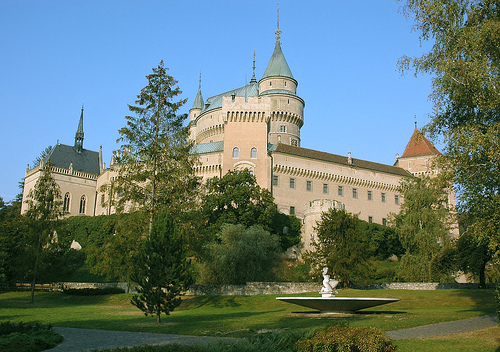
Bojnice Castle (Bojnicky zámok) is one of Slovakia's most iconic and romantic landmarks, perched on a travertine hill overlooking the town of Bojnice in the Upper Nitra region. Often described as a fairytale castle due to its neo-Gothic architecture inspired by French Loire Valley châteaux, it blends medieval fortifications with Renaissance and Romantic elements. The castle's history spans over nine centuries, evolving from a simple wooden fort to a luxurious residence and now a national museum attracting hundreds of thousands of visitors annually. It features a natural travertine cave system, ancient linden trees, and has served as a filming location for fantasy films like Fantaghirò. Its grounds include Slovakia's oldest zoo and a landscaped park in the Strážov Mountains.
Early History: Origins and Medieval Period (12th–15th Centuries)
The castle's documented history begins in 1113, when it was first
mentioned in a deed from the Zobor Abbey, a Benedictine monastery near
Nitra. At this time, it was a wooden structure built atop an older
hillfort, serving as a defensive outpost in the Kingdom of Hungary. The
site was chosen for its strategic position on a travertine mound, which
provided natural defenses and access to underground water sources via
caves.
In the 13th century, the Poznań (or Poznan) family rebuilt the
castle in stone, transforming it into a more permanent Gothic fortress
with outer walls adapted to the rocky terrain. This Romanesque-Gothic
core included a central tower and fortified walls. Toward the end of the
century, around 1302, the powerful Hungarian nobleman Matthew III Csák
(also known as Matus Cak Trenciansky) seized control of the castle from
King Ladislaus V. Csák, a regional warlord who controlled much of
western Slovakia, held it until his death in 1321. During this period,
the castle functioned as a key stronghold in feudal conflicts.
After
Csák's demise, ownership shifted among several noble families, including
the Gileth, Leustach, and Noffry clans throughout the 14th and 15th
centuries. In 1489, King Matthias Corvinus of Hungary donated the castle
and its estate to his illegitimate son, John Corvinus. Matthias
frequently visited Bojnice, reportedly dictating royal decrees under a
linden tree in the castle park—now known as the Linden Tree of King
Matthias, estimated to be over 700 years old and planted around 1301
(though legends attribute it to Csák). This tree was declared a
protected natural monument in 1969 and remains one of Slovakia's oldest
documented trees.
Following Matthias's death in 1490, Zápoľský
(Zapolya) troops occupied the castle until 1526, amid the power
struggles in Hungary. The medieval era saw the castle as a symbol of
aristocratic power, with its architecture emphasizing defense over
comfort.
Renaissance and Baroque Transformations (16th–18th
Centuries)
In 1527, amid the Habsburg-Ottoman wars, King Ferdinand I
of Hungary gifted Bojnice Castle to the wealthy Thurzó (Thurzo) family,
one of the richest noble houses in the northern Kingdom of Hungary. The
Thurzós initiated a major reconstruction in 1528, converting the Gothic
fortress into a more livable Renaissance palace. They added residential
buildings around an inner courtyard, incorporating Italianate features
like arcades and decorative elements to enhance comfort for aristocratic
life.
The Thurzó line died out in 1636, and the castle reverted to
the crown. Emperor Ferdinand III then granted it to the Pálffy (Palfi)
family in 1637 as a deposit, with full ownership confirmed in 1645 (or
1646 per some sources). The Pálffys, a prominent Hungarian noble family,
began Baroque-style renovations, adding ornate interiors and expanding
the structure. Construction peaked in the late 17th century but slowed
in the 18th, with no significant changes during this period. The castle
served as a family residence, hosting noble gatherings and
administrative functions.
Romantic Reconstruction and 19th–Early
20th Century (19th–Early 20th Centuries)
The castle's most
transformative phase occurred under Count Ján Ferenc Pálffy (1829–1908),
who acquired it in 1852 as the last private noble owner. Inspired by
European Romanticism and visits to French châteaux, Pálffy oversaw a
comprehensive neo-Gothic renovation from 1888 (or 1889) to 1910. He
acted as both architect and designer, collaborating with Jozef Hubert to
recreate a fairy-tale aesthetic with turrets, spires, and intricate
details. This included rediscovering a natural travertine cave (22
meters in diameter and 6 meters high) beneath the fourth courtyard in
1888, which had served prehistoric inhabitants as a shelter and water
reservoir. The cave, with two interconnected ponds, was opened to the
public in 1967.
Pálffy amassed an extensive art collection, including
paintings, sculptures, furniture, and artifacts, integrating them into
the castle's interiors. He died on June 2, 1908, in Vienna without
direct heirs. His 1907 will expressed a desire for the castle to become
a public museum, with artworks preserved in place. However, heirs
contested the will, leading to auctions of parts of the collection from
1924–1926. In 1923, an agreement with the Czechoslovak government
protected key items. After the 1920 Treaty of Trianon, which redrew
borders and incorporated the area into Czechoslovakia, the castle's fate
shifted from Hungarian nobility to state oversight.
In 1939, amid
economic pressures, the heirs sold the castle and lands to the Czech
shoe magnate company Baťa (Bata). Post-World War II, under the Beneš
Decrees, the property was confiscated by the Czechoslovak state.
Modern Era: Museum and Cultural Monument (20th Century Onward)
A
devastating fire on May 9, 1950, destroyed the castle's towers,
prompting urgent restoration supported by the Communist authorities.
Reconstruction was completed by autumn 1951, and the castle reopened as
a museum on September 2, 1951. Initially established as the Regional
Museum of Local History in September 1950, it drew from regional
collections, including artifacts from manors, churches, and monasteries.
The Upper Nitra Museum Association had placed ethnographic and
historical items in the Winter Garden as early as 1941.
In 1960,
territorial changes made it the official history museum for the
Prievidza district, focusing on Upper Ponitrie (Upper Nitra) research.
It fell under the Ministry of Culture in 1969 and was declared a
national cultural monument in 1970. A new statute in 1981 repositioned
it as a specialized art-historical museum with nationwide scope,
emphasizing neo-styles (neo-Gothic, neo-Renaissance, etc.) in Slovakia.
Exhibitions shifted from local history to art and crafts, launching new
displays in 1983.
Administrative changes continued: from 1984–1996,
it evolved through separations (e.g., the Upper Nitra Museum in
Prievidza) and integrations with the Slovak National Museum (SNM) in
Bratislava. Since 1996, it has operated as an independent unit under
SNM, managing about 6,000 items in fine arts (paintings, sculptures),
handicrafts (furniture, clocks, ceramics, weapons, armor, textiles), and
focusing on 17th–18th century art. Post-1989, it pioneered cultural
events like the International Festival of Ghosts and Spirits, Castle
Fairytale, and Summer Music Festival.
Today, Bojnice Castle is a key
cultural site, with ongoing preservation of its park (documented since
1910) and features like the King Matthias Linden Tree, which received
its first museum-led treatment in 1952. The museum conducts scientific
research, publishes on art history, and remains a symbol of Slovak
heritage.
Legends and Notable Features
Bojnice is steeped in
folklore, including the Legend of the Black Lady (a ghostly figure
haunting the halls), the Legend of a Broken Heart, and the Story of
Peter Poky. These tales add to its mystical allure, making it a hub for
ghost festivals.
Notable features include the travertine cave system,
the ancient linden tree, and collections documenting neo-styles. The
castle's park blends natural and landscaped elements, with the adjacent
Bojnice Zoo enhancing its appeal.
Historical Development and Construction Phases
The castle's
origins trace back to the 12th century, with the first written mention
in 1113 in a deed from Zobor Abbey, describing a wooden fort on an older
hillfort site. During the 13th century, the Poznań family rebuilt it in
stone, establishing a Romanesque core with outer walls adapted to the
rocky, uneven terrain. Ownership passed through Hungarian nobles,
including Matthew III Csák in 1302, and later King Matthias Corvinus in
the 15th century, who used it as a hunting lodge and gifted it to his
son John Corvinus in 1489.
A major transformation occurred in 1528
under the Thurzó family, who converted the Gothic fortress into a
Renaissance palace with uniform-height residential buildings around an
inner courtyard. In 1646, the Pálffy family acquired it and added
Baroque features through ongoing construction. The most defining phase
was the romantic reconstruction from 1888 to 1910 led by Count János
Ferenc Pálffy (1829–1908), who personally designed much of it, drawing
inspiration from French Loire Valley châteaux (e.g., Chambord and
Chenonceau), the Papal Palace in Avignon, Tyrolean Gothic castles, and
early Italian Renaissance architecture. Architect Jozef Hubert oversaw
the neo-Gothic elements, incorporating Pálffy's extensive art
collection.
A fire in 1950 damaged the towers, leading to swift
restoration by 1951, preserving the romantic style while declaring it a
national monument in 1970.
Architectural Styles and Influences
Bojnice Castle exemplifies a fusion of styles, rooted in Romanesque
simplicity but layered with Gothic verticality (pointed arches, ribbed
vaults, pinnacles), Renaissance symmetry (courtyards, arcades, sgraffito
decorations), and Baroque grandeur (ornate facades, stucco work). The
19th-century overhaul introduced Romantic/Neo-Gothic romanticism,
characterized by fairy-tale towers, steep rooftops, battlements, and
intricate ornamental details like ogival windows and vertical lines,
evoking a sense of medieval fantasy. This blend distinguishes it from
typical Slovak fortresses, aligning it more with Bavarian (e.g.,
Neuschwanstein) or French models, with ochre walls and green rooftops
harmonizing with the landscape.
The overall plan is oval, with the
core on the hilltop, enclosed by crenellated walls from the medieval
era. Early fortifications included wood-and-earth structures replaced by
stone walls connecting to the town below.
Exterior Features
The castle's exterior is dominated by soaring towers with pointed
conical roofs, evoking a dramatic silhouette against the forested
backdrop. Key elements include the central Middle Castle with its
reconstructed towers (post-1950 fire), flanked by outer baileys and a
moat-like artificial pond. The facade features Gothic pinnacles,
Renaissance arcades, and Baroque portals, with sgraffito patterns and
heraldic motifs adorning the walls. A unique natural feature is the
travertine cave (22m diameter, 6m height) 26m below the fourth
courtyard, with two ponds; it served as a prehistoric shelter and water
source, integrated into the castle's foundations during the 1888
rediscovery.
The surrounding landscape park, formalized in 1910,
features manicured gardens, exotic trees, and the 700-year-old Linden
Tree of King Matthias, where the king reportedly dictated decrees. It
connects to Slovakia's oldest zoo, adding to the site's allure.
Interior Features
Internally, the castle is organized around multiple
courtyards, with the central one featuring Renaissance arcades and a
well. Key spaces include the Gothic chapel with a 14th-century
Florentine altar, adorned with frescoes and vaulted ceilings. The grand
halls, such as the Golden Hall and Knights' Hall, showcase Baroque
stucco, Renaissance furniture, and neo-Gothic woodwork, housing Pálffy's
collection of tapestries, paintings, sculptures, and antiques from the
early modern period to the late 19th century. Other highlights include
armories with medieval weapons, ornate chandeliers, porcelain displays,
and textile artifacts. The museum emphasizes fine arts, housewares,
tools, and apparel, serving as a research center.
Unique Aspects
and Cultural Significance
Distinctive elements include legends like
the Black Lady ghost and the Broken Heart tale, fueling events such as
the International Festival of Ghosts and Spirits. Architecturally, its
romantic facade and integrated natural features (cave, park) create an
immersive, storybook environment, setting it apart as Slovakia's
"fairy-tale castle." The castle's evolution mirrors Slovakia's history
under Hungarian, Czechoslovak, and Slovak rule, making it a symbol of
national heritage.