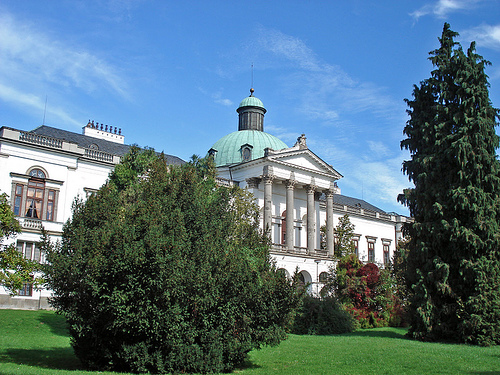
Location: 56 km (35 mi) Northeast of Trnava Map
The history of Topoľčianky Castle begins in the 13th century in the village of Topoľčianky, located in western-central Slovakia, north of Zlaté Moravce at the southern foothills of the Tribeč Mountains, at an elevation of approximately 214 meters above sea level. The village itself was first documented in 1293 as Topolchen parvum in a charter delineating property boundaries of the Nitra Chapter, though archaeological evidence suggests human settlement in the area as early as the 6th-7th centuries. The castle's foundations are attributed to Július Hoslav (or Haslav), a nobleman active in the 13th-14th centuries, who established the initial fortified residence for his family. Ennobled as a count and adopting the surname Topoľčiansky, Hoslav constructed an original Gothic water castle—a moat-surrounded fortress designed for defense in the lowland terrain. By the mid-14th century, the Hoslav family expanded their influence, gaining privileges such as gold panning rights in nearby streams, which contributed to the village's growth and the fortification of local structures, including a parish church. This early Gothic structure served as an administrative center and evolved into a more prominent role, becoming the seat of Tekovská County in 1561. In the 15th century, the castle was occupied by Hussite forces, highlighting its strategic importance during regional conflicts. It originated on the site of a lowland fortified castle with a massive residential tower, whose foundations lie beneath the current structure.
Renaissance Fortifications and Defense Against the Ottomans
During
the 16th century, amid the threat of Ottoman expansion, the castle
underwent significant reconstruction under Ján Topoľčiansky. Built on
the existing medieval foundations, it was transformed into a Renaissance
fortress featuring corner bastions and reinforced walls suitable for
artillery defense. This upgrade made it a key stronghold in the
Habsburg-Ottoman wars, protecting the northern frontiers from
incursions. From 1561 onward, Topoľčianky served as the administrative
seat of Tekovská County for nearly 200 years, underscoring its dual
military and governance functions. The fortress played a crucial role in
defenses against Turkish forces, reflecting the turbulent era of Ottoman
threats in Central Europe.
Baroque Modifications and the Rákóczi
Era
In the mid-17th century, under Count Ladislav Rákóczi and his
wife Alžbeta Bánffy, the castle saw Baroque modifications, including the
addition of the Castle Chapel in 1662 within the northwestern bastion.
This chapel features their alliance coat of arms and a Latin inscription
above the eastern gate. The period was marked by conflict; in 1708,
during the anti-Habsburg Kuruc uprising, the chateau was occupied by
František II Rákóczi. Imperial forces under General Johann Lucas von
Heister defeated the rebels, leading to the estate's confiscation by
Emperor Joseph I. The direct Rákóczi-Erdődy lineage ended with Alžbeta
Rákóczi-Erdődy's death in 1707, setting the stage for new ownership. The
castle suffered severe damage during Rákóczi's rebellion but was later
reconstructed, though it eventually fell into partial decay.
18th-19th Century Ownership Changes and Classicist Rebuild
Following
confiscation, the estate was briefly owned by Prince Coburg in 1710
before being sold to Count Karol Zichy in 1711, who undertook repairs to
war-damaged structures, including the Gothic church, rectory, mill,
lumber yard, sawmill, and brewery. In 1742, ownership transferred to the
Keglevich family under Count Adam Keglevich during Empress Maria
Theresa's reign. The Keglevichs enhanced the orchards, gardens,
vineyards, and brewing operations, holding the property until 1890. A
major transformation occurred in the early 19th century when Count Ján
Keglevich, governor of Tekov County, demolished the southern Renaissance
wing and commissioned a new Classicist wing between 1818 and 1825,
designed by Viennese architect Alojz Pichl. This addition is considered
one of Slovakia's purest examples of Classicism. Ján Keglevich also
founded the chateau's library, amassing over 14,000 volumes—one of the
few fully conserved castle libraries in Slovakia—and landscaped the park
with designer Michal Kadlečík. Earlier, Count Karol Keglevich had
demolished the old Gothic church and built a new Baroque one on a nearby
hill in the late 18th century.
20th Century: Habsburg Residence,
Presidential Retreat, and Nationalization
After 1890, the estate was
acquired by the Habsburgs, serving as a summer residence for Archduke
Joseph August and Archduchess Augusta (granddaughter of Emperor Franz
Joseph I) until their departure in October 1918 amid the collapse of the
Austro-Hungarian Empire. They left behind furnishings that now form the
core of the castle's museum. Following World War I, it became the summer
residence of Czechoslovak presidents from 1918 to 1951, including Tomáš
Garrigue Masaryk (who visited frequently from the 1920s until 1933),
Edvard Beneš, Jozef Tiso, Klement Gottwald, and Antonín Zápotocký (whose
last visit was in 1951). Attic extensions were added for guests during
this period. In 1921, the National Stud Farm Topoľčianky was established
on the estate, focusing on breeding horses such as Arabians,
Lipizzaners, Nonius, English Half-bloods, and Huculs. After the 1948
communist coup, the property was nationalized, and in the 1950s, the
Classicist wing was reorganized into period-specific salons
(Renaissance, Baroque, Rococo, Classicist, Biedermeier) using the
preserved Habsburg furnishings. It was designated a national cultural
monument in 1970.
Notable Events, Residents, and Legends
Throughout its history, the castle hosted pivotal events, such as its
defensive role in the 16th-17th century Ottoman wars, the 1708 Kuruc
occupation, and its use as a Habsburg and presidential retreat from 1918
to 1951. Notable residents include the early Lords of Topoľčianky, Ján
Topoľčiansky (Renaissance rebuild), Ladislav Rákóczi and Alžbeta Bánffy
(Baroque chapel), František II Rákóczi (1708), Karol Zichy (repairs),
the Keglevich family (including Ján as library founder), Archduke Joseph
August and Archduchess Augusta, and presidents like Masaryk (who used it
for relaxation and work). A enduring legend surrounds the "White Lady,"
believed to be the ghost of Alžbeta Rákóczi-Erdődy, tied to her personal
tragedies and the estate's storied past. Today, the castle remains a
living testament to Slovakia's history, with its museum, park, and stud
farm open to visitors, preserving the spirit of its multifaceted legacy.
Historical Evolution of the Architecture
The site's architectural
history begins in the 15th century with a Gothic water castle built by
the lords of Topoľčianky on medieval foundations documented as early as
1293. This lowland fortified structure featured defensive moats and a
massive residential tower, designed for protection in a flat terrain
prone to flooding. By the mid-16th century, under owner Ján
Topoľčiansky, it was rebuilt on these foundations into a Renaissance
fortress, incorporating corner bastions and reinforced walls to defend
against Ottoman threats. It became the administrative seat of Tekovská
County from 1561 until around 1760.
In the mid-17th century, Count
Ladislav Rákóczi and his wife Alžbeta Bánffy introduced Baroque
modifications, including the construction of a chapel in 1662 within the
northwestern bastion. Their alliance coat of arms and a Latin
inscription from that year remain preserved above the eastern gate,
adding heraldic and epigraphic elements to the facade.
The most
transformative phase occurred in the early 19th century under Count Ján
Nepomuk Keglevich, who demolished the southern Renaissance wing and
commissioned a new Classicist wing between 1818 and 1825. Designed by
Viennese architect Alojz Pichl, this addition embodied neoclassical
ideals inspired by Classical antiquity, emphasizing symmetry,
proportion, and restraint. After World War I, the three Renaissance
wings underwent further reconstruction, including attic extensions for
guest apartments, adapting the structure for presidential use. Ownership
shifted multiple times—from the Rákóczi and Erdödy families (extinct by
1707), to Habsburg confiscation in 1708, brief Coburg and Zichy
holdings, the Keglevich family until 1890, and finally the Habsburgs
until 1918—each influencing repairs and enhancements. Post-1948
nationalization led to the reorganization of interiors into period
salons in the 1950s.
Architectural Styles and Key Features
The
castle's architecture harmoniously integrates Gothic, Renaissance,
Baroque, and Classicist elements across its U-shaped layout. The overall
design features a galleried courtyard, arcaded corridors connecting the
wings, and corner bastions remnants of its fortified past. A prominent
towering cupola crowns the complex, adding vertical emphasis and
neoclassical grandeur.
Gothic Influences: Visible in the
foundational elements, such as the residential tower's base below the
current courtyard level and the original moat system, which provided
defensive water barriers.
Renaissance Style: Dominant in the northern
and eastern wings, characterized by mansard roofs (added later for attic
spaces) and robust, symmetrical fortifications with bastions. The
eastern gate's decorative elements, including the 1662 inscription,
reflect late Renaissance heraldry.
Baroque Additions: Primarily the
1662 chapel, integrated into the northwestern bastion, with ornate
interior details typical of the era, such as elaborate stucco or fresco
work (though specifics are preserved modestly).
Classicist Dominance:
The southern wing exemplifies pure Classicism, with a facade defined by
rigorous symmetry, balanced proportions, and clean lines. Pichl's design
avoids excessive ornamentation, focusing on harmonious integration with
the older wings through arcades and proportional scaling.
The
exterior facade combines these styles: the Classicist southern section
presents a refined, pillared or porticoed entrance (though not overly
grand), while the Renaissance wings retain a more fortress-like
appearance with sloped roofs and defensive projections.
Detailed
Description of Wings and Elements
The castle comprises three wings
forming a courtyard:
Northern and Eastern Wings: These retain
Renaissance cores with later mansard roofs, providing a sloped, tiled
appearance for weather resistance and attic utility. They now house
hotel accommodations, with ground-floor common areas like dining rooms.
Arcaded corridors link them to the southern wing, creating a cohesive
internal space.
Southern Wing: The Classicist highlight, rebuilt from
1818-1825, features a symmetrical facade with possible pilasters or
columns framing windows, embodying neoclassical balance. The galleried
courtyard here includes open arcades for light and air circulation,
while the cupola rises centrally, offering panoramic views and symbolic
elevation.
Additional elements include the eastern gate with its
Baroque coat of arms, bastions at corners for remnant fortification, and
integrated outbuildings like a riding school tied to the 1921 national
stud farm.
Interior Architecture
The interiors, particularly
in the Classicist wing, are preserved as a museum showcasing styles from
Renaissance to Biedermeier. Rooms feature historical furniture with
ornate carvings, embroidered Oriental curtains, paintings, clocks,
weapons, and one of Slovakia's largest collections of porcelain and
ceramics. The library, founded by Ján Keglevich, holds over 14,000
volumes in a conserved space with period shelving and reading areas.
Salons are arranged chronologically, with Baroque rooms displaying rich
stucco and Rococo ones featuring lighter, playful motifs. The chapel's
interior includes Baroque altars and possibly frescoes, emphasizing
religious architectural detail.
Grounds and Landscape
Architecture
Surrounding the castle is an extensive English-style
park, landscaped under Michal Kadlečík during Keglevich ownership, with
naturalistic elements like winding paths, woodlands, a canalized river,
and manicured lawns. A preserved Classicist greenhouse adds
horticultural interest, while orchards and vineyards (enhanced in the
19th century) integrate productive landscapes. The park enhances the
castle's romantic appeal, providing vistas that frame the architecture.