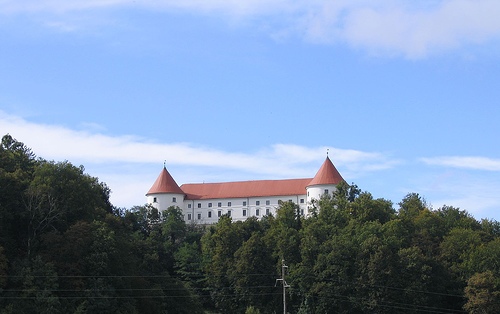
Location: Jesenice, Brežice Map
Constructed: 1444
Tel. +3867 457 4240, +3867 493 6700
Email: mokrice@terme-catez.si
Mokrice Castle (Grad Mokrice in Slovenian) is a historic fortified structure located in southeastern Slovenia, near the village of Jesenice na Dolenjskem, on the gently sloping hillsides of the Gorjanci mountains as they descend into the Sava River Valley. Positioned just a few kilometers from the Croatian border and approximately 8 km from the town of Brežice, the castle's name derives from the Slovenian word "mokrišče," meaning a swampy or wet area, reflecting the marshy terrain that once surrounded it. Today, it stands as a cultural monument, transformed into a luxury four-star hotel resort known as Golf Hotel Mokrice Castle, managed by Terme Čatež, Slovenia's largest health resort operator. The site encompasses a 200-year-old English-style park, a pond, the Chapel of St. Anna, a renovated dairy farm, and an 18-hole golf course, making it a popular venue for weddings, business events, and tourism. Its history spans from Roman antiquity to modern times, marked by military fortifications, noble ownership, architectural evolutions, and cultural significance.
Ancient Roman Origins
The history of Mokrice Castle begins in
antiquity, long before its medieval incarnation. Archaeological evidence
indicates that the site was occupied by a Roman fortress known as
Romula, which served as a key waypoint along the ancient road leading
from the Roman Empire toward Byzantium (modern-day Istanbul). This
fortification is documented on the 4th-century Tabula Peutingeriana, an
ancient Roman map that illustrated the empire's road network. Beneath
the fortress lay a Roman settlement of the same name, from which various
artifacts have been excavated, including remnants that highlight the
area's strategic importance for trade and military purposes. These finds
underscore Mokrice's role in the broader Roman infrastructure,
connecting the western provinces to the eastern frontiers. The presence
of a Roman milliary column (a milestone marker) now displayed in front
of the castle's entrance further attests to this era.
Medieval
Foundations and Early Mentions
Transitioning into the medieval
period, Mokrice evolved into a fortified site amid the turbulent
landscape of Central Europe. The castle is first mentioned in written
records in 1444, establishing it as a medieval landmark perched on a
hill above the right bank of the Sava River. At this time, it functioned
primarily as a defensive structure, reflecting the region's history of
invasions and conflicts. The surrounding area's marshy nature likely
provided natural defenses, contributing to its selection as a fortified
location.
A notable legend from this era, tied to the Ottoman
(Turkish) invasions that plagued the region in the 15th and 16th
centuries, adds a layer of folklore to Mokrice's history. According to
the tale, during one such incursion, a crow was shot by advancing
Turkish forces and fell into the castle's courtyard, alerting the
residents to the impending danger. In gratitude, the castle's owner
incorporated the crow into the family's coat of arms, symbolizing
vigilance and providence. This story not only highlights the castle's
role in regional defense but also illustrates how local myths
intertwined with historical events, including peasant uprisings that
left their mark on the castle and its environs.
The Chapel of St.
Anna, located on the grassy southern edge of the castle, dates back to
the 15th century. It features a Gothic window and was later rebuilt in
the Baroque style, enriched with decorative stucco interiors. This
chapel remains a key architectural remnant from the late medieval
period.
Renaissance Rebuilding and Noble Ownership
The 16th
century marked a transformative phase for Mokrice Castle, when it was
completely rebuilt and expanded in the Renaissance style. This
reconstruction included the addition of four peripheral wings enclosing
an irregularly shaped inner arcaded courtyard, fortified externally by
four protruding Renaissance towers. These enhancements not only
bolstered its defensive capabilities but also reflected the
architectural trends of the time, blending functionality with aesthetic
grandeur.
Throughout its history, Mokrice passed through the hands of
numerous noble families, underscoring its status as a prized estate.
Among the most prominent were the Erdődy and Auersperg families, who
held significant influence in the region. In more peaceful periods, the
castle became a hub of aristocratic life, with later owners like the Von
Gagern brothers using it as a creative retreat where they painted and
wrote novels. These noble residencies contributed to the castle's
reputation for luxury, with owners rearranging interiors, introducing
parks, and fostering cultural activities amid the backdrop of east-west
trade routes that continued to pass nearby.
Baroque and Landscape
Developments in the 18th and 19th Centuries
By the 18th century,
during the late Baroque period, attention shifted to the castle's
surroundings. The garden was initially designed with a symmetrical axial
layout south of the castle, featuring Baroque stone statues representing
the Four Seasons, the baroquized Chapel of St. Anna, and a grand gate
portal. This formal design emphasized order and grandeur, typical of
Baroque landscaping.
In the early 19th century, the garden underwent
a significant redesign in the English landscape style, which prioritized
naturalism over symmetry. Key elements included a central grassy lawn, a
pond with an island, winding walking and riding paths, and extensive
tree plantings. Subsequent expansions focused on diversifying the flora,
resulting in over 60 varieties of trees and shrubs today, creating a
romantic, park-like estate that spans about 200 years in development.
20th Century Rebuilding and Modern Transformation
The castle
experienced another major rebuilding in 1941, likely in response to
damage or modernization needs during the interwar period. Following
World War II, Mokrice was nationalized and repurposed for hospitality.
Catering operations began in 1952, and it was fully converted into a
hotel after the war. In 1988, an 18-hole golf course covering over 66
hectares was added to the grounds, enhancing its appeal as a resort
destination.
Culturally, the castle gained modern fame as a filming
location. Notably, it served as the set for the Pet Shop Boys' 1988
music video "Heart," which drew inspiration from the 1922 film Nosferatu
and topped international charts. Several mysterious legends persist
around Mokrice, adding to its allure as a site of historical intrigue
and romance.
Current Status and Significance
Today, Mokrice
Castle operates seasonally from April to October as a boutique hotel
with period-style furnishings, a massage studio, restaurants, lounges,
and a renowned wine cellar showcasing Slovenia's finest vintages. It
hosts protocol events, conferences, and ceremonies, while its park and
golf facilities attract visitors seeking a blend of history and leisure.
As one of Slovenia's many castles—over 920 structures dot the
country—Mokrice exemplifies the nation's rich architectural heritage,
from Roman roots to contemporary luxury. Its preservation as a cultural
monument ensures that its layered history continues to be appreciated,
offering insights into Slovenia's past amid a picturesque setting.
Mokrice Castle, located in southeastern Slovenia near the Croatian
border in the Gorjanci Hills, is a medieval fortress that has evolved
through centuries of reconstruction and adaptation. First documented in
1444, the site originally hosted a Roman fort known as Romula, as
indicated on ancient maps like the Tabula Peutingeriana. The castle's
current form largely dates to the 16th century, when it was rebuilt in
Renaissance style, incorporating defensive elements with aesthetic
refinements. Further modifications occurred in the Baroque period,
particularly in the 18th century, and a major restoration in 1941
preserved its historical integrity while transforming it into a luxury
hotel and golf resort. Architecturally, it blends medieval fortification
with Renaissance symmetry and Baroque ornamentation, set amid a
sprawling English-style park. The name "Mokrice" derives from the marshy
(mokrišče in Slovene) terrain that once surrounded it, enhancing its
strategic hilltop position above the Sava River.
Exterior
Architecture
The castle's exterior exemplifies fortified Renaissance
design, characterized by robust stone construction that prioritizes
defense while incorporating elegant proportions. It features four
protruding corner towers, typical of 16th-century Renaissance
fortifications, which provide both structural support and a commanding
silhouette against the landscape. These towers are cylindrical or
polygonal in form, rising from the base to crenellated tops, allowing
for panoramic views and artillery placement. The main structure is
organized into four peripheral wings that enclose an inner courtyard,
creating a compact, irregular quadrilateral layout that adapts to the
hilly terrain.
A standout feature is the preserved drawbridge on the
castle bridge, one of the few remaining operational examples in Europe,
which spans a dry moat and leads to the primary entrance. This wooden
mechanism, reinforced with iron fittings, underscores the castle's
medieval origins while adding a dramatic approach. At the entrance, a
large Turkish cannonball is prominently displayed, a relic from
historical sieges that adds to the site's narrative charm. The facade is
primarily austere, with thick stone walls punctuated by narrow slit
windows for archers, evolving into larger mullioned windows in upper
levels to reflect Renaissance influences. Baroque elements appear in
decorative accents, such as the stone statues representing the Four
Seasons, positioned along the southern grassy edge. A gate portal aligns
with the park's axis, framing the transition from fortified structure to
landscaped grounds.
Interior Architecture
Internally, Mokrice
Castle revolves around an arcaded courtyard, irregularly shaped due to
the site's topography, which serves as the heart of the complex. The
arcade features slender columns supporting rounded arches, a hallmark of
Renaissance architecture that introduces light and airiness to the
otherwise defensive space. The wings house a series of rooms adapted
over time: lower levels retain medieval vaulted cellars and storage
areas, while upper floors include grand halls with wooden beamed
ceilings and fresco remnants from the 16th century.
Restorations in
1941 focused on preserving original elements, such as stone fireplaces
and wrought-iron details, while modernizing for hotel use without
compromising historical authenticity. The interiors blend functionality
with opulence—think exposed stone walls contrasted with polished wooden
floors and period furnishings. Notable is the integration of defensive
features like hidden passages and thick internal walls, which hint at
the castle's turbulent past under owners like the Erdődy and Auersperg
families.
The Chapel of St. Anne
Adjacent to the castle on the
southern edge stands the Chapel of St. Anne, a key architectural
highlight that merges Gothic, Renaissance, and Baroque styles.
Originally constructed in the 15th century with a pointed Gothic window,
it was rebuilt in the Baroque period during the 18th century. The
interior is richly decorated with stucco work—elaborate plaster moldings
depicting floral motifs, cherubs, and religious scenes—that create a
sense of depth and movement on the walls and ceiling. This contrasts
sharply with the castle's more restrained Renaissance exterior,
showcasing the era's emphasis on theatrical ornamentation. The chapel's
facade is simple yet elegant, with a small bell tower and arched
entrance, integrating seamlessly into the park setting.
Surrounding Park and Landscape Integration
The castle's architecture
extends beyond its walls into a meticulously designed landscape. The
park originated as a late Baroque garden in the 18th century, featuring
a symmetrical axial layout south of the castle, aligned with the gate
portal and statues. In the early 19th century, it was transformed into
an English landscape style, emphasizing naturalism with winding paths, a
central grassy lawn, and a pond complete with an island. Over 60
varieties of trees and shrubs, including exotic imports, create a
arboreal collection that enhances the romantic atmosphere. Riding and
walking trails weave through the 200-year-old grounds, while the
adjacent 18-hole golf course on 70 hectares modernizes the estate
without detracting from its historical core. This integration of built
and natural elements makes Mokrice a prime example of how European
castles evolved from fortresses to aristocratic retreats.