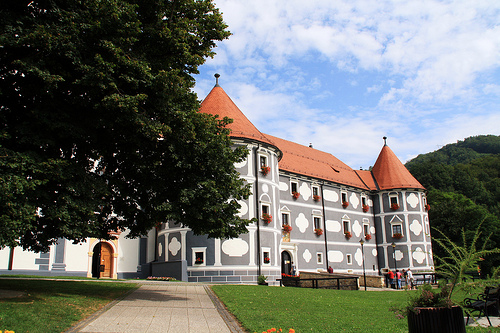
Location: Podčetrtek Map
Constructed: 16th century
Olimje Castle, also known as Grad Olimje, is a historic structure located in the village of Olimje in eastern Slovenia, near the Sotla River and at the foot of Mount Rudnica. Originally constructed around 1015 as a fortified residence, it has undergone significant transformations over the centuries, evolving from a medieval stronghold into a Renaissance castle and eventually a monastery. Today, it is primarily recognized as Olimje Monastery, housing Conventual Franciscan friars since 1999. Its architecture reflects a blend of defensive medieval elements, Renaissance residential refinements, and Baroque ecclesiastical additions, making it a prime example of adaptive historical building in Central Europe.
Origins and Early Medieval Period
The history of Olimje
Castle, known in Slovenian as Grad Olimje, traces its roots back to
the early 11th century in the region of Styria, eastern Slovenia,
near the village of Olimje in the Municipality of Podčetrtek. The
site's earliest structure was likely a fort constructed around 1015
by the Counts of Pilstien (also referred to as Peilestein or
Pilštajn), a noble family with ties to the area. This fortification
was part of a broader network of defensive structures in the region,
which was strategically positioned near the Sotla River and under
Mount Rudnica, providing natural defenses and oversight of trade
routes between Slovenia and Croatia.
One of the most notable
early figures associated with the site is Hemma of Gurk (Slovene:
Sv. Ema Krška), an 11th-century saint and member of the Pilstien
family. Born around 980, Hemma was a devout noblewoman who inherited
properties in the area and is remembered for her charitable works,
including founding monasteries and churches. She was canonized in
1938, and her legacy adds a layer of religious significance to
Olimje's early history. The castle is first explicitly mentioned in
historical records in 1208 as a possession of Otto Rufus, held as a
feudal estate under the authority of the church in Krka (Gurk,
Carinthia, Austria), reflecting the intertwined ecclesiastical and
secular powers of the medieval period.
Over the following
centuries, the original fort was remodeled into a more comfortable
country mansion, adapting to the changing needs of its owners amid
the shifting political landscape of the Holy Roman Empire and the
Habsburg territories. This period saw the region vulnerable to
external threats, including Ottoman incursions, which influenced
later fortifications.
Renaissance Reconstruction and
Fortification (16th Century)
By the mid-16th century, Olimje
underwent a significant transformation under the ownership of Count
Tattenbach. In approximately 1550, he expanded and renovated the
building in the Renaissance style, elevating it from a modest
mansion to a full-fledged castle. This reconstruction included
architectural elements typical of the era, such as symmetrical
facades, arcaded courtyards, and decorative features that blended
functionality with aesthetic appeal. To bolster defenses against the
growing threat of Turkish raids into the Habsburg lands, Tattenbach
added a protective ditch around the structure, turning it into a
more fortified residence.
The castle's Renaissance form largely
defines its appearance today, with elements like the central
courtyard and towers reflecting the architectural trends of the
time. During this era, Olimje served as a noble residence, hosting
local aristocracy and functioning as an administrative center for
surrounding estates.
Transition to Monastic Use (17th-18th
Centuries)
A pivotal shift occurred in the mid-17th century when
the castle changed hands. In 1657 or 1658, Baron Ivan Zakmardy de
Dyankoch, a noble from Zagreb, acquired the property. Motivated by
religious devotion, he began converting parts of the castle into
monastic facilities and, in 1663, donated it to the Pauline Order
(The Order of Saint Paul the First Hermit) from the monastery in
Lepoglava, Croatia. The Paulines, known for their eremitic
traditions and scholarly pursuits, transformed the castle into a
full monastery, establishing the Church of the Assumption of Mary as
its centerpiece.
Under Pauline stewardship, which lasted for
about 120 years (1663-1782), the monastery flourished as a center of
religious life, education, and herbal medicine. One of its most
enduring legacies is the old monastic pharmacy, established in the
late 17th century and adorned with Baroque frescoes depicting saints
and medicinal themes. This pharmacy, considered one of the oldest in
Europe, produced remedies using local herbs and served the
surrounding communities, blending monastic spirituality with
practical healing arts.
The Pauline era ended abruptly in 1782
when Emperor Joseph II, as part of his Josephinist reforms aimed at
secularizing and centralizing Habsburg administration, dissolved
many monasteries across the empire, including Olimje. The monks were
forced to return to Croatia, and the property reverted to secular
use as a castle once more.
19th-20th Centuries: Noble
Ownership and Revival
Following dissolution, the parish of Olimje
was established in 1785, marking a new chapter in local religious
organization. In 1805, the former monastery was acquired by the
Attems noble family, Austrian aristocrats who owned it as a private
estate. The Attems maintained the castle's grandeur, but financial
burdens, including high taxes, led to multiple ownership changes in
the 19th century.
The 20th century brought further
transformations amid the tumultuous events of World Wars and the
establishment of Yugoslavia. After World War II, under communist
rule, many religious sites faced suppression, but Olimje's
historical value preserved it. In the late 20th century, the site
was revitalized when Franciscan Friars Minor Conventual (Minorites)
took residence, restoring its monastic function. The Minorites have
since maintained the Baroque church, the pharmacy (now a museum),
and added a herbal garden, emphasizing natural remedies and
spiritual retreats.
Modern Significance and Preservation
Today, Olimje Monastery stands as a cultural and historical
landmark, attracting tourists, pilgrims, and hikers to its serene
location near the Terme Olimia spa. Recognized for its architectural
beauty and historical depth, it was awarded as one of Europe's most
beautiful villages in 2019. The site blends Renaissance and Baroque
elements, with the pharmacy's frescoes and herbal exhibits
highlighting its unique heritage in European monastic medicine.
Ongoing preservation efforts ensure its legacy endures, serving as a
testament to Slovenia's rich medieval, Renaissance, and religious
history.
Historical Modifications and Architectural Evolution
The site's
architectural history began in the 11th century under the Counts of
Peilestein (Pilštajn) as a basic fortified outpost with a central tower
for defense against invasions. From the 12th to 15th centuries, it
functioned as a modest country mansion with minimal alterations. A major
reconstruction occurred around 1550 under Count Hans Tattenbach, who
expanded and renovated it in the Renaissance style, converting the
mansion into a more elaborate castle with enhanced residential features
and fortifications to counter Ottoman threats. In 1657-1663, Baron Ivan
Zakmardy donated the property to Pauline monks from Lepoglava, Croatia,
who adapted it into a monastery. Between 1665 and 1675, they added a
Baroque church and modified interior spaces for monastic life. The
Attems family, who acquired it in the late 18th century, demolished the
decaying northwest and northeast wings in 1805, leaving only the
southeast and southwest wings intact. The structure was nationalized
after World War II in 1945 and suffered damage from the 1974 earthquake
(sometimes referenced as the 1976 Friuli earthquake in related
contexts), prompting renovations that restored the facades in
Renaissance style. Post-1999 restorations by the Franciscans focused on
the wings and gardens, preserving its dual castle-monastery character.
Layout and Exterior Features
The castle's layout is based on a
quadrangular plan organized around a central inner courtyard, a typical
medieval fortification design that facilitated defense and internal
movement. Defensive towers are positioned at the corners, originally
providing overlapping surveillance and fields of fire. The surviving
structure consists of the southeast and southwest wings, forming a
three-storey complex with oval towers integrated into the
corners—remnants of the Renaissance expansion. Encircled by walls, the
castle once included a defensive ditch or moat added in the 16th century
to channel attackers and enhance security. The Baroque Church of the
Assumption of Mary is attached to the west side, featuring a prominent
facade with ornate detailing, a bell tower, and a single-nave interior
connected to the monastery via elements like a pulpit. The exterior
facades, renovated after the 1974 earthquake, exhibit Renaissance
characteristics such as symmetrical designs, arched windows with
decorative motifs, and larger openings cut through thick walls for
improved lighting. The south-facing side opens to herbal and vegetable
gardens, adding a functional monastic element to the layout.
Architectural Styles and Materials
Architecturally, Olimje Castle
embodies a progression from medieval utilitarianism to Renaissance
elegance and Baroque grandeur. The early medieval phase emphasized
fortification with simple stone structures. The 1550 Renaissance rebuild
introduced symmetrical proportions, ornamental details, and residential
comforts, such as wider windows and arched openings, softening the
defensive aesthetic. The 17th-century monastic conversion layered
Baroque influences, evident in the church's dramatic facades, intricate
interior decorations, and illusory frescoes, drawing from Central
European and Croatian Pauline traditions. Materials primarily include
local limestone for the walls, towers, and wings, providing durability
and a regional aesthetic. The Baroque church incorporates wood for
elaborate carvings and gilding, particularly in altars, while stucco is
used for decorative elements in chapels.
Key Interior Elements
The Church of the Assumption of Mary
Added between 1665 and 1675,
this Baroque church is a highlight of the complex. It features a
single-nave layout with four side chapels (two on each side), creating a
rhythmic spatial progression. The three-storey main altar, crafted in
1680 from black wood (later gilded), depicts Mary with the infant Jesus,
surrounded by angels, saints, and paintings of the Baptism and
Coronation of the Virgin. Side altars focus on themes like the Passion
of Christ and St. Paul the Hermit. The pulpit, adorned with statues of
the Evangelists and a canopy showing Christ as Ruler, connects directly
to the monastery. The presbytery boasts 1739 frescoes by Ivan Ranger,
illustrating the Holy Family, Annunciation, and Litany medallions with
an illusory dome and balcony effect. The side Chapel of St. Francis
Xavier, built around 1760, includes stucco decorations and paintings by
Anton Lerchinger.
The Historic Pharmacy
Located in the
ground-floor circular room of the south tower, this 17th-century
pharmacy is one of Europe's oldest preserved apothecaries. Established
after 1663 by the Pauline monks, it features arched shelving with glass
jars, pestles, mortars, and preparation tools. The walls are adorned
with 1780 frescoes by Anton Lerchinger, depicting health-related themes
and tributes to figures like Paracelsus. It reflects the monks'
historical role in herbal medicine, with adjacent gardens supplying
ingredients.
Gardens and Surrounding Elements
The monastic
gardens, facing south, have been cultivated since 1663 and now feature
around 200 species of medicinal plants, including chamomile, lavender,
and St. John's wort, arranged in formal beds with walking paths,
interpretive signage, and greenhouses for rare species. These gardens
integrate functionally with the architecture, providing a serene
extension of the complex and underscoring its ongoing monastic purpose.