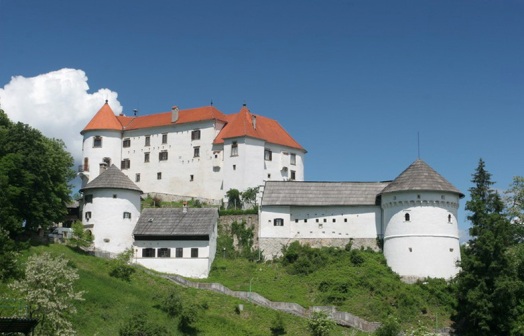
Location: Velenje Map
Constructed: 1270 by Kunšperk family
Velenje Castle, known in Slovene as Velenjski grad, stands as one of the best-preserved Renaissance castles in Slovenia. Perched on a hill overlooking the town of Velenje in the Šalek Valley (Šaleška dolina), it has served various roles over the centuries—from a medieval fortress controlling key trade routes to a noble residence and now a cultural museum. The castle's strategic location allowed it, along with nearby Šalek and Ekenštajn castles, to oversee passages from the Celje Basin to Carinthia. Archaeological evidence suggests the valley was inhabited since prehistoric times, with Roman remains also discovered in the area, earning it the nickname "Valley of Castles" due to over 20 fortifications built there during the Middle Ages.
Origins and Early History (13th–14th Centuries)
The castle's
foundations trace back to the mid-13th century, with the first
written mention occurring in 1270. It was constructed by the
Kunšperk (Kunšperški) family, local noblemen who used limestone to
build a fortified structure on a rounded hilltop for defensive
purposes. This early form was a typical medieval fortress, designed
to withstand sieges and protect the surrounding lands. The Kunšperks
held it until 1322, when their relatives, the Ptuj (Ptujski)
gentlemen, acquired it through purchase.
In 1322, the Ptuj family
gifted the castle as dowry to the Liechtenstein (Lichtenberg)
family, marking the first of many ownership transfers. By the late
14th century, the castle briefly fell under the control of the
powerful Counts of Celje (Celjski grofje), a prominent Slovenian
noble house. However, this conquest was short-lived; in 1393, Duke
Albert of Habsburg issued a decree forcing the Counts to return it
to its previous owners. These early shifts reflect the turbulent
feudal politics of the region, where alliances, marriages, and
conflicts frequently redrew property lines.
Renaissance
Transformation and Ownership in the 15th–18th Centuries
The 15th
century saw continued changes in ownership, with the castle passing
through various noble hands amid the broader power struggles in the
Habsburg territories. A pivotal moment came in the early 16th
century under the Wagen von Wagensberg family, who undertook a
comprehensive renovation. They transformed the medieval fortress
into a Renaissance residence, adding elegant architectural elements
that emphasized comfort over pure defense. This included the
construction of a large courtyard with a well and flowerbed, arcaded
walkways, residential wings with basement cellars, a defensive tower
on the northeastern side, and a triangular fortification. The
exterior walls, forming a five-pronged layout adapted to the hill's
contours, and a majestic Renaissance roundel (a circular bastion)
were also added during this period, giving the castle much of its
current appearance.
In 1603, the von Sauer family purchased the
castle and retained ownership for nearly two centuries, until 1797.
Under their stewardship, it functioned as a family seat, with minor
modifications to maintain its Renaissance style. The Sauers' long
tenure provided stability, allowing the castle to evolve into a
symbol of noble life in the Šalek Valley.
19th Century to
World War II
The 19th century brought new owners: Karl and Bianca
Adamovich de Csepin, who acquired the castle and used it as a
residence. In 1918, it was sold to the Coronini von Cronberg family
from Gorizia, who treated it primarily as a summer retreat. This
period saw the castle maintained but not significantly altered,
preserving its historical integrity amid Slovenia's shifting
political landscape under Austrian and later Yugoslav rule.
World
War II marked a dramatic turn. In 1943, following Italy's
capitulation, German forces evicted the Coronini owner and occupied
the property. The war caused some damage, but the castle survived
relatively intact. After the war's end in 1945, it was nationalized
by the Yugoslav government, becoming state property. Initially
repurposed for social housing, the building fell into disrepair;
much of the interior furniture was destroyed, and neglect threatened
its structure.
Post-War Renovation and Modern Era
(1950s–Present)
The castle's revival began in 1957 when the
Velenje Coalmine (a major local industry) established the Museum of
Slovene Coalmines within its walls. This initiative sparked an
intensive renovation project, restoring the building to its former
glory and preventing ruin. By the 1960s, it had been fully
refurbished, with efforts focusing on historical accuracy while
adapting spaces for public use.
Today, Velenje Castle houses the
Velenje Museum (Muzej Velenje), which occupies most of the premises
and features diverse permanent exhibitions. These include:
A
collection of over 1,000 African art pieces donated by Czech-born
sculptor Frančišek Foit.
Contemporary Slovenian art, including
works by local artist Lojze Perko.
Historical artifacts spanning
Roman times to the Baroque era, such as remnants from St. George's
Church at Škale.
A mastodon skeleton unearthed nearby in the
Šalek Valley.
Reconstructions of a 1930s grocer's shop and inn,
offering insights into local daily life.
A model of a coal pit,
nodding to Velenje's mining heritage (with the Slovenian Coal Mining
Museum located nearby, featuring actual underground shafts).
Galleries on Velenje's urban development and Baroque sacral art.
The castle also hosts temporary exhibitions, cultural events,
music festivals organized by the Velenje Library, and rentals for
receptions. Its well-preserved state makes it a key tourist
attraction, drawing visitors interested in Slovenia's feudal past,
art, and industrial history.
Overall Layout and Structure
The castle's architecture is
ingeniously adapted to the rounded hill on which it sits, creating a
compact yet imposing structure that prioritizes both defense and
residential comfort. It features a five-pronged exterior wall that
encloses a spacious central courtyard, forming an irregular pentagonal
shape. This design not only follows the terrain but also enhances
fortification, with walls that vary in height and thickness to provide
strategic vantage points over the valley below. The total footprint
includes defensive towers, residential wings, and service areas, with
the entire complex measuring approximately 100 meters in length and 50
meters in width at its broadest points.
At the heart of the layout is
the large courtyard, which serves as the castle's focal point. Accessed
via a main gate on the southern side, it includes a deep well for water
supply and a landscaped flowerbed integrated with elegant arcades. The
residential buildings are concentrated in the southeast corner, complete
with basement cellars for storage, while a prominent triangular defense
tower anchors the northeast side, adding a sharp, fortified edge to the
silhouette. This tower, along with rounded bastions (rondelles),
reflects 16th-century military adaptations to artillery threats,
blending medieval robustness with Renaissance aesthetics.
Exterior Features
From the outside, Velenje Castle exudes a romantic,
fairy-tale-like charm, often compared to Neo-Renaissance and Gothic
Revival styles seen in structures like Neuschwanstein Castle in Bavaria,
with possible Saxon influences in its detailing. The facade is dominated
by high stone walls punctuated by Renaissance windows on the upper
floors, characterized by arched frames and decorative sills. A standout
element is the accentuated stone barrel wreath—a protruding cornice that
encircles the building at roof level, providing both structural support
and visual emphasis. Characteristic resin spouts, shaped like ornate
gargoyles, protrude from the eaves to channel rainwater, adding a
whimsical yet functional Gothic touch.
The walls are fortified with
mighty towers and a prominent Renaissance rondelle—a rounded bastion
added in the 16th century for enhanced defense against sieges. The
entrance features a robust arched gateway, often flanked by sloping
ramparts that lead up the hill, offering panoramic views of Velenje and
the surrounding Šalek Valley. The exterior stonework, primarily local
gray limestone, has been meticulously restored, preserving the patina of
age while ensuring structural integrity. Baroque additions from the
17th-18th centuries include subtle ornamental flourishes on the upper
facades, such as pilasters and pediments, which soften the otherwise
austere medieval lines.
Courtyard and Arcades
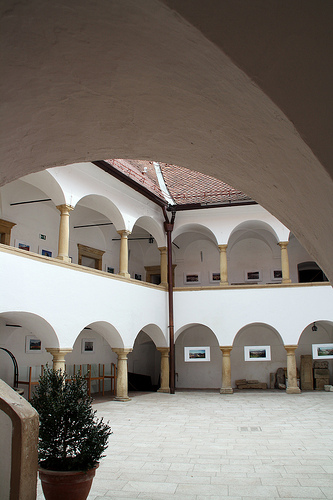
The internal
courtyard is a masterpiece of Renaissance design, enclosed by
picturesque arcades that create a sense of intimacy and grandeur. Added
during the 16th-century rebuild, these arcades consist of semi-circular
arches supported by slender columns on the ground level, with
balustrades above for upper walkways. The courtyard measures about 30 by
20 meters and is paved with cobblestones, featuring a central well
adorned with wrought-iron detailing. This space not only served
practical purposes—like gatherings and defense mustering—but also
aesthetic ones, with flowerbeds and climbing vines softening the stone
surroundings.
On the northern side, an arched tower rises
prominently, integrating seamlessly with the arcades and providing
access to upper levels via spiral staircases. The courtyard walls are
decorated with fresco remnants and sgraffito techniques, where layers of
plaster reveal intricate patterns, hinting at the castle's historical
opulence. Today, this area hosts events like weddings in a dedicated
hall, blending historical architecture with modern use.
Interior
Architecture
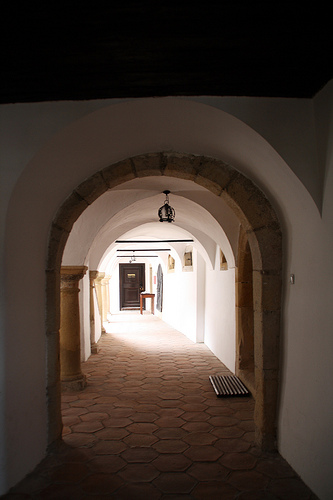
Inside, the castle transitions from defensive to
residential spaces, with rooms that showcase a progression of styles
from Romanesque to Baroque. The ground floor features vaulted ceilings
in the cellars and service areas, supported by thick stone pillars,
ideal for storage and withstanding sieges. Upper floors house grand
halls with wooden beam ceilings, some coffered in Renaissance fashion,
and walls paneled in dark oak or adorned with tapestries.
Key
interior highlights include the chapel, now exhibiting Baroque sacral
art rescued from a demolished local church, with ornate altars and
stucco decorations. Residential wings have large, mullioned windows that
flood rooms with light, and fireplaces with carved mantels depicting
heraldic motifs. The museum spaces, renovated post-World War II,
maintain original features like exposed brick arches while incorporating
modern displays. Former stables display mastodon remains, their high
vaulted ceilings evoking the castle's multifunctional past.
Specific Architectural Elements and Details
Windows and Portals:
Renaissance-style on the first floor, with segmented arches and stone
frames; lower levels have narrower slits for defense.
Roof and
Spouts: Steep, gabled roofs covered in red tiles, with resin spouts
shaped like mythical creatures for drainage.
Fortifications:
Triangular tower and rondelles with embrasures for cannons, emphasizing
16th-century military engineering.
Materials: Predominantly local
stone, with wood for interiors and iron for reinforcements.
Blended
Styles: Gothic pointed arches in older sections, Renaissance symmetry in
the courtyard, and Baroque ornamentation in later additions.
Renovations and Preservation
After nationalization in 1945, the
castle faced decay until the Velenje Coalmine established a museum in
1957, sparking intensive renovations. These efforts, continuing into the
21st century, have restored facades, roofs, and interiors while
preserving authentic elements. The castle's excellent condition today is
due to careful conservation, making it a prime example of Slovenian
heritage architecture.
Velenje Castle's design masterfully balances
fortification, elegance, and adaptation to its environment, offering a
window into Slovenia's rich architectural evolution.