Location: Lokev Map
Discovered: 1633 (recorded)
Length: 1,300 metres (4,300 ft)
Depth: 180 m (590 ft)
Tel: +3865 7344 259
+3865 1648 711
E-mail: vilenica@siol.net
Open: Apt- Oct 3- 5 pm
Nov- March by prior arrangement
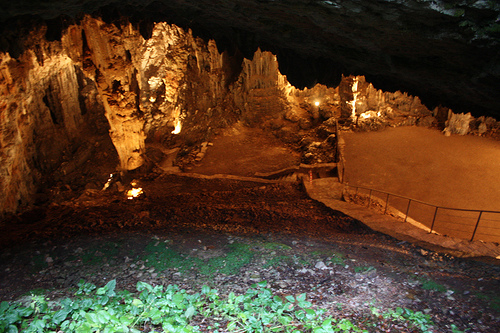
Vilenica Cave, known in Slovene as Jama Vilenica pri Lokvi, is a remarkable karst cave system located near the village of Lokev in the municipality of Sežana, on the Karst Plateau in southwestern Slovenia. Formed in Cretaceous limestones of the Lipica Formation, the cave extends approximately 1,300 meters in length and reaches a depth of 180 meters, running in a northwest-to-southeast direction shaped by an ancient underground river. It is renowned as the oldest show cave in Europe—and arguably the world—with organized tourist visits dating back to 1633. This status predates tourism in other famous Slovenian caves like Postojna by nearly two centuries. The cave's name derives from the Slovene word "vile," meaning fairies, rooted in local folklore that depicted it as a mystical dwelling for benevolent fairies who were believed to inhabit its depths and influence the surrounding area. These legends added to its allure, portraying the cave as a place of enchantment and natural wonder.
Prehistoric Use
The human connection to Vilenica Cave stretches
back to late prehistory. Archaeological findings, including
fragments of Copper Age pottery discovered in the entrance area,
suggest that the cave served as a temporary refuge or dwelling
during this period. Its natural partial enclosure provided shelter
from weather and potential threats, making it an ideal spot for
early inhabitants. However, the cave has not undergone comprehensive
archaeological investigation, and only isolated artifacts have been
recovered, leaving the exact purpose of its prehistoric use somewhat
unclear. This early interaction highlights the cave's role as a
natural haven in the Karst region's harsh landscape, long before it
became a site of organized exploration.
Folklore and
Mythological Significance
Embedded in Slovenian folklore,
Vilenica was seen as the home of "vile"—fairies who were thought to
be kind and protective. One popular legend tells of a poor widow
living near Lipica who, while gathering wood, encountered three
fairies in the forest. They invited her to their home in Vilenica,
where they rewarded her kindness with gold coins hidden in a loaf of
bread, transforming her life. Such tales not only explain the cave's
name but also contributed to its mystical reputation, drawing early
curiosity from locals and travelers alike. This blend of myth and
reality fueled interest in the cave as a site of supernatural
energy, setting the stage for its transition into a tourist
destination.
Early Tourist History and First Visits (17th
Century Onward)
Vilenica's documented history as a tourist site
began in 1633, marking it as the first show cave in the world where
admission fees were collected, indicating a commercial operation.
That year, Count Benvenuto Petazzi (also spelled Petač), the
landowner, granted the cave as a fief to the Lokev parish. Under
this arrangement, the parish managed the cave, and income from
entrance fees was shared between the count and the parish. This
formalized the cave's role as an attraction, primarily for nobility
and travelers along the bustling Vienna-Trieste trade route. Its
proximity to the famous Lipica Stud Farm further enhanced its
appeal.
The first notable royal visit occurred in 1660, when
Austrian Emperor Leopold I explored the cave during a stop at
Lipica. By the 18th century, the cave gained wider recognition. In
1778, the Carniolan physician and naturalist Balthasar Hacquet
visited and documented it, contributing to scientific interest.
Early documentation includes a 1748 sketch by Austro-Hungarian
mathematician and cartographer Joseph Anton Nagel, which provided
one of the first pictorial representations of the cave's layout.
Another early image appeared in Tranquillo Moll's 1752 atlas.
Management Changes and Development (18th–19th Centuries)
In
1809, doors were installed at the entrance for security, and full
management was transferred to the Lokev chaplaincy. This period saw
continued growth in popularity, with Vilenica hailed as the largest,
most beautiful, and most visited cave in the Classical Karst until
the mid-19th century. Between 1829 and 1830, a passage to the "Hall
of the Fairies" was constructed, expanding accessible areas. A
visitor book was introduced in 1821, recording over 2,000 signatures
by 1889 in various languages, reflecting its international draw. The
original book is now preserved at the Karst Research Institute in
Postojna, with a copy displayed at the cave.
Notable royal
visitors during this era included Ferdinand I, King of Naples and
Sicily (1790); Emperor Leopold II (1790 and 1791); Emperor Francis I
(1816 and 1818); and King Frederick Augustus I of Saxony (1836). The
cave's speleothems inspired artists and writers, such as Giuseppe
Compagnoni di Lugo's 1795 poem "La Grotta di Vileniza" and Francesco
Trevisani's 1802 work. Painters Ferdinand Runk and Peter Fendi
captured its beauty, with Fendi earning a gold medal in 1821 for his
oil painting. An 1818 watercolor plan by Francesco Vicentini
detailed the cave's formations and paths.
Decline in
Popularity (Mid-19th Century)
Vilenica's prominence waned in the
mid-19th century as Postojna Cave gained fame with new discoveries
and a direct railway connection, diverting tourists. By 1836, the
Lokev community ceased organizing visits, transferring management to
local innkeeper Anton Muha. From 1886 until the end of World War II,
the Trieste Alpine Society (Società Alpina delle Giulie) oversaw the
cave. Visits nearly halted, and the cave fell into disrepair amid
shifting tourism trends and infrastructure developments favoring
other sites.
Revival and Modern Era (20th Century Onward)
In 1963, the Sežana Caving Society (Jamarsko društvo Sežana) took
over management and initiated a major restoration. Thousands of
volunteer hours were invested to repair stairs, clean paths, and
install electric lighting, reopening the cave to visitors on May 19,
1963. By 1975, the society built the Jože Gustinčič Caving Hut at
the entrance. Ongoing improvements included path repairs, railings,
a stage in the Dance Hall, and sectoral lighting in six chambers.
External enhancements featured water and electricity installation,
sculptures by artist Marko Pogačnik, information boards, and park
landscaping. Over 100,000 volunteer hours have been contributed to
maintain the site.
Since 1986, Vilenica has hosted the annual
Vilenica International Literary Festival, organized by the Slovene
Writers' Association. Held in early September, the festival
culminates in the conferral of the Vilenica Prize in the cave's
Plesna (Dance) Hall, honoring Central European authors for literary
and essay achievements. This cultural revival has blended the cave's
natural heritage with artistic expression. In 2003, Slovenia issued
a postage stamp featuring Vilenica, underscoring its national
significance.
Formation and Age
Vilenica Cave originated through epigenic
speleogenesis, driven by the dissolution of soluble carbonates
enhanced by biogenic CO₂ from soil. It was primarily formed by the
erosive action of an ancient underground river, which carved a
pathway through the rock in a northwest-to-southeast direction. The
cave's development occurred in multiple phases: the upper sections
likely formed in the epiphreatic zone (fluctuating between vadose
and phreatic conditions) with initial water flow, while the lower
parts developed in the phreatic zone along fractures and faults.
Over time, tectonic influences, collapses, and infills significantly
modified the cave, with walls now largely controlled by fault lines
rather than original dissolution features. Only isolated sections
preserve primary walls with large scallops indicative of ancient
water flow.
The cave is estimated to be several million years
old, though its precise age remains undetermined. Sediments within
the cave, dated using methods such as U/Th, ESR, C¹⁴, and
paleomagnetism, reveal deposits over 2 million years old that match
recent compositions, suggesting long-term stability in the karst
aquifer. The entrance formed more than 60,000 years ago due to a
ceiling collapse, creating a doline that exposed the interior. The
cave's evolution is decoupled from the current surface topography
and recent hydrological activity, indicating it predates modern
landscape features. Multiphase development is evident from Ice Age
influences, with increased collapses during colder periods and
variable speleothem growth in warmer ones.
Originally submerged,
the cave has risen closer to the surface through ongoing erosion of
the overlying strata. It represents a segment of a larger cave
system, modified by periglacial processes and tectonic events, and
is not actively connected to contemporary water flows (active caves
in the region are typically at elevations above 50 meters a.s.l.).
Rock Types and Geological Setting
The primary bedrock is
light grey, bedded, and massive Upper Cretaceous limestone from the
Lipica Formation, part of a thicker sequence of carbonate rocks in
the region. This limestone is highly soluble, facilitating karst
development. The cave is intersected by faults in the Dinaric
(SE-NW, dextral strike-slip) and cross-Dinaric (sinistral
strike-slip) directions, which guided passage formation. Surrounding
geology includes impermeable Eocene flysch from the Pivka Basin,
which erodes to provide allogenic sediments that enter the system
via rivers like the Pivka.
Vilenica lies within an
800-meter-thick limestone sequence bounded by major fault zones
(e.g., Predjama and Idrija faults). The rock is partially
dolomitized in some areas, with variations including very
thick-bedded grey rudist limestones, micritic limestones, and
thin-bedded varieties with cherts.
Structure and Dimensions
Vilenica is structured as a single, sloping tunnel oriented NE-SW
along a major fault, characterized by sinuous shapes, undercuts, and
extensive collapses. The upper touristic part (transformed
epiphreatic passages) differs from the lower phreatic sections, with
interconnected chambers following fractures. It connects to adjacent
caves like Gustinčičeva jama (550 meters long) and potentially Črna
jama, forming part of a broader system.
Speleothems and Key
Features
The cave is richly decorated with speleothems, including
stalactites, stalagmites, columns, curtains, organs, sinter
waterfalls, tubes, and helectites. Many formations exhibit
reddish-brown hues due to iron oxide. Notable areas include:
Dance Hall (Dance Floor Hall): Features a dark gray stalactite
column and acts as a cold trap with a ceiling opening.
Dripstone
Avenue (Alley of Dripstones): Abundant dripstones and flowstone.
Red Hall: Dominated by reddish-brown speleothems, influenced by
cold, dry air circulation.
Fairy Hall: Hosts a massive
20.3-meter-tall stalagmite with a 10-meter base circumference.
Other features: Čarobni vrt (Magic Garden) with overturned
speleothems, Pisani rov, and areas with porous sinter at collapse
bases.
Entering Vilenica, visitors descend into a world of stunning speleothems—mineral deposits formed by dripping water rich in dissolved limestone. The cave boasts an array of stalactites hanging from ceilings like intricate chandeliers, stalagmites rising from the floor in conical shapes, and flowstones creating smooth, curtain-like walls. Notable chambers include the Dance Hall (Plesna Dvorana), a vast space with high ceilings and ethereal formations that evoke a sense of otherworldliness, often illuminated to highlight their crystalline sparkle. Other highlights are delicate helictites twisting in defiance of gravity, rimstone pools, and columns where stalactites and stalagmites have merged over millennia. The cave's biodiversity includes endemic species adapted to the dark, humid environment, such as cave crickets and bats, though it's less known for troglobites compared to nearby caves. The air inside maintains a constant temperature of about 10°C (50°F) year-round, with high humidity that enhances the misty, fairy-tale ambiance. Unlike more commercialized sites, Vilenica retains a raw, intimate charm, with narrower passages that require careful navigation, adding to the adventure.
Guided tours are the primary way to experience Vilenica, lasting about 1 to 1.5 hours and covering roughly 450 meters of accessible paths with some stairs and uneven terrain, making it suitable for families and moderately fit visitors. Regular tours operate on weekends, while year-round visits are available by appointment, with multilingual guides providing insights into its history and geology. Entrance fees are modest, around €10-15 for adults, with discounts for children and groups. Warm clothing and sturdy shoes are recommended due to the cool, damp conditions. The cave is part of broader Karst tours, often combined with visits to Škocjan Caves or Postojna for a comprehensive exploration of Slovenia's underground marvels.
Beyond its natural allure, Vilenica holds cultural importance as a symbol of Slovenia's karst heritage and a venue for artistic events, reinforcing its folklore-inspired name. It contributes to ecological awareness, highlighting the fragility of karst systems vulnerable to pollution and climate change. As a less crowded alternative to Slovenia's busier caves, it offers a peaceful, authentic experience that underscores the region's geological diversity and historical depth.