Location: Bled, Upper Carniola Map
Open: Apr- Oct 8am- 8pm
Nov- March: 8am- 6pm
Entrance Fee: adult €7
Children €6
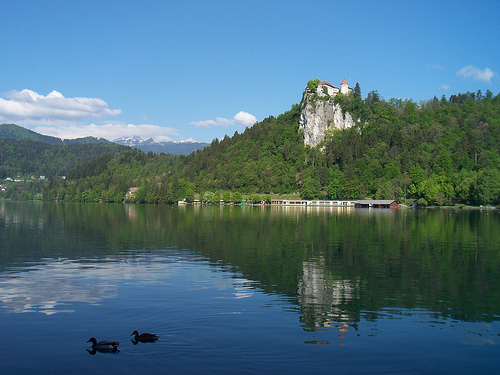
Bled Castle (Blejski grad in Slovene, Burg Veldes in German) stands dramatically on a steep cliff over 130 meters above Lake Bled in northwestern Slovenia. As the oldest castle in Slovenia documented in written sources, it has overlooked the picturesque alpine lake and surrounding landscape for over a millennium, serving as a fortress, residence, administrative center, and now a major cultural and tourist site. Its history intertwines with the broader narratives of the Holy Roman Empire, Habsburg rule, religious shifts, and Slovenia's path to modernity. The castle's strategic location provided natural defenses, while its evolution reflects architectural adaptations from Romanesque to Renaissance styles. Today, it houses a museum under the National Museum of Slovenia, showcasing the region's development from prehistoric times to the present, and hosts events that revive its storied past.
Early Origins and Foundation (1004–1011)
The roots of Bled
Castle trace back to the early 11th century within the March of
Carniola, a frontier region of the Holy Roman Empire. On April 10,
1004, German King (and later Emperor) Henry II granted the Bled
estate to Bishop Albuin of Brixen (now Bressanone in Italy) and his
diocese as a reward for supporting Henry's campaigns to consolidate
control over northern Italy. This gift included lands between the
Sava Bohinjka and Sava Dolinka rivers, but the castle itself wasn't
explicitly mentioned—suggesting a Romanesque tower or basic
fortification may have already existed on the cliff for defensive
purposes against potential invasions.
The first unambiguous
reference to the castle appears in a donation deed dated May 22,
1011, issued by Emperor Henry II. In this document, the structure is
named "castellum Veldes," confirming its role as a fortified
episcopal residence. This makes Bled Castle one of the earliest
documented castles in Slovenia, predating many others in the region.
The bishops of Brixen, who held spiritual and temporal authority,
used it to administer their distant holdings in Carniola, marking
the start of nearly 800 years of ecclesiastical ownership.
Medieval Period under Episcopal Control (1011–1371)
For the next
three centuries, Bled Castle remained under the bishops of Brixen,
who rarely visited due to the perilous six-day horseback journey
from their seat in Tyrol. Instead, they delegated management to
ministeriales—knightly vassals known as the Knights of Bled—who
handled daily operations, alongside stewards and castellans under
feudal law. The castle served as an administrative hub for the
estate, collecting tithes, enforcing justice, and providing defense.
Architecturally, the core structure during this era included a
Romanesque tower, the oldest surviving element, with additional
towers and fortifications added over time to bolster defenses. The
complex grew around two courtyards connected by staircases,
featuring ramparts, a moat, and a drawbridge. In 1278, the region
fell under the Austrian House of Habsburg after they acquired
Carniola, integrating Bled into their expanding domains while the
bishops retained nominal control.
Era of Leaseholders and
Turmoil (1371–1574)
By 1371, the bishops shifted to leasing the
estate to avoid direct involvement, starting with Konrad von Kreigh.
The Kreigh family held it for nearly two centuries, but their rule
was marked by harsh treatment of serfs, contributing to local
unrest. In 1511, a devastating earthquake struck, severely damaging
the castle's buildings and causing residents to flee amid fears of
collapse into the lake below. Repairs dragged on for over 60 years.
The unrest culminated in 1515 when some Bled farmers joined the
widespread Slovenian peasant revolt against feudal oppression.
Later, the castle passed to Baron Herbard VIII von Auersperg of
Turjak, a notable Protestant and military leader against Ottoman
incursions. In 1561, he hosted Primož Trubar, the father of
Slovenian Protestantism and author of the first Slovenian printed
book, at the castle. However, Auersperg's Protestant affiliations
forced him to relinquish Bled in 1574 amid Counter-Reformation
pressures.
Governance and Natural Disasters (1597–1622)
Abandoning leases, the bishops appointed governors—initially nobles
like the Eggenbergs and Turjaks, later townspeople such as the
Petschachers and Gallenfels. Some resided at the castle, others
managed remotely via stewards. This period was plagued by
calamities: multiple lightning strikes caused fires, and a 1690
earthquake inflicted further damage. The Gallenfels family led
restorations around 1695, with preserved architectural plans showing
efforts to make the castle habitable again. A 16th-century chapel in
the upper courtyard was built and later renovated around 1700 with
illusionist Baroque frescoes, adding to the Renaissance elements
that reshaped much of the structure.
End of Episcopal Rule
and Napoleonic Interlude (1803–1813)
In 1803, after eight
centuries, a Viennese court decree nationalized the Bled estate,
ending Brixen control amid secularization trends in the Holy Roman
Empire. From 1809 to 1813, during Napoleon's occupation of Carniola
as part of the Illyrian Provinces, the castle became French state
property under Governor-General Marshal Auguste Marmont, who managed
its revenues.
Private Ownership and Industrial Era
(1838–1937)
The Diocese of Brixen briefly regained ownership in
1838 but, unable to maintain it after the 1848 abolition of
feudalism, sold it to entrepreneur Viktor Ruard, owner of the
Jesenice ironworks. Ruard kept the castle and lakeside areas but
sold forests to the Carniolan Industrial Company. In 1882,
wholesaler Adolf Muhr acquired it, followed by hotelier Ivan Kenda,
who envisioned transforming it into a luxury hotel and restaurant.
Financial woes led to bankruptcy; the property passed to the
Cooperative Commercial Bank and then the Drava Banovina
administration.
Post-World War II Restoration and Modern Era
(1945–Present)
World War II left the castle in disrepair. In
1952, under the National Museum and architect Tone Bitenc (a student
of renowned Slovenian architect Jože Plečnik), a major restoration
began with support from the state and Municipality of Bled.
Completed in 1961, it modernized the castle for tourism while
preserving historical features.
On September 9, 1999, Bled Castle
was declared a national cultural monument. Since 2007, the Institute
for Culture Bled has managed it, overseeing renovations like the
2008 museum update. Today, it offers accessibility features such as
tactile guides for the visually impaired and audio tours in 19
languages. The site hosts concerts, exhibitions, historical
reenactments, and includes attractions like a recreated Gutenberg
printing press, wine cellar, herbal gallery, and a restaurant with
panoramic views. Archaeological exhibits in the museum highlight
prehistoric settlements, medieval nobility, and the castle's role in
regional history, drawing visitors to its blend of heritage and
natural beauty.
Historical Context Shaping the Architecture
The castle's
architecture reflects its long history as a feudal stronghold under the
Bishops of Brixen, who owned it for over 800 years but never resided
there, leading to a focus on fortification rather than luxurious living
quarters. The initial structure, built around 1011, consisted primarily
of a Romanesque tower and surrounding walls for defense against
invasions. Over the Middle Ages, it was expanded with additional towers,
ramparts, and a sophisticated fortification system, including a
drawbridge over a moat (now filled in but still visible in the
landscape). A devastating earthquake in 1511 prompted major
reconstructions, incorporating Renaissance styles, while another in 1690
led to Baroque influences, particularly in the chapel. Post-World War II
deterioration was addressed through extensive restorations from 1952 to
1961 under architect Tone Bitenc, preserving its historical integrity
while modernizing for tourism. Recent updates, including a 2025
renovation of the ground floor with improved parquet, wiring, and
security, have enhanced accessibility, adding features like tactile
guides for the visually impaired and audio tours in 19 languages.
Overall Layout and Structural Design
Bled Castle exhibits a
characteristic double structure typical of medieval fortifications: a
fortified inner core (the upper courtyard) for the lords and caretakers,
surrounded by robust walls, and an outer ring (lower courtyard) housing
servants' quarters, workshops, and storage. These two courtyards are
connected by a grand staircase, creating a terraced layout that adapts
to the cliff's steep topography. The entire complex is built from local
limestone and granite, providing durability against the elements and
contributing to its seamless integration with the rocky precipice.
Defensive elements dominate, with thick walls featuring wooden defense
corridors (reconstructed from the original Romanesque design) and
battlements for archers. The entrance, accessed via a winding path up
the cliff, passes through a Gothic gatehouse with a former drawbridge
mechanism, emphasizing the castle's impregnable position.
The lower
courtyard, entered first by visitors, includes functional buildings like
the knights' hall (now a venue for events), a wine cellar, and a
printing workshop demonstrating Gutenberg-era techniques. This area
reflects Renaissance influences in its arched doorways and vaulted
ceilings, added during 16th-17th century rebuilds. Ascending to the
upper courtyard reveals the castle's heart: a Romanesque entrance tower
(the oldest surviving element) flanked by later Gothic additions,
including residential wings with timber-framed galleries. The spatial
layout maximizes the cliff's natural defenses, with towers positioned to
overlook the lake and surrounding valleys, offering panoramic views that
were strategically vital.
Key Architectural Features
Towers
and Ramparts: The Romanesque keep tower, dating to the 11th century,
anchors the structure with its cylindrical form and narrow slits for
defense. Medieval expansions added polygonal towers and a lifting tower
over the moat, enhancing the fortification system with crenellated walls
that allowed for enfilading fire. These elements, built in rubble
masonry with ashlar facing, exemplify Gothic military architecture
adapted to the site's rugged terrain.
Chapel: Dedicated to St. Albuin
and St. Ingenuin, the 16th-century Gothic chapel on the upper terrace
was remodeled in Baroque style after the 1690 earthquake. It features
illusionistic frescoes depicting donors and saints, a ribbed vault
ceiling, and ornate altars blending Gothic simplicity with Baroque
grandeur. Today, it's a popular spot for weddings, with its small nave
and apse preserving medieval proportions.
Interior Spaces and Museum:
The castle's interiors, lacking the opulence of royal residences, focus
on functionality with exposed stone walls, wooden beams, and sparse
Renaissance furnishings. The museum, housed in the upper buildings,
displays archaeological artifacts from the Bronze Age to Slavic
settlements, including the oldest gold item found in Slovenia. Renovated
in 2008 and 2025, it includes interactive exhibits on the castle's
evolution, with rooms featuring parquet floors and modern heating while
retaining historical authenticity.
Surrounding Elements: The castle's
integration with its environment is key—its cliff-top location not only
provided natural protection but also symbolic dominance over the
landscape. Recent park renovations around the base enhance
accessibility, with paths leading to viewpoints that highlight the
castle's silhouette against the Julian Alps.