Location: Lož Valley Map
Discovered: 1832
Length: 8.27 km
Depth: 32 m
Tel. +386 41 632 153
Email: krizna_jama@yahoo.com
Official site
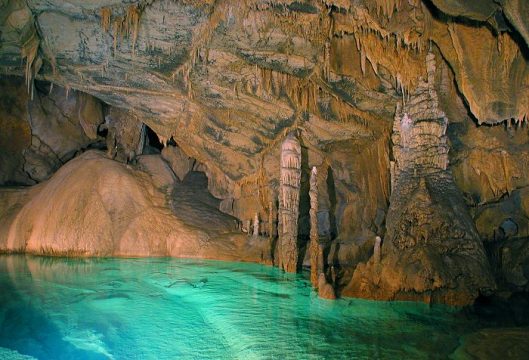
Križna Cave, known in Slovene as Križna jama and also referred to as Cross Cave or Cold Cave under Cross Mountain, is a world-renowned karst cave system located in southwestern Slovenia. It stands out for its extensive chain of subterranean lakes, stunning calcareous formations, and exceptional biodiversity, making it one of the most beautiful and best-preserved caves in Europe. Often described as the longest explored spring cave in the world, it spans over 8 kilometers and features crystal-clear emerald-green waters that create a mesmerizing underground landscape. The cave's name derives from the nearby Holy Cross Church in Podlož, and it serves as a vital part of Slovenia's karst heritage, drawing adventurers and researchers alike while emphasizing strict conservation to protect its fragile environment.
Situated in the Lož Valley, Križna Cave lies at the intersection of the Lož Karst Field, Cerknica Karst Field, and Bloke Plateau, near the village of Grahovo and approximately 55 kilometers southwest of Ljubljana. It is positioned under Križna Gora hill (857 meters elevation) and forms part of a larger hydrological system where waters from the Bloke Plateau flow through karst poljes like Cerknica Polje and Loško Polje. Access is via a single entrance, believed to have formed from a ceiling collapse, and visitors typically reach it by car or guided transport from nearby towns. The cave's remote setting in the Slovenian karst region enhances its mystique, with the entrance leading directly into a subterranean riverbed that requires boats for deeper exploration.
Križna Cave, also known as Cross Cave (Križna jama in Slovene and
Kreuzberghöhle in German), is a remarkable karst cave system situated in
southwestern Slovenia, within the Lož Valley between the Lož Karst
Field, Cerknica Karst Field, and Bloke Plateau. Named after the nearby
Church of the Holy Cross in Podlož, the cave is celebrated for its
pristine subterranean environment, featuring a chain of over 22
underground lakes with emerald-green water, formed by sinter dams that
create pools up to 7 meters deep. The cave extends approximately 8,273
meters in length and reaches a depth of 32 meters, primarily composed of
dolomite and limestone. It is also a hotspot for biodiversity, hosting
around 60 troglobitic species, making it the fourth-richest cave
ecosystem worldwide in terms of known organisms. Beyond its natural
wonders, Križna Cave holds profound historical significance as a site of
prehistoric human activity, early modern exploration, paleontological
discoveries, and controlled tourism development.
Prehistoric
Human Use
The history of Križna Cave begins in prehistoric times,
with evidence suggesting human utilization as far back as the Eneolithic
period (Copper Age), around 2800 B.C. Archaeological findings, primarily
pottery fragments discovered in the water-filled sections of the cave,
indicate that early inhabitants used the site sporadically as a seasonal
shelter or for ritual purposes. These artifacts, some nearly 5,000 years
old, were found near the entrance and the beginning of the first lake,
highlighting the cave's role in ancient human life in the region. No
extensive settlements have been identified, but the presence of ceramic
and other remains from the Metallic Ages underscores the cave's appeal
as a protected environment amid the karst landscape.
Early Visits
and Initial Documentation (16th–Early 19th Centuries)
The first
documented signs of post-prehistoric human visits date to the 16th
century. Wall inscriptions and signatures inside the cave provide the
earliest written proof, with one from 1557 and another from 1567. During
this period and the subsequent centuries, visits were rare and largely
confined to the dry entrance areas, as the challenging terrain and water
obstacles deterred deeper penetration. Local folklore associated the
cave with mystical qualities, linking its name to Christian symbols of
the cross due to its proximity to the Church of the Holy Cross, which
influenced perceptions among communities in the Lož Valley.
The cave
entered the scientific record in 1832, when J.J. Tobin published the
first known printed report describing its existence. This marked the
beginning of formal interest, though earlier undocumented explorations
likely occurred. In 1838, explorer J. Cerar produced the first detailed
description and sketch, advancing as far as the first underground lake
and noting its karstic passages.
19th Century Explorations and
Paleontological Breakthroughs
The mid-19th century saw increased
scientific activity, driven by geological curiosity and the discovery of
fossils. In 1847, local resident Aleksander Škofiz (also referred to as
A. Škofiz) first noticed cave bear bones and reported them to Henrik
Freyer, curator of the Ljubljana Museum. This led to initial
publications on the findings.
Systematic excavations commenced in
1878 under Ferdinand von Hochstetter, a prominent geologist from the
Vienna Academy of Sciences (formerly the k.k. Hof-Naturalienkabinett).
Over just four days in 1878 and 1879, his team unearthed more than 2,000
bones and bone fragments from over 100 cave bears (Ursus spelaeus),
dating between 45,000 and 146,000 years old. This made Križna Cave one
of Europe's richest paleontological sites for cave bear remains.
Hochstetter assembled two complete skeletons, which were sent to
Vienna's Natural History Museum, and created the earliest detailed plan
of the initial passages. The bones' size was notable, with the largest
skull measuring 56 cm. Other contributors, including Škoflic, Schmidl,
and Schulze, aided in mapping the dry sections, focusing on descriptive
sketches under Austro-Hungarian scientific auspices. These efforts
equated early tourism with research, as fossil discoveries attracted
visitors, though many remains were removed from the site.
20th
Century Advancements in Exploration
The early 20th century shifted
focus to the cave's water-filled sections, which define its unique
character. In 1926, Slovenian speleologists from the Ljubljana Cave
Exploration Society (Društvo za raziskovanje podzemnih jam, or DZRJL)
first explored the lakes and stream passages, overcoming limestone tuff
barriers in front of the First Lake. This breakthrough revealed the
cave's extensive subterranean river system, including the iconic Calvary
(Kalvarija), where the passage splits into the Muddy Passage (Blatni
rov) and Colorful Passage (Pisani rov). The exploration elevated Križna
Cave's status as a premier karst feature in the Dinaric Alps.
In
1934, led by A. Šerk, cavers conquered Crystal Mountain, reached the
final hall of the Pisani tunnel, and discovered the Blatni tunnel.
Pre-World War II research involved scholars like R. Badiura, B. Brinšek,
I. Michler, P. Kunaver, F. Bar, R. Kenk, A. Kraševec, J. Kos, and
Bohinec, who published on the cave's features.
Post-war, the
Slovenian Speleological Society (DZRJS) conducted detailed mapping in
the 1950s–1970s, discovering Mark’s tunnel and Tršanov’s tunnel, and
measuring lake depths, water flow, and chemical properties. Photography
and further probes occurred, with locals and international cavers
exploring additional halls and diving into the Kittlow wells siphon in
the 1970s–1990s.
The underground lakes, a hallmark of the cave, were
formed by rapid carbonate deposition at rapids, creating sinter dams and
deep pools. These features, visible during boat tours today, underscore
the cave's hydrological uniqueness.
Late 20th and Early 21st
Century Discoveries
In 1991, local cavers discovered "Križna jama 2,"
an extension beyond a siphon in the Kittlow rov, adding to the cave's
mapped length but remaining inaccessible to the public. Between 1990 and
2003, the Speleological Society of Karlovec and the Association of
Križna Cave Lovers focused on new tunnels, cleaning, and documentation.
In 2003, divers reached 70 meters in the 2nd Kittel’s well siphon.
Geological studies from 1968–1971 detailed allochthonous sediments and
the cave's surroundings.
Tourism Development and Conservation
Tourism in Križna Cave is intertwined with its exploration history.
Early visits surged after fossil discoveries, but organized access began
in the 1950s under the Lož Valley Tourist Association, which equipped
visitors with lanterns and boots to minimize impact. Management passed
to the Ljubljana Cave Research Society, and since 1998, the Friends of
Cross Cave Association (Društvo ljubiteljev Križne jame) has prioritized
conservation, limiting groups to preserve fragile speleothems (growing
at 0.1 mm/year) and biodiversity. Tours, including boat rides across
lakes, are capped at 1,000 visitors annually for the water sections,
making it Slovenia's only naturally preserved tourist cave without
artificial lighting or paths. This approach balances economic benefits
with ecological protection in Notranjska Regional Park.
Križna Cave is a classic example of a karst cave, formed through the dissolution of soluble rocks by water over millennia. It developed in Upper Triassic dolomites and Upper Jurassic limestones within a syncline influenced by the Idrija fault zone. The cave's passages are shaped by a subterranean river that drains from the Bloke Plateau, creating an aquifer system connected to nearby poljes. Local faults and tectonized bedding planes guide the formation of corridors, with an average sinter deposition rate of about 0.256 mm per year—extremely slow, contributing to the fragility of its features. The total length is 8,273 meters, with a depth of 32 meters, and it functions as a spring cave where waters eventually surface as the Steberščica River in Cerknica. Its geological highlights include pillar-like sinter dams that form lakes by accelerating carbonate precipitation at rapids, up to ten times faster than in still water.
The cave's interior is a labyrinth of over 22 interconnected
underground lakes, with emerald-green waters up to 7 meters deep,
separated by calcareous sinter barriers formed from rapid mineral
deposition. These lakes create a serene, otherworldly atmosphere, with
crystal-clear streams rushing through halls adorned with stalactites,
stalagmites, and massive columns. Key sections include the First Lake
near the entrance, the Bear Tunnel with its enormous King Matthias
Column, the Calvary (Kalvarija) where the cave splits into the muddy
northern branch and the Variegated Passage leading to the Crystal
Mountain—the largest chamber, featuring a climbable pile of collapsed
rocks above the stream. The air temperature hovers around 8°C
year-round, with 100% humidity and total darkness beyond the entrance,
enhancing the dramatic interplay of light on the formations when
illuminated. Stalactites appear to emerge directly from the water in
some areas, though they predate the flooding.
Further in, the
Variegated Passage boasts large columns and leads to uncharted
extensions like New Cross Cave, with the entire system estimated at
around 10 km of explored passages, though parts remain unmapped.
Despite the oligotrophic (nutrient-poor) environment, Križna Cave ranks as the fourth-most biodiverse cave ecosystem globally, hosting 45 to 60 species of organisms, including both aquatic and terrestrial troglobionts (cave-adapted species). Many are endemic or rare, with 10 species having the cave as their type locality (first discovery site). The largest aquatic inhabitant is the cave salamander (Proteus anguinus), though its presence is reported but not always confirmed. Bats hibernate here in winter, and surface visitors like dormice occasionally enter. Other notable fauna include tiny bats with wingspans under 10 cm, smaller snakes, crustaceans, spiders, insects, and earthworms. The cave supports 32 aquatic stygobionts and 28 terrestrial troglobionts, adapted to constant darkness and low nutrients.
All tours are guided and boat-based due to the water-filled
nature of the cave, with equipment like rubber boots, flashlights,
and basic insurance provided. Visitor numbers are strictly
limited—up to 1,000 annually for longer sections—to minimize damage
to fragile formations. Options include:
Short Tour (First
Lake): 1-1.5 hours, 7-12 euros, suitable for all ages (from 3 years
old), involving a 600-meter walk and boat ride on the first lake;
groups up to 60, available regularly in high season (April-October)
at 3 PM, weekends only in winter.
Bear Tunnel Tour: 1-2 hours,
15-18 euros, on request, featuring the King Matthias Column and cave
bear bones.
Calvary Tour: 3-4 hours, 40-80 euros, on request for
small groups (up to 4), exploring the protected water section with
stalactites and columns; the most photographed area.
Crystal
Mountain Tour: 6-7 hours, 280 euros (flat rate for groups of 4 or
fewer), on request, venturing to the largest chamber.
Longer
tours require advance booking (at least 2 weeks), cash payment, and
adherence to special conditions like no photography in sensitive
areas. Guides explain formations, fauna, and history, often turning
off lights to experience total darkness.