Location: South of Linköping Map
Constructed: 1791-1795, rebuilt in 1894-1898
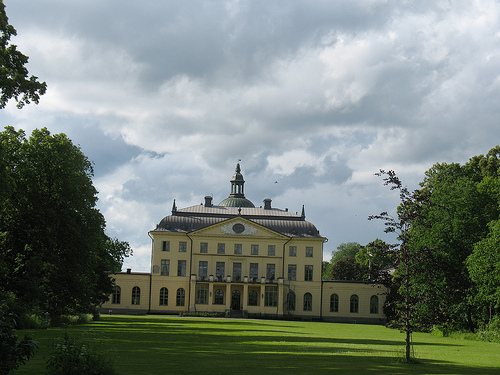
Bjärka-Säby Castle is a beautiful baroque residence situated near Linkoping in Ostergotland County in Sweden. Despite its military name Bjärka-Säby Castle is not actually a castle. Bjärka-Säby Castle was constructed in 1791 as a private residence for Swedish aristocrat and a diplomat Germund Louis Cederhielm under supervision of an architect Fredik Magnus Piper (1746- 1824).
Later Bjärka-Säby Castle was sold to Consul Oscar Ekman (1812- 1907) in 1872. Original building had a neo- classical architectural style, but in 1894- 98 reconstruction under guidance of Agi Lindegren a more baroque style became evident in the appearance of Bjärka-Säby Castle. Ekman family that owned this residence finally sold their residence to the Zion Church in Linkoping on April 1, 1980 which still owns the residence today.
The 17th Century: Construction of the Old Castle
The modern
history of Bjärka-Säby begins in the early 17th century, building upon
the medieval foundations. In 1632, Per Nilsson Natt och Dag, a prominent
Swedish nobleman involved in the Thirty Years' War, initiated
construction of a manor house on the shores of Lake Stora Rängen—what is
today referred to as the Old Castle. Per died in 1637, but his wife,
Sofia Christina Stenbock, oversaw its completion. Their coat of arms
still adorns the gate, symbolizing the family's legacy. The Natt och Dag
family owned the property for five generations, during which it served
as a key estate in Östergötland.
By the late 17th century, financial
difficulties arose under Carl Persson Natt och Dag during King Karl XI's
reduction policies, which aimed to reclaim noble lands for the crown. To
settle debts, the estate was transferred to Germund Cederhielm, whose
son was married to Carl Persson's daughter. Around 1704, Germund added
timbered Carolingian wings flanking the Old Castle: the southern wing
became a residence (and remains one today), while the northern served
economic purposes, such as housing the farm's office. After these
additions, the main castle building transitioned into a guest house.
The 18th Century: Building the New Château
The estate's
transformation accelerated in the late 18th century with the
construction of what is now the primary structure, often called the New
Château or simply Bjärka-Säby Castle. Swedish diplomat and nobleman
Germund Louis Cederhielm (a descendant of the earlier Germund)
commissioned the building in 1791, drawing on designs by the renowned
landscape architect Fredrik Magnus Piper. Completed just before 1800,
the château exemplifies late-18th-century architecture, with the
surrounding grounds landscaped in the style of a traditional English
park—featuring rolling lawns, scenic views, and a harmonious integration
with the natural environment around Lake Stora Rängen.
The château's
layout includes the palace and outbuildings forming a three-sided
courtyard, enhancing its grandeur. Inside, it originally reflected
neoclassical influences, but later renovations would alter its
appearance. A side chapel was added in the 18th century, inspired by the
pietist devotion of Hedvig Ekman, incorporating elements of Lutheran
spirituality.
19th and Early 20th Centuries: Ownership Changes
and Renovations
Following the Cederhielm era, the property passed
through inheritance to the Sparre and von Salza families in 1841. In
1868, it was acquired by consul Oscar Ekman, marking the beginning of
the Ekman family's long stewardship, which continues in aspects of the
estate today. Under the Ekmans, the Old Castle hosted an agricultural
school starting in 1882, educating around 25 students annually in
farming, along with barn and dairy training. This school operated until
1955, after which the Domain Authority rented the space for forest
ranger training.
A major renovation of the New Château occurred from
1894 to 1898 under architect Agi Lindegren, diverging from Piper's
original design to impart a more pronounced Baroque style—characterized
by ornate facades and elaborate detailing that remain visible today.
In 1932, the Old Castle suffered a devastating fire but was restored,
though the dairy was demolished during the process.
Further interior
restorations were proposed by Sigurd Curman of the Swedish National
Heritage Board and executed between 1920 and 1921 by Erik Fant of the
Nordic Museum. These efforts aimed to recapture the château's late-1700s
origins, balancing historical authenticity with the Baroque exterior
from Lindegren's work. From 1976 to 2000, the Old Castle became a
cultural hub, hosting an annual Christmas exhibition that drew up to
25,000 visitors, transforming it into a beloved seasonal market
showcasing Swedish traditions.
Late 20th Century to Present:
Spiritual and Ecumenical Transformation
In 1975, Sten and Brita
Holmquist purchased the estate, but a pivotal shift occurred in 1980
when the Ekman family donated the New Château to Sionförsamlingen i
Linköping, the local branch of the Swedish Pentecostal movement. This
marked its evolution into a spiritual center. By 1996, an independent
Ecumenical Community of Bjärka-Säby had formed, where individuals from
various Christian denominations live communally, following a simple rule
of prayer, work, and study. Members, scattered across Scandinavia,
regularly return to the château for retreats, seminars, and shared life.
The interior now features portraits of key figures like Hedvig Ekman,
Gustaf Aulén, and Nathan Söderblom, alongside icons from Russian
Orthodox, Greek Orthodox, Coptic Orthodox traditions, and those painted
by community members. A patristic library supports scholarly pursuits,
and the side chapel continues to embody pietist heritage. Peter Halldorf
served as the spiritual leader (preces) from the community's inception
until 2017, when Jonas Eveborn succeeded him.
Today, Bjärka-Säby
Castle stands as a blend of historical architecture and living
spirituality in southeastern Sweden, approximately 20 kilometers
southeast of Linköping. The Old Castle, fully renovated, exemplifies
17th-century Swedish design and is used for exhibitions and events,
while the New Château serves as the heart of the ecumenical community,
hosting visitors and fostering interdenominational dialogue.
Bjärka-Säby Castle, often referred to as the New Castle (Nya Slottet
Bjärka-Säby) to distinguish it from the older structure on the estate,
is a prominent baroque-style château located approximately 2 miles
southeast of Linköping in Östergötland County, Sweden. The estate has a
long history, with the original Old Castle dating back to 1632, built by
Per Nilsson Natt och Dag on the shores of Lake Stora Rängen. This older
building represents classic 17th-century Swedish architecture, featuring
a timbered Carolingian style with two flanking wings added around 1704
by Germund Cederhielm—one serving as a residence and the other as an
economic building. However, the primary focus of architectural interest
is the New Castle, constructed between 1791 and 1799 for Swedish
diplomat and nobleman Germund Louis Cederhielm. The New Castle was
designed by the renowned Swedish landscape architect Fredrik Magnus
Piper, initially in a neoclassical style that emphasized symmetry and
restraint.
Architectural Evolution
The New Castle's
architecture has evolved through several phases, reflecting shifts in
taste and function. Piper's original design from the late 18th century
drew on neoclassical principles, with clean lines, proportionate
facades, and an emphasis on harmony with the surrounding landscape.
Construction began in 1791 and was completed around 1799, creating a
two-story structure with a central block and subtle decorative elements.
A major renovation between 1894 and 1898, led by architect Agi
Lindegren, transformed the building into its current baroque form.
Lindegren introduced a high, mansard-style roof with dormers, which
added vertical emphasis and a more dramatic silhouette, evoking the
flamboyant baroque aesthetics popular in continental Europe. This
included ornate gables, pilasters, and rusticated bases that enhanced
the château's grandeur while diverging from Piper's more restrained
vision. Further interior restorations in 1920–1921 by Erik Fant,
architect at the Nordic Museum, aimed to recapture the late-18th-century
essence, with Sigurd Curman of the Swedish National Heritage Board
advocating for historical accuracy. These changes ensured the interior
aligned with the building's origins, while the exterior retained
Lindegren's baroque modifications.
Exterior Features
The
exterior of the New Castle is characterized by its symmetrical baroque
facades, which blend neoclassical symmetry with baroque exuberance. The
main structure is built from light-colored stone or stucco, featuring a
central pavilion that projects slightly forward, flanked by wings that
create a balanced U-shaped courtyard. Pilasters and cornices divide the
facade horizontally and vertically, adding depth and rhythm. The high
baroque roof, added during Lindegren's renovation, is a defining
element: it features a steep pitch with multiple dormer windows, copper
or slate cladding, and decorative finials that punctuate the skyline.
Rustication on the lower levels grounds the building, while upper-story
windows are framed with pediments and ornate surrounds. The south-facing
view, overlooking Lake Stora Rängen, emphasizes the château's
integration with its environment, with broad steps leading to manicured
gardens.
The Old Castle, in contrast, showcases a more rustic
Carolingian style with its timber-framed construction and low-pitched
roofs. Its wings, added in the early 18th century, are single-story with
simple gabled ends and wooden siding, preserving a sense of 17th-century
Swedish manor architecture. Recent renovations have enhanced its
appearance, making it a complementary historical counterpart to the New
Castle.
Interior Layout and Details
Internally, the New Castle
spans multiple levels with rooms designed for both functionality and
display. The ground floor includes service areas and a grand entrance
hall with vaulted ceilings and stucco decorations, leading to a central
staircase adorned with wrought-iron balustrades and neoclassical motifs.
Upper floors house drawing rooms, libraries, and bedrooms, many restored
in the 1920s to feature period-appropriate paneling, fireplaces with
marble surrounds, and chandeliers. Baroque influences from Lindegren's
era appear in elaborate moldings, gilded accents, and frescoed ceilings
in key spaces like the dining hall. The chapel and upper hall, added or
enhanced in later years, incorporate stained-glass elements with mottos
such as "Pray and work. Be, and be not seen," reflecting the estate's
spiritual heritage under later owners like the Ekman family.
Landscape and Surroundings
Integral to the architecture is the
surrounding English-style park, designed by Piper to complement the
château. Rolling lawns, tree-lined avenues, and artificial water
features create a romantic, naturalistic setting that frames the
building. Pathways lead to viewpoints over the lake, and the estate
includes outbuildings like barns from the early 20th century. This
landscape architecture underscores the château's role as a harmonious
blend of built and natural elements, typical of late-18th-century
European estates.