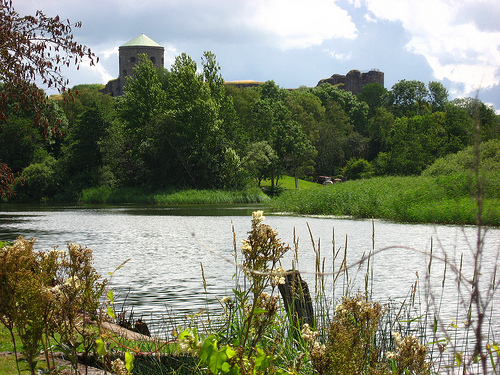
Location: Kungälv, Bohuslän Map
Constructed: 1308
Bohus Fortress (Norwegian: Båhus festning; Swedish: Bohus fästning) is a medieval fortress located in Kungälv, Bohuslän, Sweden, approximately 20 km north of Gothenburg. Situated on a 40-meter-high cliff overlooking the Göta River, where it splits into two branches, the fortress was strategically positioned with the river serving as a natural moat. This location made it a commanding defensive structure near the historic Norwegian-Swedish border. Originally built from granite, brick, and wood, it functioned as Norway's primary stronghold in the region from 1308 until 1658, when it passed to Swedish control. Over its history, it withstood 14 sieges without ever being captured, earning a reputation as one of the strongest fortifications in Scandinavia. Today, it stands as a well-preserved ruin and a popular tourist site.
Initial Construction and Early Development (1308–1450)
The
fortress's construction commenced in 1308 under the orders of King
Haakon V Magnuson of Norway, who reigned from 1299 to 1319. This was
part of a larger defensive strategy that included building other key
fortresses like Akershus in Oslo and Vardøhus in northern Norway. At
the time, Bohuslän was Norwegian territory, and the new structure
was intended to serve as the main defense against Swedish incursions
along the coast, while also acting as the administrative and
military center for the Bohuslän region.
By 1310, the initial
build was complete, utilizing granite and brick, possibly under the
supervision of Count Jacob of Halland. The early design featured a
continuous surrounding wall that was 3 meters thick at the base and
ranged from 8.5 to 13.5 meters in height, adapting to the uneven
terrain. The fortress had a rectangular layout with four rectangular
corner towers. Key internal structures included a brick tower at the
eastern end, a gatehouse with a drawbridge on the west side, the
King's hall, the castle commander's residence, a chapel, a
guardroom, barracks, and a kitchen. For added security, vaulted
positions were carved directly into the mountain, complemented by
strong outer-works. The defendable area was relatively compact—about
250 by 150 meters—allowing it to be held by a small garrison due to
the challenging approaches. This made Bohus Norway's most formidable
fortress during the medieval period.
Upgrades, Sieges, and
Conflicts (1450–1658)
From the mid-15th century onward, Bohus
Fortress underwent significant expansions and faced numerous
military challenges, solidifying its role in Scandinavian power
struggles. It was attacked or besieged 14 times but never fell to an
enemy.
During the Northern Seven Years' War (1563–1570), the
fortress suffered major damage in 1566 when Swedish forces assaulted
and captured the northeastern 'Red Tower.' In a desperate act of
heroism, two Norwegian garrison volunteers detonated the tower's
gunpowder magazine, creating a massive explosion dubbed the "Bohus
Bang." This blast killed hundreds of Swedish soldiers and repelled
the attack. The volunteers' families were rewarded with land grants,
some of which remain in descendants' possession today.
Reconstruction followed under Dutch engineer Hans Paaske, who
reinforced the structure with additional stone and brick.
In
1590, the fortress hosted a notable royal visit from King James VI
of Scotland and Anne of Denmark, who were en route to Oslo. They
gifted the captain, Henrik Gyldenstierne, a ring and gold chain
valued at 3,000 Danish dalers; in return, he presented them with a
firearm and sword.
Further modernization occurred between 1593
and 1604, transforming Bohus into a bastion fortress with new outer
fortifications. This work was overseen by Dutch architect Hans van
Steenwinckel the Elder, renowned for his Renaissance-style designs
in Denmark. Amid ongoing threats from Sweden, additional upgrades
were made in 1651–1652 by another Dutch engineer, Isaac van
Geelkerck. These included two new corner towers on the south façade
and a ring wall around the arsenal building.
The fortress's
Norwegian era ended in 1658 with the Treaty of Roskilde, which
concluded the Second Northern War. Under its terms, Denmark–Norway
ceded several territories to Sweden, including Bohuslän and thus
Bohus Fortress, along with Trøndelag, Scania, Blekinge, and Halland
(the latter permanently, after a 30-year temporary cession from the
Peace of Brömsebro).
Post-Cession and Final Sieges
(1658–1678)
After becoming Swedish property, Bohus lost much of
its frontline strategic importance, as Sweden shifted focus to new
border fortifications like Fredriksten in Halden, New Älvsborg in
Gothenburg, and Carlsten in Marstrand. However, it still faced
threats during the Scanian War.
In 1676, Norwegian forces made an
unsuccessful attempt to recapture the fortress. They returned in
June 1678 under the command of Ulrik Frederik Gyldenløve, laying
siege with a 16,000-strong army against 850 Swedish defenders. The
bombardment was intense: over six weeks, the attackers fired
20–30,000 iron shots, 2,265 chemical or biological bombs, 384
explosive grenades, 384 stone boulders, 161 fire shots, 79
grenade-filled sacks, 600 mortar rounds, and detonated mines under
the outer walls. The siege ended when a Swedish relief force
arrived, but not before heavy casualties—only 400 defenders
survived, with 300 dead and 120 wounded (many suffering
amputations). The fortress was left in ruins, and repairs dragged on
for 50–70 years due to limited funds, focusing only on essential
structures.
Use as a Prison and Decline (Late 17th–18th
Century)
With its military role diminished, Bohus was repurposed
as a prison. One infamous inmate was Thomas Leopold, a radical
pietist accused of heresy, who spent 42 years incarcerated (32 at
Bohus) in a stone-clad cell that still exists today. The fortress
featured grim dungeons, such as the one in the Fars Hatt tower,
which had an iron net floor allowing waste to drop through, creating
a foul stench intended to break prisoners and force confessions.
Confessions led to punishments ranging from fines and public shaming
to dismemberment or execution. Another dungeon in the Sven Hall
tower ran along a sewer exit; it's now barely visible and accessible
only to experts via a small opening.
By the late 18th century,
the fortress was deemed obsolete and unused. Demolition efforts
began, with crews removing dressed stone for two months until funds
ran out. Local residents from Kungälv repurposed much of the
material for their own buildings, contributing to the site's partial
dismantling.
Modern Era and Current Status (19th
Century–Present)
In the 19th and 20th centuries, Bohus
transitioned from a forgotten ruin to a preserved historical site.
Much of the structure remains intact, including the prominent
northern tower known as "Fars Hatt" (Father's Hat). Archaeological
and restoration efforts have highlighted its significance.
As of
2026, Bohus Fortress operates as a museum and tourist attraction,
open primarily during the summer months. Visitors can explore the
ruins, learn about its history through exhibits, and enjoy events on
the site. It attracts those interested in Scandinavian medieval
history, architecture, and military engineering. The fortress's
enduring legacy is as a symbol of resilience, having never been
conquered despite centuries of conflict.
Initial Construction (1308–1310)
Construction began in 1308 under
Norwegian King Haakon V Magnuson (reigned 1299–1319) as part of a
defensive strategy to protect Norway's southern frontier against Sweden.
At the time, the region of Bohuslän was Norwegian territory, and the
fortress was intended to safeguard the coastal approaches and the nearby
town of Kongahälla (modern Kungälv). The initial structure was built
rapidly, with records indicating completion by 1310. Materials primarily
consisted of locally sourced granite for durability and brick for
structural elements, supplemented by wood for internal frameworks and
roofing—typical of medieval Scandinavian fortifications during this era.
The work may have been overseen by Count Jacob of Halland, reflecting
early influences from regional nobility.
The early design emphasized
simplicity and strength, focusing on a basic enclosure rather than
elaborate features. It included a surrounding wall approximately 3
meters thick at the base, designed to withstand sieges. The layout was
roughly rectangular, adapted to the cliff's irregular terrain, with the
river providing additional protection on multiple sides. This phase
represented a standard medieval castle architecture, prioritizing
elevation and natural barriers over advanced artillery defenses.
Medieval Expansion and Fortification (1310–1450)
By the mid-15th
century, Bohus had evolved into a more robust medieval castle. The
surrounding wall was continuous and varied in height from 8.5 to 13.5
meters, contoured to the landscape for optimal defense. It remained 3
meters thick at the base, tapering slightly upward, and was constructed
from granite blocks with brick facing for added resilience against
weathering and attacks. Four rectangular corner towers anchored the
structure, providing elevated positions for archers and surveillance. At
the eastern end, a prominent brick tower served as a key defensive
point, likely housing artillery or serving as a last-resort stronghold.
On the western side, the main entrance featured a gatehouse with a
drawbridge, allowing controlled access across a dry moat or the cliff's
edge. Internal buildings lined the inside of the walls, creating a
self-contained compound. These included:
King's Hall: A central
gathering space for royalty and officials, likely featuring
timber-framed ceilings and stone fireplaces.
Castle Commander's
Residence: Private quarters for the fortress leader, emphasizing comfort
amid the militaristic setting.
Chapel: A small religious structure
for worship, integrated into the walls for protection.
Guardroom,
Barracks, and Kitchen: Functional spaces for soldiers, with the barracks
accommodating a modest garrison and the kitchen supporting extended
sieges.
Secure vaulted chambers were partially excavated into the
cliffside rock, offering storage for supplies, ammunition, and safe
retreats. Outer-works, such as additional earthworks or palisades,
extended defenses beyond the main walls. This configuration made Bohus
Norway's strongest fortress at the time, with difficult approaches
limiting the need for a large force. The architecture blended practical
medieval elements—thick walls for melee defense—with early adaptations
for gunpowder weaponry, though it remained vulnerable to prolonged
artillery barrages.
Reconstruction and Upgrades During Wars
(1563–1604)
Bohus withstood 14 sieges or attacks, primarily by
Swedish forces, without ever falling. A pivotal event occurred during
the Northern Seven Years' War (1563–1570) in 1566, when Swedish troops
captured the northeastern "Red Tower." In a desperate act, two Norwegian
volunteers detonated the tower's powder magazine, creating the infamous
"Bohus Bang"—an explosion that killed hundreds of attackers and damaged
the structure but saved the fortress.
Post-war reconstruction,
directed by Dutch engineer Hans Paaske (Påske), rebuilt the fortress in
stone and brick, significantly reinforcing walls and towers to better
resist cannon fire. From 1593 to 1604, it was transformed into a bastion
fortress (or starfort), incorporating angled bastions for improved
artillery coverage and enfilade fire—a shift from medieval vertical
defenses to Renaissance-era trace italienne principles. This upgrade, an
early project by Dutch architect Hans van Steenwinckel the Elder,
introduced Dutch Renaissance stylistic elements, such as decorative
brickwork and symmetrical layouts, similar to those at Akershus Fortress
in Oslo. A new outer fortification ring enhanced the perimeter, with
sloped earthworks to deflect cannonballs.
Further Modifications
and Peak Fortification (1651–1678)
Ongoing Swedish threats prompted
continued enhancements. Between 1651 and 1652, Dutch engineer Isaac van
Geelkerck oversaw the addition of two corner towers along the southern
façade and a new ring wall encircling the arsenal building, further
bolstering storage and defensive capabilities. These changes emphasized
layered defenses, with the bastions allowing overlapping fields of fire.
In 1678, during the Scanian War, a massive Norwegian-Danish siege
involving 16,000 troops and advanced munitions (including bombs with
chemical and biological elements) nearly destroyed the fortress. The
bombardment left it in ruins, with repairs spanning 50–70 years but
limited by funding, focusing on essential structural integrity rather
than full restoration.
Transition to Swedish Control and Later
Use (1658–1789)
Under the Treaty of Roskilde in 1658, Denmark-Norway
ceded Bohuslän to Sweden, shifting the fortress away from the border. It
lost its frontline role, with Sweden prioritizing other sites like New
Älvsborg and Carlsten. Repurposed as a prison, it housed notable inmates
like the pietist Thomas Leopold, imprisoned for 32 years in a stone-clad
cell that still exists today. Dungeons included grim features, such as
the one in Fars Hatt tower with an iron net floor for waste disposal
(later modified), and a medieval sewer-linked cell in Sven Hall tower.
By the late 18th century, deemed obsolete, demolition began but halted
after two months due to exhausted funds. Local residents repurposed the
stone, leaving the site as ruins.
Modern Preservation
Restoration efforts started in the early 20th century, preserving
remnants like Fars Hatt tower. As a cultural site, it hosts tours,
reenactments, and events, allowing visitors to explore its layered
history.