Location: Borgholm Map
Constructed: 12th century with subsequent improvements
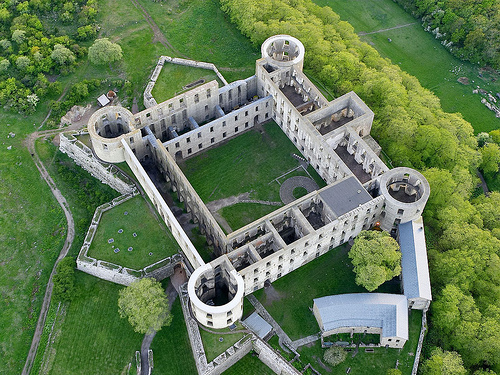
Borgholm Castle, situated in the town of Borgholm on the Swedish island of Öland, overlooks the Kalmar Strait from its position on a limestone plateau. This strategic location has made it a significant site for nearly 900 years, evolving from a medieval fortress to a Renaissance palace and eventually a Baroque ruin. Today, it stands as one of Scandinavia's most impressive castle ruins, managed by the Swedish National Property Board and recognized as a national monument since 1929. The castle's architecture reflects layers of historical development, marked by conflicts, royal ambitions, and eventual abandonment, culminating in its dramatic destruction by fire in 1806.
Origins in the 12th and 13th Centuries
The foundations of Borgholm
Castle date back to the 12th century, during a time of instability in
Northern Europe when Sweden faced threats from pagan tribes and pirates
across the Baltic Sea. Initially built as a defensive fortification, it
consisted of a central keep surrounded by a bailey wall to protect the
sparsely populated coastal regions of Öland. This early structure was
likely commissioned under King Canute I of Sweden (reigned 1167–1195),
who focused on fortifying the east coast against external invasions. By
the 13th century, the keep was strengthened with thicker walls and
additional towers to enhance its defensive capabilities.
The first
documented reference to the castle appears in 1281, in a letter from
King Magnus III (also known as Magnus Ladulås), where it is described as
a "newly built castle" and referred to as "Our Castle." This indicates
its growing importance as a royal stronghold. During this period, the
castle served primarily as a military outpost, reflecting the
architectural style of medieval Scandinavian fortifications with its
circular defense tower on a limestone plateau.
Medieval
Developments and Conflicts (14th–15th Centuries)
In the 1360s, under
increasing military pressures, the castle was rebuilt into a more robust
square stronghold, solidifying its role as one of Sweden's most vital
fortresses. A significant event occurred in 1361 when King Valdemar IV
(Atterdag) of Denmark attacked and damaged the structure during his
campaign against Swedish territories. This assault highlighted the
castle's strategic position in the ongoing power struggles between
Sweden and Denmark.
Throughout the 14th and 15th centuries, Borgholm
endured repeated damage amid the conflicts of the Kalmar Union
(1397–1523), a political alliance that united Denmark, Sweden, and
Norway under a single monarch but often led to internal rebellions and
wars. The castle's fortifications were tested multiple times, with
repairs and modifications made to adapt to evolving warfare tactics.
Renaissance Transformation Under the Vasa Dynasty (16th Century)
By the early 16th century, after Gustav Vasa (Gustav I) dissolved the
Kalmar Union in 1523 and established Swedish independence, Borgholm's
medieval defenses had become obsolete due to the advent of firearms like
cannons. The castle suffered further destruction during the Swedish War
of Liberation.
A major turning point came under King John III
(reigned 1568–1592), who ordered a complete reconstruction starting in
1572. The project, lasting until around 1589 or 1592, transformed the
outdated medieval fortress into a magnificent Renaissance palace. Four
Milanese engineers and architects, known as the Pahr brothers
(Dominicus, Antonius, Franciscus, and Johannes), led the effort,
incorporating Gothic elements and the Italianate bastion style. This
redesign emphasized both defensive features and aesthetic grandeur, with
elaborate facades, bastions, and interior spaces fit for royalty. The
renovation marked Borgholm's shift from a purely military site to a
symbol of royal prestige.
The Kalmar War and Early 17th-Century
Decline (1611–1630s)
The castle's resilience was tested again during
the Kalmar War (1611–1613) between Sweden and Denmark. In 1611, Borgholm
surrendered to Danish forces but was quickly reconquered by the Swedes.
The following year, after a two-week siege led by Danish troops, Swedish
commander Peter Michelsen Hammarskiöld was forced to yield. The Treaty
of Knäred in 1613 returned the castle to Swedish control, but it emerged
severely damaged and in disrepair.
In the 1630s, following the war,
Lord High Chancellor Axel Oxenstierna assessed the site and deemed it
unsuitable as a modern fortress, suggesting it could serve only as a
royal hunting lodge. This period of neglect reflected broader shifts in
military architecture and strategy.
Baroque Era and the Last
Major Reconstruction (1640s–1709)
In the 1640s, Queen Christina
granted the island of Öland, including Borgholm, to her cousin and heir,
Duke Karl Gustav (who became King Charles X Gustav in 1654). He
envisioned the castle as a grand Baroque palace and initiated
construction in 1652 or 1654. The original medieval keep was demolished
in 1653 to make way for the new design, crafted by renowned architect
Nicodemus Tessin the Elder.
Work continued intermittently after
Charles X Gustav's death in 1660, under his successors Charles XI and
Charles XII. The palace, featuring unified Baroque architecture with
ornate wings, halls, and courtyards, was finally completed in 1709,
though never fully realized in its intended splendor. Charles X Gustav
remains the only Swedish king to have used Borgholm as a residence,
underscoring his personal investment in the project.
Decline,
Fire, and Preservation Efforts (18th–19th Centuries)
The 18th century
saw the palace occupied by various figures, including kings, wardens,
farmers, prisoners, and industrialists. In 1803, tenant Axel Adlersparre
established a short-lived dyehouse in the northern wing.
Tragedy
struck on October 14, 1806, when a fire—sparked by masonry work and
fueled by strong winds—engulfed the structure, destroying the roofs,
interiors, and much of the palace. Left as a ruin, the site decayed
further until the mid-19th century, when preservation calls grew. Crown
Prince Oscar (later Oscar II) visited in 1858 and advocated for its
upkeep. In 1860, the first state funds were allocated for maintenance,
including rebuilding windows and gun ports.
By the 1880s, renovations
focused on safety for visitors, with repairs to arches and stairs,
allowing access for tourists from the nearby seaside resort of Borgholm.
Vegetation like trees and shrubs added to its romantic, ruined
aesthetic.
Modern Era and Current Status (20th Century–Present)
Over the last century, extensive renovations have preserved Borgholm as
a cultural heritage site. Managed by the National Property Board of
Sweden, the ruins now host a museum exhibiting its 900-year history
through displays like "Uppgång & Fall" (Rise & Fall). The inner
courtyard serves as a venue for concerts, theater, and events, including
notable performances by Bob Dylan in 2001 and the Swedish pop group
Roxette filming music videos there in 1989.
Today, Borgholm Castle
attracts visitors as a well-preserved ruin of the 17th-century Baroque
palace, offering insights into Sweden's architectural and military past.
It remains a symbol of resilience, blending historical significance with
modern tourism.
Historical Development of the Architecture
The origins of Borgholm
Castle date back to the 12th century, when it was initially constructed
as a simple defensive structure amid regional tensions, including
threats from piracy and conflicts between Sweden and Denmark. The
earliest phase featured a circular defense tower, or keep, surrounded by
a bailey—a fortified enclosure for additional buildings like halls,
workshops, stables, and cattle sheds. This medieval core was built under
royal oversight, likely initiated by King Canute I, with thick walls
designed to withstand sieges. By the 13th century, reinforcements were
added, including new towers and a thicker curtain wall, enhancing its
role as one of Sweden's key eastern defenses.
In the 1360s, following
a destructive attack by Danish King Valdemar IV in 1361, the castle was
rebuilt into a square stronghold. This reconstruction solidified its
status as a royal fortress, incorporating more organized spatial
elements while retaining its defensive focus. The Swedish War of
Liberation in the early 16th century brought further changes; Gustav
Vasa seized control from Danish forces in 1523, though the structure
suffered artillery damage and a fire before being reintegrated into
Swedish holdings by 1525.
A major transformation occurred between
1572 and 1589 under King John III, who enlisted Italian engineers and
architects, the Pahr brothers from Milan, to convert the medieval castle
into a magnificent Renaissance palace. This phase introduced Gothic
influences with Italianate bastions—protruding fortifications for better
artillery defense—marking an exemplary shift toward more aesthetic and
functional design. The layout expanded to include a rectangular inner
courtyard measuring 54 by 54 meters, which facilitated better spatial
organization and expanded living quarters.
The castle endured damage
during the Kalmar War (1611–1613), including a surrender to Danish
forces and subsequent reconquest. Restoration began in 1652 under King
Charles X Gustav, who commissioned architect Nicodemus Tessin the Elder
to redesign it as a grand Baroque palace. This ambitious project,
inspired by French and Italian models, aimed for symmetry and opulence,
with construction lasting until 1709 but never fully completed due to
royal deaths, financial constraints, and the Great Northern War. Key
actions included demolishing the original medieval keep in 1653 to make
way for new elements, though work paused after Charles X's death in 1660
and resumed sporadically under Charles XI and Charles XII.
By the
early 18th century, the castle's strategic importance waned, leading to
abandonment and brief repurposing as a dyehouse and factory. A
devastating fire on October 14, 1806, originating in the north wing's
roof, destroyed wooden interiors and roofs, leaving only the bare
limestone walls. This event sealed its fate as a ruin, though
preservation efforts began in the mid-19th century with state-funded
repairs to windows, gun ports, arches, and stairs. Major conservation
work from 1996 onward, using traditional techniques like on-site lime
mortar production, has stabilized about 2,000 square meters of the site,
earning a 2003 European Heritage Award for accessibility and heritage
protection.
Architectural Styles and Influences
Borgholm
Castle's architecture embodies a progression of styles, each layered
upon the previous. The medieval phase (12th–14th centuries) was purely
defensive, characterized by robust, functional forms like the circular
keep and thick walls, typical of Romanesque fortifications in Northern
Europe. The Renaissance reconstruction under John III blended Gothic
elements—such as pointed arches and vaulted spaces—with Italianate
bastions, emphasizing harmony, proportion, and artillery adaptation,
which was innovative for Swedish architecture at the time.
The
Baroque phase, dominant in the current ruins, introduced grandeur and
theatricality. Designed by Tessin the Elder, it featured symmetrical
facades, a central corps de logis (main building) flanked by wings,
high-ceilinged halls, and ornate details. The bastions were repurposed
from defensive to aesthetic features, with plans for formal gardens that
echoed Versailles-like influences but remained unfinished. This style
symbolized Swedish royal prestige during the 17th century, though its
incomplete state adds to the ruin's poignant aesthetic.
Key
Features and Layout
The castle's layout forms a roughly square
stronghold, approximately 54 by 54 meters in the inner courtyard,
enclosed by massive outer walls and four round corner towers that
provide defensive vantage points and structural stability. The central
courtyard, now grass-covered with modern concrete blocks marking
entrances, reveals the foundations of the 12th-century keep—excavated in
1929—with walls up to 5.5 meters thick. Arched gateways punctuate the
perimeter, allowing access through the fortifications, while partially
restored staircases lead to upper levels and vaulted chambers offering
panoramic views over the surrounding landscape.
Fortifications
include large bastions, originally for artillery but later aesthetic in
the Baroque design, and a moat that enhanced defensibility. The western
facade's limestone walls rise dramatically to 30 meters, dominating the
site. Hidden features, uncovered by ground-penetrating radar (GPR)
surveys from 2005–2008, include a 12th–13th-century defense wall running
parallel to the courtyard, a possible gate building near the entrance,
and a Renaissance-era cellar in the northeast court with stone walls and
staircase remnants. A rectangular structure (10.5 by 5.8 meters) in the
western courtyard suggests an older building phase, oriented differently
from the main layout, indicating evolving construction priorities.
Interiors, largely lost to the 1806 fire, are now exposed skeletal
spaces without roofs, revealing intricate room divisions, vaulted
ceilings, and remnants of high-status halls. The Baroque plans included
opulent living quarters, but only foundations and lower levels survive,
such as the cellar excavated briefly in 2008, which showed no dateable
artifacts but confirmed multi-phase use.