Location: Kalmar, Småland Map
Constructed: 12th- 16th century
Phone: 46 480 451490
Giftshop: 46
480 451491
Fax: 46 480 451499
The Letter of Union (July 20th, 1397)
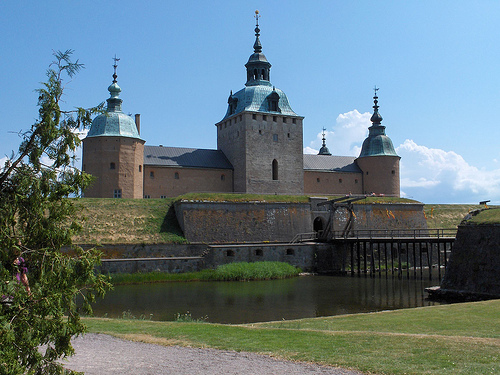
Kalmar Castle, located in the city of Kalmar in the province of Småland, Sweden, is one of the country's best-preserved Renaissance castles, with a history spanning over 800 years. Originally constructed as a defensive structure on the strategic Kalmarsund strait, its architecture has evolved from a simple medieval tower into a grand Renaissance palace through successive expansions, renovations, and restorations. The castle's design reflects influences from medieval fortification principles, Renaissance aesthetics imported from continental Europe, and 19th-20th century romantic restorations. Today, it features imposing walls, towers, a moat, and luxurious interiors, serving as a museum and cultural site that showcases Sweden's royal and military past.
Origins and Medieval Period (12th-14th Centuries)
Kalmar
Castle, located in the city of Kalmar in southeastern Sweden, has a
history spanning over 800 years, beginning as a strategic defensive
structure in a volatile border region. The earliest construction
dates back to around 1180, when a single fortified defense tower was
erected on an islet overlooking the Kalmar Strait to protect against
pirate raids and potential invasions from the sea, particularly from
the powerful Hanseatic League, a confederation of merchant guilds
dominating Baltic trade. By the early 1200s, as Kalmar grew into an
established city and trading hub, the site expanded. Under King
Magnus III (also known as Magnus Ladulås) in the latter half of the
13th century, the tower was fortified further with additional
towers, a curtain wall, and moats, transforming it into a more
robust medieval fortress. This development was crucial because
Kalmar's location made it "the key to the kingdom," guarding
Sweden's southern frontier—especially significant as the Danish
border lay just south of the city until the mid-17th century, with
regions like Scania and Blekinge under Danish control.
The
castle's early role was primarily military, serving as a bulwark
against external threats. It endured its first major tests during
the turbulent medieval era, including conflicts with Denmark and
internal power struggles among Swedish nobility. By the 14th
century, it had become a symbol of royal authority and a center for
regional administration.
The Kalmar Union and Late Medieval
Significance (1397-1520s)
Arguably the most pivotal event in the
castle's history occurred in 1397, when Queen Margaret I of Denmark
orchestrated the signing of the Kalmar Union treaty within its
walls. This union united Denmark, Norway (including its territories
like Iceland, Greenland, and the Faroe Islands), and Sweden
(including Finland) under a single monarch, creating a vast
Scandinavian realm intended to counter the economic dominance of the
Hanseatic League and stabilize the region. Margaret, a shrewd
diplomat and regent, hosted nobles and representatives from the
three kingdoms at the castle for negotiations, leading to the formal
agreement on July 13, 1397. The union emphasized a common foreign
policy and monarchy while allowing each country internal autonomy,
though tensions arose over Danish dominance.
Throughout the 15th
century, Kalmar Castle remained a key venue for union meetings and a
flashpoint in the ongoing power struggles. It withstood numerous
sieges—reportedly 22 in total—without ever being captured by
enemies, underscoring its formidable defenses. A notable episode
came during the Swedish War of Liberation in 1520, when the castle
was defended by Anna Eriksdotter (Bielke), widow of a Swedish noble,
who took command after her husband's death and held off Danish
forces amid the rebellion against Danish rule. The union began to
unravel in the early 16th century, formally dissolving with the
coronation of Gustav Vasa as King of Sweden in 1523, marking
Sweden's independence.
Renaissance Transformation and Vasa
Era (1520s-1600s)
The 16th century marked a golden age for Kalmar
Castle under the House of Vasa, Sweden's ruling dynasty. King Gustav
I (Gustav Vasa), who ascended the throne in 1523, initiated major
expansions and fortifications, recognizing the castle's strategic
importance in securing his new kingdom. His sons, Erik XIV (r.
1560–1568) and Johan III (r. 1568–1592), continued this work,
transforming the medieval fortress into a lavish Renaissance palace.
They imported architects, artists, and craftsmen from Italy,
Germany, and the Netherlands to modernize the structure, adding
ornate interiors, grand halls, and decorative elements like
frescoes, stucco work, and intricate wood carvings.
Johan III, in
particular, oversaw extensive renovations starting shortly after his
coronation, including the addition of bastions for artillery defense
and luxurious royal apartments. The castle served as a royal
residence during times of crisis; for instance, in 1571, amid a
bubonic plague outbreak in Stockholm, Johan III relocated his court,
including his wife Queen Catherine Jagiellon and son (future King
Sigismund), to Kalmar for safety. This period also saw the castle
host court intrigues, banquets, and diplomatic events, blending its
military function with royal splendor.
The Vasa renovations gave
the castle its current appearance, with four corner towers, a
central courtyard, and elements like the Golden Hall and Queen's
Chamber reflecting Renaissance aesthetics. Architect Nicodemus
Tessin the Elder contributed to later designs in the 17th century,
further enhancing its grandeur.
Decline and Modern Era (17th
Century-Present)
By the mid-17th century, following the Treaty of
Roskilde in 1658, Sweden acquired Scania and Blekinge from Denmark,
shifting the border southward and diminishing Kalmar Castle's
strategic military role. It transitioned from a frontline fortress
to a more administrative and occasional royal site. Over time, it
fell into disrepair, serving variously as a prison, granary, and
distillery in the 18th and 19th centuries.
Restoration efforts
began in the late 19th century, led by architect Fredrik
Lilljekvist, who aimed to preserve its Renaissance features while
making it accessible as a museum. Today, Kalmar Castle stands as one
of Sweden's best-preserved Renaissance castles and a major cultural
landmark, managed by the Swedish National Heritage Board. It
attracts visitors with exhibitions on its history, including the
Kalmar Union, Vasa renovations, and artifacts from sieges. The
castle hosts events like medieval reenactments, concerts, and
weddings, symbolizing Sweden's medieval power and resilience.
Origins and Medieval Architecture (12th-13th Centuries)
The
architectural foundations of Kalmar Castle date back to around 1180,
when a single round defensive tower was erected on an islet to protect
the emerging trading hub of Kalmar from pirates and invaders. This
initial structure was modest, focused on fortification rather than
grandeur, and included a nearby harbor for strategic control over the
Baltic Sea routes. By the early 1200s, Kalmar had grown into a
formalized city, and the tower served as the core of what would become a
major stronghold.
Significant expansion occurred in the late 13th
century under King Magnus III Ladulås (also known as Magnus Ladulås),
who transformed the site into a full-fledged fortress. This phase
introduced a curtain wall encircling the original tower, along with
round corner towers for enhanced defense and two square gatehouses—one
serving as the main entrance (known as the Guard Tower). The layout was
rectangular or square in plan, with massive stone walls and flanking
towers dividing the site into an outer and inner bailey. At the time,
this made Kalmar Castle one of Sweden's most advanced fortifications,
strategically positioned near the Danish border (as southern regions
like Scania and Blekinge were Danish until 1658). The design emphasized
military functionality, with high walls for archers, a wide moat for
added protection, and a drawbridge over the water surrounding the islet.
Elements like a dungeon and secret passages were incorporated, adding to
its defensive mystique.
Renaissance Transformations (16th
Century)
The most dramatic architectural evolution occurred during
the 16th century under the Vasa dynasty, particularly Kings Gustav I (r.
1523–1560), Erik XIV (r. 1560–1568), and Johan III (r. 1568–1592), who
sought to modernize the medieval fortress into a Renaissance palace
befitting a European monarch. This shift was influenced by continental
trends, with Erik XIV and Johan III hiring artists, architects, and
carpenters from across Europe to infuse the structure with elegance and
sophistication.
Gustav I initiated the changes, but it was Johan III
who launched an extensive reconstruction program almost immediately
after his coronation in 1568. In 1574, architect Domenicus Pahr (likely
of Italian or German origin) took charge, focusing on harmonizing the
exterior. All towers except three—the southeastern, northeastern, and
"Kuretornet" (Curator's Tower)—were adjusted to a uniform height, with
their roofs clad in lead for durability and aesthetic appeal. Windows
were reshaped into squares, replacing narrower medieval slits, and the
overall roofing was converted to a gable style covered in clay tiles.
The facade was painted white, while the roofs were rendered in red,
creating a striking contrast that remains a hallmark of the castle's
appearance. Massive bastions were added at the corners for artillery
defense, and a new gatehouse was positioned at the rear, fronting a
widened moat. This blended military robustness with residential grace,
as the inner courtyard was fully integrated into the design without a
traditional keep, allowing for open, light-filled spaces.
The
exterior now featured fairy-tale-like turrets and stout watchtowers,
anchored in a lush park setting, while the overall form took on a more
symmetrical, palatial silhouette. These changes not only enhanced
defensibility—evident during sieges like the 1599 rebellion and the
1611–1613 Kalmar War—but also symbolized royal power.
Interior
Features and Decorations
Internally, the Renaissance renovations from
1587 onward remodeled key spaces to emphasize luxury and artistry.
Notable rooms include:
Gamla Kungamaket (Old Throne Room): One of
the earliest renovated halls, featuring period furnishings and
decorations.
Rutsalen (Chequer Hall) and Grå Salen (Grey Hall): These
were updated with intricate paneling and motifs, blending functionality
with aesthetic appeal.
Nya Kungamaket (New Throne Hall): A highlight,
adorned with 2,200 gold-painted leaves on the ceiling and walls,
creating a opulent, regal atmosphere.
King’s Chamber: Contains a
1560s marquetry panel depicting the castle itself, offering a historical
snapshot of its mid-renovation state.
Golden Hall: Boasts a
well-preserved 16th-century coffered ceiling with original colors and
paintwork, exemplifying European craftsmanship.
Castle Chapel: A
serene space with Renaissance detailing, including ornate woodwork.
Queen’s Chamber: Reflects domestic royal life, with elegant furnishings
and views over the grounds.
The interiors are characterized by
light, luxurious finishes, fine carvings, painted woods, and inlaid
details, transforming the once-austere fortress into a residence
suitable for courtly life. Legends add intrigue, such as the engraved
face of traitor Krister Some on a courtyard staircase.
Decline,
Restoration, and Current State
After the 1658 Treaty of Roskilde
shifted borders southward, reducing its military role, the castle fell
into disrepair. It suffered damage from a 1642 fire and was repurposed
as a prison, distillery, and granary. Restoration began in the mid-19th
century amid national romanticism, led by architects like Fredrik
Wilhelm Scholander (1856), Helgo Zettervall (1880s), and Carl Möller
(1885–1891), who rebuilt lost elements to restore the Renaissance
silhouette. From 1919 to 1941, Professor Martin Olsson reconstructed the
earthworks, moat, bridge, and drawbridge, re-surrounding the castle with
water.
In its current form, Kalmar Castle stands as a majestic,
moated structure with imposing walls, uniform towers (mostly
lead-roofed), a white facade, red roofs, and a blend of medieval and
Renaissance elements. It includes bastions for defense, a main entrance
with courtyard stairs, and sea-facing views. Open to the public, it
offers guided tours, exhibits on its history (including interactive
touch screens with multilingual content), and spaces for events like
weddings. The architecture not only preserves Sweden's turbulent
past—marked by unions, wars, and royal intrigues—but also exemplifies
the transition from fortification to palatial splendor.