Location: 28 km North-west Olomouc, Moravia Map
Constructed: 1317
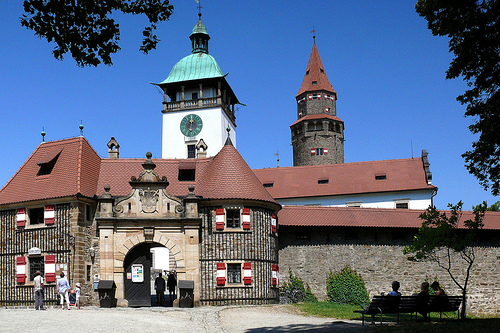
Bouzov Castle (Hrad Bouzov) is a striking hilltop fortress in the Olomouc Region of Moravia, Czech Republic, perched above the village of Bouzov roughly 28 km northwest of Olomouc. It guards a historic trade route between Olomouc and Loštice. While its origins trace back to the late 13th/early 14th century as a modest defensive outpost, its present-day fairy-tale appearance—complete with soaring towers, red-tiled roofs, ornate gables, and romantic Neo-Gothic flourishes—dates almost entirely from a lavish reconstruction between 1895 and 1910. Today, it ranks among the Czech Republic’s most visited and photogenic castles, famous as a filming location for fairy-tale movies, yet its 700-year history reflects shifting roles from medieval border watchtower to Hussite stronghold, aristocratic residence, near-ruin, and finally a luxurious Teutonic Order seat.
Medieval Origins and Early Owners (Late 13th–15th Centuries)
The
castle was first mentioned in written records in 1317. It was built in
the second half of the 14th century (some traditions place initial
construction slightly earlier) primarily to protect and oversee the
vital medieval trade route through the Třebůvka valley. The earliest
known owners were the minor noble Bůz of Bludovec family (1317–1339),
from whom the castle and nearby village took their name. At this stage,
it was a simple early-Gothic structure: likely just a central tower,
basic ramparts, and wooden dwellings focused on defense rather than
comfort.
Ownership soon passed to more powerful families, notably the
Lords of Kunštát, who became the most important medieval proprietors.
Local tradition (not universally confirmed by historians) claims that
the future King of Bohemia George of Poděbrady (Jiří z Kunštátu a
Poděbrad) was born here in 1420; he later used the title “of Kunštát and
Bouzov” before his coronation in 1458. In 1408 the property came into
the hands of Viktorin of Bouzov. By the early 15th century, during the
Hussite Wars era, Bouzov was strengthened and converted into a Hussite
stronghold.
Fortifications evolved rapidly. In the 14th century the
castle was enlarged with an outer settlement, ditch, ramparts, a massive
~61-metre (200 ft) watchtower, and a moat wall. Under the Kunštát lords,
new ramparts with two bastions were added, the moat wall received five
round bastions, and a round gun bastion was built for artillery defense.
In 1499 the Haugwitz family began constructing a palace on the eastern
side and linking the northern and southern residential wings, shifting
the castle toward a more residential Renaissance character.
Fires, Wars, and Decline (16th–17th Centuries)
The castle suffered
repeated setbacks. A major fire in 1558 destroyed much of its majesty.
Another blaze in the second half of the 16th century left large sections
uninhabited for decades. During the Thirty Years’ War it served as a
prison for captured Swedish soldiers. Ownership changed frequently among
the lords of Vildenberk, Margrave Jobst of Moravia, the Haugwitz, and
the Podstatzky families. By this point defensive functions had largely
ended, and the structure was gradually converted into a dwelling. A
late-17th-century remodeling of the southern wing marked the transition
to purely residential use.
Teutonic Order Ownership Begins (1696
Onward)
A pivotal turning point came in 1696 when the barony was
purchased by Franz Ludwig von Pfalz-Neuburg (also Bishop of Wrocław),
Grand Master of the Teutonic Order. The Order would hold Bouzov (with
some interruptions) until the early 20th century. During the 18th
century the castle lost even its residential function for the main
complex; only the outer settlement remained inhabited. By the late 19th
century the core had become a picturesque ruin and a popular tourist
destination.
The Great Romantic Reconstruction (1895–1910)
The
castle’s defining transformation occurred under Archduke Eugen of
Austria, Grand Master of the Teutonic Order (1894–1923). He personally
funded and oversaw a complete Neo-Gothic rebuilding inspired by
late-Gothic and early-Renaissance architecture of Germany and the
Netherlands. The prominent Munich architect Georg von Hauberrisser
(designer of Munich and Saarbrücken town halls and St. Paul’s Church in
Munich) drew up the plans. Between 1895 and 1910 the near-ruin was
reborn as a luxurious summer residence with modern conveniences: running
water, central heating, and richly decorated interiors. Parts of the
castle were deliberately opened to the public from the outset.
The
result is the fairy-tale Bouzov we see today. Highlights of the new
interiors include:
The magnificent Neo-Gothic chapel with a
Gothic altar and tombstones of Teutonic Order masters (1395–1515).
The armoury (housed in the original Gothic hall) displaying historic
weapons.
The knights’ hall, chapter hall, grandmaster’s apartments,
hunting hall, and ornate guest rooms with carved wood, murals,
chandeliers, and period furnishings.
20th Century to the Present
The Teutonic Order’s ownership ended abruptly in 1939 when the Order was
abolished and the castle confiscated by Nazi authorities. It was
occupied and looted during World War II; Gestapo chief Reinhard Himmler
reportedly forced the Strahov Monastery to sell it for one million
crowns as a “gift” to Adolf Hitler. After the war, a 1945 decree by
President Edvard Beneš nationalized the property. It has remained in
state hands ever since and is administered by the National Heritage
Institute. Following the 1989 Velvet Revolution the Teutonic Order
requested restitution, but the claim was rejected.
Today Bouzov
Castle is a protected national cultural monument and one of Moravia’s
top tourist attractions. Guided tours (including grand tours of the
representative rooms, winter tours, and special themed visits) showcase
its opulent interiors. Its romantic silhouette and film-friendly setting
continue to draw visitors and filmmakers alike, preserving its legacy as
both a medieval sentinel and a 20th-century Neo-Gothic dream.
The earliest structure was a modest early-Gothic castle with a
central tower, ramparts, and wooden buildings. Over the centuries,
ownership by various noble families (Vildenberks, Kunštáts, Haugwitzes,
and others) transformed it: the Vildenberks added a stone manor and
expanded the settlement with a 61-metre watchtower, moat, and
circumvallation; later owners added Renaissance residential wings,
bastions, and a palace on the eastern side. A fire in 1558 left it
ruined, and by the 19th century it had become a picturesque but
dilapidated ruin.
The decisive transformation came when Archduke
Eugen of Austria (Grand Master of the Teutonic Knights, 1894–1923)
commissioned Munich architect Georg von Hauberrisser (designer of
Munich’s town hall and St. Paul’s Church) to rebuild it as a romantic
residence. Between 1895 and 1910, Hauberrisser created a Neo-Gothic
fantasy inspired by late-Gothic and early-Renaissance architecture of
Germany and the Netherlands. The result blends preserved medieval
fragments with ornate 19th-century Romantic elements, modern comforts
(running water, central heating), and a deliberately “knightly”
aesthetic. Since 1945 the castle has been state property and was
declared a national cultural monument in 1999.
Overall Layout and
Exterior Architecture
The complex is arranged in a distinctive
horseshoe shape around a central eight-storey watchtower that rises 58
metres (190 ft) and dominates the skyline. This layout follows the
medieval core but was dramatically enhanced during the Neo-Gothic
rebuild. The entire structure sits on a hilltop and is encircled by a
deep dry moat crossed by two long stone bridges that end in a short,
still-functional drawbridge and a working portcullis (demonstrated on
special occasions).
Key exterior features include:
Red-tiled
roofs with steep gables and numerous turrets and chimneys.
Battlemented walls, oriel windows, loopholes, and Gothic lattice
windows.
An arcaded loggia and helical staircase inside an octagonal
tower.
Dragon-head gargoyles, a sundial on the courtyard façade, and
heraldic carvings (including the Teutonic Knights’ crest on the second
gate).
Stone façades in warm beige and grey tones, with some sections
whitewashed.
The result is the archetypal Central-European castle
of fairy tales—pointed turrets, dramatic silhouettes against the
Moravian countryside, and an almost theatrical romanticism.
Interior Architecture and Key Rooms
The interiors are richly layered:
some original Gothic elements survive (especially in the armoury), while
most spaces were redesigned in the late 19th/early 20th century with a
mix of Neo-Gothic, Renaissance-revival, and Baroque-revival details. The
castle is fully furnished with period pieces, Teutonic Knights’
collections, and custom-made furniture.
Armoury — One of the few
rooms retaining its original medieval character, featuring authentic
Gothic ribbed vaulting. It houses weapons, shields, an executioner’s
sword (1677), and painted shooting targets.
Neo-Gothic Chapel — A
highlight of the reconstruction, with a 15th-century German late-Gothic
altar, six tombstones of early Grand Masters (1395–1515), stone reliefs,
and a marble Renaissance statue of St. George at the entrance. The space
feels both medieval and romantically theatrical.
Knights’ Hall
(Rytířský sál) — The ceremonial heart of the castle. It features a grand
Neo-Gothic fireplace, a Renaissance coffered ceiling, exquisite wall
paintings (including St. George slaying the dragon and the myth of
Actaeon and Diana), coats of arms of all Teutonic Grand Masters, and
large stained-glass windows. Large Nuremberg-style chandeliers (one
weighing over 300 kg and holding 48 candles) hang from the ornate wooden
ceiling.
Grand Master’s Bedroom and Private Apartments —
Baroque-revival splendour with exquisitely carved wooden closets and
chairs, a tiled stove decorated with Renaissance figures, and a copy of
Rembrandt’s self-portrait.
Other notable spaces include the Hunting
Hall (with similar mythological murals), Court Hall (with a floor hatch
leading to the dungeon), bay windows, staircase halls, and guest
rooms—all unified by the Romantic Neo-Gothic aesthetic of carved wood,
painted walls, heraldic motifs, and Gothic-revival tracery.
The
guided tours (the longest “Grand Tour” covers representative and
residential areas) allow visitors to experience how the 1895–1910
reconstruction created a cohesive “knightly residence” while respecting
the medieval footprint.
About Ondřej the Bear (1959, director: Jaroslav Mach)
Daisies for
the Lady of the Castle (1981, directed by Josef Pinkava)
Restored
beauty
The Third Judge (1986, director: Vojtěch Štursa)
War of the
Oxen
About Princess Jasněnka and the Flying Shoemaker (1987,
director: Zdeněk Troška)
About Jan and a Wonderful Friend (1990,
director: Ludvík Ráža)
Golden Rose Cave
Princess Fantaghiró (1991,
directed by Lamberto Bava)
Dance for God
Young Indiana Jones
Azrael, the angel of death
Arabela Returns or Rumburak the King of
the Fairytale Kingdom (1993, directed by Václav Vorlíček)
Ten
Centuries of Architecture (1997)
Rumplcimprcampr (1997, director:
Zdeněk Zelenka)
Cruel Lake
About the treasure of Anežka Česká
Half (2004, Dir: Dennis Gansel)
The blood of the missing
In the
footsteps
Hotzenplotz Robber
The Kingdom of Streams (2005,
director: Pavel Jandourek)
Cottage is a game
Boys in action
Behind the school
The Three Musketeers
Twelve moons (2012–2013,
director: Karel Janák)
Adventures (2016)
Where the princesses
lived (Czech TV documentary, 2010, director: Jakub Wehrenberg)
About
the cursed king and brave Martin (2018, director: Peter Bebjak)
Princess and Half a Kingdom (2019, director: Karel Janák)
Princess
Enchanted in Time (2020, director: Petr Kubík)
Princess Enchanted in
Time 2 (2022, director: Petr Kubík)