Location: 25 km (16 mi) Southwest of Prague
Tel. 311 68 16 95
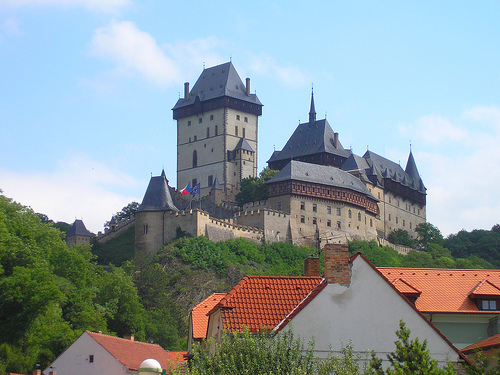
Karlštejn Castle (Czech: Hrad Karlštejn; German: Burg Karlstein) is a
prominent Gothic castle in the Czech Republic, located about 30 km (19
mi) southwest of Prague in the market town of Karlštejn, Central
Bohemian Region. It sits dramatically on a promontory of Kněží Hora hill
overlooking the Berounka River.
Founded in 1348 by Charles IV (Karel
IV), King of Bohemia and later Holy Roman Emperor, it served as a secure
repository for the Imperial Regalia (crown jewels of the Holy Roman
Empire), the Bohemian crown jewels, extensive collections of holy
relics, and important royal archives and documents. It also functioned
as a private royal residence and a symbol of Charles IV’s power,
elevating Bohemia as a cultural and political center of Central Europe.
Founding and Construction (1348–1365)
Charles IV laid the
foundation in 1348, the same year he founded Charles University in
Prague and expanded other major projects. The castle was designed not
only as a fortress but as a sacred treasury and stately home.
Construction was personally supervised by Charles IV, who took a deep
interest in the details, especially the chapels and interiors. The works
were directed on-site by figures like Vitus of Bítov (later burgrave),
though the primary architect remains unknown. Some speculate involvement
of Matthias of Arras (architect of St. Vitus Cathedral), but he died in
1352.
Key phases: The Well Tower was built first for water
supply. Miners from Kutná Hora dug a deep well (over 70 meters) but
found no water, so a secret underground channel from a nearby stream was
created (a state secret; legend claims the miners were eliminated
afterward).
Charles IV first stayed at the castle in 1355, overseeing
ongoing work.
Construction culminated in 1365 with the consecration
of the Chapel of the Holy Cross in the massive Great Tower (about 60
meters high, with walls 4–7.5 meters thick). This chapel, with no direct
parallels elsewhere, featured exceptional security (multiple doors and
locks) and housed the most precious treasures. It includes a renowned
cycle of 129 panel paintings by Master Theodoric (one of the largest
surviving sets of medieval panel paintings).
The castle’s layout
reflects hierarchical importance across terraced levels: the lower
Imperial Palace (with Knight’s Hall, royal apartments, etc.), Marian
Tower, and the dominant Great Tower at the highest point. It
incorporated advanced fortifications, drawbridges, and strategic design
making it extremely difficult to capture.
Role as Royal Treasury
and Residence (14th–15th Centuries)
Karlštejn primarily served as a
secure vault rather than a primary residence after Charles IV’s time. It
housed the Imperial Crown Jewels and relics until the Hussite Wars.
Charles IV and his son Wenceslas IV (Václav IV) used it as a
representative residence until around 1419.
During the Hussite Wars
(starting 1419), the treasures faced significant threats:
In
1421, the Imperial Regalia were evacuated to Nuremberg via Hungary for
safety.
In 1422, Hussite forces under leaders like Jan Žižka (or
associated forces including Prince Sigismund Korybut) besieged the
castle for about seven months. Attackers reportedly used early
biological warfare tactics, catapulting dead bodies and thousands of
cartloads of dung to spread disease. Despite this and other assaults,
the castle—particularly the inner fortifications and Great Tower—held
firm and was never fully captured.
After the wars, Bohemian crown
jewels returned (around 1436) and remained in the Chapel of the Holy
Cross for nearly two centuries (with interruptions).
Later
History, Reconstructions, and Decline (16th–19th Centuries)
The
castle underwent stylistic changes:
Late Gothic reconstruction after
1480.
Renaissance adaptations in the late 16th century (including
repairs after a 1487 fire in the Big Tower).
In the Thirty Years’
War era:
In 1619, during Bohemian Revolt events, the crown jewels and
archives were moved to Prague.
The castle passed to Ferdinand II,
Holy Roman Emperor, in 1620.
It was conquered by Swedish forces in
1648 and subsequently fell into disrepair.
By the 18th–19th
centuries, it had lost much of its strategic and symbolic importance. A
major Gothic Revival (purist) reconstruction by architect Josef Mocker
from 1887 to 1899 restored and reshaped it into its present romantic
neo-Gothic appearance, emphasizing medieval authenticity.
In 1902,
industrialist Wilhelm von Medinger purchased the castle and estate from
a previous owner. It remained under state or royal control overall and
never passed into ordinary private hands for long.
Modern Era and
Significance
Today, Karlštejn is one of the Czech Republic’s most
visited castles (over 200,000 visitors annually pre-2020s data) and a
major tourist attraction. It is managed by the National Heritage
Institute and open to the public with guided tours. Highlights include
the Chapel of the Holy Cross (limited access, often requiring advance
booking), original 14th-century decorations, the portrait gallery of
Bohemian kings, a replica of the Bohemian Crown, and the unique well
system.
It has inspired culture, notably Jaroslav Vrchlický’s comedy
A Night at Karlštejn Castle. Recent renovations have opened more spaces
for visitors.
Karlštejn Castle (Hrad Karlštejn) is a iconic 14th-century Gothic
fortress in the Czech Republic, about 30 km southwest of Prague, perched
dramatically on a rocky spur above the Berounka River in the Bohemian
Karst landscape.
Built primarily between 1348 and 1365 by Holy Roman
Emperor Charles IV (King of Bohemia) as a secure repository for the
Imperial Regalia, Bohemian crown jewels, state archives, and a vast
collection of holy relics, it also served as a private royal residence.
Its architecture masterfully blends defensive strength with symbolic
hierarchy and spiritual significance.
Overall Layout and
Structure
The castle is ingeniously arranged on three ascending rocky
terraces, reflecting a deliberate gradation of importance—from
secular/administrative functions at the base to the most sacred and
secure spaces at the pinnacle. This stepped design enhances both
defensibility and visual drama.
Outer fortifications and lower areas:
Include multiple gates (up to seven in the full defensive system), a
moat, the Burgrave’s Palace (administrative center), and a deep well
tower (an 80-meter-deep pit with a treadwheel mechanism for water).
These provide layered defenses.
Core inner castle: Features the
Imperial Palace on the lowest terrace, the Marian Tower above it, and
the dominant Great Tower at the highest point. Massive walls, some up to
4–7.5 meters (13–25 ft) thick in the Great Tower and around 30 feet in
places elsewhere, underscore its fortress role.
Imperial Palace
On the lowest main terrace, this is a single-tract rectangular building,
roughly 12.5 m wide by 46 m long, with a semi-cylindrical tower on the
east end. It includes:
A rock-hewn cellar.
Ground floor (partly
open to the courtyard, used for granary/storage).
Two solid upper
floors plus a half-timbered third floor under the roof.
Interior
layout (typical of Bohemian palace design of the era):
First floor:
Three rooms, dominated by the large central Knight’s Hall.
Second
floor: Emperor’s private apartments (four rooms divided by partitions),
with bedrooms on the east, a stateroom, hall, and western chambers. A
spiral staircase connects levels.
Third floor: Reportedly for the
empress and her retinue, with similar room arrangements.
It features
Gothic elements like pointed arches and served as the administrative and
residential heart for daily operations and court life.
Marian
Tower (Church Tower)
Rising above the Imperial Palace, this tower
houses key religious spaces and served spiritual and somewhat
residential functions.
Chapel of the Virgin Mary (Church of Our
Lady): A major space with Gothic ribbed vaults and rich decoration.
Chapel of St. Catherine: Charles IV’s private oratory (later
rededicated), known for its exquisite Gothic details, including walls
and vaults adorned with semi-precious stones, gilding, frescoes, and a
decorative arched ceiling. It exemplifies lavish medieval craftsmanship.
Great Tower (Big Tower)
The architectural and symbolic climax— a
massive, separately fortified rectangular structure about 60 meters (200
ft) high, with exceptionally thick walls (4–7.5 m). It has limited entry
points for maximum security and stands as a "tall pillar" designed to
withstand sieges.
Chapel of the Holy Cross (consecrated 1365):
Located centrally on an upper floor, this is the castle’s most sacred
and unique space, with no direct analogies elsewhere. It features:
Two bays of rib vaulting.
Heavily secured with multiple doors and
complex locking systems (originally 19 locks, keys held independently).
Repository for the Imperial Regalia, Czech Crown Jewels, relics, and
archives.
Opulent decoration: Gilded elements, glass lenses in the
vault imitating the starry sky, and a world-famous collection of 129
panel paintings by Master Theodoric (depicting saints, angels, and
prophets)—one of the largest and most valuable surviving medieval
portrait galleries.
Access is via a staircase from the Marian Tower’s
second floor, emphasizing its exclusivity.
Architectural Style
and Evolution
Primary style: High Gothic—pointed arches, ribbed
vaults, slender columns, spires, intricate arches, and fortified towers.
It blends defensive Romanesque-like massiveness with Gothic elegance.
Later modifications: Late Gothic rebuilds after 1480; Renaissance
influences in the late 16th century (ornate interiors, decorative
facades); significant 19th-century purist restoration by architect Josef
Mocker, which restored and enhanced its Gothic appearance (giving it the
current romanticized look).
Exterior details often feature white
walls contrasting with dark roofs, battlements, and prominent towers.
Karlštejn Castle (Hrad Karlštejn) is one of the Czech Republic’s most
iconic and visually stunning medieval fortresses, located about 30 km
(19 miles) southwest of Prague in the Beroun District. Built in the 14th
century, it sits dramatically atop a rocky spur overlooking the Berounka
River valley in the protected Český kras landscape. It’s a classic and
highly recommended day trip from Prague, especially popular with history
buffs, architecture enthusiasts, and photographers.
Brief History
Holy Roman Emperor and King of Bohemia Charles IV founded the castle in
1348 primarily as a secure repository for the imperial crown jewels,
royal treasures, holy relics, and state archives. Construction was
largely completed by 1365. The castle’s design emphasized defense and
sanctity—the most sacred areas, like the Chapel of the Holy Cross in the
Great Tower, were accessible only to a very few, with Charles IV
reportedly entering barefoot.
It withstood sieges (including a
seven-month Hussite siege in 1422) but later declined. Major
19th-century restorations under architect Josef Mocker returned it to a
purist Gothic appearance. Today, it is a state-owned national monument
managed by the National Heritage Institute.
What to Expect and
What to See
The castle complex includes the Imperial Palace, Marian
Tower, Great Tower, Burgrave’s Palace, and defensive structures.
Interiors feature period furnishings, Gothic architecture, frescoes, and
chapels. Key highlights on tours:
Basic Tour (Imperial Residence of
Charles IV): Covers the 1st and 2nd floors of the Imperial Palace and
parts of the Marian Tower (Courtiers’ Hall, Knights’ Hall with St.
Nicholas Chapel, etc.). Lasts ~55 minutes. Focuses on 14th–19th century
furnishings and daily life of the era.
Chapels Tour (Exclusive):
Includes the Church of the Virgin Mary, St. Catherine’s Chapel
(gold-covered with precious stones and frescoes), and the breathtaking
Chapel of the Holy Cross in the Great Tower (with 129 medieval panel
paintings by Master Theoderic). This is widely considered the highlight
for its opulence and spiritual significance.
Special “Explore Entire
Castle” Tour: Extended small-group visit (up to 6 people) covering
nearly everything, including upper levels usually closed to the public.
Lasts ~3 hours and is quite expensive.
Note: All interior visits are
guided tours only—no self-guided access. Photography is often restricted
inside.
Exterior views, courtyards, and surrounding landscapes are
spectacular and free to enjoy (you can walk around the grounds without a
ticket in many areas).
Opening Hours (2026, subject to change)
Closed on Mondays most of the year. Guided tours only; last tour starts
at closing time. Check the official site for exacts.
Peak summer
(July–August): Tue–Sun ~9:00–18:00.
Shoulder (April–June, September):
~9:30–17:00/17:30.
October: Shorter days.
Winter (limited): Open
select days; closed Dec–Feb or very restricted.
Always verify on the
official website: hrad-karlstejn.cz/en.
Tickets and Tours
Basic tour: ~260–300 CZK adults (reduced for students/seniors/children).
Chapels tour: ~500–640 CZK.
Full/special tours: Significantly higher
(e.g., 1,800 CZK).
Discounts for families, children under 6 often
free. Audio guides or combined options available.
Booking advice:
Buy in advance online (especially May–September and for chapel/special
tours) via the official site or platforms like GetYourGuide. Walk-up
tickets are often available off-peak, but popular slots fill up. Tours
run frequently in high season (every 10–30 minutes).
How to Get
There
By Train (recommended for most): Direct trains from Prague Main
Station (Hlavní nádraží) or Smíchov station take ~40–55 minutes.
Round-trip ~130 CZK. From Karlštejn station, it’s a pleasant 1.5–2 km
uphill walk through the village (20–30 minutes). Allow extra time.
By
Car: ~35–45 minutes from Prague. Parking in the village lot (~200
CZK/day); no driving in the pedestrian zone. Walk ~1.4 km uphill from
main parking.
Organized Tours: Many half-day options from Prague
include transport, guide, and tickets—convenient for first-timers.
Taxi/Other: Castle shuttle or local taxi from station/village available.
In-Depth Visiting Tips
Best Time to Visit: Early morning (arrive
by opening) to beat crowds and enjoy better light for photos. Late
afternoon for fewer people. Avoid peak summer weekends if possible.
Spring/fall for milder weather and landscapes. May–October is ideal for
full access.
Duration: 2–4 hours total (1–1.5 hours for a standard
tour + walking/exteriors). Combine with village exploration or nearby
sights.
The Walk Up: Moderate uphill but doable for most
(stroller/wheelchair challenging). Wear comfortable shoes. The views as
the castle comes into sight are magical.
Weather & Season: Exposed
hilltop—check forecasts. Winter visits are possible but limited; summer
can be hot/crowded.
Crowds: Very touristy village with souvenirs,
restaurants, and kitschy attractions. Push past the initial stretch for
the best experience. Eat before/after or bring snacks.
Accessibility:
Limited due to terrain and stairs. Some paths and facilities adapted;
check official site.
Pets/Families: Rules apply (pets often
restricted). Family-friendly with kid discounts; look for the large
nativity scene museum in the village.
Nearby Attractions: Velká
Amerika (flooded quarry), Koněprusy Caves, other walks in the protected
area, or combine with Křivoklát Castle.
Food/Refreshments: Overpriced
options in the village; better choices or picnics possible. Wine cellar
area near restrooms has a short historical film.
Practical: Toilets
available. No drones. Respect no-photo rules inside. Bring cash/card for
tickets/parking.
Photography: Exteriors and views are the
stars—golden hour or clear days are best. The castle against green hills
or autumn foliage is postcard-perfect.