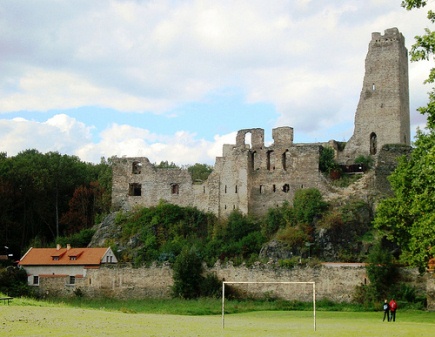
Location: 15 km (10 mi) North- West of Prague, Central Bohemian Region Map
Constructed: 1359 by Frantisek Rokyčansky
Okoř Castle, a striking medieval ruin perched on a rocky outcrop, stands as a testament to Czech history just outside Prague. Located in the village of Okoř in the Central Bohemian Region, it's approximately 15 kilometers (9 miles) northwest of the Czech capital, at coordinates 50°9′50.9″N 14°15′19.4″E. The site overlooks a verdant meadow and is easily accessible, about a 30-minute drive from Prague, making it a popular day-trip destination for history enthusiasts and tourists. Originally built as a fortress, it has evolved through multiple architectural phases before falling into disrepair, and today it hosts cultural events amid its atmospheric remnants.
Origins and Founding (Late 13th Century)
Archaeological
evidence dates the castle’s founding to the second half of the 13th
century (roughly 1260s–1270s). It was likely established by a
high-ranking church figure or possibly the monarch, given the
presence of an unusually elaborate octagonal Gothic chapel (internal
dimensions approx. 12 × 5.15 m) with traceried windows (trefoil and
quatrefoil designs) and 1-metre-thick walls. Dendrochronology of
wooden elements in the chapel dates them to 1311–1312. The core
featured a polygonal tower on the highest point of the rock,
incorporating the chapel on its ground floor.
The village of Okoř
itself appears in records as early as 1227, when King Přemysl Otakar
I granted it to the St. George’s Monastery at Prague Castle; this
early ecclesiastical connection supports the theory of a
church-linked founding. The initial stronghold was modest, with
economic support from distant villages such as Čelákovice,
Buštěhrad, and Třebotov. It lacked major military or economic
significance but was architecturally ambitious for its era, later
classified among Bohemia’s “block-type” castles.
The name “Okoř”
is popularly linked to the Czech word kořen (“root”). A local legend
claims that Přemysl the Ploughman (legendary founder of the
Přemyslid dynasty) stumbled on a tree root while traveling to
Vyšehrad, giving the site its name.
14th-Century Gothic
Rebuilding under František Rokycanský
The first written record of
the castle dates to 1359, when it belonged to František (Frána)
Rokycanský, a wealthy patrician and alderman of Prague’s Old Town
(Staré Město). He sold most of his urban property, adopted the
predicate “z Okoře,” and undertook a comprehensive Gothic
reconstruction that transformed the modest stronghold into one of
the most elaborately built noble residences in Bohemia.
Key
changes included:
Demolition of much of the earlier masonry.
Construction of a large quadrangular residential tower (donjon, 16 ×
8.5 m) that incorporated the original chapel.
Addition of a
substantial western palace with traces of hot-air heating.
A
two-part layout: an eastern forecourt and the main core on the rock
promontory.
A simple eastern gate portal (later upgraded).
Administration was managed by a burgrave (e.g., Jindřich Zubák,
1377–1380). František’s two sons (both named Jan) inherited the
property; the elder sold associated villages and the castle itself
in 1391 to an unknown buyer.
15th Century: Hussite Wars,
Donín Family, and Late Gothic Fortifications
Ownership passed
through several hands in the early 15th century:
1414 —
Mikuláš z Prahy (a former royal official).
Briefly to Jindřich
Lefl z Lažan and then sold in 1416 to the wealthy Prague pharmacist
Ludvík (of Italian origin).
During the Hussite Wars, the
castle was captured in spring 1421 by Prague Old Town forces and
placed under the command of Václav Carda z Petrovic. After the wars,
it reverted to Ludvík’s son Jan and his wife Dorota. Following Jan’s
death (before 1445), it passed via marriage and inheritance to
Bořivoj mladší z Lochovic and eventually to the Lords of Donín (páni
z Donína), specifically Bořivoj z Donína.
Under the Doníns
(mid-to-late 15th century), the castle received its most significant
defensive upgrades in response to the spread of firearms:
An
outer wall system on three sides (protected by a pond on the
fourth).
Two semi-circular artillery bastions for active cannon
defense.
Expansion of the western economic forecourt (including a
large brewery) and an eastern residential forecourt with a well
tower and refectory.
These late Gothic additions made Okoř
one of the better-defended smaller noble castles in Bohemia.
16th–Early 17th Century: Renaissance Remodelling and the Martinic
Family
In 1518, Bořivoj z Donína sold Okoř to Hynek Bořita z
Martinic (of the powerful Martinic family from nearby Smečno). The
Martinics held it through the 16th century, introducing Renaissance
features such as clustered windows and vaulted ceilings. After
inheritance divisions and lawsuits, it remained with branches of the
family (Volf, Jan mladší, Anna Bořitová, and finally Jiří Bořita).
The castle was damaged during the Thirty Years’ War (1618–1648) and
gradually fell into disrepair.
Jesuit Period and Baroque
Adaptations (Mid-17th to Late 18th Century)
In 1649, Jaroslav
Bořita z Martinic (the famous survivor of the Second Defenestration
of Prague) bequeathed the castle to the Jesuits of the St. Wenceslas
Seminary in Prague as part of the Tuchoměřice estate, with the
condition that three youths from Smečno be educated for spiritual
service on the family lands. The Jesuits used Okoř as a summer
residence. They carried out Baroque repairs (mainly maintenance),
built a new refectory and kitchen (1700–1712), and reconsecrated the
Gothic chapel in 1673 (by Jan Tomáš Pěšina of Čechorodu).
Decline into Ruins (Late 18th Century Onward)
After the Jesuit
order’s dissolution in 1773, the property passed to the imperial
Study Fund. Neglect set in rapidly: roofs were removed and sold,
timber and stone were quarried by locals (with official permission
in some cases), and the structure decayed. By 1787 the chapel was
closed due to the risk of tower collapse; cracks widened, and parts
of the tower eventually fell. The site became a convenient source of
building material for the village.
Minimal protective work began
in the early 20th century (wall-crown reinforcement by the Club of
Czech Tourists around 1920–1921). The Czechoslovak state acquired it
formally and carried out basic stabilization. It was declared a
protected cultural monument in 1965. Archaeological research and
conservation work intensified in the second half of the 20th century
under the Central Bohemian Museum in Roztoky u Prahy (west and south
palace walls, partial interior restoration).
Since 1994,
management has involved the municipality of Okoř (following earlier
transfers), with ongoing rescue work, public access, and cultural
events. The castle remains state-protected and attracts tens of
thousands of visitors annually.
Okoř Castle (Hrad Okoř) is a ruined medieval fortress located on a
low rocky promontory in the village of Okoř, about 15 km northwest of
Prague in the Central Bohemian Region of the Czech Republic. Situated at
roughly 275 m elevation above the Zákolanský potok valley, it
exemplifies the layered evolution of Czech castle architecture: from a
late-13th-century defensive stronghold with an elaborate chapel, through
sophisticated 14th-century Gothic expansion, late-Gothic artillery
upgrades, Renaissance residential adaptation, to Baroque Jesuit
modifications, before declining into ruins in the late 18th century.
Today, only substantial stone remnants survive—towers, palace walls,
fortifications, and scattered outbuildings—making it a striking example
of how Czech castles transitioned from pure military structures to
comfortable noble residences and ecclesiastical retreats. The site is
state-protected and offers a clear stratigraphic record of these
changes.
Construction Phases and Stylistic Evolution
Late 13th
century (origins): Archaeological evidence points to an initial
stronghold, likely founded by a high-ranking church figure (given the
unusually large and ornate chapel). The earliest element was a polygonal
tower on the highest rock point incorporating a ground-floor chapel.
Mid-14th century (major Gothic rebuild, c. 1359): Wealthy Prague burgher
František Rokycanský (or his father Mikuláš) transformed the site into
one of Bohemia’s most ambitiously executed noble castles of the “block
type.” This phase created the compact upper core (hradní jádro) with a
massive donjon-style tower, attached palaces, and a high perimeter wall.
No moat was needed; the protruding tower itself defended the entrance.
Late 15th century (Late Gothic artillery upgrade, completed c. 1494):
Under the Lords of Donín (especially Bořivoj z Donína), the castle
received comprehensive outer fortifications to counter firearms. A new
lower bailey (předhradí or “dolní hrad”) encircled the core on three
sides, featuring two semi-circular bastions and a protective
fishpond/moat system created by redirecting the stream. This is the only
major expansion of the defensive perimeter.
16th century (Renaissance
residential conversion): Under the Bořitas of Martinice (from 1518
onward, notably Jiří Bořita z Martinic), the medieval fortress became a
comfortable palace. The western palace was internally remodelled with
widened windows, vaulted rooms, sgraffito plaster, courtyard arcades,
and wooden galleries (pavlače). A 1590 urbář describes it as a
well-appointed residence with brick-covered structures, cellars, wells,
and stables.
17th–18th centuries (Baroque restoration and Jesuit
use): Heavily damaged during the Thirty Years’ War, the castle was
repaired and extended by the Jesuits (owners from 1649). Works included
new bridges (1665–66), roof repairs, tower flooring, chapel restoration
(consecrated 1675), and new Jesuit-era buildings (refectory, kitchen,
granaries, 1700–1712). After the Jesuit order’s suppression in 1773, the
castle was abandoned, systematically quarried for building stone, and
reduced to ruins by the late 18th century.
Detailed Layout and
Specific Architectural Features
The complex divides into two main
zones:
Upper Castle Core (hradní jádro) — Enclosed by a high wall on
the rocky outcrop. Buildings attach to the wall except for the
free-standing tower. A subsidence between two peaks is levelled by the
southern palace; the western palace closes the courtyard on the west.
Entrance is via the ruined 4th gate into the central courtyard.
Lower/OOuter Bailey (předhradí) — Late-Gothic outer ward surrounds the
core on three sides from the stream to the fishpond dam. Inside the
bailey wall (with two protruding bastions and brewery ruins) are modern
buildings and a path that circles the core. A late-Gothic refectory
building projects from the inner wall opposite one bastion.
The Tower
with Chapel (dominant donjon): The most visually striking surviving
element is the tall, rectangular tower (approx. 16 × 8.5 m) at the
highest point. Its base incorporates the original late-13th-century
Gothic chapel—one of the largest and finest in any Czech castle. The
chapel interior measures roughly 12 × 5.15 m with a five-sided polygonal
(originally octagonal) eastern end preserved up to cornice height. Walls
were thickened by 1–1.3 m during the 14th-century rebuild. Windows
feature two-light lancet arches with trefoil or quatrefoil tracery (one
northern window has a four-leaf design); most were bricked up except the
eastern and southern ones. Upper floors originally had flat ceilings on
stone corbels and small rectangular windows. The tower torso remains the
most intact and photogenic feature today.
Palaces:
Southern
palace: Abuts the tower and southern wall; contains a surviving Gothic
niche with a sharp gable (vimper) and suspended tracery (c. 1330). Later
adapted for Baroque courtroom, armory, and prison access.
Western
palace: The main residential wing; heavily remodelled in the Renaissance
with grouped windows, valené (barrel) vaults, sgraffito plasterwork
(psaníčkové sgrafito), courtyard arcades, and external wooden galleries.
Fortifications and Outworks:
Core walls: Original Gothic masonry
on the south and east (later used as parkán/cordon walls).
Late-Gothic outer bailey walls and bastions: Two semi-circular artillery
bastions with loopholes protrude from the wall; one near the first gate
still shows traces of the 1494 Donín coat of arms (antlers and
chevrons). The system included an advanced eastern outwork with moat and
vallum.
Additional elements: Rock-excavated two-level cellars, deep
well, traces of hot-air heating, bakery and stables below the castle
(per 1590 description).
The lower bailey fortifications and
bastions are visible in the foreground and encircling walls of many
views (e.g., the rounded structure in the right foreground of several
panoramas).
Current State and Preserved Details
The protected
monument (since the 1960s, state-owned since 1921) consists of the tower
with chapel (listed separately), southern and western palace torsos, 4th
gate, core walls, well tower, refectory, lower bailey wall with
bastions, and associated plots. Fragments of Renaissance sgraffito and
Gothic window tracery are still discernible on surviving walls. Minimal
conservation work has been done beyond stabilisation; the ruins remain
atmospheric and accessible, with excellent views revealing the
stratigraphic layering of Gothic, Late Gothic, Renaissance, and Baroque
phases.
Okoř Castle (Hrad Okoř) is a picturesque Gothic ruin located about
15–25 km northwest of Prague in the Central Bohemian Region (Praha-západ
district), in the scenic valley of the Zákolanský Stream (Zákolanský
potok). It is a popular day-trip destination for locals and tourists
seeking a romantic, less crowded alternative to Prague’s grand castles.
Brief History
Okoř was likely founded in the late 13th or early
14th century (some sources say around the 13th century) by a noble
family, possibly the Berka of Dubá or related lineages. Its unusual
position in a valley (rather than on a high hill) made it somewhat
atypical for Czech fortifications.
It served as a medieval stronghold
but suffered significant damage during the Hussite Wars (15th century)
and the Thirty Years’ War (17th century). After abandonment, locals
quarried stones for building materials, accelerating its decay into
romantic ruins. Today, the preserved elements include parts of the
tower, chapel of St. Wenceslas (Kaple sv. Václava), fortifications, and
walls, offering atmospheric views.
The site hosts cultural events,
concerts, and festivals in summer, adding vibrancy. It is famously
linked to the folk song “Na Okoř je cesta” (“There is a path to Okoř”),
which evokes its scenic appeal.
Legends: Like many Czech castles,
Okoř has tales of the White Lady (Bílá paní), said to be the ghost of a
former lady of the castle who wanders the ruins, sometimes guarding
hidden treasure. While not as famous as the Perchta of Rožmberk White
Lady, it adds mystery and draws folklore enthusiasts.
How to Get
There
By Car (easiest, ~25–30 minutes from central Prague): Take Road
7 (E48) toward Slaný, then follow signs to Okoř. There is parking in the
village (small fee possible, prepare change ~50 CZK). The walk to the
ruins is short.
By Public Transport:
Bus 350 or 323 from Prague
(Dejvická or Nádraží Veleslavín metro station, green Line A) — direct or
short walk. Bus ~30–45 minutes, cheap (~30 CZK).
Train to Noutonice
(lines S54/T4), then ~2.5 km walk or local connection.
By Bike or
Hike: Popular option via cycle paths and hiking trails from Prague
(e.g., through Divoká Šárka nature reserve). Okoř is a hub for trails;
routes are well-marked. One moderate bike route from Veleslavín is ~33
km one way.
Tip: Combine with a visit to nearby Budeč (early
Přemyslid settlement) or other Central Bohemian sites for a full day.
Visiting the Castle: Practical Tips
Opening Hours (as of recent
info; always verify): Generally April–May and October–November: weekends
10:00–16:30. June–September: Tuesday–Sunday (closed Mondays) 10:00–16:30
or later on weekends. Closed or limited in winter. Check the official
site for exact/current times and events.
Tickets/Admission: Modest
fee — adults around 160 CZK, concessions (students/seniors) ~105 CZK,
children ~80 CZK, family tickets available. Dogs ~70 CZK. Guided tours
(often in Czech) last ~30–60 minutes; self-guided is common.
Duration: 30–90 minutes for the ruins themselves, plus time for
surroundings. Guided tours may lock gates temporarily.
Accessibility:
Ruins involve uneven terrain, stairs, and slopes — not fully
wheelchair-friendly. Sturdy shoes recommended. The approach path is
gentle but can be muddy after rain.
Best Time to Visit: Spring to
early autumn for greenery and events. Weekends can be busier with
families and events; weekdays quieter. Early morning or late afternoon
for better light and fewer crowds. Avoid winter due to limited access
and slippery conditions.
On-Site: Small restaurant/snack options and
a confectionery nearby for Czech food, beer, and refreshments. Picnic
spots available.
What to See and Do
Explore the tower
remnants, chapel, and defensive walls for panoramic valley views.
Wander the surrounding paths along the stream — peaceful and photogenic.
Look for interpretive signs on history and legends.
Attend summer
cultural events (check program on okor.cz).
Nearby: Short hikes, the
village of Okoř, potential extensions to Zoopark Zájezd or other local
attractions.
In-Depth Visiting Tips for Travelers (Ideal for
ermakvagus.com)
Preparation: Wear comfortable walking shoes. Bring
water, sunscreen, and rain gear. Download offline maps (e.g., Mapy.cz)
as signal may vary. Learn a few Czech phrases or use translation apps,
as not all staff/guides speak fluent English.
Photography: Golden
hour light enhances the romantic ruins. Drone use may be restricted —
check rules.
With Kids/Families: Child-friendly atmosphere with space
to run, but watch for drops and uneven ground. Nearby paths suit
strollers somewhat.
Hiking/Cycling Integration: Excellent base for
longer trails. The red trail along the brook is easy and scenic.
Safety & Etiquette: Respect barriers — ruins can be unstable. No
littering; the area is kept tidy. Be mindful during events.
Combine
Visits: Pair with Prague Castle contrasts, Kokořínsko rock formations,
or other nearby ruins/chateaus for a themed “Central Bohemian Castles”
itinerary.
Budget: Low-cost day trip (transport + ticket + food
~500–1000 CZK/person). Free exterior views possible outside hours, but
interior access requires ticket.
Sustainability: Support local
businesses; use public transport or bike when possible.
Okoř
offers a charming, authentic slice of Czech medieval history with a
relaxed vibe. It’s perfect for history buffs, photographers, hikers, and
those wanting a peaceful escape from Prague’s crowds. For the latest
details, visit the official site: okor.cz.