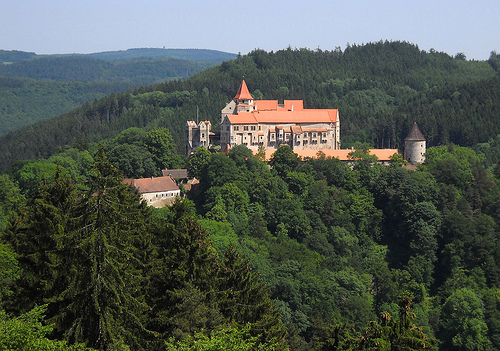
Location: Nedvědice, 40 km (25 mi) Northwest of Brno Map
Famous: filming location of Nosferatu
Tel. 566 566 101
Constructed: 1270-1285
Open:
Apr, Oct:
9am- noon, 1pm- 3pm Sat, Sun, public holidays
May- Sept: 9am- noon,
1pm- 4pm Tue- Sun
Jul & Aug 9am- noon, 1pm- 5pm Tue- Sun
Pernštejn
Castle is situated near village of Nedvědice, 40 km (25 mi) Northwest of
Brno in Czech Republic.
Pernštejn Castle (Czech: hrad Pernštejn, from German Bernstein or
originally Bärenstein meaning "Bear Rock") is one of the best-preserved
castles in the Czech Republic. It sits dramatically on a rocky
promontory above the village of Nedvědice and the confluence of the
Svratka and Nedvědička rivers, about 40 km (25 mi) northwest of Brno in
the South Moravian Region.
It is often called the "Marble Castle" due
to the marble-like stone framing its doors and windows. Its history
spans from the late 13th century to the present, closely tied to the
powerful Pernštejn (Pernstein) noble family. It evolved from a simple
Gothic fortress into a sophisticated Late Gothic/Early Renaissance
residence while retaining a formidable medieval appearance. Unlike many
Czech castles, it was never conquered by enemies, which helped preserve
its authentic form.
Founding and Early History (13th–14th Centuries)
The castle
was founded by the Lords of Medlov (a Moravian noble family) between
roughly 1270 and 1285. A branch of the family seated there and
adopted the name Pernštejn after their new seat. The first
historically recorded ancestor is often cited as Stephen of Medlov,
a prominent figure in early 13th-century Moravia who shifted family
holdings northward into the Bohemian-Moravian Highlands.
The site
was chosen for its natural defensibility: a rocky crag protected on
three sides by steep slopes, accessible primarily from the north via
a narrow ridge. The original core included:
The prominent round
Barborka Tower (a bergfried or defensive tower with a sharp edge
facing the approach).
A palace building.
A courtyard protected
by a rampart.
A chemise (outer wall) enclosed the core, with
additional early expansions in the 14th century, such as a second
towered palace. The castle featured a reliable water source (a rock
lake/spring) within its walls.
During the turbulent period after
the Přemyslid dynasty's extinction (1306) and under King John of
Bohemia, records are sparse, but the Pernštejns expanded their lands
amid weak royal control in the Highlands. They participated in
regional assemblies while building power through colonization,
forests, and private lordships. The castle itself saw limited major
changes in this era.
Rise and Fortification Peak (Late
14th–15th Centuries)
Under Vilém (William) I of Pernštejn (active
1378–1422), the family rose significantly. The castle became a base
for political activities and raids during Moravia's factional strife
after Margrave John Henry's death in 1375. Vilém balanced military
exploits with official roles in parliament and justice.
A major
fire damaged the castle before 1460. Extensive Late Gothic
rebuilding followed under Jan (John) I of Pernštejn (d. 1475), High
Chamberlain and Regent of Moravia, and his sons. This phase added:
Sophisticated fortifications: moats, walls, towers (including a
distinctive square tower connected by wooden bridges for last-resort
defense), and a strong barbican.
Expansions northward (the only
vulnerable direction), with multiple baileys, gates, drawbridges,
and a semicircular Renaissance bastion.
Upward growth due to
space constraints, with new halls, oriel windows, and jetties.
The barbican (with 3m-thick walls) is a standout example of late
Gothic fortification in Czech lands. These defenses made Pernštejn a
key stronghold in regional conflicts, including during the Hussite
Wars.
Renaissance Golden Age (Late 15th–Mid-16th Centuries)
The most transformative period came under Vilém (William) II of
Pernštejn (1435–1521), a highly influential statesman often compared
to Charles IV for his political skill, learning, and economic
acumen. He expanded the family fortune dramatically during a
relatively peaceful era under the Jagiellonian kings.
Reconstruction turned the fortress into a luxurious residence while
maintaining defenses:
New halls and living spaces with
diamond (ribbed) vaults.
Italian-influenced Renaissance elements
in spatial design, windows, and portals.
Upper floors expanded
via cantilevers.
Completion of the Knights' Hall and other
representative rooms.
By the mid-16th century, under Vilém's
successors (including Jan IV), the castle reached its final
Gothic-Renaissance form. It symbolized the Pernštejns' peak as one
of the wealthiest and most powerful families in the Bohemian
Kingdom, rivaling or surpassing others like the Rožmberks.
Decline of the Pernštejns and Later Ownership (Late 16th–19th
Centuries)
Financial strain in the late 16th century—exacerbated
by loans to the emperor and other costs—forcing the family to sell
Pernštejn in 1596. Much of their wealth transferred elsewhere (e.g.,
via marriage to the Lobkowicz family).
Subsequent owners
included:
Adam Lev of Rýzmburk (1604).
The Lichtensteins (from
1625).
The Stockhammer family (1710–1793).
The Schröfl von
Mannsperg family (late 18th century).
The Mitrovský family (from
1818/1828 until 1945).
During the Thirty Years' War, the
castle's impregnability shone: it withstood a Swedish siege in 1645
(with only minor damage to upper levels) and served as a refuge. It
was declared a Moravian land fortress in 1655.
Later changes
were mostly interior-focused:
Baroque chapel (1716, with frescoes
by Franz Gregor Ignaz Eckstein).
Stucco in the Knights' Hall.
Rococo decorations (1760s).
Minor repairs after the Swedish
attack.
The Mitrovskýs resisted 19th-century Romantic
rebuilding trends, preserving the castle's authentic
medieval/Renaissance character. They conducted restorations in the
19th century (e.g., interiors, library).
Modern Era (20th
Century–Present)
After World War II, following the Mitrovskýs'
emigration (due to their alleged Nazi sympathies), the castle became
state property. It has undergone conservation efforts and is now
open to the public as a protected monument, attracting tens of
thousands of visitors annually.
Its preserved state stems from
never being conquered, limited major post-16th-century alterations,
and owners' restraint. Recent uses include filming (e.g., Nosferatu
in 2024). The surrounding park and old yew tree add to its
atmospheric appeal.
Overall Layout and Site
The castle exemplifies a "naze"
(promontory or ridge) castle design, perfectly adapted to its
topography. It sits on an elongated rocky spur protected by steep slopes
on three sides, with the rock itself penetrating into the lower levels
of the buildings (up to the second floor in places). Access is only
possible from the north via a gradually rising ridge, which was heavily
fortified with multiple lines of defense.
The complex includes:
An extensive outer prostrate settlement with five yards,
outbuildings, ramparts, gates, a northern bastion, and a central
barbican.
Multiple baileys (courtyards) separated by defensive walls,
moats, and bridges.
A labyrinthine interior with narrow passages,
winding staircases, and secret corridors designed for defense—two armed
men could barely pass side by side in many places.
This creates a
highly layered, vertical fortress that grew organically over centuries
while maintaining its medieval silhouette.
Construction Phases
and Architectural Evolution
13th Century (Foundations – High Gothic
Core)
Founded by the Lords of Medlov (who later took the name
Pernštejn) between roughly 1270–1285. The initial layout was a simple
bergfried-type castle:
A chemise (curtain) wall around the rocky
summit.
The prominent Barborka Tower (a round, five-storey bergfried
with a sharp edge facing the approach road), which still dominates the
complex.
A three-storey palace in the southern part of the core,
entered from the south.
A protected inner courtyard.
14th–Early 15th Century
Expansion added a second tower-like palace in
the northeast corner and an outer ward with battlements, creating an
inner bailey. Fortifications were strengthened with the rectangular Four
Seasons Tower (with dungeon) and a round Clock Tower.
Late
15th–Mid-16th Century (Major Late Gothic & Early Renaissance Rebuilding)
This is the period that gave the castle its enduring Gothic-Renaissance
character under the powerful Pernštejn family (especially William II).
Key changes:
Massive fortification upgrades: Deep ditches,
multiple moats with drawbridges, ramparts, and a sophisticated northern
defense system.
A tall semicircular Renaissance bastion at the
northern end.
A mighty barbican (one of the best-preserved late
Gothic examples in Czechia) with 3m-thick walls, crenellations for
firearms, and machicolations.
Upward expansion due to limited space:
Upper floors extended via cantilevers and jetties, making them larger
than the ground floors.
Replacement of wooden ceilings with elaborate
stone vaulting (after a major fire around 1416).
Introduction of
Renaissance elements: Refined stonework on window/door reveals, portals,
and spatial planning of new halls. Italian influences are evident.
The castle reached its final medieval/Renaissance form by the
mid-16th century and has remarkably retained this external appearance,
never succumbing to major Romantic 19th-century alterations.
Later
Modifications (17th–19th Centuries)
Interiors saw Baroque, Rococo,
and Neo-Classical updates (stuccowork, paintings, furniture), but the
exterior and core structure changed little. The Mitrovský family (from
1818) preserved its authentic Gothic-Renaissance look.
Key
Architectural Features
Towers:
Barborka Tower: Iconic round
five-storey defensive tower, the oldest and most prominent.
Clock
Tower: Round tower with a sharp edge.
Four Seasons Tower:
Rectangular, named for colorful window glass.
Various smaller towers
and turrets integrated into the complex.
Vaulting: Exceptional.
Diamond (or stellar) rib vaults in the entrance hall and many rooms
(16th century); cross vaults; Late Gothic and Renaissance designs
throughout. Many wooden ceilings were replaced post-fire.
Fortifications: Multiple gates with marble portals, drawbridges, covered
staircases, defensive bridges between sections, and a labyrinthine
layout optimized for last-stand defense.
Interiors: Mix of
styles—Gothic structural elements, Renaissance halls (e.g., Knights'
Hall with stucco and frescoes), Baroque library with ornate bookcases,
Rococo decorations, and preserved wall inscriptions/paintings from the
16th century.
Materials: Local stone, with the distinctive light
"marble" framing providing elegant highlights against robust
fortifications.
As of 2025, Pernštejn Castle remains in excellent condition, managed by the National Heritage Institute of the Czech Republic, and is open to the public year-round with guided tours available in multiple languages. Visitors can explore various routes, including the main interiors showcasing Renaissance and Baroque furnishings, or shorter paths focusing on the fortifications and legends. The site hosts cultural events such as medieval festivals, concerts, and historical reenactments, drawing thousands annually. Its location in the Bohemian-Moravian Highlands makes it accessible by car (about 2 hours from Prague) or train to Nedvědice, followed by a short hike uphill. Facilities include a restaurant, gift shop, and parking, with entry fees supporting ongoing conservation efforts. Pernštejn's cinematic appeal continues, having appeared in films like "Van Helsing" and "The Brothers Grimm," cementing its status as a must-visit for history buffs and families alike.