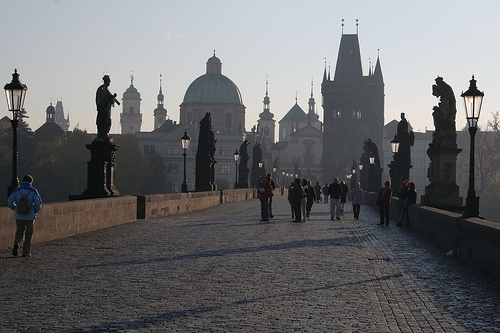
Charles Bridge across Vltava river made only for pedestrians.
Charles bridge replaced Judith bridge that was build in 1170, but
collapsed in 1342. Its reconstruction began in 1357, July (seventh
month) 9, at 5 o'clock 31 minutes with the first stone laid by king
Charles VI himself. This date was specifically chosen as it
represents a mathematical pyramid with the number "9" on top and
1.3.5.7.9.7.5.3.1 below. It was believed that this set of numbers is
especially favorable for any undertaking including erection of the
Charles Bridge. Its construction was later continued under
supervision of architect Peter Parler. Its 30 statues were added
later with inscriptions from the donors.
One of the statues has iron relief on its base. The material that
makes this work got darker except the center due to a belief that
once touched main wish will come true. Thousands of hands that
touched polished the iron plate. Another remarkable statue is that
of Crucifixion. It is the first statue on the bridge and stood here
alone for 200 years since 1629. Hebrew letters are translated as
"Holy, Holy, Holy Lord". They were added as a punishment of a Jewish
man who spoke crap about Christianity. Obviously political
correctness standards were different back then. He had to pay for
his blasphemy with golden letters that were added here.
Forerunner buildings and the construction of today's
bridge
A ford initially served as a crossing over the Moldau,
probably supplemented by raft traffic since the 9th century. A wooden
bridge was first mentioned in the 10th century by the envoy of the
Caliph of Cordoba, Ibrahim ibn Yaqub. The wooden bridge was repeatedly
damaged and finally destroyed by a flood in 1157 or 1158. Between 1158
and around 1170 the first stone bridge in Prague was built in the
Romanesque style, the Judith Bridge (Juditin most, named after Judith of
Thuringia, the wife of Duke Vladislav II). In 1342 this was also
destroyed by the Magdalenen flood. One of the two bridge towers in
Lesser Town remained intact, as did a gate tower (which was later
incorporated into the Maltese Monastery) and some piers and bridge
arches, which were integrated into residential buildings in Lesser Town.
The foundation stone of the Charles Bridge was laid in 1357 by
Emperor Charles IV. According to different sources, the celebration was
either on June 15 (Feast of Saint Vitus) or on July 9, the ninth day of
the seventh month at 5:31 a.m., so that the date can be represented by a
regular sequence of odd numbers: 1-3-5-7-9-7-5-3-1.
Larger and
smaller tidal waves and heavy ice have repeatedly threatened the bridge
throughout its history, most recently in 1872/74 when five piers were
severely damaged.
In 1890, during another flood, two pillars
collapsed from drifting tree trunks. The repairs were under the
direction of Josef Hlávka and the Viennese professor Franz von Rziha.
They dragged on for two years.
The architect of the Charles Bridge is not known for
certain. It was long believed to be the work of Peter Parler. But a new
theory from 2007 says the architect was a Prague stonemason named Otto,
also known as Otlin. However, work on the bridge and towers was under
the direction of Parler.
Based on the model of the Stone Bridge
in Regensburg, it was built as an arch bridge with 16 arches. It is 516
meters long and around 10 meters wide. The arches are arranged almost
symmetrically over the entire bridge construction. Old millstones,
granite from the riverbed and sandstone (from the quarries of the
Crusaders with the Red Star near Hloubětín) were used as building
materials. The tradition that the mortar was enriched with eggs to
increase stability was answered contradictory after scientific material
analyzes during the reconstruction in 2008. However, the admixture of
quark and wine as "Roman mortar" could be proven.
Significance of
the bridge, damage and modifications
In the period that followed, the
Stone Bridge (Kamenný most) or Prague Bridge (Pražský most) made a
significant contribution to making Prague an important trading post
between Western and Eastern Europe. The Knights of the Cross with the
Red Star were initially responsible for protecting the bridge.
In
1432 three pillars of the bridge were damaged by a flood. At the end of
the Thirty Years' War, the bridge was the scene of fierce fighting in
1648 when Swedish troops besieged Prague's Old Town from Lesser Town on
the west bank of the Vltava River.
Around 1700, the bridge
essentially took on its present form, with the thirty baroque sculptures
symmetrical on either side. A symbolic figure was erected just above
each arched pillar.
It was not until 1870 that the bridge was
officially renamed Charles Bridge. From 1883 a horse tram ran over it.
In 1905 the horse-drawn tram was replaced by a tram, which gave way to
buses three years later. For centuries it was an important transport
connection between the Prague districts.
Extensive renovation work was carried out from 1965 to
1978 after more detailed investigations revealed numerous cracks, mainly
caused by rainwater and the road salt used in winter service. The repair
costs totaled around 50 million crowns: sandstone blocks and granite
blocks had to be replaced. The bridge structure was then closed to all
vehicle traffic. It is frequented by pedestrians, artists and souvenir
dealers offer their products here, and a bridge band plays music several
times a day.
Starting in 2007, more recent extensive restoration
work took place in stages, which was to last until after 2011. These
measures were heavily criticized because an allegedly unqualified
construction company was commissioned. In 2010, the monument protection
authority of the Czech Republic imposed a fine of around 130,000 euros
on the city of Prague because serious mistakes had been made during the
renovation. Among other things, complaints were made that historical
stone blocks had been unnecessarily destroyed and replaced with
inappropriate replicas. UNESCO also began investigating, as Charles
Bridge is a World Heritage Site as part of Prague's Old Town. A petition
launched in October 2009 to save the Charles Bridge, calling for the
reconstruction to be halted in its current form, has been signed by over
43,135 people (as of March 2011).
Old technology is used in the
efforts to present the bridge in an appropriate light: the electric
lighting for the historic lanterns was converted to gas using Berlin
technology and has been in operation since November 11, 2010. In the
future, night watchmen will switch gas lanterns on and off on Charles
Bridge like in the old days.
The Charles Bridge (Karlův most) in Prague is one of
the city's most iconic landmarks, a 14th-century stone bridge crossing
the Vltava River. It is famous for its atmospheric alley of 30 baroque
statues (and statuary groups), mostly added between the late 17th and
early 18th centuries (1683–1714), with some later additions. These
sculptures, created by prominent artists like Matyáš Bernard Braun and
Ferdinand Maxmilián Brokoff, depict Christian saints, biblical scenes,
and religious figures. They were commissioned by various guilds,
religious orders, and institutions.
All the original statues have
been replaced by replicas (mostly sandstone) due to weathering and
pollution; the originals are preserved in museums like the National
Museum Lapidary.
Here are some of the most notable and frequently
highlighted statues:
Statue of St. John of Nepomuk (1683, by Jan
Brokoff) — The oldest statue still in its original form (though the
current one is a bronze copy in parts). It depicts the saint (a
14th-century martyr thrown from the bridge in 1393 for refusing to
reveal the queen's confession). This is the bridge's most famous and
visited statue. Tradition says touching the relief of the saint on the
pedestal (specifically the spot where he fell) brings good luck and
ensures a return to Prague.
Calvary / Holy Crucifix and Calvary
(prominently located, with elements from the 17th–19th centuries) — A
dramatic crucifixion scene with Christ on the cross flanked by statues
of the Virgin Mary and St. John the Evangelist. The cross features
Hebrew inscriptions (added in the 17th century), which have sparked
historical discussions. It's one of the most visually striking and
centrally placed groups.
Statue of St. Ivo (1711, by Matyáš Bernard
Braun) — Patron saint of lawyers, shown with a widow and children
appealing for justice, accompanied by a figure of Justice (blindfolded
with sword).
Statues of St. Barbara, Margaret, and Elizabeth (1707,
by Jan Brokoff and son Ferdinand) — A group portraying three female
saints, often associated with protection and martyrdom.
Pieta /
Lamentation of Christ — A poignant scene of the mourning Virgin Mary
with the body of Jesus, evoking deep emotion (similar in theme to
Michelangelo's famous Pietà).
Madonna with St. Bernard and Madonna
with Ss. Dominic and Thomas Aquinas — Groups honoring the Virgin Mary
alongside key saints and theologians.
Other significant ones include
St. Francis Xavier, St. Christopher, St. Ludmila (a Bohemian patron),
St. Francis of Assisi, St. John of Matha, Felix of Valois, and Ivan
(Trinitarians), St. Luitgardis, and St. Adalbert (Vojtěch, a Czech
patron saint).
Striking are the towers on both sides of the bridge,
which were completed at different times.
Old Town Bridge Tower
On the Old Town side, between 1370 and 1380, the Old Town Bridge Tower
was built in the Gothic style just above the first bridge pier, the east
facade of which has been preserved over the centuries. The coats of arms
of all countries that were part of the Czech Kingdom at the time the
bridge was built, the coat of arms of the Roman emperor, the coat of
arms of the Czech king and a kingfisher surrounded by a veil (a symbol
of Wenceslaus IV) are carved in sandstone. At the level of the second
floor of the tower, two bridge arches are designed in relief, on which
St. Wenceslas is depicted in the middle as the patron saint of the
bridge. On both sides are the statues of Charles IV in imperial dignity
and Wenceslaus IV with the crown of a Roman king. On the next floor
there is a shield with an eagle and a (non-heraldic) lion. Statues of
Saint Adalbert and Saint Siegmund form the upper end of the façade.
The tower can be climbed and circumnavigated on a viewing platform.
A historically dressed trumpeter often entertains the tourists from up
there.
In the towers and in the passage, the walls and ceilings
are decorated with paintings, which were restored to their original
Gothic appearance at the end of the 19th century. The net vault of the
gateway has a keystone designed as a royal crown. The work on this tower
is attributed to Peter Parler.
The decoration on the west facade
was destroyed during the bombardment by Swedish troops and was not
restored. The tower also served as a political issue: the heads of 27
executed participants in the 1618 uprising against the Habsburgs were
hung on poles outside for ten years (1621-1631) as a deterrent. A plaque
placed in 1650 commemorates the participants in the liberation struggles
against the Swedes in 1648.
Lesser Town Bridge Towers
The
lower of the two towers is the slightly modified intact tower of the
Judith Bridge. It is built in the Romanesque style on a rectangular
ground plan. Preserved decorations from this period are remains of
sgraffito, windows, gables and the roof. In 1591 it was rebuilt in the
Renaissance style.
In 1464 the taller Lesser Town Bridge Tower
was built by order of King George of Podebrady, probably on the site of
an older Romanesque tower. The design was based on the old town bridge
tower on the east bank. The towers were joined by a crenellated archway
in the 15th century.
Charles Bridge (Karlův most) in Prague is one of the
most iconic medieval structures in Europe, built between 1357 and 1402
under Holy Roman Emperor Charles IV to replace the flood-damaged Judith
Bridge. It spans the Vltava River, connecting the Old Town with the
Lesser Town (Malá Strana), and is famous for its 30 Baroque statues
(added mostly 1683–1714) and two towers. Beyond its architecture and
history, the bridge is steeped in Czech folklore, mysticism, numerology,
and tales of martyrdom, pacts with the devil, and national destiny.
These legends blend historical events with supernatural elements,
reflecting medieval beliefs in symbolism, divine protection, and the
bridge’s role as Prague’s “guardian.” Many persist today as tourist
rituals (like touching statues for luck). Here’s an in-depth look at the
major ones, drawn from Czech oral traditions, historical accounts, and
local sources.
The Numerological Foundation: A “Numerical Bridge”
for Eternal Strength
Czech legend holds that construction began
precisely on 9 July 1357 at 5:31 a.m., with Charles IV himself laying
the first stone. The date and time were chosen deliberately for their
numerological power: they form a perfect palindrome — 1-3-5-7-9-7-5-3-1
(1357, 9th day of the 7th month, 5:31). This “numerical bridge” was
believed to magically reinforce the structure against floods, disasters,
and time itself.
Charles IV, deeply interested in astrology, alchemy,
and mysticism, reportedly timed it when planets aligned favorably (Sun
in Leo, symbolizing the Czech coat of arms). The sequence rises to 9 and
falls symmetrically, symbolizing balance and unbreakable unity. This
legend underscores the emperor’s vision of Prague as a cosmic capital.
The bridge endured centuries of floods and wars, reinforcing the story’s
power in local lore.
Eggs (and More) in the Mortar: Community
Sacrifice for Unbreakable Strength
To ensure durability after the
Judith Bridge’s 1342 flood collapse, builders allegedly mixed raw eggs
into the mortar. Charles IV ordered every village in the kingdom to send
cartloads of eggs — whites or yolks believed to bind stone like modern
additives. Some versions include milk, flour, and even wine, creating a
“thick, partially organic dough.”
Humorous variants add flavor:
residents of Velvary sent hard-boiled eggs (ridiculed for
misunderstanding), while Unhošť villagers confused the request and
delivered cottage cheese and Olomouc cheese instead of milk. These were
supposedly incorporated anyway. Statues on the bridge are said to still
use a bit of milk and egg yolk in repairs or replicas.
The legend
symbolizes national unity. Modern research has mixed results: some 2008
analyses found egg proteins; others (around 2010) detected milk and wine
but no eggs (claiming raw eggs would weaken mortar). Regardless, an
annual Egg Festival procession now celebrates it. The tale endures as a
charming emblem of collective effort.
The Martyrdom of St. John
of Nepomuk: Silence, Stars, and Wishes
The bridge’s most famous
legend centers on its oldest statue (erected 1683, the only metal one):
St. John of Nepomuk (Jan Nepomucký), patron saint of bridges,
confessors, and the Czech lands. In 1393, he served as confessor to
Queen Sophia (wife of King Wenceslaus IV). Suspecting infidelity, the
jealous king demanded he reveal her secrets. Nepomuk refused, upholding
the seal of confession. He was tortured (tongue torn out in some
accounts), then thrown from the bridge into the Vltava River and
drowned.
As he sank, five stars miraculously appeared above the water
— now haloing his statue (symbolizing “tacet” = “he is silent” in Latin,
with five letters). The exact spot is marked by a brass crucifix with
five stars embedded in the railing (on a red stone). Touching it with
one finger per star is said to grant a wish, ensure a return to Prague,
or bring good luck — a ritual performed by millions of tourists.
A
bronze dog at the statue’s base (added later) has its own newer
tradition: petting it promises fidelity and a long, happy marriage.
Reliefs on the pedestal depict the queen’s confession and the martyrdom.
Nepomuk was canonized in 1729; his story, promoted during the
Counter-Reformation, turned the bridge into a site of pilgrimage and
moral symbolism.
The Devil’s Pact: Repairing the Broken Arch with
a Soul
When Nepomuk was thrown (or during a later flood, like 1432),
the arch at that spot reportedly cracked or collapsed. Repairs
repeatedly failed — work undone overnight by unseen forces. A desperate
young architect (or builder) made a pact with the Devil: the arch would
be fixed instantly in exchange for the soul of the first living being to
cross the repaired section.
The architect planned a trick: release a
rooster (or cock/chicken/cat) first, as animals were traditional
protections against the Devil in old bridge folklore. Guards were
ordered to hold people back. But the Devil, disguised as an assistant or
stone mason, tricked the architect’s pregnant wife: he ran to her
claiming her husband had been injured in an accident. She rushed across
the bridge in panic, past the guards and before the rooster could be
released.
The wife died soon after in childbirth, along with their
unbaptized child. The Devil claimed their souls. The architect,
grief-stricken, freed the rooster and reportedly threw himself into the
river. For years afterward, passersby heard an invisible baby crying on
the bridge — the child’s tormented soul — until a kind stranger blessed
it (“God bless you” after a sneeze), releasing it. The spot remains
marked by the Nepomuk cross, and the legend warns against deals with
dark forces. Variations exist (some say the Devil took only the wife;
others tie it directly to the 1393 event), but the core — deception,
tragedy, and the soul of an innocent — is consistent.
Bruncvík’s
Magical Sword: A Weapon Buried for the Nation’s Hour of Need
On a
pillar (slightly off the main statue line, near the St. Vincent and St.
Prokop group) stands the statue of Bruncvík, a legendary Czech knight
with a lion at his feet and a golden sword in hand (sculpted 1884 by
Ludvík Šimek, replacing a damaged 15th-century Roland figure).
Bruncvík traveled abroad to win the right to a lion on his coat of arms
(replacing a black eagle). He saved a lion from a nine-headed dragon,
and it became his faithful companion. He possessed a magical sword that
decapitated enemies on command. Before dying, he buried it in Charles
Bridge so St. Wenceslas (the patron saint) could retrieve it in
Bohemia’s darkest hour. When invaders threaten, knights will ride from
Blaník Mountain; St. Wenceslas’ white horse will stumble, its hoof
unearthing the sword for the rightful heir to wield and secure
victory/peace.
A rusted sword was supposedly found during 1890 flood
repairs, fueling the tale. The statue and legend symbolize hope,
national resilience, and Czech identity — the bridge as protector of the
realm.
Other Supernatural and Atmospheric Elements
At night,
under the old gas lamps, the statues are said to “come alive” and
descend from their pedestals to aid humans — part of broader Prague
mysticism. The bridge is protected by Prague’s guardian angel.
Historical events add eerie layers: after the 1620 Battle of White
Mountain, the heads of 27 executed Czech rebels were displayed on the
Old Town Bridge Tower (1621). The “Bearded Man” sculpture (from the
older Judith Bridge) once served as a flood marker.
These legends
make Charles Bridge more than stone and statues — it’s a living tapestry
of faith, trickery, sacrifice, and destiny. Visitors still perform the
rituals (touching Nepomuk’s stars or the dog), keeping the folklore
vibrant. Whether rooted in real events (like Nepomuk’s documented death)
or embellished over centuries, they capture Prague’s enchanting,
slightly haunted soul. If you walk the bridge at dawn or dusk, you might
feel the weight of these stories in the mist over the Vltava.