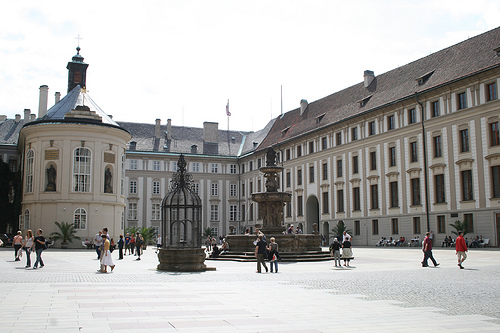
Second Courtyard
Tel. 224 373 531
Subway: Malostranska,
Hradcanska
Train: 22
Open: 10am- 6pm daily (10am- 4pm in
winter months)
The Prague Castle Picture Gallery (Obrazárna Pražského hradu) is a distinguished art institution within the expansive Prague Castle complex, recognized as the oldest continuously existing collection of paintings in the Czech Republic. Its origins trace back to the late 16th century, showcasing a curated selection of over 100 high-quality European artworks from a vast treasury exceeding 4,000 pieces. Housed in the historic Imperial Stables on the western side of the castle's second courtyard, the gallery emphasizes Mannerist, Renaissance, Baroque, and early modern works, with a focus on Italian, Flemish, Dutch, German, and Bohemian masters. Despite significant historical losses, its holdings rival major European collections in quality, offering visitors a glimpse into the artistic patronage of Holy Roman Emperor Rudolf II and subsequent eras. It appeals to art enthusiasts, historians, and tourists exploring Prague Castle, blending cultural heritage with archaeological elements.
Origins under Emperor Rudolf II (late 16th–early 17th
century)
The collection’s true foundation was laid by Holy Roman
Emperor Rudolf II (r. 1576–1612), who made Prague his imperial residence
in 1583 and turned the castle into a European “mecca for sciences and
arts.” A passionate collector of paintings, sculptures, curiosities, and
naturalia (his Kunstkammer), Rudolf spent nearly 30 years amassing what
contemporaries called one of the largest collections in Europe—reaching
roughly 3,000 paintings by around 1600 (with inventories listing about
1,300 paintings plus thousands of other objects).
He inherited works
from Habsburg relatives (Spain and Austria), commissioned new pieces,
and employed agents (such as Jacopo Strada) across Europe to buy
Italian, German, Dutch, and Flemish masters. Court artists in residence
or on short stays included Hans von Aachen (his favorite, court painter
from 1592), Bartholomeus Spranger, Joseph Heintz the Elder, Pieter
Stevens, Giuseppe Arcimboldo, Roelant Savery, Aegidius Sadeler, and
others. Notable surviving or once-held works from this era include
Veronese’s Portrait of Jakob König and Saint Catherine of Alexandria
with an Angel, Heintz’s The Last Judgement, Spranger’s allegories, and
pieces by Lucas Cranach the Elder (The Ill-Matched Couple, Saint
Catherine, fragments of a Prague altarpiece).
Display spaces were
purpose-built: the former imperial stables (repurposed by 1585) on the
ground floor of the Northern wing, a 100-metre-long “Long Corridor” (or
Spanish Corridor) on the upper floor (second floor of the Long Building,
connected to the newly built Spanish Hall, 1598–1606), and adjacent
rooms in the Northern Palace. The collection was never intended for
public viewing but for the emperor and select guests.
Losses and
Dispersal (17th–18th centuries)
Rudolf’s death in 1612 marked the
beginning of dramatic decline. His successor, Emperor Matthias, removed
large numbers of paintings to Vienna. After the Catholic victory at the
Battle of White Mountain (1620), Maximilian I of Bavaria carted away
hundreds on 1,500 wagons. Saxon troops looted more in 1630, and Swedish
forces under General Königsmarck seized the remainder during their 1648
occupation of Prague, sending prized pieces (including many Arcimboldos
and Rudolfine works) to Queen Christina in Stockholm. A 1697 fire at the
Stockholm royal castle destroyed yet more. Only damaged, secondary, or
hidden works stayed in Prague.
A partial revival came in 1650 when
Emperor Ferdinand III purchased over 500 paintings from the Duke of
Buckingham’s collection in Antwerp, adding major 17th-century Italian,
Flemish, and Dutch masters (Titian, Veronese, Tintoretto, Domenico
Fetti, Guido Reni, Peter Paul Rubens, Rembrandt influence, Nicolas
Poussin, and Czech Baroque artists such as Karel Škréta, Jan Rudolf Bys,
and Petr Brandl). Some of these remain core holdings today.
Under
Empress Maria Theresa (mid-18th century), court architect Nicolò Pacassi
radically remodelled the castle in Baroque style. The old picture
gallery was abolished; many canvases were shipped to Vienna, others cut
or adapted to fit new wall panelling, and some sold (e.g., to Dresden in
1742 and 1749). The collection effectively ceased to exist as a coherent
gallery.
19th Century: Patriotic Revival and Loans
In reaction
to the removal of artworks to Vienna, Czech aristocrats and
intellectuals founded the Society of Patriotic Friends of the Arts
(1796, later the core of today’s National Gallery in Prague). They
secured loans from Vienna: 67 paintings in 1797 and 32 more in 1802.
These formed a temporary public gallery in Prague, but most were
gradually returned from 1836 onward. By 1918 the Society still held
about 30 castle paintings.
20th Century: Czechoslovak State
Ownership and Modern Gallery Creation
After Czechoslovakia’s founding
in 1918, Prague Castle became the presidential seat. Commissions
assessed the remaining artworks; the Masaryk Fund (from the 1930s)
enabled purchases of Czech Baroque and 19th-century masters (Jan
Kupecký, Petr Brandl, Jan Kašpar Hirschely, Norbert Grund, Josef Mánes,
Adolf Kosárek, Jan Preisler, Antonín Slavíček). During the Nazi
occupation many works were stored safely at the presidential residence
in Lány.
Post-WWII inventories were incomplete. In 1960–1961 many
paintings were temporarily transferred to the National Gallery or stored
at Opočno Castle. Art historian Prof. Jaromír Neumann (with Eliška
Fučíková) recognised their importance, leading to restorations and
returns. In 1963–1965 the first modern Prague Castle Picture Gallery was
created in the ground-floor spaces of the Northern and Western wings
(the former Imperial Stables rebuilt by Rudolf II in 1583). Architects
František Cubr and Josef Hrubý designed the six-hall exhibition space,
which incorporated archaeological remains of the 9th–11th-century Church
of the Virgin Mary (founded by Bořivoj I; tombs of Prince Spytihněv I
and his wife were discovered during 1950s digs). The gallery opened in
1965 with a permanent exhibition focused on Rudolfine, Italian, Flemish,
Dutch, German, and Czech Baroque works.
A theft (Lucas Cranach’s Old
Man in Love, 1990) and technical/safety problems forced closure. Between
1995 and 1998 the Presidential Office oversaw a major reconstruction
designed by architect Bořek Šípek (commissioned under President Václav
Havel). The entrance was moved to the Second Courtyard, interiors
modernised with climate control and security, and the Church of the
Virgin Mary area integrated. The gallery reopened temporarily during the
1997 “Rudolf II and Prague” exhibition and officially on 1 June 1998.
Several original Rudolfine paintings were reacquired (e.g., a triple
portrait by Paul Roy in 1995).
Today’s Permanent Exhibition and
Significance
The current exhibition (in six halls) is arranged
thematically by schools and periods:
Hall 1: Rudolfine-era works
(returned originals).
Subsequent halls: Italian 16th–17th century
(Titian workshop Madonna and Child, Veronese, Tintoretto’s Flagellation,
Christ and the Adulteress, Bassano brothers), Flemish/Dutch masters
(Rubens, Fetti), German and Czech Baroque (Cranach, Brandl, Kupecký,
Reiner).
Masterpieces include works by Titian, Veronese,
Tintoretto, Rubens, Cranach the Elder, Hans von Aachen, and Czech
artists. Occasional temporary shows and guided tours supplement the
permanent display. Prague Castle (including the gallery) has been a
National Cultural Monument since 1962.
Historical Layers and Original Structure (9th–16th
Centuries)
The site’s oldest fabric dates to the late 9th century:
the Church of the Virgin Mary (Kostel Panny Marie), founded by Prince
Bořivoj I before 885 CE. It was Bohemia’s second-oldest Christian
church—a simple single-nave building with an eastern apse. An
11th-century extension enlarged it; the tomb of Prince Spytihněv I (d.
915) was discovered here. The church burned in the mid-13th century, was
never rebuilt, and was partially demolished or buried when later castle
wings were constructed. Its northern masonry section survives today
inside the gallery.
In 1583, Rudolf II (Holy Roman Emperor and
passionate art collector) commissioned the reconstruction of the
northern palace wing and converted or built new stables here for his
prized Spanish horses. These formed part of a larger Rudolfine complex
that included the 100-metre Long Corridor (saddlery on the ground floor,
Kunstkammer above, picture gallery on the second floor) and the adjacent
Spanish Hall (1598). The stables were utilitarian Renaissance
structures—likely with simple vaulting, functional doorways, and
practical proportions suited to horses rather than grandeur. Paintings
were originally displayed upstairs, not in these ground-floor spaces.
Baroque Unification (18th Century)
During Maria Theresa’s reign,
court architect Nicolò Pacassi (1760s) radically remodelled the entire
castle after Prussian damage in the Seven Years’ War. The Northern Wing
received a uniform Baroque/early-Neoclassical façade: three storeys of
regularly spaced windows, pilasters, restrained cornices, and a pale
stucco finish typical of the castle’s courtyards. The former stables
were subsumed into this grander imperial scheme; their original
Renaissance character was largely erased on the exterior while the
ground-floor spaces remained relatively intact internally.
Today the
exterior visible from the Second Courtyard is this 18th-century façade—a
long, elegant Baroque wall with arched or rectangular openings,
red-tiled roof, and rhythmic fenestration that blends seamlessly with
the rest of the castle.
1965 Modernist Conversion (František Cubr
& Josef Hrubý)
After 1945 the Prague Castle administration decided to
create a permanent public gallery from the neglected stables. Architects
František Cubr and Josef Hrubý—best known for Czechoslovakia’s
award-winning modernist pavilion at Expo 58 in Brussels—led the
1963–1965 project. They transformed the ground-floor spaces into six
interconnected exhibition halls. The design was functionalist: clean
lines, neutral or warm wall colours, controlled artificial lighting to
protect paintings, and heavy oak furniture (designed by Cubr himself)
that emphasised solidity and Czech craftsmanship. Crucially, the project
preserved and incorporated the excavated 9th–11th-century church
remains, turning the gallery into an archaeological showcase. The
northern part of the church masonry (walls, foundations, column bases,
and fragments of the apse) is now visible through glass or open views,
with interpretive plaques. Visitors can see it from inside the gallery
and from a window or passageway between the Second and Fourth
Courtyards.
1995–1998 Renovation (Bořek Šípek)
After the
Velvet Revolution, President Václav Havel appointed designer-architect
Bořek Šípek (1949–2016) as a key figure in reopening and humanising
Prague Castle. Šípek’s 1995–1998 intervention gave the gallery its
current refined character. Key changes included:
Relocating the
main public entrance to the Second Courtyard for better accessibility.
Complete technical upgrade (climate control, security, lighting).
New
custom furnishings—most notably elegant, curved, tufted benches in rich
teal/blue upholstery with dark wood frames, plus tables and lighting
fixtures in Šípek’s signature organic yet refined style (sometimes
described as “neo-baroque” or sculptural postmodernism).
Sensitive
reworking of the church-remains zone to integrate it more dramatically
into the visitor flow.
The result is a warm, contemplative
environment: terracotta-red or ochre walls, white-painted vaulted or
coffered ceilings (some echoing earlier structures), polished parquet or
stone floors, and Šípek’s seating arranged in gentle curves that
encourage lingering. The 1990s work respected the 1960s modernist bones
while adding comfort and contemporary elegance.
The Defining
Architectural Feature: Exposed 9th-Century Church Ruins
The most
striking element is the juxtaposition of 1,100-year-old masonry against
20th-century gallery design. The preserved section includes rough stone
walls, early Romanesque column capitals, foundations, and tomb
fragments. Modern railings, subtle lighting, and a protective modern
ceiling allow safe viewing without compromising the ruins’ authenticity.
This creates one of Prague’s most evocative museum experiences:
Renaissance and Baroque masterpieces hang just metres from the
birthplace of Bohemian Christianity.
The permanent collection is thematically organized by
artistic schools, displaying 107 paintings and three sculptures from the
15th–18th centuries. Key sections include:
Italian Masters:
Titian's "Young Woman at Her Toilet" (c. 1515), Tintoretto's dramatic
"Flagellation of Christ," Veronese's "Portrait of Jakob König," and
works by Guido Reni and Domenico Fetti.
Flemish and Dutch: Rubens'
"Assembly of the Olympic Gods" (c. 1602, a youthful mythological scene),
van Dyck portraits, and Rembrandt influences.
German and Mannerist:
Dürer's "Feast of the Rosary" (1506), Cranach works, and court painters
like Hans von Aachen and Bartholomeus Spranger.
Bohemian and Later:
Baroque by Petr Brandl and Karel Škréta; 19th-century pieces by Josef
Mánes and Antonín Slavíček.
Temporary exhibitions rotate, focusing on
European art. The full holdings include prints, drawings, and
sculptures, with many in storage or at Opočno Castle.
The integration of the Virgin Mary Church ruins adds archaeological depth, with visible foundations and tombs enhancing the historical narrative. Šípek's redesign features artistic furniture and lighting, creating an intimate viewing experience. Arcimboldo's influence is evident in whimsical prints. The gallery hosts cultural events and is part of the UNESCO-listed Prague Castle, a National Cultural Monument since 1962. Reviews highlight standout pieces like Rubens' mythological work but note the collection's modest scale and occasional dim lighting.
Open daily year-round from 9:00 AM to 5:00 PM (last entry 4:30 PM; confirm on official site as hours may vary). Admission: 200 CZK for adults, 150 CZK reduced (students, seniors, children 6–16), 500 CZK family (2 adults + up to 5 children); free for under 6. Not included in basic castle tickets—opt for Circuit A (350 CZK) for bundled access or pay separately at the gallery. Tickets available on-site; no online purchase mentioned. Average visit: 45–60 minutes. Accessibility: Partial; elevators may be available, but historic elements like uneven floors pose challenges—contact for details. Photography without flash permitted, but no photos in some areas. Ratings average 3.7/5 on Tripadvisor (62 reviews), with praise for art quality and value but criticism for small size, stern staff, and not being essential. Combine with castle tours; nearby attractions include St. Vitus Cathedral. For updates, visit hrad.cz or prague.eu.