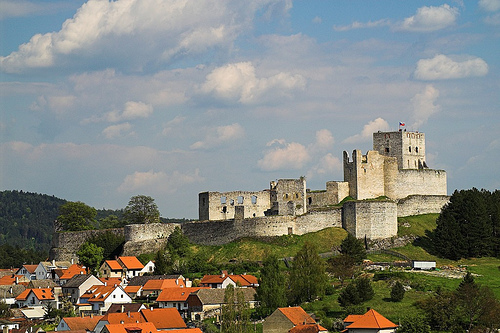
Location: Plzeň Region, West Bohemia Map
Constructed: 14th century by Lords of Velhartice
Official site
Rabí Castle (Czech: Hrad Rabí) is a vast ruined fortress located in the Plzeň Region of the Czech Republic, recognized as the largest castle in the country by area, with its buildings and walls spanning up to 3 kilometers. Situated on a prominent hill at 529 meters above sea level overlooking the Otava River, it lies in the foothills of the Bohemian Forest (Šumava Mountains), approximately 8 km from the town of Sušice and 130 km southwest of Prague. The castle's strategic position was chosen to guard trade routes, including the historic "Golden Route" for salt, and to oversee gold-bearing deposits along the river. Its coordinates are approximately 49°16′45″N 13°37′06″E. Today, it stands as a national cultural monument, proclaimed in 1978, and exemplifies medieval fortification in a picturesque, forested landscape.
The origins of Rabí Castle trace back to the first half of the 13th
century, with early Romanesque masonry in its grand tower suggesting
construction around 1200–1300, possibly commissioned by Bavarian princes
as border fortifications or by the Czech Lords of Velhartice to protect
trade and gold resources. The castle is first documented in 1380, during
the reign of Charles IV's successors. By the 14th century, it came under
the Švihovský of Rýzmburk (Ryzmberk) family, who expanded it into a
major complex.
During the Hussite Wars (1420–1421), the castle was
captured twice by Hussite forces led by Jan Žižka. In the first siege,
Catholic loyalists surrendered without resistance; in the second, after
a prolonged assault, Žižka's troops prevailed, executing seven monks by
burning and resulting in Žižka losing his remaining eye to a splinter
from a pear tree struck by an arrow—leaving him fully blind. In 1479,
under Půta Švihovský of Rýzmberk, a provincial governor, the castle
underwent extensive remodeling by architect Benedict Rejt, enhancing
fortifications and adding living quarters, though financial issues left
parts unfinished.
Sold in 1549 due to debts, it passed to the House
of Chanov in 1570, who neglected maintenance. Devastated by Mansfeld’s
soldiers during the Thirty Years' War (1618–1648), it was ordered
destroyed by Emperor Ferdinand III in 1650 but spared on condition of no
repairs. A major fire in the early 18th century destroyed roofs and
wooden elements, accelerating its ruin, with locals using it as a
quarry. The Lamberk family owned it from 1708 until 1920, when they
donated it symbolically for 1 CSK to the Horažďovice Society. After
1945, it became state property, and since 2013, it has been managed by
the National Heritage Institute.
Legends abound: The name "Rabí" may
derive from "raben" (raven) or "vrabec" (sparrow), or "Rabiri" (gold
surveyors). One tale involves Půta Švihovský walling three nannies alive
for alienating his wife from his brothers. Another features a noble's
escaped monkey mistaken for a devil, leading to a "monkey tax" (possibly
a misnomer for a bread tax). A German alchemist was imprisoned in the
tower for failing to turn lead into gold.
Rabí Castle is a prime example of Gothic architecture with Romanesque roots, designed as a donjon-type fortress in three tiered sections for layered defense. Its advanced fortification system, one of Europe's most sophisticated in the late medieval period, includes ramparts up to 6 meters thick, bastions, moats, a deep ditch, and arrow slits in scarred white stone walls. The central feature is a massive 26-meter-high residential keep (donjon), originally taller with an additional floor and roof, measuring 13 x 18 meters at the base—the second largest in Bohemia after Karlštejn. Built from limestone quarried from the moats, it includes two square towers, an outer ward, a strong palace, and a 60-meter-deep well, one of the deepest in Czech castles. The central courtyard served defensive and residential purposes, with later additions under Půta Švihovský including new living quarters and service buildings. The overall structure, with broken masonry and tiny black windows, conveys an imposing, unconquerable aura.
As a ruin, Rabí Castle's interiors are limited but evocative. Surviving rooms display 16th-century decorative tiles, such as motifs of Saint George slaying the dragon, along with metal and glass artifacts. The deepest cellars, maintaining a constant 6°C temperature, house bats and historical surprises, including a guard tower and prismatic tower where the alchemist was imprisoned. The palace section features remnants of living quarters and service buildings from the 15th-century expansions. No extensive collections are housed due to its ruined state, but exhibits focus on its construction and Hussite conquest via video projections in tours.
Rabí Castle lacks a formal park but is enveloped by the natural beauty of the Bohemian Forest Foothills and Šumava Mountains, with dense forests, rolling hills, and the Otava River below. The surrounding landscape, part of the historic gold-rich region, offers scenic views from the keep, including the river valley and nearby towns. Hiking trails in the area connect to the Šumava region, making it ideal for outdoor exploration. The castle's hilltop position provides panoramic vistas, enhancing its romantic, ruined charm.
Rabí Castle is a preserved ruin and national cultural monument,
managed by the National Heritage Institute since 2013, open to the
public as a tourist site. It is not fully barrier-free due to its Gothic
terrain, but accessible paths exist. Visitors can explore via two guided
tours (50-60 minutes each): the "Tower" tour covers the oldest sections,
keep, and views; the "Palace" tour details history, development, and
includes a Hussite conquest video. The large courtyard is accessible
without a guide for a small fee.
Opening hours vary seasonally but
are generally closed Mondays; check the official site (hrad-rabi.cz/en)
for details. Admission is around 160 CZK for guided tours (discounted
130 CZK), with parking at 100 CZK per car below the castle. Reach it by
car (paid parking available) or public transport to Sušice, then a short
hike or local bus. Allow 2-3 hours for a visit; wear sturdy shoes for
uneven terrain. Photography is allowed, but respect ruin preservation
rules. The site is family-friendly, with legends adding intrigue, and
best visited in summer for full access and fewer crowds in shoulder
seasons.