Location: South Bohemian Region Map
Constructed: 13th century
Tel. 380 749 838
Open: Apr, Oct
9am- 4pm Sat & Sun
May & Sept 9am- 4pm Tue- Sun
Jun- Aug
9am- 5pm Tue- Sun
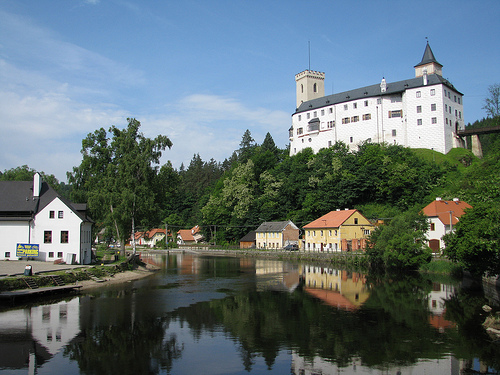
Rožmberk nad Vltavou is a picturesque small town in the South Bohemian Region of the Czech Republic, nestled along the banks of the Vltava River in the Bohemian Forest Foothills. With a population of around 375 as of 2025, it serves as a charming gateway to natural beauty and historical sites, most notably dominated by the majestic Rožmberk Castle perched on a promontory above the town. The town and castle together form a harmonious blend of medieval history, scenic landscapes, and tourist appeal, attracting visitors for rafting on the Vltava, hiking, and cultural exploration. Often compared to a miniature version of nearby Český Krumlov, Rožmberk nad Vltavou offers a quieter, more intimate experience of Bohemian heritage.
Perched on a rocky promontory carved by the Vltava River on three sides, Rožmberk Castle overlooks the town from coordinates 48°39′25″N 14°22′10″E. It's about 20 km south of Český Krumlov, making it a strategic vantage point in the romantic South Bohemian landscape.
Founding and Early History (13th–14th Centuries)
The castle was
founded in the first half of the 13th century by members of the Vítkovci
(Witigonen or Witikonides) family, a powerful clan of Czech nobility. It
is first mentioned in writing in 1253 in a document signed by Vok of
Rožmberk (Vok z Rožmberka, also Vok of Prčice), who took his name from
the castle. Some sources attribute the founding to Vítek the Younger of
Prčice or his son Vok.
Vok established the original Upper Castle
(Horní hrad) as the family’s primary seat and administrative center.
This early Gothic structure featured:
A prominent cylindrical tower
known as the Jakobínka (about 9.6 meters in diameter with corbelled
ramparts).
A palace.
Defensive walls and a moat.
A
settlement (the future town) soon grew in the barbican area. Vok donated
part of the estate to the Cistercian monastery at Vyšší Brod, which he
helped establish.
In 1302, the Rožmberk branch inherited the nearby
Český Krumlov estate after the Krumlov line of the Vítkovci died out.
The family gradually shifted their main residence to Český Krumlov, but
Rožmberk remained symbolically important as their ancestral home.
Around the 1330s, Jindřich (Henry) of Rožmberk constructed the Lower
Castle (Dolní hrad), adding defensive ramparts and enhancing the
complex. By the early 15th century, the site consisted of two distinct
but connected fortifications, each with its own administrators.
Medieval Challenges and Pawning (15th–Early 16th Centuries)
During
the Hussite Wars, the Rožmberks navigated complex political and
religious conflicts. In 1420, Oldřich II of Rožmberk (1403–1462) pawned
the castle to the Austrian Lords of Walsee to fund his forces against
the Hussites. It was later redeemed. In 1465, it was pawned again to the
Lobkowicz family and again redeemed.
Oldřich II’s daughter, Perchta
of Rožmberk (1429–1476), became the inspiration for the famous White
Lady (Bílá paní) legend associated with multiple Rožmberk properties.
Unhappily married, she is said to haunt the castle, with the color of
her dress foretelling good or bad events.
In 1522, a major fire
destroyed the Upper Castle, which was never rebuilt. Only the Jakobínka
tower survives today as a landmark and viewpoint.
Renaissance
Transformations (16th–Early 17th Centuries)
The Lower Castle
underwent significant Renaissance renovations. In the mid-16th century
(around 1556), it received sgraffito facade decorations and interior
updates.
Petr Vok of Rožmberk (Peter Wok, 1539–1611), the last major
male member of the direct line and a renowned Renaissance patron,
bequeathed Rožmberk in 1597–1598 to his nephew Johann Zrinski of Seryn
(Jan Zrinský ze Serynu, 1565–1612). Zrinski further remodeled the
interiors in a Mannerist style, adding notable painted decorations in
the Knights’ Hall and Music Niche.
Post-Rožmberk Owners:
Švamberks and Buquoys (17th–19th Centuries)
After Zrinski’s death in
1612, the estate passed to the Švamberk family (relatives of the
Rožmberks). Following their defeat in the Battle of White Mountain
(1620), their properties were confiscated by Emperor Ferdinand II. The
castle was granted to Charles Bonaventure de Longueval, Count of Buquoy
(Bucquoy), a commander in the Imperial army of French-Belgian origin.
The Buquoy family (whose main seat was at Nové Hrady) held Rožmberk
until 1945. In the 19th century, particularly under Jan Jiří Buquoy
(1840–1857), the castle was extensively remodeled in the Romantic
Neo-Gothic (“Tudor Gothic”) style. This included:
A new entrance with
stairs.
The Crusaders’ Gallery.
Furnishings with historic and
specially commissioned pieces.
Conversion into a family museum—one of
the first in Bohemia—open to the public.
The family created a new
residence and English-style park roughly on the site of the old Upper
Castle.
20th Century to Present
After World War II, in 1945,
the castle was nationalized and became state property. It is now
administered by the National Heritage Institute (Národní památkový
ústav) and remains open to the public with guided tours showcasing both
Rožmberk and Buquoy legacies.
The interiors blend Renaissance
sgraffito and paintings with Neo-Gothic elements, featuring collections
of weapons, paintings, furniture, and applied arts. The White Lady
legend endures as a cultural highlight.
Overall Layout and Structure
The castle complex originally consisted
of two main parts: the Upper Castle (Horní hrad) and the Lower Castle
(Dolní hrad). Today, the visible structure primarily represents the
Lower Castle, which has been adapted over centuries into a residential
and representative building. The Upper Castle was largely destroyed by
fire in 1522 and never fully rebuilt; only its prominent defensive
tower, the Jakobínka, survives.
Site: The castle occupies a
strategically elevated position on a narrow rocky headland, carved on
three sides by the river, with a moat (partly rock-cut) protecting the
vulnerable neck of the promontory.
Lower Castle: Irregular two-storey
building arranged around a closed oblong courtyard.
South side:
Original palace wing.
North side: Long Crusaders' Gallery (added or
significantly modified in the 19th century).
Eastern entrance side:
Transversal wing with a prominent needle-like tower (often called the
clock tower or entrance tower) topped with Neo-Gothic crenellation,
which dominates the silhouette.
Jakobínka Tower: A massive
circular Gothic defensive tower (about 9.6 meters in diameter, around 38
meters high) from the 13th century. It features corbelled ramparts
(originally supporting wooden hoardings or a walkway) and now has a
reconstructed conical roof. It stands somewhat separately as a landmark.
Architectural Evolution and Styles
Rožmberk exemplifies layered
Bohemian architecture:
Gothic Origins (Mid-13th Century):
Founded by the Vítkovci (Witigonen) family, specifically associated with
Vok of Rožmberk.
Initial Upper Castle: High tower (Jakobínka) +
palace, enclosed by walls and moat.
Lower Castle added after ~1330 by
Jindřich of Rožmberk: Defensive ramparts and basic residential
structures.
Features: Thick stone walls, limited openings, functional
military design with corbels and defensive elements.
Renaissance
Transformation (16th Century):
Major reconstruction around 1556 under
Rožmberk owners (notably after the 1522 fire).
Facades decorated with
sgraffito (scratched plaster technique showing Renaissance patterns and
figures) — a hallmark of the Rožmberk style.
Interiors enhanced with
painted decorations, including Mannerist elements under later owners
like Jan Zrinský (early 17th century).
Shift from pure fortress to
comfortable aristocratic residence: larger windows, decorated halls, and
representative spaces.
19th-Century Romantic Neo-Gothic (Tudor
Gothic / Romantic Gothic):
Extensive remodeling 1840–1857 by the
Buquoy family (who owned it from the 17th century).
Aimed to create a
romantic, "picturesque" medieval appearance fitting 19th-century ideals
(inspired by English Gothic Revival).
Additions: Neo-Gothic
crenellations, tower modifications, new entrance stairs, and the
Crusaders' Gallery.
Interiors refurnished as a family museum with
historicist furniture, wood carvings, and collections.
Key
Architectural and Decorative Features
Exterior: White/ light-colored
facades with sgraffito remnants, multi-story rectangular windows, dark
roofs, and prominent towers. The irregular massing reflects organic
growth and later harmonization.
Jakobínka Tower: Stark, functional
Gothic form contrasting with the more ornate residential wings.
Interiors (notably the Knight's Hall / Rožmberk Hall):
Painted panel
ceilings.
Rich Mannerist/Renaissance frescoes and decorations,
including a famous "musical niche."
Baroque and Neo-Gothic
furnishings, collections of paintings, arms, porcelain, glass, and
furniture.
Chapel with painted decorations.
Significance
Rožmberk served as the original seat of the powerful Rožmberk
(Rosenberg) family, one of Bohemia's most influential noble houses. It
later passed to the Buquoys and was nationalized after WWII. Its
architecture tells the story of transition from medieval stronghold to
Renaissance palace to Romantic-era museum. The setting above the Vltava
enhances its dramatic, fairy-tale quality.
Today, it is open to the
public with tours highlighting its history, the "White Lady" legend
(associated with Perchta of Rožmberk), and its collections. The nearby
town and river add to the picturesque ensemble.
Location and Getting There
Address: Státní hrad Rožmberk, 382 18
Rožmberk nad Vltavou.
It's about 25–30 minutes (20–25 km) south of
Český Krumlov by car or bus, making it an easy half-day or full-day
trip.
By car: Parking is available but limited near the base; the
castle is on a hill. Note that driving directly up to the castle may be
restricted—walk up the path (steep but short, 10–15 minutes) for the
best experience.
Public transport: Buses from Český Krumlov or České
Budějovice. The village below has a charming square and riverfront.
From Prague: About 2–2.5 hours by car or via train/bus to Český Krumlov
then local connection.
Best Time to Visit
Season: Primarily
April to October (closed or very limited in winter).
Peak summer
(July–August): Longest hours but busier.
Shoulder seasons (May–June,
September–October): Fewer crowds, pleasant weather, and beautiful autumn
colors in the surrounding forests.
Early morning or late afternoon:
Better light for photos, fewer tour groups, and more peaceful
atmosphere. Avoid Mondays if possible, as some Czech castles have
restricted hours.
Opening Hours and Tickets (as of recent data;
always verify)
Hours vary seasonally—typically Tuesday–Sunday, with
shorter winter/off-season times (e.g., tours at specific slots like 11
AM and 1 PM in October). Check the official site (hrad-rozmberk.cz/en)
for current "Opening hours today."
Tickets: Available on-site or
online in advance (recommended in peak season). eTickets up to 48 hours
before.
Approximate prices (recent figures; expect slight increases):
Adults: 180–220 CZK (~€7–9).
Reduced (seniors 65+, youth 18–24,
disabled): 150–180 CZK.
Children (6–17): Lower rates; under 6 often
free.
Combined tickets for multiple tours or tower available.
Payment: Cards accepted. Family discounts often exist.
There are
usually two main guided tours:
Representative rooms (halls,
Renaissance elements).
Private/family rooms (19th-century furnished
interiors).
Tours last 45–60 minutes each and are primarily in
Czech, but English info sheets or audio guides are provided. Some guides
speak English and answer questions. Special tours may include the
English Tower (great views, 200+ steps) or Jakobínka Tower (remains of
the upper castle).
Additional attractions:
Museum of the
Capital Justice System (dungeon/exhibition in cellars).
Collections
of paintings, weapons, furniture, porcelain, and glass.
The legendary
White Lady (Perchta of Rožmberk) ghost story—her portrait is in the
castle.
Visiting Tips
Guided tours only for interiors—no free
roaming. Arrive 15–20 minutes early for your slot. Tours can feel
somewhat rushed, so read the English booklet thoroughly.
Physical
demands: Steep hill access, stairs inside, and narrow passages. Not
ideal for severe mobility issues (check accessibility on official site).
Wear comfortable shoes.
Photography: Allowed in most areas (no
flash); exterior and views are stunning, especially from the river or
towers.
Weather: The hill can be windy/exposed. Bring layers and rain
gear.
Crowds: Smaller and less touristy than Český Krumlov or Prague
Castle—more intimate experience.
Time needed: 1.5–3 hours for tours +
grounds/views. Add time for the village and lunch.
With kids:
Family-friendly with engaging history and views. Some programs or
entertainment options available.
Food/Refreshments: Limited on-site;
better options (including a brewery with good restaurant) in the village
below.
What to Expect Inside
The interiors feature richly
decorated halls with frescoes, chandeliers, period furniture, portraits,
and artifacts from the Rožmberk and Buquoy eras. Highlights include the
Knight's Hall, Renaissance elements, and Neo-Gothic touches. The setting
feels romantic and atmospheric rather than overwhelmingly grand.
The Legend of Perchta of Rožmberk (The White Lady)
The central
figure is Perchta of Rožmberk (also Perchta von Rosenberg, c.
1429–1476), a real historical noblewoman whose tragic life inspired one
of Central Europe's most enduring ghost stories.
Historical
Background:
Perchta was the daughter of Oldřich II of Rožmberk, a
shrewd and ambitious politician who expanded the family's vast holdings
in southern Bohemia.
She grew up in relative privilege in Český
Krumlov, receiving an education unusual for the time (she could read and
write).
Her father arranged her marriage in 1449 to Jan V of
Lichtenštejn (John of Liechtenstein), a widower from a powerful but
indebted family, primarily for political and financial alliances.
Perchta, around age 20, had hoped to marry for love (a local knight,
Petr ze Šternberka), but had no say in the matter.
Unhappy
Marriage:
The union was disastrous from the start. Jan expected a
large dowry that was delayed or paid in installments, leading to
resentment.
Perchta was mistreated by her husband, mother-in-law, and
sister-in-law. She was fed scraps, given rags instead of proper
clothing, denied heat in winter, and treated more like a servant than a
noblewife.
She gave birth to at least two children (a daughter
Alžběta and a son), but this did not improve her situation. She was
often prevented from attending family events.
Perchta wrote dozens of
desperate letters (over 30–92 survive, preserved in archives like
Třeboň) to her father and brothers, vividly describing her abuse and
begging for rescue. These letters are rare examples of medieval women's
writing and confirm the mistreatment. Her pleas were mostly met with
empty promises or advice to endure.
Death and Curse:
Jan fell
ill; Perchta nursed him, but when he begged for forgiveness on his
deathbed (1473), she refused. He reportedly cursed her.
Perchta died
in 1476 in Vienna during an epidemic (possibly plague) at around age
46–47. She was buried in the Lichtenstein family tomb (now lost).
The Ghostly White Lady:
According to legend, the curse bound
Perchta's spirit to roam the Rožmberk family estates eternally. She
appears as a benevolent but mournful figure in a white dress
(symbolizing purity and mourning), often with keys at her waist,
wandering corridors and chambers.
Omens: White gloves or a smiling
face signal good news or favor for someone in the family. Black gloves
or a solemn expression foretell death or tragedy.
She is protective,
especially of children—comforting them when nurses sleep or intervening
in their care. One famous tale involves her scolding a nanny for young
Petr Vok z Rožmberka (a later prominent family member); when chastised,
she vanished through a wall. Petr Vok later supposedly found treasure
there.
Sightings have been reported across multiple Rožmberk
properties (Rožmberk nad Vltavou, Český Krumlov, Jindřichův Hradec,
Třeboň, Telč), making her one of the most "well-traveled" White Ladies
in folklore.
Notable Later Sightings and Stories:
During WWII,
when the castle was used by Nazi youth groups, Perchta allegedly
appeared angrily when swastika banners were hung, causing the young
women to drop them and suffer temporary insanity.
She has reportedly
appeared during renovations (e.g., late 1990s) and to tourists making
noise in Český Krumlov.
A painting in Rožmberk Castle depicts her
pointing to an Enochian (angelic language) inscription linked to
alchemists John Dee and Edward Kelley, who had ties to the region under
Emperor Rudolf II. Decoding it is said to free her spirit and reveal
treasure.
Her story blends real historical suffering with
folklore. White Lady legends predate her in Germanic traditions, but
Perchta became the archetype in Bohemia. Historian Bohuslav Balbín in
the 17th century helped popularize the connection.
Other
Hauntings and Legends at Rožmberk Castle
While the White Lady
dominates, the castle has other eerie associations:
General
atmosphere of melancholy due to its isolated, romantic setting and
history of family decline (the Rožmberks' power waned after Petr Vok).
Tales of protective or warning spirits tied to the family's fortunes.
The executioner's house nearby features torture exhibitions, adding to
the dark historical vibe, though not directly supernatural.
Like many
old castles, there are vague reports of shadowy figures, unexplained
noises, or cold spots, but these are secondary to Perchta's
well-documented legend.
The castle is not considered one of the
most terrifyingly haunted sites in Czechia (compared to places like
Houska Castle, said to cover a hell portal), but its ghost is among the
most famous and sympathetic.