Location: South Bohemian Region Map
Constructed: 12th century
Tel. 383 321 537
Open:
May- Oct: Tue- Sun
Official site
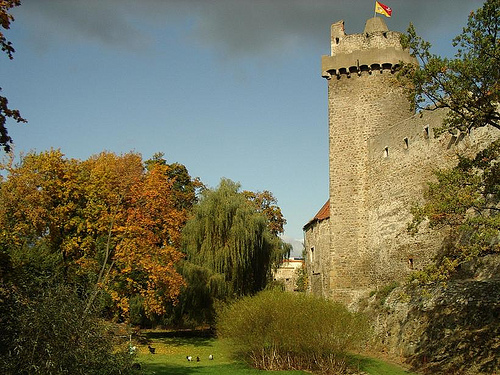
Strakonice Castle (Czech: Strakonický hrad or simply Hrad Strakonice) stands at the confluence of the Otava and Volyňka rivers in the town of Strakonice, South Bohemia, Czech Republic. It ranks among the oldest aristocratic castles in the region and one of the most significant medieval sites tied to the Knights Hospitaller (Order of St. John, later the Sovereign Military Order of Malta). The complex blends Romanesque, Gothic, Renaissance, and Baroque elements across three courtyards, a moat (partially preserved), fortifications, a church, and residential palaces. Today, it functions as the Museum of the Middle Poothavia (Muzeum středního Pootaví), housing exhibitions on regional history, the Order of Malta, bagpipes, motorcycles, firearms, and traditional fez production, along with a library, art school, and cultural spaces. It has been a protected national cultural monument since 1995.
Founding by the Bavor Family (Late 12th–Mid-13th Century)
The
castle's origins trace to the powerful Bohemian noble Bavor family
(Bavorové ze Strakonic), who built it as a fortified residence and
religious center between roughly 1220 and 1235 (some sources suggest
construction began in the late 12th century). The site, on a strategic
river confluence with gold-bearing waters in the Otava, featured early
Romanesque-Gothic elements: a moated fortress, a palace, the Church of
Saint Procopius (originally dedicated to Saint Adalbert or Wenceslaus),
an ambit (cloister walkway), and defensive towers. The first written
mention appears in a 1235 charter of King Wenceslaus I, where a Bavor is
listed as a witness bearing the title "of Strakonice."
In 1243, Bavor
I (the Elder, d. 1260)—a royal cupbearer, Zvíkov castellan, and
participant in the Crusades—and his wife Bohuslava (or Dobroslava)
formally donated the eastern half of the castle, including the church
and several villages (such as Lom, Ptakovice, and others), to the Order
of St. John (Hospitallers). This established a commandery (komenda)
there, linking the castle's fate to the Order for centuries. The
donation was confirmed by the king and reflected the family's ties to
the Crusades (legend claims the Bavor coat of arms, featuring an arrow,
originated from the 1190 Siege of Acre). The castle was initially
divided: the western secular Bavor residence and the eastern Hospitaller
section with a hospital for pilgrims on routes linking Prague, Bavaria,
and Austria.
Expansions Under the Bavors (Mid-13th to Early 14th
Century)
Under Bavor II (the Great, active 1260–1280s), son of Bavor
I and half-brother to King Ottokar II Přemysl via marriage, major Gothic
expansions occurred. These included raising and extending the southern
palace, adding a quadrangular residential tower in the southwest corner,
new stone walls on the west and north, and the prominent Rumpál Tower (a
Gothic structure with a blade-like feature) on the western
fortifications. The castle retained its divided layout. Bavor II also
developed nearby Horažďovice and participated in key royal campaigns,
including the 1278 Battle on the Marchfeld.
Bavor III (early 14th
century) continued work, particularly in the Hospitaller section:
vaulting the ambit and completing the church's presbytery and polygonal
tower. The ambit received its famous frescoes (c. 1310–1340), depicting
a Christological cycle—one of the oldest and most valuable north of the
Alps. Property divisions among Bavor heirs (including brothers Vilém and
Mikuláš) saw Strakonice pass to Vilém's line; by the late 14th century,
the family declined amid political turmoil. In 1402, the last Bavor
holdings were sold, and the Hospitallers acquired the entire castle and
estate.
Hospitaller Commandery and Grand Prior Residence
(1402–17th Century)
From 1402, the castle became a full Hospitaller
commandery. After Hussite forces looted the Order's Prague headquarters
in 1420–1421, Strakonice served as the official residence of the Grand
Priors (velkopřevoři) of the Czech Grand Priory, housing archives and
insignia. The town itself grew into a royal town by the early 14th
century under Bavor privileges (a 1367 charter by Bavor IV, or Bašek,
granted urban rights).
Key events and figures under the Order
include:
1420: Hussite commander Jan Žižka occupied the town but
failed to take the fortified castle.
1449–1451: Grand Prior Václav z
Michalovic hosted the Strakonice Union (against the Utraquist Calixtines
and George of Poděbrady); it ended in defeat, and he died at the castle
in 1451.
Mid-15th century: Improvements to a hospital and Church of
Saint Margaret under successors like Oldřich II z Rožmberka and Jošt z
Rožmberka.
Renaissance phase (early 16th century): Under Grand Prior
Jan III z Rožmberka (1511–1532), the southern wing was rebuilt, the
Jelenka Tower (hunting-related, with Rožmberk rose frescoes) was added,
and town fortifications (including gates and bastions) were
strengthened. He also created the town's coat of arms and granted
economic privileges (guilds, salt monopoly, etc.).
Later 16th
century: Brewery expansion in the northern wing; plague columns and
guild support under priors like Wenceslas Zajíc of Házmburk and
Christopher of Vartenberk.
Thirty Years' War, Decline, and
Baroque Era (17th–18th Centuries)
The castle suffered heavily during
the Thirty Years' War: looted in 1620 by estates' troops and again in
1641 by Swedish forces (possibly via betrayal at a mill gate, still
called the "Swedish gate"). Fires (e.g., 1626) devastated parts of the
complex and town. Post-war, it declined as Grand Priors shifted focus
back to Prague (main seat returned 1694), with economic uses like
granaries and brewing.
Major Baroque reconstruction occurred under
Grand Prior Ferdinand Leopold Dubský of Třebomyslice (1714–1721), who
added a new palace at the river confluence. Later priors landscaped
gardens, a pheasantry, and orchards in the moat. Economic and
administrative roles continued into the 19th century, though the Order
faced challenges.
19th–21st Centuries: Nationalization, Wars, and
Modern Museum Use
The Order retained ownership until the early 20th
century (formally until 1925, despite post-1918 land reforms
expropriating much estate land). Interwar negotiations for sovereign
status in Czechoslovakia failed. During the Nazi occupation (1939–1940),
the northern wing was partially demolished for NSDAP apartments.
Post-WWII Beneš decrees and communist repression (Action K from 1949)
targeted Order members; the last prior, Prof. Antonín Voráček, was
imprisoned until 1960.
Nationalized after 1945, the castle was
declared a cultural monument in 1963 and a national cultural monument in
1995. Extensive restorations preserved frescoes (e.g., 1932–1933
efforts) and structures. Since the late 20th century, it has housed the
regional museum, which expanded in 2022 with a dedicated Order of Malta
exhibition after acquiring additional church spaces. Today, it serves as
a cultural hub with the Šmidinger Library, art school, and events.
Archaeological traces (e.g., from 1970s digs) and preserved elements
like Romanesque portals, ribbed vaults, and the unique brick-ribbed
ambit underscore its layered history.
Construction Phases and Architectural Evolution
Construction began
between 1220 and 1235 under the Bavor (Bavarian) family of Strakonice.
The first phase included the main fortifications, the western part of
the Church of St. Procopius, the ambit (cloister), and the original
Romanesque palace with its chapter hall. In 1243, Bavor I donated the
eastern half to the Knights Hospitaller, establishing a commandery.
Further Gothic expansions occurred under Bavor II (new palace and
vaulted ambits, 1260–1280) and Bavor III (western fortifications and
Rumpál Tower transformation, early 14th century). The Order acquired the
entire castle in 1402, making it the seat of the Grand Priors from 1421.
Renaissance rebuilding followed in the late 15th–16th centuries
(especially under Jan III z Rožmberka after 1500). Baroque
modifications, including the entrance prelature, were added 1714–1721.
Minor 20th-century restorations preserved frescoes and adapted spaces
for museum use.
Key Architectural Features
Rumpál Tower (the
dominant defensive keep): Originally a prismatic Romanesque-Gothic
tower, it was transformed in the early 14th century into a cylindrical
(or blade-edged in plan) Gothic structure with crenellations and a
distinctive “blade” profile for defense. It served as a lookout, prison,
and torture chamber. Built of massive stone blocks, it remains one of
the castle’s oldest and most visually striking elements, offering
panoramic views today.
Jelenka Tower: A Renaissance addition built
after 1500 by Jan III z Rožmberka along the northern stone wall. It
features lighter proportions than the Rumpál Tower and an interior
wooden painted joist ceiling, typical of the period’s shift toward
residential elegance.
Church of St. Procopius (Kostel sv. Prokopa):
The oldest structure, with clear Romanesque origins (western nave,
narrow southern aisle, profiled stone portal to the sacristy, and a
Romanesque circular window). The main nave, chancel, and a large
prismatic tower were added by the end of the 13th century. It was later
rebuilt in Baroque style with Rococo decorative elements. Interiors
contain late-Gothic wooden statues (including a 1320–1330 Madonna, now
in Prague’s National Gallery), a late-Gothic altar of St. Anne, a 1370
wooden crucifix, and fresco fragments on the gallery’s western wall.
Baroque furnishings and altars complete the layered appearance.
Ambit
(Cloister / Cross Corridor): A cross-shaped Gothic walkway surrounding
the church and chapter hall, featuring ribbed cross vaults with brick
ribs and Romanesque stone portals. Its walls bear one of the most
significant medieval mural cycles in Central Europe: a richly detailed
christological cycle of frescoes dated 1310–1340 (restored 1932–1933).
Often described as the oldest or largest preserved cycle of wall
paintings north of the Alps, these Gothic masterpieces depict biblical
scenes with exceptional artistic quality and remain a highlight of the
interior.
Capitular (Chapter) Hall: Located on the ground floor of
the original Romanesque palace. It features a four-bay ribbed vault, a
Romanesque circular window above the entrance, and additional fresco
decoration complementing the ambit cycle. This space served the knights’
administrative and religious functions.
Residential Palaces and
Wings:
The old (Romanesque) palace forms the core.
The new palace
(1260–1280) and later Renaissance residential palace (rebuilt after
1500) line the second courtyard, with sgraffito remnants and oriel
windows.
The northern wing (former burgraviate) retains a
half-timbered gable.
The southern palace now houses historical and
ethnographic exhibitions.
Baroque Prelature / Entrance Manor: The
youngest major addition (1714–1721) is the two-storey yellow-and-white
Baroque building at the main entrance. It features a prominent clock
gable, balustraded balcony, and sculptural decoration. Today it contains
the chateau gallery of contemporary art.
Materials and
Construction Techniques
The castle is built primarily of local stone
(massive ashlar blocks for towers and walls) with brick used for vault
ribs. Wooden elements appear in Renaissance ceilings and roofs (red
tile). Defensive features include machicolations on the Rumpál Tower and
a moat system. Interiors combine ribbed Gothic vaults, Romanesque
portals, and later Baroque stucco/plasterwork.
Current Use and
Significance
Since the 1950s the castle has functioned as a museum
and cultural centre. Permanent exhibitions cover local history,
traditional bagpipe-making, 19th-century interiors, fez production
(Strakonice was a major exporter), weapons, and motorcycles (Jawa
brand). The Baroque prelature hosts rotating contemporary art shows. The
site remains an outstanding example of layered Central European castle
architecture, where military Gothic meets refined Renaissance and
Baroque residential styles.
One of the castle's standout features is the Rumpál Tower, which offers panoramic views as a lookout point. The southern palace hosts historical and ethnographical expositions, including displays on pipes (bagpipes), 19th-century interiors, fez production, weapons, and motorcycles. The castle boasts the largest exposition of bagpipes and bagpiping in the Czech Republic. The Baroque prelature features a chateau gallery of contemporary art, with paintings, sculptures, pottery, porcelain, and jewelry. The unique Gothic wall paintings in the ambit and capitulary hall are particularly noteworthy.
Following extensive reconstruction between 2005 and 2010, Strakonice Castle is now a vibrant cultural site managed by the Museum of Central Otava Basin. It hosts events such as weddings, concerts, castle safaris, museum nights, night tours, and seasonal markets like Advent and Christmas markets in the courtyard. Visitors can enjoy tours, walks, and refreshments, with the site serving as a regional museum and gallery. For more details, contact the museum at Zámek 1, 386 01 Strakonice (tel: +420 380 422 608, email: informace@muzeum-strakonice.cz, website: www.muzeum-strakonice.cz).