Location: South Bohemian Region Map
Hussite Festival in September
Tábor is a historic town in the South Bohemian Region of the Czech Republic, serving as the second-largest settlement in the area with a population of approximately 34,000 residents. Located about 90 kilometers south of Prague, it lies along a bend in the Lužnice River, nestled amid rolling hills, forests, and agricultural fields that characterize the Bohemian countryside. The town's strategic position on a hilltop has historically provided natural defenses, contributing to its role as a fortified stronghold. Geographically, Tábor benefits from a temperate climate with mild summers and cold winters, and its proximity to natural features like the Jordan Reservoir—the oldest in Central Europe—adds to its scenic appeal.
Prehistoric and Early Medieval Roots (Iron Age to 14th Century)
The area around Tábor shows continuous settlement from the Hallstatt
(Iron Age) and La Tène (Celtic) periods, with Roman coins and possible
smaller Celtic sites. In the 13th century, the Vítkovci noble family
established a settlement called Hradiště (“hillfort”). King Přemysl
Otakar II attempted to found a royal town here around 1270–1272,
enclosing the area with walls and starting a massive castle on the
southwestern edge. The project collapsed after his death in 1278; the
site remained largely unpopulated until the 15th century. By the late
14th century, the Church of Saints Philip and James (the oldest sacral
building) is documented, and the castle passed to the lords of Ústí.
Founding of Hussite Tábor (1420) and the Radical Experiment
Tábor
was deliberately founded in spring 1420 by radical Hussites fleeing
persecution after the Defenestration of Prague (1419). Led by Petr
Hromádka of Jistebnice and others, they chose the site for its
defensibility and biblical symbolism — naming it after Mount Tabor,
where the prophetess Deborah defeated the Canaanites (Judges 4). The
full original name was Hradiště hory Tábor (“Fortified settlement of
Mount Tabor”).
The early Taborites created one of medieval Europe’s
most radical social experiments: “Hussite communism.” Newcomers
surrendered all property into communal chests (kádě) on the main square;
goods were distributed according to need. Everyone was theoretically
equal; four elected hejtmani (captains) governed. Jan Žižka, the
one-eyed military genius, trained a peasant army famous for war wagons
(mobile fortresses with artillery and infantry) and innovative tactics.
Tábor quickly became the base for devastating raids on monasteries
(Milevsko, Zlatá Koruna, etc.), iconoclasm, and plundering — loot was
the main early revenue. The population reached about 3,000. The
egalitarian phase lasted only about six months; by autumn 1420 the
Taborites imposed feudal taxes on surrounding villages and became
landlords themselves.
Tábor’s army helped win key early victories in
the Hussite Wars, including the defense of Prague. After Žižka’s death
(1424) and the decisive defeat of the radicals at the Battle of Lipany
(1434), the Taborites reconciled with moderate forces.
Royal Town
and Renaissance Flourishing (1437–16th Century)
In 1437 King
Sigismund of Luxembourg granted Tábor royal-town status with privileges
modeled on Prague’s Old Town; its coat of arms featured walls, towers,
and the Luxembourg eagle (later the Czech lion). In 1452 the town
submitted to George of Poděbrady (future Hussite king), ending the
independent Taborite era.
The late 15th and 16th centuries brought
rapid growth. In 1492 the Jordán Reservoir — the oldest artificial lake
in Central Europe — was created by damming the Tismenický stream to
solve water shortages; water was pumped to a tower supplying seven
fountains (named after the biblical River Jordan). The Dean Church of
the Transfiguration of Christ on the Mount (Bohemian Renaissance style)
was completed in 1512. Most of the present historic center took shape,
with sgraffito-decorated burgher houses and gables. Major fires in 1532
(366 houses destroyed) and 1599 (over 250 houses) prompted rebuilding in
stone. In 1547 Tábor was punished for refusing aid to Ferdinand I
Habsburg, losing its landed estates.
Habsburg Rule, Wars, and
Catholicization (17th–18th Centuries)
After the Battle of White
Mountain (1620), Tábor resisted Ferdinand II and endured a six-month
imperial siege (ending November 1621). During the Thirty Years’ War the
Swedes stormed and looted the town in 1648. Catholicization followed:
Discalced Augustinian monks arrived, building a monastery and Church of
the Nativity of the Virgin Mary (1642–1666, later a prison and now part
of the museum complex). Plague struck in 1680; Prussian forces occupied
the town in 1744. Maria Theresa elevated Tábor to a regional
administrative center in 1750.
19th-Century Industrial and
National Awakening
The 19th century transformed Tábor into a modern
Czech cultural and economic hub. A permanent theater opened in 1841; the
first all-Czech gymnasium (secondary school) in the Austrian monarchy
was founded in 1862. The Prague–Vienna railway arrived in 1871, followed
by the pioneering electrified Tábor–Bechyně narrow-gauge line
(“Bechyňka”) in 1903 — the first electric railway in Austria-Hungary,
engineered by František Křižík. A massive tobacco factory (1881) became
the largest industrial employer in South Bohemia. The Neo-Renaissance
theater (now Divadlo Oskara Nedbala) opened in 1887. A huge South
Bohemian exhibition in 1902 drew tens of thousands. The iconic bronze
statue of Jan Žižka on Žižka Square (by Josef Strachovský) replaced an
earlier flawed version in 1884. Czech national identity surged; the city
became a pilgrimage site for Hussite heritage.
20th Century:
Independence, Occupation, and Communism
Tomáš Garrigue Masaryk, en
route from exile, stopped in Tábor in December 1918 and famously
declared “Tábor je náš program” (“Tábor is our program”), linking the
new Czechoslovak Republic to Hussite ideals. He returned in 1920 for the
city’s 500th anniversary and was made an honorary citizen.
Tábor
became a garrison town (305th artillery regiment from 1932). During the
Nazi occupation, following the 1942 assassination of Reinhard Heydrich,
Gestapo courts executed 156 people (including 20 women) from southern
Bohemia in June–July 1942 at a site now marked by a monument with bronze
lions. The town was briefly merged into “Velký Tábor” (1942–1945).
Post-war, it expanded (annexing villages in 1960 and 1971) and grew
rapidly under communism, reaching over 36,000 inhabitants by 1991.
Infrastructure modernized with the D3 motorway and expanded rail links.
Post-1989 to Present
After the Velvet Revolution, population
stabilized around 34,000. Tourism boomed around the Hussite heritage.
The Old Town Hall (late Gothic, heavily restored) has housed the Hussite
Museum since the 20th century, displaying war wagons, relics, and
underground cellars (a 500-meter labyrinth of interconnected tunnels
used for defense and storage). The former Augustinian monastery complex
also serves museum functions. A new zoo opened in Větrovy in 2015
(largest in the region). The Jordán Reservoir was cleaned in 2013 for
the first time since 1830. Today Tábor is a regional center with
preserved historic core, modern cultural venues, sports teams (football,
ice hockey, cyclo-cross), and international twinnings. Its legacy as the
“spiritual capital” of Hussitism remains central to Czech identity.
Žižka Square (Žižkovo náměstí)
The pulsating heart of Tábor and
the natural starting point for any visit, this irregular, sloping main
square serves as the social and historical hub. Named after Jan Žižka of
Trocnov (the legendary one-eyed Hussite general), it features a central
Renaissance fountain as a meeting spot, an imposing late-19th-century
monument to Žižka, and a ring of beautifully preserved burgher houses
adorned with colorful sgraffito, frescoes, and ornate gables from the
prosperous 15th–16th centuries.
The square hosts markets, festivals,
and events year-round. In summer it buzzes with café life; in winter it
feels quietly atmospheric under the glow of lanterns. Architecturally,
the façades reflect Tábor’s golden age after the Hussite conflicts, when
the town grew wealthy. From here, narrow alleys radiate outward—some
appearing as dead-ends but leading deeper into the medieval maze.
Old Town Hall & Hussite Museum
Dominating the square’s western
side, the Old Town Hall (built 1440–1521) ranks among the Czech
Republic’s finest surviving Gothic civic buildings. Its stepped gable,
tall clock tower, and rib-vaulted interiors showcase late-Gothic
mastery. Today it houses the Hussite Museum, whose ten exhibition halls
trace the movement from its origins through the wars to
19th–20th-century memory. Rare artifacts include Hussite weapons (maces,
arrowheads), a ceremonial mug, and interactive displays; children
especially enjoy the royal throne photo op and touchscreens.
A
highlight is the adjacent Gothic Hall (the “Palace”)—the second-largest
secular Gothic hall in the country—featuring a soaring rib-vaulted
ceiling, a stone town emblem with figures of Žižka and Hus, and a
dramatic equestrian statue of Jan Žižka. The museum is fully accessible
(Braille labels, audio guides in multiple languages).
Underground
Tunnels
One of Tábor’s most unique attractions, this 15th-century
labyrinth lies directly beneath Žižka Square. Citizens originally dug
cellars under their houses for food and beer storage (stable cool
temperatures were ideal). Over generations these interconnected into a
multi-level defensive network up to 16 m deep—shelter during fires,
sieges, or attacks. About 500 m of the system is open to the public,
forming a atmospheric maze that feels genuinely medieval. Guided tours
(sometimes in historical costume with lanterns) are available by
reservation. Combine tickets with the museum for the full experience.
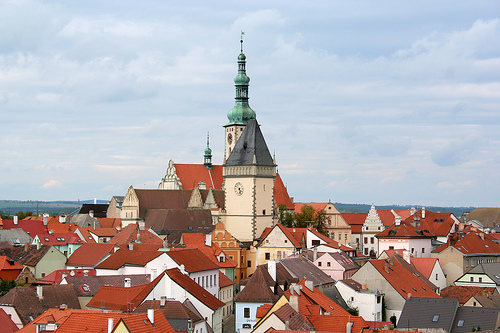
Dean’s Church of the Transfiguration of the Lord on Mount Tabor
Rising prominently on the square, this church (also called the Dean’s
Church or Church of the Metamorphosis/Transfiguration) began as a wooden
structure but was rebuilt in Gothic style at the end of the 15th century
as Tábor became a major religious center. Later Renaissance and Baroque
additions created a harmonious blend. The soaring green-spired tower
offers panoramic views after a steep climb of about 200 narrow, rickety
stairs (passing under the massive bell). The interior rewards with
elegant vaults and historical details.
Kotnov Tower, Bechyne Gate
& Town Walls
Approaching the old town from the south or east, you
first encounter these iconic fortifications. The circular Kotnov Tower
(likely late 13th century, completed in the Hussite era) and adjoining
Bechyne Gate form a dramatic skyline landmark. Climb 155 steps inside
the tower for sweeping views. The gate houses a small exhibition on
Tábor’s history.
The town’s defensive system was ingenious: double
concentric walls with a 6–10 m moat between them (the “bailey”), plus
bastions and cannon positions. Enemies breaching the outer wall would be
trapped and exposed. Most walls were dismantled in the 19th century, but
significant sections survive as a national cultural monument—especially
the massive Žižka Bastion (the “Big Bastion”) to the north. The remnants
create a green belt around the historic core and offer atmospheric
walks.
Monastery Church of Klokoty
A short uphill walk (or
jog) from the center via Klokotská Street and Lipová Alej brings you to
this Baroque pilgrimage complex (construction began early 18th century,
inspired by architect Jan Santini-Aichel). Its white walls, green domes,
and ornate façade make it a serene contrast to the Gothic core. Still an
active pilgrimage site and venue for community events, the church and
surrounding gardens reward the detour with peaceful views and
architectural elegance.
Jordán Reservoir
Just below the old
town lies the Jordán—Central Europe’s oldest artificial reservoir
(dammed 1492 on the Tismenický Stream, named after the biblical site).
Originally built to supply drinking water, it now frames the town
beautifully and serves as a recreational area for walks, swimming (in
summer), or panoramic photos from the opposite shore (near restaurant
Černá Perla). The reflection of the church tower and historic buildings
on calm water is especially photogenic.
Location and Regional Context
Geographically, Tábor sits at
approximately 49°24′52″N 14°39′28″E, roughly 70 km (43 mi) south of
Prague and 50 km (31 mi) north of České Budějovice. It occupies the
northern edge of South Bohemia on the transitional boundary between the
Třeboň Basin (to the south) and the Vlašim Highlands (to the north),
though it is primarily classified within the Tábor Uplands (Táborská
pahorkatina).
The Tábor Uplands form a geomorphological mesoregion
within the Central Bohemian Hills, covering about 1,599 km² (617 sq mi)
with an average elevation of 449 m (1,473 ft) and dimensions roughly 50
km long. This places Tábor amid rolling hills, river valleys, and
Pleistocene terraces shaped by long-term erosion and minor tectonic
influences.
The municipal area spans 62.22 km² (24.02 sq mi) across
15 parts (including the historic core and surrounding villages like
Čekanice, Klokoty, and Všechov).
Topography and Terrain
Tábor
lies in an area of medium-high hills with an erosional-denudative
relief. The average elevation within the municipality is around 437–464
m (1,434–1,522 ft), depending on the exact reference point (town center
vs. broader area). The historic old town occupies a prominent defensive
hill above the river, a strategic choice dating to its 1420 Hussite
founding.
Highest point: Hýlačka hill at 525 m (1,722 ft).
Lowest point: The surface of the Lužnice River (approximately 376 m /
1,234 ft in the municipal range).
Regional upland peaks (outside
immediate town) reach up to 633 m at Velký Mehelník.
The terrain
features gentle to moderate slopes, river-cut valleys, and scattered
rock formations (notably on the eastern edge). Arable land dominates the
central uplands, with forests more prevalent on steeper hillsides. The
old town's elevated position provides panoramic views over the
surrounding agricultural plains and wooded ridges.
Hydrology
Tábor lies directly on the Lužnice River (a Vltava tributary that drains
the eastern Tábor Uplands). The river flows through the municipal
territory, forming a natural low point and historical defensive/moat
feature.
The most prominent water body is the Jordán Reservoir (or
Jordán Pond), an artificial storage lake created in 1492 in the town
center—the oldest such reservoir in Central Europe. Originally for water
supply, it now serves recreation; it sits in a natural depression and is
fed by local streams. The municipality also contains numerous smaller
fish ponds, typical of South Bohemian hydrology.
The broader Tábor
Uplands are rich in watercourses, including sections of the Vltava,
Otava, and Smutná rivers, plus major reservoirs like Orlík and
Hněvkovice farther afield.
Geology
The bedrock consists
primarily of granitoids (especially syenites) of the Bohemian Massif.
This ancient crystalline foundation has been sculpted into the current
uplands through prolonged erosion, denudation, and Pleistocene
periglacial processes that left river terraces. Soils are typically
fertile loams supporting agriculture, with rocky outcrops on hills.
Climate
Tábor experiences a temperate humid continental climate
(transitioning toward oceanic influences), with cold winters, mild
summers, and precipitation distributed throughout the year. Data from
the nearby Kocelovice station (2012–2021) provide these averages (in
°F/°C conversions approximate):
Annual mean temperature: ~48 °F
(9 °C)
Hottest month: July (high 76 °F / 24 °C, low 55 °F / 13 °C,
mean 66 °F / 19 °C)
Coldest month: January (high 35 °F / 2 °C, low 26
°F / −3 °C, mean 31 °F / −1 °C)
Annual precipitation: ~33 inches (842
mm), fairly even but with peaks in winter or summer months depending on
the dataset (some sources note July as wettest at ~96 mm).
Humidity averages 76%, with higher levels in winter (up to 89% in
November). Winds are moderate (strongest in January), and the upland
topography moderates extremes while providing good drainage. Sunshine
hours are higher in summer (e.g., July ~208 hours in some records). Snow
cover occurs in winter, and the region sees occasional fog in valleys.
Environmental and Landscape Overview
The landscape blends rolling
hills, river valleys, extensive arable fields, and patches of
deciduous/coniferous forest. Only a few small protected areas exist;
land use prioritizes agriculture and recreation (around Jordán and the
Lužnice). Settlement density is high due to favorable conditions, with
the historic core on its hill providing a striking contrast to the open
countryside.
Tábor's culture is deeply rooted in its Hussite heritage, celebrated through annual events like the Tábor Meetings (Táborská setkání), featuring historical reenactments, medieval markets, and parades in period costumes. The town hosts music festivals, theater performances, and art exhibitions, reflecting a vibrant local scene. Traditional Czech cuisine, including hearty goulash, dumplings, and local beers, is prominent in its restaurants and breweries. As a regional center, Tábor supports education with schools and a branch of the University of South Bohemia, fostering a community-oriented atmosphere.
Economically, Tábor functions as a transport hub with major rail and road connections, facilitating trade and commuting to Prague. Key sectors include manufacturing (machinery, food processing), services, and tourism, which draws visitors for its history and proximity to other South Bohemian gems like Český Krumlov. The town balances preservation with development, featuring modern amenities like shopping centers alongside historic preservation efforts. With a low unemployment rate and growing eco-tourism focus, Tábor remains a livable, dynamic place that honors its past while looking forward.