Location: South Moravia Region Map
Constructed: 12th century
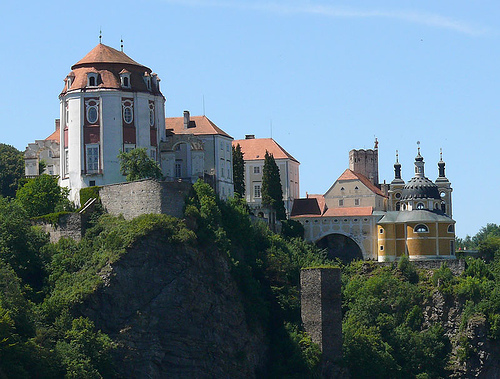
Vranov nad Dyji (German: Frain an der Thaya) is a small market town in the Znojmo District of the South Moravian Region, Czech Republic, nestled in a dramatic valley along the Dyje (Thaya) River. Its history is inseparable from the imposing castle (now chateau) perched on a rocky cliff 80 meters above the river, which has dominated the landscape for over 900 years. The town grew as a settlement beneath this border fortress, serving as a defensive outpost, noble estate center, and later a cultural and industrial hub. Today, it is a national cultural monument within Podyjí National Park, renowned for its Baroque architecture and tourism.
Prehistoric Roots and Medieval Founding (11th–15th Centuries)
The Dyje River valley attracted settlers from prehistoric times due
to its fertile soil, water, and strategic position on the
Moravian-Austrian border. The first written record appears in 1100
in Cosmas of Prague’s Chronica Boemorum, mentioning a border
fortress (oppidum et castrum Wranou) built by Bohemian dukes (likely
Moravian Přemyslids) to guard against raids from the Austrian March.
An early wooden or Romanesque structure may have stood near the site
of today’s Church of the Assumption of the Virgin Mary in the river
meander. By the early 13th century, construction shifted to the
current rocky promontory. Royal charters document castellans (e.g.,
Bohuslav in 1224–1232) and a church with priest and chaplain by
1259. Under Přemyslid rulers like Otakar II, a stone castle emerged
with sophisticated Gothic fortifications: a cylindrical refuge
tower, curtain walls, barbican, prismatic watchtower, and Crow’s
Tower (Vraní věž) for defense. A medieval hot-air heating system
from the 15th century survives in parts of the structure.
In
1323, King John of Luxembourg pawned the estate (including towns,
mills, fishponds, and forests) to the powerful Bohemian noble
Jindřich of Lipá. During the Hussite Wars, the Lichtenburg
(Lichtenštejn) family seized control in 1421 and received it as
hereditary possession in 1499 from King Vladislaus II. They walled
the growing market town (first mentioned in 1323) between 1423 and
1431, likely in response to Hussite threats. The Lichtenburgs held
it until 1516, developing it into a fortified Gothic residence with
a residential palace and chapel.
Turbulent Ownership and
Baroque Transformation (16th–17th Centuries)
The 16th century
brought rapid ownership changes reflecting Moravia’s political
shifts: Arkleb of Boskovice (1516), Jan of Pernštejn (1525), Zdeněk
of Lomnice (1528), the Krajíř family (who added Nový Hrádek estate,
1552), Petr Čertorejský (who granted the town its seal and coat of
arms in 1568), and Estera of Dietrichstein (who founded iron ore
mines and hammer mills with furnaces in the 1580s).
The
Bavarian-origin Althann family acquired it in 1617 via Wolf Dietrich
of Althann, but his involvement in the Bohemian Estates’ rebellion
led to confiscation after the 1620 Battle of White Mountain. It
passed to General Johann Ernst of Scherfenberg (1629), a Wallenstein
ally. The Thirty Years’ War devastated the area: Swedish troops
looted the town in 1645 after the Battle of Jankov, besieged the
castle for months (attempting to divert the Dyje River), and
withdrew only under imperial pressure. A catastrophic fire in 1665
gutted much of the medieval structure. The Starhemberg family
briefly owned the ruins before Michael Johann II of Althann
repurchased it in 1680.
This marked the start of Vranov’s golden
era. Althann commissioned the celebrated Austrian architect Johann
Bernhard Fischer von Erlach (designer of Vienna’s Karlskirche and
Prague’s Clam-Gallas Palace) to convert the Gothic ruins into a
grand Baroque residence. Key features include:
The oval Hall
of Ancestors (1687–1695) with its soaring cupola, frescoes by Johann
Michael Rottmayr glorifying the Althann lineage, stucco by Italian
masters, and statues by Tobias Kracker.
The Chapel of the Holy
Trinity (1699–1700) with a family vault, cylindrical nave, and
dramatic frescoes depicting Heaven, Paradise, and the Last Judgment.
A magnificent Baroque staircase in the courtyard with heroic
sculptures by Lorenzo Mattielli (Herakles fighting Antaeus; Aeneas
saving Anchises), gifted by Emperor Charles VI.
Subsequent
Althanns (Michael Hermann, Marie Anne Pignatelli, Michael Anton)
added three-wing extensions, bridges, and facades, completing the
transformation by the early 18th century.
18th–19th
Centuries: Aristocratic Refinement, Industry, and Culture
The
last Althann owner, Michael Joseph, faced bankruptcy in 1793.
Bohemian lawyer Joseph Hilgartner of Lilienborn acquired it,
landscaped a pre-Romantic English-style park with antique temples,
caves, waterfalls, and sculptures. In 1799, it passed to Polish
Count Stanisław Mniszech (highest marshal of Galicia), whose family
and later the Stadnicki heirs (from 1876) owned it until WWII.
They expanded the park with chapels, obelisks, and memorials, built
a library, hosted theater and chamber music (inviting Viennese
artists and even novelist Henryk Sienkiewicz), and revived industry.
In 1816, Stanisław Mniszech transformed a small earthenware factory
into a major porcelain and stoneware manufactory producing
Wedgwood-style ceramics, a key Czech industry contributor until
1882. Infrastructure improved: roads widened (1806 serpentine to
Znojmo), bridges built (including the 1898 Kaiser-Jubiläums-Brücke),
and the Northwest Railway reached nearby Šumná-Vranov station in
1870. The town gained a post office (1723), school (1724), plague
column (1713), and rebuilt church.
20th Century: Wars,
Expulsion, and State Ownership
Vranov (97% German-speaking in the
early 20th century) experienced upheaval after 1918. It briefly
joined the German South Moravia assembly but was occupied by
Czechoslovak troops in December 1918. Land reform stripped much of
the vast estate (over 5,500 hectares). The 1938 Munich Agreement
incorporated it into Hitler’s Reich; the castle and lands were
confiscated from Adam Zbyněv Stadnicki and sold to German Baron
Gebhard von der Wense-Mörse (1942).
Post-WWII, the state
confiscated the property. German inhabitants were expelled in 1945
(limited to 15 kg luggage). The chateau opened to the public, with
major restorations in the 1970s (roofs, interiors, park). The Vranov
Reservoir (dam constructed in the early 1930s, expanded postwar)
flooded parts of the valley, created a popular beach and recreation
area, and boosted tourism while submerging some historic sites.
Modern Era (Post-1989–Present)
After the Velvet Revolution,
the chateau became a national monument managed by the National
Heritage Institute. It remains largely unaltered since the Baroque
era, showcasing original Vranov porcelain, period furnishings, and
interiors from the late 18th–19th centuries. The town (population
around 800) focuses on tourism, with the chateau, reservoir beach,
hiking in Podyjí National Park, and historic square (with plague
column and church) as highlights. Socialist-era housing slightly
altered the skyline, but the dramatic cliffside chateau still
defines the picturesque skyline.
Historical and Architectural Evolution
The site originated as a
medieval border fortress first mentioned in 1100 (in the Chronica
Boemorum by Cosmas of Prague). Constructed by the Dukes of Bohemia to
guard Moravia's southern frontier against Austrian raids, it began as a
Gothic structure with stone fortifications, curtain walls, a cylindrical
tower, barbican, prismatic watchtower, and the distinctive Crow's Tower
(Vraní věž). Ownership passed through families like the Lichtenburgs,
Pernštejns, and Dietrichsteins, with incremental Renaissance-era
modifications and damage from events like the 1645 Swedish siege and
fires.
The transformative Baroque phase occurred under the Althann
family after Michael Johann II Althann repurchased the estate in 1680.
He commissioned the imperial court architect Johann Bernhard Fischer von
Erlach (a leading figure in Central European Baroque, known for works
like Vienna's Karlskirche). Construction from the late 1680s to early
1700s converted the medieval fortress into a modern aristocratic
residence while preserving some Gothic and Renaissance elements (e.g.,
the watchtower at the main gateway and parts of the front castle). Later
contributions came from architect Anton Erhard Martinelli, who added a
three-wing extension, reconstructed the access bridge, and refined
facades. Subsequent owners (Mniszech, Stadnicki, and von der Wense
families) introduced Neo-Classical and Romantic interiors in the late
18th–19th centuries, along with landscaped park features. The complex
became state-owned after WWII and has been meticulously restored.
Materials primarily include local stone for the robust fortifications
and foundations, brick for upper structures, and rich decorative stucco,
frescoes, and sculptures. The overall plan exploits the narrow
promontory: defensive elements at the base, residential wings around
courtyards, and the standout oval and cylindrical Baroque pavilions at
the dramatic cliff-edge focal points.
Exterior and Site
Integration
The chateau's exterior presents a harmonious blend of
styles. Medieval remnants (rugged stone walls, towers) contrast with
smooth Baroque facades in white, yellow, and red tones, red-tiled roofs,
and ornate window surrounds. The structure cascades down the cliff in
terraces, with the prominent cupola of the Hall of Ancestors and the
domed Chapel of the Holy Trinity rising as landmarks. A grand Baroque
fountain once adorned the courtyards, and the adjacent terraced garden
features antique-inspired triumphal arches with busts of Socrates and
Pallas Athena. The design perfectly fuses architecture with nature— the
building seems to grow organically from the rock, offering panoramic
views over the river valley and town.
Hall of the Ancestors (Sala
Předků)
The undisputed architectural masterpiece is this secular
Baroque hall, designed by Fischer von Erlach and built 1687–1695. It
features an oval ground plan crowned by a bold, imposing cupola that
dominates the skyline. The balanced composition—harmonious proportions,
rhythmic niches, and theatrical lighting—exemplifies high Baroque
dynamism and serves as a dynastic monument glorifying the Althann
family.
Key decorative elements:
Large statues of prominent
Althann ancestors in wall niches, sculpted by Viennese artist Tobias
Kracker.
Elaborate stucco ornaments by Italian masters.
A
magnificent allegorical-mythological fresco in the cupola by Johann
Michael Rottmayr, depicting the family's glorification amid gods,
heroes, and symbolic motifs.
The hall's oval form, cupola, and
illusionistic painting create a sense of infinite space and grandeur,
perfectly suited for receptions and celebrations.
Chapel of the
Holy Trinity
Built 1699–1700 (also by Fischer von Erlach) as a
spiritual counterpoint to the secular Hall, this chapel occupies the
promontory's free space. Its innovative plan centers on a cylindrical
nave surrounded by six symmetrically arranged oval rooms, creating a
complex, flowing interior that echoes the Hall's ovality while
emphasizing eternity and transience. It houses the Althann family vault.
Decorations include oval panel paintings by Ignaz Heinitz of Heinzenthal
(themes of Heaven, Paradise, and the Last Judgment above altars) and a
cupola fresco of Archangel Michael (the family's patron saint). The
chapel's compact yet sophisticated Baroque geometry and symbolic program
highlight Fischer von Erlach's mastery of integrating architecture with
theology.
Courtyard and Staircase
The great courtyard boasts a
magnificent two-flight Baroque staircase (added under later Althanns),
adorned with dramatic sculptures by Lorenzo Mattielli: Hercules Fighting
Antaeus and Aeneas Saving Anchises (gifts from Emperor Charles VI). This
theatrical entranceway exemplifies Baroque movement and heroism, leading
to the piano nobile.
Later Interiors and Collections
Post-1774
Classicist and Romantic modifications transformed the first-floor rooms
with stucco, wallpaper, wall paintings, and refined furnishings
reflecting noble lifestyle. The 19th-century western wing includes
unique "spiritual alchemy"-themed paintings. The chateau preserves an
outstanding collection of earthenware and porcelain from the renowned
local Vranov factory (1799–1882), founded under the Mniszechs,
showcasing fine ceramics alongside the architectural splendor.
Surrounding Park and Town Context
The English-style landscape park
(developed 18th–19th centuries) complements the chateau with paths,
brooks, arbours, an antique temple, artificial caves, a lake, waterfall,
and Romantic neo-Gothic elements (chapels, obelisks). The town of Vranov
nad Dyjí itself features supporting historical architecture, such as a
distinctive white-and-yellow Baroque church with belfries visible below
the chateau, plus scattered medieval and Baroque elements, but the
chateau remains the unchallenged centerpiece—one of Europe's finest
preserved secular Baroque ensembles.
The crown jewel of Vranov nad Dyjí is its Baroque chateau, perched
dramatically on a cliff overlooking the river, often described as one of
Central Europe's most impressive secular Baroque structures. Rebuilt
from a medieval castle, it features the monumental Hall of Ancestors
with an oval dome, frescoes by Johann Michael Rottmayr, and stucco work,
alongside lavishly furnished 18th- and 19th-century interiors showcasing
noble life and local earthenware. The Chapel of the Holy Trinity
includes a family vault and thematic paintings. Guided tours, including
Christmas ones from December 27–31, are available during the tourist
season.
Other notable sites include the Church of the Assumption of
the Virgin Mary with its remarkable interior, the Vranov Dam (completed
1934, 60m high), and the Vranov Reservoir, the 10th largest in Czechia,
ideal for swimming, boating, and cruises to nearby Bítov Castle. The
ruins of Nový Hrádek Castle are a national cultural monument. The Podyjí
National Park offers hiking trails like Clary’s Circle (6 km) and
cycling routes (e.g., 36 km to other castles).
Vranov nad Dyjí's culture revolves around its historical heritage and natural beauty, with events tied to the chateau and reservoir. The town features a tourist information center at Náměstí 47, providing details on activities. Cultural aspects include guided castle tours highlighting Baroque art and noble history, as well as seasonal events like chateau Christmas tours. The area's Polish influences from 19th-20th century owners add a layer of multicultural history. Local cuisine and accommodations cater to visitors, enhancing its appeal as a summer resort.
The economy is primarily driven by tourism, supported by the chateau, national park, and reservoir activities. Historically, the earthenware manufactory was significant, but today, services like boat cruises, campsites, and restaurants dominate. Accessibility via buses from Znojmo and Uherčice, or by car, facilitates visits. The town's low population density and preserved historical charm contribute to a peaceful, community-oriented lifestyle focused on heritage preservation and eco-tourism.