Location: south suburbs of Prague
Built: 10th century
Subway:
Vyšehrad
Trolley: 3, 7, 16, 18, 24, 97
www.praha-vysehrad.cz
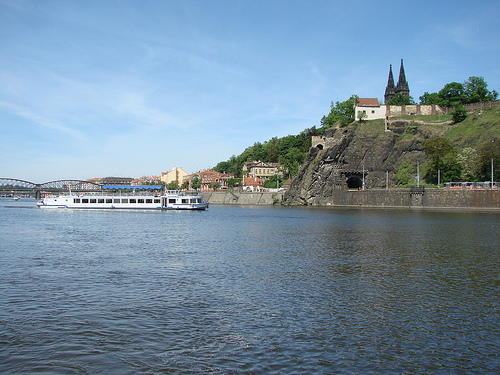
Vyšehrad (Czech for “Upper Castle” or “Castle on the Heights”) is one of
Prague’s most significant historic sites—a rocky promontory fortress on
the right bank of the Vltava River, roughly 3 km southeast of Prague
Castle. For over a millennium it has symbolized Czech statehood, rivaled
Prague Castle as a royal seat, served as a military stronghold, and
today functions as a national cultural monument and popular public park
with panoramic views. Its history blends rich legends with
archaeological and documentary evidence, spanning from early Slavic
settlement to Baroque fortifications and 19th-century national revival.
Legendary Origins (Mythic Foundations)
Czech legends tie
Vyšehrad to the very birth of the nation and Prague itself. The
12th-century chronicler Cosmas of Prague and later writers describe
it as the seat of the mythical judge Duke Krok and his daughter
Princess Libuše, who prophesied the founding of a great city (“I see
a great city whose glory will touch the stars”) and married the
ploughman Přemysl, establishing the Přemyslid dynasty. Other tales
include the “Maidens’ War” after Libuše’s death, in which women
built a rival fortress (Děvín) and men responded by creating
Vyšehrad (possibly from “Chrasten,” meaning brushwood). The knight
Horymír legend claims he escaped imprisonment here by leaping on his
horse Šemík over the walls into the river.
Archaeological and
Early Historical Founding (10th Century)
Historical reality
begins in the mid-10th century. Archaeological evidence shows a
Slavic walled settlement (initially possibly called Chrasten)
established on the rock amid the decline of older hill-forts in the
Prague basin (e.g., Šárka, Butovice). It started as a military
outpost guarding trade routes along the Vltava.
The earliest firm
evidence comes from Přemyslid silver denars minted at a Vyšehrad
mint between 992 and 1012. By 1003–1004, Cosmas’s Chronicle records
Prince Jaromír being proclaimed ruler here. The fortified princely
courtyard (south of the later church) included a mint, military
quarters, stables, and early Romanesque churches (St. Clement and
possibly St. Lawrence). Wooden-and-earth ramparts enclosed a smaller
area than today’s complex. It was not the “first settlement of
Prague” (Prague Castle predates it), but it quickly gained strategic
importance.
Golden Age: Seat of the First Czech King (Second Half
of 11th Century)
Vyšehrad reached its medieval zenith under Duke
(later King) Vratislav II (r. 1061–1092, crowned 1085). Due to
disputes with his brother, the Prague bishop, Vratislav moved the
royal residence from Prague Castle to Vyšehrad around 1070. He
transformed it into a grand Romanesque stone complex with a palatial
residence large enough for over 3,000 people, plus churches and a
chapter house directly subordinate to the Pope (bypassing the Prague
bishopric).
Key surviving or foundational structures from
this era:
The Rotunda of St. Martin (second half of 11th century)
— one of Prague’s oldest Romanesque buildings, still standing today.
The original Basilica of Saints Peter and Paul (founded 1070).
The Rotunda of St. Lawrence (on an older site).
Vyšehrad
became a prosperous trade center, with settlements growing below the
northern slope and along the road to Prague Castle. Successors
continued to rule from here until around 1140, when Prince Soběslav
returned the seat to Prague Castle. Vyšehrad then declined into a
chapter domain under provosts.
Decline, Ruin, and Charles
IV’s Revival (12th–14th Centuries)
After 1140 the site
deteriorated, though it remained an ecclesiastical center. In the
14th century, Emperor Charles IV (r. 1346–1378), a Přemyslid
descendant who revered his ancestors, revived Vyšehrad symbolically
and defensively. Between 1348 and 1350 he built new Gothic brick
fortifications, two gates (Špička and Pražská/Jeruzalémská), a royal
palace with arcades, servant quarters, a piped-water system (c.
1361), a town hall, and a school. Vyšehrad became the starting point
of the royal coronation route (first used 1347). He also began a
grander Gothic basilica (never finished; the Romanesque-Gothic
hybrid measured about 110 m).
The complex was integrated into
Prague’s defenses and served as a “guardian” of the city. Fragments
of these works survive, including parts of the Romanesque bridge and
the ruined Gothic lookout tower (“Libuše’s Bath”).
Hussite
Wars and Further Destruction (15th Century)
The Hussite Wars
devastated the site. In 1420, after defeating Sigismund’s troops
nearby, Hussite forces stormed and plundered Vyšehrad, destroying
most buildings (the collegiate church and St. Martin’s Rotunda were
spared). Further damage came in 1448 under King George of
Poděbrady’s troops. By the end of the wars the area was largely a
ruin, with Podvyšehradí (the lower settlement) burned.
Baroque Fortress Era (17th–18th Centuries)
After the Thirty
Years’ War and a devastating Swedish bombardment in 1648, the
Habsburgs rebuilt Vyšehrad as a massive Baroque star fortress
(1650s–1720s). It served as the main armory of Bohemia, a training
center for the Imperial Army, and part of Prague’s Baroque city
walls. Iconic features include powerful brick ramparts and bastions,
the Tábor Gate, Leopold Gate (pre-1670), and later Empire-style
Brick Gate (1841). Underground casemates (linked to French
engineering in 1741–42) and passages were added. The fortress
symbolized imperial military power rather than Czech royal prestige.
19th Century: National Symbol and Pantheon (Romantic Revival)
Vyšehrad’s fortunes rose again with Czech national awakening. In
1883 it was incorporated into Prague as a cadastral district. The
Basilica of Saints Peter and Paul was rebuilt in grand Neo-Gothic
style (1885–1903, designed by Josef Mocker, with spires by František
Mikš).
Most importantly, the old cemetery (dating to at least
1660, with roots to 1260) was transformed into the Vyšehrad Cemetery
(national burial ground from 1869) and the Slavín pantheon (1889–93,
designed by Antonín Wiehl). Slavín became the final resting place of
Czech luminaries: composers Antonín Dvořák and Bedřich Smetana,
writer Karel Čapek, painter Alphonse Mucha, sculptor Josef Václav
Myslbek, and dozens of other artists, scientists, and patriots. It
symbolized the nation’s cultural greatness.
20th–21st
Centuries: Public Park and National Cultural Monument
In the 20th
century Vyšehrad suffered minor damage (e.g., 1945 U.S. bombing
affected park sculptures) but was protected. Declared a national
cultural monument in 1962, it was converted into a peaceful public
park with gardens, Myslbek’s legendary statues (moved here in the
mid-20th century), casemate tours, and the Gothic cellar exhibition.
Today it hosts cultural events, New Year’s Eve celebrations, and
millions of visitors drawn to its views, history, and tranquility.
The Baroque ramparts, Neo-Gothic basilica, ancient rotunda, and
Slavín continue to embody layers of Czech identity—from mythic
origins to modern nationhood.
Architectural History and Construction Phases
10th–11th centuries
(Romanesque origins): The site began as a wooden-then-stone fort under
early Přemyslid rulers, with its zenith under King Vratislav II (first
Bohemian king), who moved the royal residence here. Key early structures
included a large Romanesque basilica (over 110 m long, the biggest
pre-Hussite sacral building in Prague) and the Rotunda of St. Martin.
Foundations of a Romanesque apse from around 1070 have been
archaeologically confirmed.
14th century (Gothic renewal under
Charles IV): The complex was revitalized with new fortifications,
battlements, towers, portals, two main gates (including the preserved
Špička/Peak Gate fragment), and a royal palace. Gothic elements were
added to the basilica, and structures like the Old Burgrave’s House and
Gothic Cellar (with oriel chapel) were built. A Romanesque bridge
connected parts of the acropolis.
15th century (Hussite destruction):
Repeated sieges (1420 and 1448) left the site ruined, with most medieval
buildings damaged or abandoned.
17th–18th centuries (Baroque fortress
era): Post-Thirty Years’ War, Ferdinand III initiated a massive citadel
(1650 onward, completed ~1727). Italian architects (Filippo Galduzzi,
Carlo Lurago, Santon Bossi) and military engineers (Innocenzo de Conti,
Joseph Priami) designed high brick ramparts in a pentagram plan with
bastions, turning Vyšehrad into a modern defensive stronghold and army
training center. Casemates and gates were integrated. Later additions
included post-1742 French/Prussian/Austrian enhancements.
19th–20th
centuries (modern adaptations and restorations): The fortress was
decommissioned in 1883 when Vyšehrad joined Prague. The Brick Gate
(1841, Empire style) and a redan (1849–50) were added. The basilica
received a full Neo-Gothic overhaul (1885–1887), and medieval fragments
were restored (e.g., Špička Gate in 1903 by Antonín Wiehl). The area
became a park, with the cemetery expanded.
Fortifications,
Ramparts, and Gates
The Baroque ramparts form the most imposing
feature: thick brick walls enclosing the promontory in a pentagram with
six bastions and a moat system. These replaced earlier stone and wooden
defenses and incorporate loopholes and advanced positions for artillery.
Key gates include:
Leopold Gate (1676–1678, by Carlo Lurago): A
grand Baroque portal with pilasters, a gable bearing Habsburg and
Bohemian emblems, and decorative elements by Giovanni Battista Allio. It
serves as the main southern entrance from Pankrác.
Tábor Gate
(1655–1656): Earlier Baroque access point.
Brick Gate (Cihelná brána,
1841, Empire style): Tripartite (one vehicular, two pedestrian passages)
with guardrooms; now an information center and casemate entrance. Also
called the Cemetery Gate.
Medieval remnants: The main part of the
Špička Gate (Charles IV era, Gothic) and fragments of a Romanesque
bridge plus the ruined Gothic Libuše’s Bath lookout tower (a bastion
enclosure tied to legends of Princess Libuše).
Churches and
Religious Architecture
Basilica of St. Peter and Paul (Chapter
Basilica Minor since 2003): The spiritual centerpiece, founded ~1070 by
Vratislav II as a Romanesque structure directly under papal
jurisdiction. It was enlarged in Gothic style under Charles IV
(post-1364) but largely rebuilt in Neo-Gothic form (1885–1887, primarily
by architect Josef Mocker, who also worked on St. Vitus Cathedral). The
iconic twin spires (58 m high, added early 20th century) dominate the
Prague skyline and house bells plus a carillon playing daily tunes. The
facade features pointed arches, tracery windows, and sculptural details.
Interiors form an “art gallery” with rich Art Nouveau frescoes depicting
Czech statehood and Christian roots; notable artifacts include a Gothic
Vyšehrad Madonna painting, St. Valentine reliquary, Virgin Mary of
Šancov statue, and a Romanesque sarcophagus of St. Longinus (likely from
the Přemyslid necropolis).
Rotunda of St. Martin: Prague’s oldest
standing church (second half of 11th century, pure Romanesque). A
compact circular stone structure with a conical red-tiled roof, small
cupola, narrow arched windows, and a distinctive horseshoe-shaped apse.
The portal has Romanesque carvings. It was repurposed as gunpowder
storage during the Baroque era, nearly demolished in 1841, then restored
(1875 onward, with designs by Antonín Baum). Interiors feature wall
paintings by Antonín König and Jan Heřman, plus an altar painting by
František Sequens. It survived as a rare early medieval gem amid later
fortifications.
Other religious elements: Fragments of a second
Romanesque basilica (St. Lawrence), Gothic remnants of the Church of the
Decollation of St. John the Baptist (14th century, two-nave hall), and
chapels (e.g., Baroque Chapel of the Virgin Mary on the Ramparts, later
Neo-Renaissance; St. Clement’s Chapel in the Neo-Gothic New Provost’s
Residence by Josef Niklas).
Underground Casemates and Gorlice
Hall
An engineering highlight of the Baroque phase: ~1 km of narrow
brick-vaulted corridors (1.6 m wide, 2 m high) with loopholes for
muskets and cannons, built post-1742 and improved by successive armies.
Four sections branch from the Brick Gate: one to the Gorlice Hall
(largest underground space at 330 m² and 13 m high, originally for
troops/munitions, now housing six original Baroque statues from Charles
Bridge); others near St. Martin’s Rotunda or the Podolí area, opening to
the moat. The vaulted, dimly lit tunnels create a labyrinthine defensive
network, with sophisticated (now non-functional) electric lighting added
later by František Křižík.
Other Notable Structures and the
Cemetery
Medieval palace remnants include the Old Burgrave’s House
(14th century, now used for events) and the Gothic Cellar (storage with
upper dining hall/chapel, now an exhibition space). The Powder Room
(17th century, on medieval foundations) served as a gallery. The
Vyšehrad Cemetery (national pantheon since the 19th century) features
the Slavín monument with Italian-style arcades (designed by Antonín
Wiehl), Tuscan sandstone pillars, cross-vaulted ceilings with paintings,
and ornate tombs—more sculptural than structural but integral to the
site’s cultural architecture.
Vyšehrad’s architecture masterfully
layers defensive utility, royal prestige, and religious symbolism. Its
Baroque fortifications and Neo-Gothic basilica spires create a dramatic
silhouette, while hidden Romanesque gems and casemates reveal its
military past. As a UNESCO-linked part of Prague’s heritage, it offers
panoramic views and ongoing preservation efforts (e.g., roof repairs via
public collections). Visitors can explore via guided tours of the
underground and structures, making it a profound study in Czech
architectural resilience across centuries.
Vyšehrad (meaning "Upper Castle" or "Castle on the Heights") is a
historic hilltop fortress and park in Prague, Czech Republic, perched on
a rocky promontory above the Vltava River. It serves as a peaceful, less
crowded alternative to the bustling Prague Castle, offering stunning
panoramic views, green spaces, legends, and key cultural sites. It is
ideal for history enthusiasts, photographers, walkers, and those seeking
a break from central Prague's crowds.
Brief History and Legends
Vyšehrad's roots trace to the 10th century (later than Prague Castle,
despite legends claiming it as the older seat of Czech princes). It
gained prominence in the 11th century under Vratislaus II (the first
Bohemian king), who made it his royal seat, built churches, and
established a chapter. It rivaled Prague Castle before power shifted
back. Charles IV later revived it with new fortifications and a palace
out of respect for Přemyslid ancestors. It suffered damage during the
Hussite wars, was rebuilt as a Baroque fortress in the 17th–18th
centuries, decommissioned in the 19th century, and integrated into
Prague as a public park and national cultural monument.
Key
legends include:
Princess Libuše prophesying Prague's glory from here
("I see a great city whose glory will one day touch the stars").
The
founding myth involving her marriage to Přemysl the Ploughman.
Hero
Horymír and his horse Šemík's daring leap over the walls into the
Vltava.
These stories tie deeply into Czech national identity.
Main Attractions
Basilica of St. Peter and St. Paul: The
neo-Gothic landmark (rebuilt from an 11th-century Romanesque structure)
dominates the skyline with its twin towers. Inside, enjoy colorful Art
Nouveau frescoes, stained glass, and a serene atmosphere. Check for
services or concerts.
Vyšehrad Cemetery (including Slavín Tomb):
Prague's national pantheon and a "who's who" of Czech culture. Over 600
notable graves feature artists like Alphonse Mucha, composers Antonín
Dvořák and Bedřich Smetana, writer Karel Čapek, and more. The monumental
Slavín tomb honors many cultural icons. Peaceful and sculpturally
rich—perfect for a reflective stroll.
Rotunda of St. Martin: One of
Prague's oldest buildings (c. 11th century, Romanesque). Small, simple,
and atmospheric; it survived as a powder magazine and more. Often closed
but accessible during services.
Casemates and Gorlice Hall:
Underground Baroque-era corridors (about 1 km total) for troop movement.
The vast Gorlice hall displays original Charles Bridge statues. Guided
tours only—dramatic and historical.
Gates and Ramparts: Tábor Gate
(main eastern entrance), Leopold Gate (ornate Baroque inner gate), and
Brick Gate (Cihelná brána, with exhibitions). Walk the walls for views.
Other highlights: Myslbek's sculptures (including St. Wenceslas), ruins
of Libuše's Bath, children's playground with legendary motifs, open-air
theater, and expansive park grounds.
Practical Visiting Tips
Opening Hours: The outdoor park and grounds are accessible 24/7
year-round. Indoor sites (basilica interiors, cemetery in some contexts,
exhibitions, casemates) generally open ~10 AM–6 PM (last tours around 5
PM). Confirm specifics, especially in winter. Info center: similar
hours.
Tickets and Costs:
Grounds: Free.
Casemates/Gorlice
and some tours: Paid (e.g., around 130–330 CZK depending on combo;
discounts for reduced/seniors/children). Guided tours recommended for
deeper insight. Buy at Brick Gate or online.
Best Time to Visit:
Early morning or late afternoon/sunset for fewer people, best light, and
tranquility.
Spring/fall for mild weather; summer for events but more
visitors.
Beautiful in all seasons—snowy in winter, green in
spring/summer. Avoid peak midday crowds.
Getting There (from
central Prague, ~2.5 km south):
Metro: Line C (red) to Vyšehrad
station + short walk (Tábor Gate entrance recommended).
Tram: To
Výtoň (lines 3, 17, etc.) or Albertov, then uphill walk/stairs (scenic
riverside approach).
On Foot: Pleasant 30–45 min riverside walk from
Charles Bridge/National Theater area via Náplavka (views of Dancing
House, etc.).
Other: Bus or taxi. Uphill sections exist—wear
comfortable shoes.
Suggested Route (2–4 hours):
Enter via
Tábor Gate (or Brick Gate).
Pass Leopold Gate.
Explore park,
rotunda, ramparts, and views.
Visit basilica and cemetery.
End
with casemates if interested, then exit via stairs to river or another
gate.
Accessibility: Mostly wheelchair-friendly in park areas,
but some paths/underground sites have limitations (gravel, steps).
Barrier-free options and toilets available; check details.
Practical Advice
Duration: 1–3+ hours; combine with riverside walk or
nearby sights.
What to Bring: Comfortable walking shoes (cobbles,
grass, hills), water, camera, picnic (or buy snacks). Download an
offline map or use the info center.
Food Nearby: On-site cafés/beer
garden (e.g., Na Hradbách with views). Recommendations include U Kroka
(Czech cuisine) or riverside spots. Picnics are popular.
With
Kids/Families: Playground, open spaces, legends—engaging but watch for
edges.
Photography: Golden hour for basilica silhouettes and Vltava
panoramas. Respect cemetery quiet.
Events: Check for concerts,
open-air theater (May–Sept), or festivals.
Safety/Other: Low crime;
standard tourist precautions. Public transport tickets cover metro/tram
(buy via app or machines). Combine with Prague Card if visiting multiple
sites.