Location: South Bohemia Region Map
Found: 1259
Tel. 380 746 627
Open:
May- Sept 9am- 4:15pm Tue- Sat, 1:15pm- 4:15 pm Sun
Oct- Apr by appointments
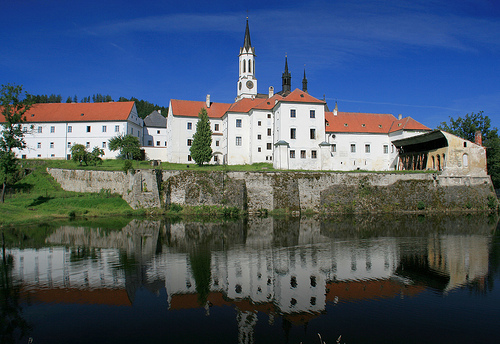
Vyšší Brod Monastery (Vyšebrodský klášter), also known as Hohenfurth Abbey, is a historic Cistercian monastery situated on the right bank of the Vltava River in the southwestern part of the town of Vyšší Brod, in the South Bohemian Region of the Czech Republic. Founded in 1259, it stands as the oldest and southernmost Cistercian abbey in Bohemia, recognized as a national cultural monument and serving as a key spiritual and historical site in the Šumava Mountains near the Austrian border. The monastery complex, built from local granite, encompasses a church, library, convent buildings, and gardens, blending Gothic, Baroque, and Rococo elements while housing significant art collections and manuscripts. Today, it remains an active religious community, home to a small group of Cistercian monks, and attracts visitors for its architectural beauty, historical significance, and serene location.
Foundation (1259) and Early Development
The monastery was
established on 1 June 1259 by Vok I of Rosenberg (also referred to as
Petr Vok of Rožmberk), the Bohemian Marshal and a leading noble. He
acted after negotiations with the Cistercian General Chapter in Cîteaux
and received confirmation from Bishop John III of Prague. The bishop
consecrated the first church on the same day, which marks the official
foundation date. Vok donated lands around the existing settlement of
Vyšší Brod (originally German Hohenfurt, “high ford”), including
patronage rights over nearby churches, for the spiritual welfare of
himself and his family. Monks arrived from the mother abbey of Wilhering
(near Linz, Austria), which traced its lineage back through Rein and
Ebrach to Morimond (a daughter house of Cîteaux).
A popular legend
claims Vok vowed to found the monastery after nearly drowning while
crossing the swollen Vltava ford en route to pray at a local chapel (now
the site of St. Anne’s Church). While this story appears in abbey wall
paintings, historians consider it unsubstantiated. The monastery was
explicitly intended as a Rosenberg family mausoleum. Vok I was buried
there in 1262; over the next centuries, ten generations of Rosenbergs
were interred, ending with Petr Vok of Rosenberg (the last male
Rosenberg) in 1611. His well-preserved coffin remains in the Rosenberg
crypt beneath the chancel — modern investigations have debunked romantic
legends of “seated golden thrones.”
The Gothic church and fortified
complex (with walls and towers) were built gradually over about a
century southwest of the settlement. By the 14th century it featured the
Church of the Assumption with four chapels, a main altar, and eight side
altars. A key early treasure was the Záviš Cross (Závišův kříž), a
late-13th-century goldsmith masterpiece containing a fragment of the
True Cross, donated by Záviš of Falkenstein. The monastery’s remote
border-forest location limited its early political role but protected it
somewhat from larger conflicts.
Hussite Wars and Late Medieval
Period (15th–16th centuries)
The monastery declined during the
Hussite Wars (15th century) but was largely spared destruction — one of
the few Cistercian houses in Bohemia to escape major damage, thanks to
its fortifications. Hussites burned the unfortified town but apparently
failed to breach the abbey; monks sometimes sought refuge in nearby
Český Krumlov. Some properties and patronage churches suffered,
requiring late-15th-century rebuilding. By 1530 the domain included two
market towns and about 900 serfs across 108 villages — modest by
Cistercian standards. Protestantism made limited inroads among serfs in
the late 16th century, and monks began serving as parish priests for the
first time.
Thirty Years’ War (1618–1648) and Baroque Growth
The war brought severe hardships through requisitions, billeting,
plunder, and debt, despite the monastery’s distance from major battles.
By 1636 many farmsteads lay deserted. In 1648 Swedish troops reached
South Bohemia, forcing temporary relocation of the community. Yet no
Bohemian or Moravian Cistercian monastery was destroyed (unlike in the
Hussite era). Under scholarly Abbot Georg III Wendschuh (1641–1668, from
Lusatia), the monastery produced the monumental nine-volume Acta
Altovadensia chronicle. His successor, Abbot Johann IV Clavey
(1669–1687, Alsatian), oversaw growth to a peak of 58 monks and built
the main convent building (1671) plus the church’s first tower (despite
the Order’s traditional ban on towers). The chancel stalls accommodated
42 monks.
Josephinism and 19th-Century Revival (Late 18th–19th
centuries)
Emperor Joseph II’s reforms nearly ended the monastery in
1786. Under Abbot Hermann Kurz (1767–1797), the community was reduced
from 65 to 18 monks; novices were banned, Kurz was temporarily deposed
and sent to a farmstead, and properties were partially secularized. A
secular “benefice abbot” was installed. The abbey survived narrowly
(partly because closing it would have burdened the state with its debts)
but faced new obligations: providing (or paying for) teachers at a
German grammar school in České Budějovice until the First Republic
(1921).
The 19th century brought revival. The abbey led Cistercian
renewal in the Habsburg lands; its abbots repeatedly served as general
vicars. In 1890 Abbot Leopold Wackarž became General Abbot of the Order;
under him a stricter observance branch separated. The community
flourished culturally and spiritually.
World War I, Interwar
Period, and Peak Membership (1914–1938)
Under Abbot Bruno Pammer
(1902–1924), electric lighting (1904) and a monastery-financed electric
railway were introduced. Pammer’s German-Christian-social politics
clashed with the new Czechoslovak Republic. His successor, Abbot Tecelín
Josef Jaksch (elected 1925, the 43rd abbot), proved an outstanding
administrator. He cleared massive war debts, navigated land reform
(losing prime estates but retaining most holdings and receiving
compensation), revived lay brothers, and oversaw extensive renovations
(church, brewery, cloisters, infirmary, refectory). By 1938 the
community reached 73 members (including 15 lay brothers). Jaksch
supported local welfare (kindergarten, hospital) and planned revival of
Zlatá Koruna abbey. The monastery enjoyed strong local ties; the town
had among the lowest Nazi Party membership rates.
Nazi Occupation
and Suppression (1938–1945)
The Munich Agreement and Sudeten
annexation (1938) brought immediate crisis. SA troops stormed the
monastery; Jaksch evacuated treasures (Záviš Cross, altar cycle,
Madonna) to Prague. He was arrested by the Gestapo in November 1938,
accused of anti-Nazi activity and spying, convicted on fabricated
immorality charges, and exiled to Porta Coeli convent near Tišnov. Monk
Engelbert Blöchl died in Dachau (1942). On 17 April 1941 the monastery
was suppressed for the first time in its history; monks were expelled,
novices dismissed, younger members sent to the Eastern Front, and the
site used by Gestapo/SS to store looted art and later as a lazaret and
refugee camp.
Post-War Expulsion and Communist Suppression
(1945–1989)
Abbot Jaksch returned briefly in June 1945 (rehabilitated
via President Beneš) but faced communist hostility. German monks and
priests were expelled with the Sudeten German population; many fled to
Austrian abbeys (Rein, Heiligenkreuz, Wilhering). The monastery was
seized again on 4 May 1950 under communist “Action K”; monks were
interned, property nationalized and looted, and the complex deteriorated
(plans to turn it into a warehouse failed). Continuity was preserved
through a 1959 union with Rein Abbey (Styria, Austria), where surviving
Vyšší Brod monks lived as the “Rein-Hohenfurth” community. The last
Vyšší Brod monks in exile dwindled over decades.
Renewal Since
1990
After the Velvet Revolution, the last two Czech monks — Fathers
Vojtěch Ivo Kvapil (later prior-administrator) and Xaver Švanda —
returned in 1990 and gradually revived community life. Austrian material
aid helped. The community adopted the 1962 Roman Missal (Traditional
Latin Mass with Cistercian propers) in 2011. Since 2007 Prior Justin
Berka has led it (full abbot election is impossible with small numbers).
The community has grown steadily: from a handful in the 1990s to 11
monks and 2 postulants by late 2025. It restored the church interior
(2011–2012), maintains traditional choral prayer and customs, and
participates in European heritage networks (Cisterscapes, 2024). It
remains the sole active male Cistercian house in Czechia and a center of
traditional Catholicism.
Cultural and Architectural Legacy
The
Gothic church and convent complex (with later Baroque and 19th-century
elements) include the Rosenberg crypt, winter chapel, water mill,
brewery, and gate. The library holds over 70,000 volumes (200 parchment
manuscripts, 400 incunabula, Bibles in 40 languages). The picture
gallery and Záviš Cross are highlights. Parts now house a branch of the
Prague Postal Museum. Visitor numbers have ranged from ~12,000 to 24,000
annually in recent decades. The monastery continues as a living
spiritual community while serving as one of South Bohemia’s premier
historical monuments.
Vyšší Brod Monastery (Vyšebrodský klášter, also known as Hohenfurth
Abbey) is a Cistercian abbey in the town of Vyšší Brod, South Bohemia,
Czech Republic, on the right bank of the Vltava River. Founded in 1259
by Vok I of Rožmberk as a family necropolis and spiritual center, it is
the only functioning male Cistercian monastery in the Czech Republic and
a protected national cultural monument.
The complex exemplifies
classic Cistercian Gothic architecture with strict ascetic
principles—simple forms, no excessive decoration initially—blended with
evolving Gothic styles and later Baroque, Rococo, Renaissance, and
neo-Gothic modifications. Construction spanned roughly a century
(mid-13th to mid-14th century), using hard local granite from the Šumava
(Bohemian Forest). The irregular fortified layout includes defensive
walls with cylindrical towers (some preserved on the north and east),
economic buildings (e.g., 14th-century Gothic mill), and later additions
like a brewery and farm structures.
Overall Layout and Cloister
The core follows the standard Cistercian plan: the Church of the
Assumption of the Virgin Mary dominates, with the convent arranged
around a central paradise courtyard (rajský dvůr) enclosed by a
cross-shaped Gothic cloister arcade (completed by the 1380s). The
sacristy connects the church transept to the convent. The chapter house
lies in the east wing. Renaissance and Baroque rebuilds (16th–18th
centuries) affected the southern, western, and partial eastern convent
wings, plus an “old convent” (1587) and prelature. A main tower (34 m,
added 1860s–1900 with neo-Gothic elements) and Rožmberk Gate
(Renaissance with frescoes and coat-of-arms carvings) provide entry. The
irregular enclosure integrates guest wings, a courthouse (1766), and
gardens.
The Church of the Assumption of the Virgin Mary
This
three-aisled hall church (Hallenkirche, with equal-height nave and
aisles) on a Latin-cross plan measures 52 m long and reaches 17.5 m at
the vault apex. Construction began in the 1260s–1280s with the eastern
section (presbytery, transept, and chapels) in North French classical
Gothic style, transitioning to a more dynamic late-classic phase and
early Czech Gothic influences. The western hall-style triple nave and
full cross vaults in all aisles were completed around 1385.
Presbytery: Pentagonal (five-sided) with tall, slender tracery windows
evoking Sainte-Chapelle in Paris or Amiens Cathedral. It features a
six-petaled rib vault.
Transept: Cross-vaulted, flanked eastward by
two unique triangular-ground-plan chapels with wedge-shaped gabled
closures (a rare European feature). These house side altars (e.g., St.
Benedict with blue/gilded crosses; St. Bernard with abbot tombstones).
Nave: Hall-type with cross vaults; bare walls emphasize Cistercian
austerity and harmonic proportions. Stained glass (added 1870s–1880s by
Munich and Innsbruck workshops) depicts Cistercian saints, Bernard of
Clairvaux scenes, and the Lourdes apparition. A monks’ choir (1725) with
statues of SS. Peter and Paul sits behind a latticed gate.
High
Altar: Early Baroque (1644–1646), carved by Linhart Wullimann, gilded in
24-carat gold with over 50 figures, angels, and statues of St. Bernard
and Blessed Eugene III. An ingenious pulley mechanism (later modernized)
allowed seasonal rotation of three paintings (Assumption,
Crucifixion/Resurrection, Nativity). A circular niche holds the
Coronation of the Virgin by Jan Kopáč.
Other Interiors: Late-Gothic
winged altars (St. Roch, St. Barbara); neo-Gothic Altar of Holy Relics;
Rosenberg family crypt and red-marble epitaph beneath the presbytery;
Rosenberg Oratory (accessible via Gothic spiral staircase) for the
famous Záviš Cross relic.
Organ: Large Romantic organ (1892, Leopold
Breinbauer; 2,052 pipes, 41 registers) in the choir loft; smaller organ
in the monks’ choir.
The church originally served only monks and
patrons (clausura); later restorations (1830s–1860s neo-Gothic under
Abbot Leopold Wackarž; major interior work 2011–2012) preserved its
Gothic character while adding a slender tower.
Sacristy
The
oldest structure (c. 1270), originally an independent abbatial chapel
and first prayer house. Two-story, it features an early Gothic portal
with a tympanum relief of grapevines, leaves, grapes, and the Right Hand
of God emerging from clouds (flanked by fox heads), drawing symbolism
from the Song of Songs and Bernard of Clairvaux’s sermons. It connects
the transept to the convent.
Chapter House (Kapitulní síň)
A
square early-Gothic room (c. 1285) in the east convent wing, used for
daily monastic gatherings, rule readings, and elections. Its standout
feature is a unique rib vault: four six-petaled fans rising from a
single central pillar (one of the earliest and most refined in Czech
lands, prefiguring Parler’s techniques in Prague Cathedral’s St.
Wenceslas Chapel by nearly a century). The central pillar base has
lamb-head consoles (symbolizing the Christian community) enveloped in
carved foliage (Tree of Life motif). Three eastern windows include a
large central circular rose window with tracery inspired by French
cathedral Gothic, evoking cosmic symbolism. Rib consoles feature plant
and zoomorphic motifs creating an “illusory paradise.” The space conveys
fragility, delicacy, and courtly refinement influenced by North French
and Hessian Gothic.
Convent and Other Buildings
The three
wings around the cloister were partly rebuilt in Renaissance style (16th
century) with Baroque upper floors. The prelature (18th century)
absorbed earlier structures. Economic wings include a 14th-century
two-story Gothic mill with narrow arched windows.
Library
One
of the Czech Republic’s largest and best-preserved monastic libraries
(over 70,000 volumes, including 200 manuscripts and 400 incunabula).
Built 1753–1757 under Abbot Quirin Mickl in Rococo style: two halls
(Philosophical with Judgment of Solomon fresco; Theological with Jesus
among scholars fresco by Lukáš Vávra) connected by a corridor lined with
abbot portraits. Cabinets by Josef Raffer; ceiling frescoes and models
enhance the elegant interior.
The abbey church, dedicated to the Assumption of the Virgin Mary, is
a highlight with its Early Baroque altar featuring gilded wood statues
of saints like Bernard and Benedict, and the side altar housing the
Gothic panel painting "Madonna of Vyšší Brod" (after 1400), depicting
the Virgin Mary against a golden background. Other chapels include those
of St. Benedict, St. Bernard, and the Virgin Mary.
The monastic
library, the third-largest in the Czech Republic with over 70,000
volumes, is a treasure trove spanning from the 13th century, including
manuscripts like an 8th-century parchment fragment of the Epistle to the
Thessalonians, a 14th-century Latin Bible, and university theses on
silk. Divided into the Library Corridor, Philosophers’ Hall (with
ceiling frescoes and scientific books), and Theological Hall (featuring
Bibles in 40 languages and a fresco of young Jesus), it boasts Rococo
interiors.
Art collections in the Gothic and Picture Galleries
include the Záviš Cross—a gold relic with 51 precious stones and 208
pearls, possibly a Hungarian coronation cross—and works by the Master of
the Třeboň Altar, Petr Brandl, Jan Kupecký, and Norbert Grund. The
Rosenberg Oratory displays the cross for meditation, and a Postal Museum
occupies the former abbot’s house. Exhibits also feature Baroque
artifacts, porcelain, and Rosenberg tomb surveys.
Rooted in Cistercian traditions, the monastery emphasizes prayer, work, and contemplation, with daily Latin Masses and a routine starting at 3:15 a.m. It hosts guided tours in multiple languages, showcasing its history and collections, and occasional events in the courtyard. As a cultural hub, it preserves medieval art and manuscripts, drawing visitors interested in Bohemian heritage.
The monastery functions as an active religious site, with monks committed to "stabilitas loci" (stability of place), and is open to tourists, particularly German and Czech speakers. Guided tours (about 60-90 minutes) cover the church, library, galleries, and more, available from April to October, with special Christmas tours. It is near attractions like Lipno Reservoir and Český Krumlov, making it a peaceful stop for cultural exploration. For details on hours and fees, visit the official website.