Location: Bartonova 2, Zbraslav
Tel. 257 921 638
Subway:
Smichovshe nadrazi then take bus: 129 241, 243, 255, 318, 360
Open:
Tue- Sun 10am- 6pm
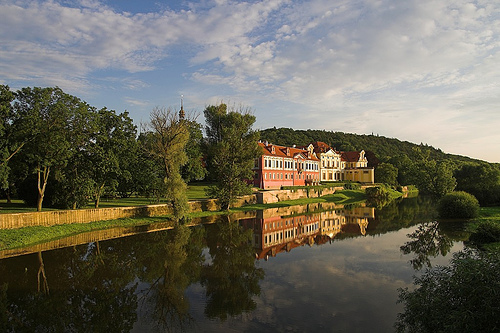
Zbraslav Château (Zámek Zbraslav), also historically known as the Cistercian Abbey of Aula Regia (Royal Hall) or Zbraslavský klášter, stands in the southern Prague district of Zbraslav, on the left bank of the Vltava River near its confluence with the Berounka. Its history stretches from the late 13th century to the present, evolving from a royal hunting lodge into one of Bohemia’s most important Cistercian monasteries — a royal necropolis for the last Přemyslids — then suffering repeated destruction, undergoing grand Baroque reconstruction, and finally becoming a private chateau after its 1785 dissolution. Today the protected national cultural monument (with parts used as a museum depository and event venue) retains its Baroque character while incorporating medieval remnants.
Founding as a Cistercian Monastery (1268–1333)
The site originated
in 1268 when King Přemysl Otakar II built an unfinished royal hunting
lodge with the Chapel of St. James (later the core of the abbey church).
Both Otakar II and his son Wenceslaus II (Václav II) loved the area as
an ideal hunting ground. In 1291–1292 Wenceslaus II decided to found a
Cistercian monastery there “to the honor of God and His mother Mary” —
partly to atone for sins, including the execution of his stepfather
Záviš z Falkenštejna, and to create a dynastic burial place inspired by
French royal abbeys such as Royaumont and Saint-Denis.
The founding
charter is dated 10 August 1292 (with a second in 1304). Twelve monks
led by Abbot Konrád (from Sedlec Abbey) arrived on 20 April 1292 and
initially used the royal manor and chapel. Construction of the Gothic
church (dedicated to the Virgin Mary and St. Wenceslaus) and convent
began immediately. The cornerstone was laid on 3 June 1297 (the day
after Wenceslaus II’s coronation), accompanied by a solemn mass and the
knighting of 240 nobles. By 1305 the church, convent buildings, royal
residence, and abbot’s quarters were largely complete; the entire
complex was finished by 1333. A hospital with its own chapel already
existed before 1311, and a small St. John the Baptist chapel stood at
the gate (demolished 1785).
Wenceslaus II donated lavish liturgical
items (including a golden cross and monstrances), funded a library, and
affiliated the monastery with the Cîteaux mother house. The abbey
quickly became the official royal necropolis of the Přemyslid dynasty.
Royal Necropolis and the Zbraslav Chronicle (1305–early 15th
century)
Zbraslav served as the primary burial site for the last
Přemyslids (surpassed only later by St. Vitus Cathedral). Key burials
include:
Wenceslaus II (23 June 1305, in royal attire in the
transept)
Wenceslaus III (moved 1320/1326)
Queen Elisabeth (Eliška
Přemyslovna, “second founder,” 1330)
Other royal children, consorts
(Guta of Habsburg, Margaret of Luxembourg, etc.), and up to 15
documented Přemyslid family members
The monastery enjoyed royal
privileges: tax exemption (granted 1331 by John of Luxembourg) and
political importance. Under Charles IV it prospered, though it later
accumulated debts.
Its greatest cultural legacy is the Zbraslav
Chronicle (Chronicon Aulae Regiae), the most important source for early
14th-century Bohemian history. Begun shortly after Wenceslaus II’s death
by Abbot Ota and continued by the famous Abbot Peter of Zittau (†1339),
it is a detailed, often critical contemporary account. A Gothic
masterpiece associated with the abbey is the Madonna of Zbraslav
(1340s).
Destruction and Slow Recovery (15th–17th centuries)
The Hussite Wars brought catastrophe. On 10 August 1420, Hussite forces
and a Prague mob led by priest Václav Koranda attacked the undefended
monastery, plundered it, burned the buildings, and desecrated royal
tombs (Wenceslaus IV’s body was reportedly mocked). Further damage
occurred in 1429. Monks gradually returned in the 1440s, but the complex
lay in ruins for decades; fields were pawned to fund repairs.
The
Thirty Years’ War inflicted more harm: looting by Passau troops
(1611–1612), Swedish burning (1639), and final imperial devastation
(1645). The abbey church of St. James the Greater was reconsecrated in
1654. Limited Renaissance additions appeared in the late 16th century
under Abbot Antoin II Plamming (1586–1609).
Baroque
Reconstruction (1705–1785)
The most visible transformation occurred
in the early 18th century under abbots Wolfgang Lochner (1684–1716) and
Tomáš Budecius. In 1705 they commissioned the brilliant Bohemian
architect Jan Blažej Santini-Aichel (known for his Gothicizing Baroque
style) to rebuild the convent. After Santini’s death in 1716, František
Maxmilián Kaňka continued the work until around 1724–1732.
The new
three-winged Baroque convent (with a planned but unrealized church
closure) incorporated medieval walls and created dynamic facades, a
paradisiacal courtyard with ambits, a magnificent refectory, and the
Royal Hall. The Gothic church received rich Baroque decoration and
furnishings (frescoes by V.V. Reiner and stucco by the Soldatti
brothers). Financial strains from loans imposed by Empress Maria Theresa
prevented full completion of the grand church. The result is a
harmonious blend of Gothic bones and Baroque splendor.
Dissolution and Conversion into a Chateau (1785–1910)
Emperor Joseph
II’s Josephine reforms abolished the monastery on 12 December 1785 (one
of nine Cistercian houses suppressed in Bohemia and Moravia). The
property passed to the Religious Fund and was sold. The convent building
became a sugar factory (later a chemical plant and brewery), while the
prelature was converted into a residential chateau.
In 1825 the
Oettingen-Wallerstein princely family acquired the prelature; in 1875
they bought the convent buildings too. Industrial use continued
alongside aristocratic residence.
20th Century to Present:
Private Ownership and Cultural Use
In 1910 the prominent Czech
industrialist Cyril Bartoň of Dobenín purchased the entire estate.
Between 1912 and 1925 he carried out a sensitive
Neo-Renaissance/Neo-Baroque reconstruction (architects A. Čenský and O.
Nyppl; some sources also credit Dušan Jurkovič’s involvement). The
chateau became the family residence.
From 1939 (by contract) and
permanently after the war until 2009, parts housed the National Gallery
in Prague’s Asian art collection (China, Japan, India, Tibet, etc.). In
1948 the communist regime nationalized the property; it served
representational purposes for various ministries.
After the Velvet
Revolution, the estate was restituted to the Bartoň of Dobenín family.
Today it remains privately owned. Selected historic spaces (including
the grand Royal Hall with frescoed ceiling) are available for hire for
events, while parts function as a depository for the Náprstek Museum of
Asian, African and American Cultures. The Baroque Church of St. James
the Greater continues as a place of public worship. Future plans include
converting sections into a study library depository for the National
Museum.
Historical Layers of Construction and Style
The site began as a
royal hunting lodge with a chapel of St. James the Greater (St. Jakub),
built around 1268 by Přemysl Otakar II. In 1292 (founding charter 1304),
King Wenceslaus II established a Cistercian monastery here as the
Přemyslid royal necropolis, modeled on French examples like Royaumont
and Saint-Denis. The original Gothic structures were completed by 1333.
The main abbey church (dedicated to the Virgin Mary and St. Wenceslas)
was an enormous Latin-cross basilica, 104 meters long—the largest
medieval church in Bohemia at the time—featuring three naves, a
polygonal presbytery with ambulatory and integrated chapels (four east,
three each on north/south), segmental windows alternating with
buttresses, and ornate portals (archivolt with crabs, crocketed western
portal). Convent buildings used brick construction with limestone and
sandstone details; key elements included a 1327 refectory, 1333 water
supply/lavatory, cloister ambulatory with well house, and a hospital
chapel. Interiors featured rib vaults and a southern portal with
pinnacles.
The complex suffered repeated destruction: burned by
Hussites in 1420 (including looting of royal tombs), raided in the
Thirty Years’ War (1611–1612, 1639, 1643). Repairs in the 15th–16th
centuries added Renaissance extensions to the abbey and St. James church
under abbot Antoin II. Plamming (1586–1609). Further convent work
occurred under abbots George I of Vrat, Wolfgang Lochner, and Tomáš
Budecius.
The defining phase came in the Baroque era (starting 1705).
Under abbots Lochner and Budecius, architect Jan Blažej Santini-Aichel
(Giovanni Santini) redesigned the ruined medieval buildings into a new
three-winged convent enclosing a right-angled courtyard. After Santini’s
death in 1719, František Maxmilián Kaňka completed the work by 1732.
Santini’s signature “Baroque Gothic” fusion is evident: trifoliate
(three-leaf) arcade windows and openings evoking Gothic emporas; a
dual-level ambulatory in the courtyard (outer walkway projecting lower);
illusory rib vaults in cells using Czech plate vaults and pendentive
domes; pillars with half-columns, pilasters, and Romanesque-style
capitals. The northern wing (facing the river) features a dynamic convex
balcony before the refectory with rounded corners and terrace. The
refectory has oval/rectangular windows with label molds, frescoes by F.
X. Palko, and sculptures by Matěj Václav Jäckel. The Royal Hall upstairs
boasts stucco by T. and M. Soldatti and frescoes by Václav Vavřinec
Reiner. The Gothic church received Baroque decoration and equipment
(financial constraints under Maria Theresa limited a full new church).
Post-1785 (Josephine abolition), the convent was modified for industrial
use by architects A. Hummel and Ignác Palliardi.
In 1910,
industrialist Cyrill Bartoň of Dobenín purchased the estate and
converted it into a private château (1912–1925 restorations by
architects A. Čenský and O. Nyppl; some sources note Dušan Jurkovič
involvement). This phase preserved the Baroque shell while adapting
interiors for residential and later cultural use (National Gallery Asian
art exhibitions 1939–2009; now partly a museum depository and event
venue). The result is a well-preserved Baroque château with classical
and modern interiors.
Exterior and Overall Layout
The château
presents as a large, symmetrical yellow-and-white Baroque country house
(rather than a fortified castle) with red-tile roofs, dormers, chimneys,
and rhythmic facades. The three-winged plan encloses a formal courtyard
(rajský dvůr / Paradise courtyard) with gravel paths, lawns, and central
features. The northern façade is particularly dynamic with its convex
balcony and river views. Arched gateways and windows (many trifoliate in
Santini style) create strong vertical and horizontal rhythms. The
complex integrates older Gothic/Renaissance remnants (e.g., in the
prelature and church tower) into the Baroque framework.
Interiors
and Key Spaces
Ground floor: Large cobblestoned corridors with
vaulted ceilings lead to exhibition/event spaces. The Knights’ Hall (152
m²) features a vaulted frescoed ceiling, four large windows, and
connections to smaller rooms—ideal for its classical proportions.
Upper floors: Four large terraces symmetrically arranged around the
inner courtyard perimeter offer garden views. The Royal Hall (237 m²) is
the highlight: two rows of windows (one opening to a balcony), frescoes
and stucco on ceiling/walls, renovated herringbone parquet floors, and
open connections to side halls. Modern exhibition rooms (seven
interconnected spaces on the second floor) provide daylight and flexible
lighting.
Sala Terrena and Gardens
A separate Sala Terrena
pavilion (300 m²) stands in the gardens: a pitched-roof structure with
dormers and ten open arcades along two sides, opening directly onto the
landscaped areas. It features a wooden beamed ceiling, statues, and
memorial plaques—classic Baroque garden architecture for al fresco
enjoyment.
The surrounding grounds include a 6,000 m² English park
with mature trees and a 1,300 m² Garden of Paradise (square grassy area
with four paved paths converging at a central well, ivy, and ornamental
topiaries). These enhance the Baroque ensemble with axial views and
terraces.
Adjacent Church of St. James the Greater
The
original Gothic chapel (mentioned as early as 1115, serving the
monastery from 1292) was expanded and rebuilt in early Baroque style in
the mid-17th century (consecrated 1654 as the abbot’s church). It
incorporates a preserved Gothic ribbed tower and portal. The interior is
richly decorated: main altar painting of the Assumption by Giovanni
Battista Piazzetta (1743–1744), works by Petr Brandl and Karel Škréta, a
copy of the famous Gothic Zbraslav Madonna (c. 1350), and a monument to
Přemysl the Ploughman. It serves as the parish church and temporary
royal necropolis (Přemyslid remains reburied 1991).
Overall
Character and Significance
Zbraslav Château stands out for
Santini-Aichel’s inventive synthesis—Baroque grandeur infused with
Gothic reminiscences—making it a prime example of Bohemian Baroque
monastic architecture. The 20th-century château phase added elegance
without erasing the historic fabric. Today, the empty, versatile halls,
vaulted corridors, arcaded courtyard, and gardens make it
architecturally striking and photogenic, while its layered history
(Gothic necropolis to Baroque abbey to modern cultural venue) reflects
centuries of Bohemian cultural shifts. Access is limited (parts open for
events or exhibitions), but the exterior, courtyard, and gardens convey
its full architectural depth.
Zbraslav Château (Zámek Zbraslav), located in the Zbraslav district
of Prague (about 13–15 km south of central Prague at the confluence of
the Vltava and Berounka rivers), is a historic Baroque château with
roots as a 13th-century Cistercian monastery. It is not a heavily
fortified castle but a former monastic complex turned noble residence.
History and Architecture Highlights
Origins: Founded around
1292–1304 by King Přemysl Otakar II as a Cistercian monastery (Aula
Regia) on a royal hunting lodge site with a chapel to St. James (Jakub).
It served as a burial place for several Přemyslid dynasty members,
including connections to Wenceslas II.
Turbulent periods: Damaged by
Hussites in 1420, looted in the early 17th century, and affected by
Josephine reforms (abolished 1785). It was later converted into a sugar
factory site and then a château.
Baroque transformation: Significant
rebuilding in the early 18th century involved architects like Jan Blažej
Santini-Aichel and F.M. Kaňka. The complex includes the convent,
prelature (now château), and the Church of St. James the Elder.
Modern era: Bought in 1910 by Cyrill Bartoň of Dobenín, who restored it
(1912–1925). It housed parts of the National Gallery’s Asian art
collection until 2009. Now privately owned (returned via restitution),
parts serve as a depository for the Náprstek Museum (Asian, African,
American cultures), and select spaces are available for events.
The
architecture blends Gothic remnants, Renaissance elements, and prominent
Baroque features. The surrounding English-style park (18th century) adds
to the appeal.
Visiting Tips: What’s Open to the Public
Important note: The château interiors are generally closed to the public
(used for storage and private events). Focus on the exterior, park, and
church.
Park/Gardens: Open daily year-round from 6:00 AM to 6:00 PM
(or similar; confirm seasonally). It’s a peaceful English-style
landscape ideal for walks, picnics, or relaxation. Free entry.
Church
of St. James the Elder (Kostel sv. Jakuba Staršího): Located within the
grounds. Open for visits (often free or donation-based) on summer
weekends (e.g., May–October, afternoons like 14:00–17:00) and for Mass
(e.g., Sundays at 11:00). It holds historical significance with
Přemyslid tombs.
Exterior and Grounds: Wander the gateway entrance
from Bartoňova Street, admire the Baroque façades, and explore the area.
Some events or rentals may allow limited interior access—check the
official site.
No regular paid tours or full interior access for
casual visitors as of recent information. It occasionally hosts cultural
or private events.
Practical Visiting Information
Address:
Bartoňova 2, 156 00 Praha-Zbraslav (Prague 5 – Zbraslav).
Best Time
to Visit: Spring to early autumn for pleasant weather and garden
greenery. Mornings or weekdays for fewer people. The park is quiet and
suitable for a half-day escape from central Prague crowds. Combine with
a riverside walk or lunch.
Duration: 1–2 hours for the park and
church; longer if exploring the wider Zbraslav area.
Accessibility:
Grounds are generally walkable; check for any mobility limitations in
the historic park. No major steep climbs mentioned for the main areas.
Facilities: Limited on-site (possible basic amenities in the area).
Nearby square has restaurants (e.g., Škoda Lásky). Bring water, snacks,
and wear comfortable shoes for walking.
Photography: Allowed in the
park; respect any restrictions near private/event areas.
Weather/Seasonal Notes: Park open in all weather, but gardens are
loveliest in spring/summer. Winter visits are still viable for a brisk,
atmospheric stroll.
How to Get There
Public Transport
(recommended, ~30–45 minutes from center):
Metro Line B to Smíchovské
nádraží, then bus 129, 241, 243, 255, 314, 318, or 390 to Zbraslavské
náměstí.
Or bus 165 from other areas.
Car: Easy drive south from
Prague; parking available near the square or château entrance. Traffic
can be heavier on weekends.
Bike/Boat: Scenic options along Vltava
trails or river transport in season.
Taxi/Rideshare: Convenient from
central Prague (~20–30 minutes).
Nearby Attractions and Combining
Visits
Zbraslav feels like a charming small town with a village vibe:
Zbraslavské náměstí: Central square with war memorial.
Local walks:
Self-guided ~3 km route including Vladislav Vančura’s villa
(functionalist architecture), Karlův stanek gloriette, cemetery, Husova
sbor (Hussite church), and Art Nouveau villas.
Nature: Vltava River
paths, views toward ancient Celtic oppidum sites (Na Závisti on the
opposite bank).
Further afield: Day trips to other Prague outskirts,
Berounka river areas, or back to central Prague sights.
Pro Tips:
Check the official website (zamekzbraslav.cz) or Facebook/Instagram
(@zamek.zbraslav) for any temporary openings, events, or updates, as
private ownership can mean changes.
Pair with a riverside meal or
picnic in the park for a relaxing half-day.
For history buffs, read
up on the Přemyslids or the Zbraslav Chronicle beforehand to appreciate
the site’s depth.
Respect private property—stick to public paths and
park areas.