Location: Český Krumlov District, South Bohemian Region Map
Tel. 380 743 126
Open:
Jun- Aug 9am- 5pm Tue- Sun
Apr, May,
Sep, Oct 9am- 4pm Tue- Sun
Lunch break: 12- 1pm
Admission
Fee:
Adults: 100 Kč
Students, Children (6-15 years): 60 Kč
Seniors (over 65 years): 70 Kč
Family package (2 adults, 3 children):
250 Kč
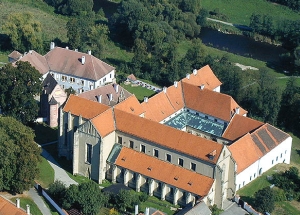
Zlatá Koruna Monastery (Czech: Klášter Zlatá Koruna), also known historically as Sancta Corona or the Abbey of the Holy Crown, is a former Cistercian monastery in South Bohemia, Czech Republic, located approximately 8 km north of Český Krumlov. It sits dramatically on a rocky promontory almost entirely encircled by a meander of the Vltava River, a classic Cistercian site chosen for its isolation in a forested, sparsely populated area. Today, it ranks among the best-preserved medieval Cistercian complexes in Bohemia and Central Europe, featuring exceptional Early and High Gothic architecture with later Baroque and Rococo overlays. Declared a National Cultural Monument in 1995, it is managed by the National Heritage Institute (Národní památkový ústav) and open to the public with guided tours focused on monastic life, architecture, and the cultural history of southern Bohemia.
Founding and Early Years (1263–Late 13th Century)
The monastery
was founded in 1263 by King Přemysl Otakar II (Ottokar II of Bohemia),
the “Iron and Golden King.” On 6 April 1263, a group of Cistercian monks
set out from the mother abbey of Heiligenkreuz (Heiligenkreuz Abbey) in
Austria and arrived at the site by mid-April. The foundation charter and
initial settlement followed shortly thereafter.
The original name was
Sancta Corona (Holy Crown or Holy Thorn Crown / Svatá Koruna; Latin
Sancta Corona Spinea). This derived from a precious relic—a thorn from
Christ’s Crown of Thorns—allegedly given to Přemysl Otakar II by the
French king Louis IX (Saint Louis), who had received it from Emperor
Baldwin II of Constantinople in 1239. The thorn was housed in a crystal
case and likely kept in the monastery’s early chapel. Baroque
chroniclers linked the foundation to a pious vow the king made before
the Battle of Kressenbrunn (1260) against Hungarian King Béla IV,
promising a monastery if victorious; the political motive was equally
important—to curb the expanding power of the Vítkovci
(Witigonen/Rožmberk) family, who controlled nearby Český Krumlov and
threatened royal influence in southern Bohemia.
The king endowed the
monastery with vast estates, primarily the Boleticko region (roughly 880
km² of forests) and parts of Netolicko, including a castellany.
Additional donations (e.g., from Bavor ze Strakonic) followed. The first
monks began building immediately. The earliest surviving structure is
the unique two-story Chapel of the Guardian Angels (Kaple Andělů
Strážných, ca. 1270), a rare feature in Czech Cistercian houses that may
have been built specifically to house the relic (echoing the
Sainte-Chapelle in Paris). Construction of the main church and convent
started around 1278–1300 (transept, presbytery, and northern parts of
the three-aisled basilica).
A major setback occurred around 1276 when
the Vítkovci destroyed the site (described in Cistercian general chapter
records as a “locum destructum”). King Přemysl Otakar II planned
relocation but died in 1278 before it could happen. Reconstruction began
in earnest under his successor, King Václav II (Wenceslaus II), with
assistance from monks of the Plasy monastery; spiritual life was
restored in 1291.
14th-Century Prosperity and Challenges
The
14th century marked the monastery’s golden age. Thanks to its huge
estates, the community undertook extensive colonization, founding
approximately 50 new villages in the Boleticko region—a scale unique
among Czech Cistercian houses. Boundary disputes with neighboring
landowners (Vyšší Brod Monastery, Vyšehrad Chapter, local nobles) were
largely resolved in the monastery’s favor between 1360 and 1396.
A
fire in 1354 damaged the complex; the famous Prague stonemason Michael
Parléř (son of Peter Parler) worked on repairs, contributing distinctive
elements such as the richly carved wheel-window in the transept and
carved details on portals and the well chapel (a seven-sided structure
with an innovative “transparent skeleton” rib vault). The main Church of
the Assumption of the Virgin Mary (Kostel Nanebevzetí Panny Marie) took
shape as a non-oriented three-aisled Gothic basilica with transept
(presbytery facing roughly north-northwest to follow the river). The
three-winged, two-story convent with its vaulted ambulatory (cloister),
chapter house (with two slender octagonal pillars and unique consoles),
and refectory were built concurrently. The name began shifting to Zlatá
Koruna (“Golden Crown”) in the early 14th century (documented by 1315),
likely reflecting the monastery’s newfound wealth.
Economic and
political troubles emerged toward the end of the century: valuables and
archives were sent to safety at Schlägl Abbey (Austria), and disputes
intensified.
Hussite Wars, Seizure of Estates, and Long Decline
(15th–16th Centuries)
The Hussite Wars brought catastrophe. In 1420
the monastery was attacked and burned (twice, once possibly under Jan
Žižka); some Hussite fighters were even former monastic vassals. The
monks fled for 17 years. The powerful Rožmberk (Rosenberg) family, based
in Český Krumlov, seized the estates as a pledge from King Sigismund of
Luxembourg; despite later royal attempts (e.g., Vladislav II Jagiellon
in 1493), the lands were never returned and were later incorporated into
the Krumlov dominion. This left the monastery without resources; the
church and large convent remained unusable or ruined until the 17th
century.
In the second half of the 16th century, a small convent with
refectory was added and the abbey repaired. The monastic filiation
(lineage within the Cistercian order) shifted temporarily after loss of
Austrian ties, moving from Heiligenkreuz via Plasy before restoration in
1400.
17th–18th Century Recovery, Baroque Flourishing, and
Suppression
After the Thirty Years’ War (during which troops looted
the site), recovery accelerated. By the second half of the 17th century,
Zlatá Koruna was counted among the exemplary monasteries of the
Czech-Moravian Cistercian province. Extensive repairs were completed,
including Baroque vaulting in the church (1665) and removal of a fourth
northern aisle. The complex received new Gothic-style extensions to the
little convent.
The second half of the 18th century brought a final
flowering under the last abbot, Bohumír Bylanský (in office from around
1755). He reformed monastic discipline and economy, introduced modern
agriculture (potatoes, mulberries, tree planting), supported scientific
interests (metrology, astronomy), and founded a school for children of
local serfs using progressive visual teaching methods. Interiors were
redecorated in exuberant Rococo style—frescoes by František Jakub
Prokyš, stuccos, and works from sculptor Jakub Eberle’s workshop—while
gardens were landscaped.
This prosperity ended abruptly in 1785 when
Emperor Joseph II’s Josephine reforms suppressed the monastery (one of
many dissolutions). Monastic life ceased forever.
Industrial
Exploitation, Damage, and 20th-Century Restoration (1787–1945)
In
1787 the Schwarzenberg family of Krumlov purchased the buildings and
rented them for industrial purposes—silk, cotton, cloth, and especially
a foundry and machine shop installed in the cloister walk. These
operations (particularly in the mid-to-late 19th century) caused severe
structural damage through vibration, pollution, and alterations.
Industrial use finally ended in 1909, after which systematic
reconstruction began. Major restoration work occurred from 1938 onward
(led by architect Fidry), continuing even during World War II. In 1940,
during the Protectorate, the Gestapo seized the complex from the
Schwarzenbergs.
Post-War Nationalization and Present Day
(1945–Today)
After World War II the monastery was confiscated from
the Schwarzenbergs under Act No. 143/1947 Coll. (“Lex Schwarzenberg”).
From 1945 it became publicly accessible with exhibitions on Cistercian
monastic life and southern Bohemian literature. Between 1979 and 2000 it
was administered by the State Scientific Library in České Budějovice.
Since then it has been under the National Heritage Institute. In 2013,
to mark the 750th anniversary of founding, the restored Gothic abbey
chapel of St. George (originally for the abbot’s private use) was opened
to the public for the first time.
Today, the monastery
complex—enclosed by medieval walls with a forecourt containing the
former parish Church of St. Margaret—preserves an extraordinary
ensemble: the vast Church of the Assumption (South Bohemia’s largest),
exquisite Gothic cloisters with Rococo stuccos and paintings, the
chapter house with its unique rib vault and consoles, the well chapel,
and the Chapel of the Guardian Angels. Tours reveal everyday monastic
routines (refectory, library, study rooms) alongside the site’s role in
colonization, politics, and culture. The village of Zlatá Koruna grew
around the former monastery after 1785.
Overall Layout and Orientation
The architectural core is the
convent church (Church of the Assumption of the Virgin Mary / Kostel
Nanebevzetí Panny Marie), a three-aisled basilica with a transept,
oriented almost due north (presbytery facing north-northwest). This
unusual alignment deviates from the traditional east-west axis to follow
the river’s course and Cistercian site-selection rules. Attached
directly to its south side is the two-storey convent with a three-winged
cloister (ambit). North of the church stands the freestanding Chapel of
the Guardian Angels (Kaple Andělů Strážných), with the so-called “little
convent” annexed to it. Further north and east lie the abbey buildings
(including the abbot’s residence and brewery), while a walled forecourt
and Gothic gates enclose the entire complex to the southwest. A separate
parish church of St. Margaret served the lay village near the entrance.
The entire ensemble is remarkably intact, with most medieval fabric
surviving despite later interventions.
The Convent Church –
Gothic Basilica with Parléř Connections
Construction was phased over
roughly a century, reflecting Cistercian restraint evolving into more
ornate High Gothic:
Early phase (late 1260s–1320): The transept,
presbytery, and initial northern section of the nave (up to the fourth
pair of pillars) were built first. The presbytery exterior is a
highlight of early cathedral-influenced Gothic, featuring triangular
gables (vimperky), pinnacles, and gargoyles.
High Gothic expansion
(second quarter to mid-14th century): The three-aisled nave was
completed, and a temporary fourth nave was added on the north side
(later removed). A richly carved rose window (wheel window) in the north
wall of the eastern transept arm displays unusually intricate, “broken”
tracery—widely attributed to master sculptor Michal (Michael) Parléř,
who worked here around 1359 (the same Parler family responsible for
Prague Cathedral’s triforium and south tower).
Southern portal: Also
features Parléř-style free tracery carving.
The church originally
had ribbed Gothic vaults; these were replaced during Baroque repairs in
the second half of the 17th century after Hussite-era damage (1420). The
interior is vast—the largest church in South Bohemia—with tall arcades,
clerestory lighting, and a late-18th-century main altar (sculptures by
Jakub Eberle), though the architectural drama lies in the surviving
Gothic skeleton and the dramatic northern orientation.
Cloister
and Chapter House – Linear Gothic Mastery
The cloister (křížová
chodba) is a three-winged, two-storey structure built in parallel with
the church. Its ribbed vaults retain their original Gothic profiles but
received lavish Rococo stucco and wall paintings in the 1760s (by
František Jakub Prokyš). The most architecturally significant space is
the chapter house (kapitulní síň) in the north wing, dated circa 1300
and exemplifying pure “linear Gothic”:
Vaulted on two slender
octagonal pillars with grooved shafts and capitals.
Eight pear-shaped
ribs spring from each capital, intersecting at smooth bosses and
descending to varied consoles on the walls—some carved as grotesque
maskarons in granite, others tiered like inverted pyramids.
Three
tall segmental-arched windows on the north wall and a stucco-rendered
monastic coat of arms above the entrance.
Central Rococo allegory
painting in green tones on the vault.
This hall is considered one
of the finest surviving examples of early Cistercian chapter
architecture in Bohemia.
Chapel of the Guardian Angels – Early
Gothic Jewel
The oldest fully preserved building (dated variably to
circa 1270–1370) is this unusual two-storey (or single-storey with upper
level) chapel north of the church. Its design is exceptional for
Cistercian monasteries and may have been inspired by the Sainte-Chapelle
in Paris—built to house the very crown-of-thorns relic given to the
monastery. Features include:
Ribbed cross-vaulting throughout.
An early Gothic portal on the west façade with a finely carved stone
tympanum.
Later Rococo frescoes (1763, again by Prokyš).
Its
compact, vertically oriented form contrasts with the larger basilica and
may originally have served as a relic chapel or infirmary.
Well
Chapel and Other Structures
Embedded in the east arm of the cloister
is the mid-14th-century well chapel—a heptagonal (seven-sided) pavilion
whose ribs rise directly from the floor, creating a transparent,
skeletal vault that opens a clear view to the ceiling above—an “artistic
play” unique in Czech Gothic. Tracery here is also linked to Parléř’s
workshop.
The little convent and abbey buildings retain Gothic cores
but were extended and renovated in the early 17th century (completed
1661) and later adapted for brewing. The abbot’s private chapel (first
mentioned 1387) survives largely unaltered. Economic structures and
Gothic gates complete the functional monastic layout.
Baroque and
Rococo Overlays; Later History
After severe damage in 1420 and a fire
in 1354, major repairs occurred in the second half of the 17th century
(new church vaults, removal of the fourth nave, latrine wing extension).
The 18th century brought exuberant Rococo decoration—stucco, frescoes,
and paintings—across most interiors, softening the original Cistercian
austerity without destroying the Gothic structure. Secularized in 1785
under Joseph II, the complex was sold to the Schwarzenberg family and
used for industry until 1909, causing some losses (e.g., well chapel
vault, parts of the north wing). Sensitive reconstruction began in the
1940s; today it is a protected national cultural monument.
Materials and Overall Aesthetic
Local stone (including granite for
consoles), brick, and timber roofs define the fabric. The architecture
is characteristically Cistercian in its initial restraint—unadorned
walls, functional forms—yet evolves into sophisticated High Gothic with
Parléř tracery, pinnacles, and ribbed complexity. The Baroque/Rococo
layers add color and ornament without overwhelming the medieval bones,
creating a harmonious dialogue between centuries.
Key features include the unique Gothic Chapel of the Guardian Angels, the immense Church of the Ascension, and exquisite cloisters. The refectory houses early Baroque frescoes and large canvases, while epitaphs of Přemysl Otakar II and Bavor II add historical depth. A rare concert piano by Carl Bechstein, originally for the Tsar’s palace, is a unique artifact. Culturally, the monastery represents peak Cistercian architecture and Bohemian literary heritage, with tours exploring monastic life and regional literature in Czech, German, and Latin. As a National Historic Monument, it symbolizes medieval religious and royal history, protected for its architectural and historical value.
Today, Zlatá Koruna is well-preserved and open to the public as a state-owned cultural site, managed by the National Heritage Institute. Visitors can enjoy two guided tour circuits: one on monastic life (little and great convent, refectory, church) and another on Southern Bohemian literature with interactive exhibits. A lapidary with statues enhances the experience. Opening hours vary seasonally; check the official website for details, with admission fees around 150-250 CZK for tours. Nearby attractions include Český Krumlov and the Vltava River, ideal for combined visits. The site hosts events and offers insights into 18th-century nun life, making it a serene, educational destination.