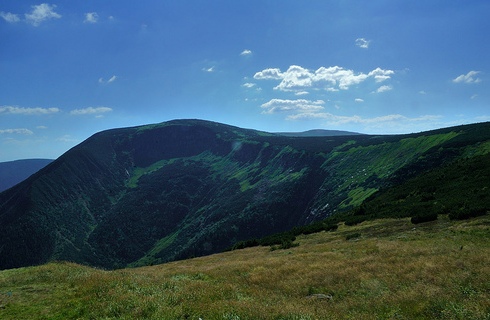
Location: Liberec Hradec Králové, East Bohemia Map
Area: 385 km2
Official site
Krkonoše National Park (also KRNAP) is a protected area located in the Krkonoše geomorphological unit in the northern part of the Czech Republic. For the most part, it lies in the northwest of the Trutnov district, but it also extends into the Semily and Jablonec nad Nisou districts. The northern border of the park follows the state border, which simultaneously separates it from the Polish Krkonoše National Park (Karkonoski Park Narodowy). The border of the protection zone continues from Žacléra and then along the axis of road I/14 to Mladý Buků, Rudník, Vrchlabí, Jilemnica, Vysoké nad Jizerou and Kořenov.
The Krkonoše National Park was declared on May 17, 1963 by Government
Decree No. 41/1963, four years after the Polish Krkonoše National Park
(Karkonoski Park Narodowy), which was established on January 16, 1959.
In 1986, the national park was expanded to include a protection zone by
Government Decree No. 58/1986 Coll. Government Regulation No. 165/1991
Coll. the statute of the Krkonoše National Park was re-proclaimed: "The
mission of the national park is the preservation and improvement of its
natural environment, especially the protection or restoration of
self-managing functions of natural systems, strict protection of wild
animals and wild plants, preservation of the typical appearance of the
landscape, fulfillment of scientific and educational goals, as well as
the use of the territory of the national park for ecologically
sustainable tourism and recreation that does not deteriorate the
environment." The last legislative re-proclamation of the Krkonoše
National Park was Act No. 123/2017 Coll., which amends Act No. 114/1992
Coll., on the protection of nature and landscape (KRNAP is promulgated §
15b).
Until June 30, 2020, the territory of the national park was
divided into three protection zones - strict natural (1st zone), managed
natural (2nd zone) and marginal (3rd zone). In the 1st zone of the
national park, entry outside the marked paths was prohibited. In the 2nd
and 3rd zones, visitors could move freely on foot also in the meadows
and forests (however, in the forests there is a general ban on moving on
skis outside the paths according to the forest law.). From 1 July 2020,
the territory of KRNAP is divided into four care zones, namely the
natural zone (A), the close-to-nature zone (B), the concentrated nature
care zone (C) and the cultural landscape zone (D). Care (management)
zoning does not affect the movement of people in the territory of the
national park. The movement of people is newly directed by the so-called
quiet areas. Eight of them are currently announced. Where quiet areas
are marked, it is only possible to move along marked paths. Quiet areas
cover 22.2% of the territory of KRNAP and mostly copy the borders of the
original 1st protection zone.
The original territory of the
national park was reduced from 385 km² to the current 363.27 km² in
1991. The boundaries of the KRNAP moved more into the mountains, and the
built-up areas of most municipalities were removed from the KRNAP, which
were reassigned to a protection zone, in which protection is at a
similar level as in a protected landscape area. In 1992, both national
parks on the Czech and Polish sides were jointly included in the UNESCO
network of biosphere reserves. On the territory of KRNAP there are
peatlands, included in the list of world-important wetlands according to
the Ramsar Convention. Both KRNAP and its Polish counterpart, the
Krkonoše National Park (Karkonoski Park Narodowy), are certified
cross-border parks in the program of the pan-European association
Federation EUROPARC. The KRNAP administration is also a member of
another international organization, EuroSite, and a co-founder of the
free association of protected areas on the Elbe, ElbeParks.
Krkonoše National Park is classified in the IUCN categorization as
Protected Landscape, i.e. category V. It does not meet the international
criteria for a national park (IUCN II).
The Krkonoše National
Park Administration located in Vrchlabí takes care of the park and
provides administrative support for activities.
The nature of the Krkonoše Mountains is very diverse - the geological bedrock, its dynamic development in the past, the influence of the cold climate and subsequent warming resulted in the creation of diverse biotopes and the preservation of rare species of both plants and animals for our nature. There are about 300 species of vertebrates and over 1,200 species of vascular plants and several times more spore-forming plants (such as mosses, mosses, ferns, lichens). There are several endemics in the nature of the Krkonoše Mountains.
The Krkonoše National Park lies mainly in the Krkonoše geomorphological unit in the Krkonoše-Jesenice system. The highest point of the park (and at the same time of the Czech Republic) is Sněžka with 1603 meters above sea level. It is divided into the Vrchlab Highlands and the Krkonoše Mountains in the south, and the Krkonoše Ridges at the northern border. The effects of the last glaciation are evident here - karas, niva karas, moraines, tors, stone seas and other relics. In the eastern part of the park in the vicinity of Albeřice, there are also karst phenomena - Albeřické quarries.
The geological bedrock of the Krkonoše region is very diverse, most of the territory falls within the area of the so-called Krkonoše-Jizera Crystalline, a significant part of which the Krkonoše-Jizera pluton, which is also made up of granitoids, extends into the territory of the national park. It forms the main ridge from Mrtvé vrch (1060 m) to the western foot of Sněžka (1603 m). In the contact yard, which stretches from Hvězda (959 m), through Čertova hora (1210 m) to Svorová hora (1411 m), there are gray svoras to phyllites. The eastern part is made up of Krkonoše gneisses and phyllites, the western part is made up of phyllites of the Ponikel group. At the edge of the Krkonoše National Park lies the sub-Krkonoše basin, where sedimentary rocks of Carboniferous to Permian age are deposited.
The mountain regions in Central Europe are characterized by a significant change of seasons and the influence of the Atlantic Ocean, which results in very variable weather. The orientation of the slopes in relation to the sunlight and the flow of the winds is essential for the microclimatic conditions - these are factors that influence the plants that grow in these places. In the mountainous regions of the Krkonoše Mountains, there is a frequent temperature inversion in the winter and autumn months, which can last for several weeks. The average annual temperature varies between 0.2 °C in Sněžka, in lower locations the average annual temperatures are higher (e.g. Dolní Malá Úpa 3.9 °C, Bedřichov 4.7 °C) and the warmest month is July and the coldest is January. The snow cover on the mountain tops lasts up to 180 days.
The border of the alpine forest ranges from 1250 to 1350 m above sea
level. At high altitudes, there are several species that are glacial
relics (i.e. plants that have survived here since the last glaciation).
They are, for example, the Krkonošský aphid, the snow sedge, the
mulberry bramble, the Lindbergh sphagnum, etc.
The following
vegetation levels occur in the Giant Mountains:
submontane
(400–800 m above sea level)
In the submontane level, broad-leaved to
mixed forests predominated, with the presence of beech, maple, whooping
crane, gray alder and, on the Polish side, deciduous larch. These trees
were cut down and a spruce monoculture was artificially planted here. In
the undergrowth there are protected plants such as bulbous and
nine-leafed sedge, buttercup and game anemone, bear's garlic, and
golden-headed lily.
montane (800–1200 m above sea level)
In
the montane level, spruce stands predominate (native and artificially
planted), dark forests are a suitable environment for the growth of
ferns (male fern, variegated rib, mountain fern). Since the 18th
century, there have been forestless mountain meadows where rare species
of plants such as bellflower, yellow Sudeten violet, arnica sedge, white
daisies, hogweed, and several representatives of the family of
interstices are abundantly represented.
subalpine (1200–1450 m
above sea level)
In the subalpine level, the most valuable habitats
are the Krkonoše Mountains - amaranth meadows, Nordic peat bogs and
kneeling stands with the occurrence of relict plants. In the herbaceous
layer, there are common primroses, hairy reeds, cranberry-like plants,
bisexual sedum, etc.
alpine (1450–1603 m above sea level)
The
highest positions form the alpine stage. The steepest rock slopes and
pits (known as the so-called Krkonoše botanical gardens) are the richest
in species. On the slopes of the karsts, there are, for example, sallow
and variegated sedges, alpine milkweed, garlic sedge and various types
of ferns. Coastal mountain chives, small primrose, alpine sedum, and
perennial primrose grow in the vicinity of the springs. Of the trees
that reach a low height due to the harsh conditions, species such as the
Silesian willow, the Carpathian birch, the mountain ash, the Sudeten
crane and the knee pine are represented.
Various species of animals are also tied to the rich plant communities. Animal communities formed during the last Ice Age and the following more favorable period (called the Holocene). Euro-Siberian fauna species are represented at lower altitudes, and mountain species increase with increasing altitude. There are several species of invertebrates that represent glacial relics here – e.g. the spiny-footed spider, the northern braid, the mountain mayfly, the ground beetle Nebria gyllenhali, the dragonflies Somatochlora alpestris and Aeschna coerulea. Among vertebrates, species such as the Northern European mountain blackbird, the tundra bluebird, the brown plover, the winter warbler and the most widespread rodent are the marsh vole were observed in the Giant Mountains. Only the Krkonoše mayfly (Rhithrogena corcontica) and two subspecies of animals found elsewhere - the yellow-banded sudetica butterfly (Torula quadriaria sudetica) and the Krkonoše snail (Cochlodina dubiosa corcontica) can be considered an endemic Krkonoše species.
According to the measurements of mobile operators, 1,027,628 visitors
visited the national park in 2017, who spent 4,658,248 "personal days"
here. Including the protective zone, 3,657,254 people visited the area
and spent 11,324,528 "personal days" here.
The Giant Mountains
are the highest and most visited Czech mountains. Among the traditional
excursion destinations are Sněžka, the Elbe spring, the Pančavský,
Labský and Mumlavský waterfalls, the educational trail through the Black
Mountain bog, the wonderful valley of the Giant mine, the ancient
Dvorský forest or Luční bouda. The destination for tourists is, for
example, the Štěpánka lookout tower on the border between the Giant
Mountains and the Jizera Mountains.
In 2020, a record number of
tourists visited the Krkonoše National Park. According to the management
of the park, however, they left a lot of garbage on the site, the
removal of which was very expensive. Tourists often break park rules and
enter quiet areas off the marked paths.