Location: Bernstein, Burgenland Map
Constructed: 1199
Official site
Email: burgbernstein@netway.at
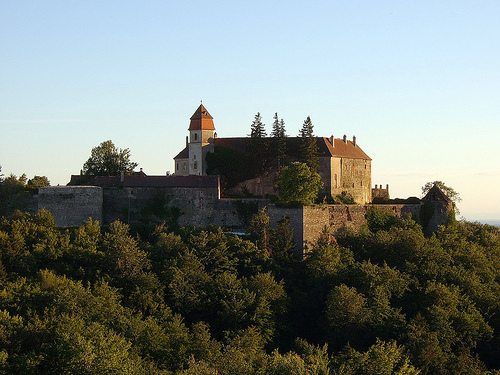
Bernstein Castle, known in German as Burg Bernstein and in Hungarian as Borostyánkő vára, is a historic fortress located in the municipality of Bernstein im Burgenland, in the southeastern Austrian state of Burgenland. Perched at an elevation of 615 meters (2,018 feet) above sea level on a wooded hill, it overlooks the surrounding landscapes of Central Burgenland, the Great Hungarian Plain, and southern Styria. First documented in the 13th century, the castle originated as a medieval defensive structure, possibly with roots tracing back to the 9th century when the area was part of the archbishopric of Salzburg. Over the centuries, it has evolved from a Gothic stronghold into a Baroque residence and, since 1953, a boutique hotel and restaurant owned by the Almásy family. The castle's resilience through sieges, explosions, and ownership changes makes it a symbol of Burgenland's turbulent history, blending medieval fortification with romantic, family-run hospitality. It is also notably linked to László Almásy, the explorer whose life inspired the Oscar-winning film The English Patient (1997).
Bernstein Castle (German: Burg Bernstein; Hungarian: Borostyánkő
vára) is a historic rock castle (Felsenburg) perched dramatically on a
hilltop at approximately 615 meters (2,018 ft) above sea level in
Bernstein im Burgenland, Burgenland province, Austria—the
highest-elevated castle in the entire region. It overlooks the Tauchen
Valley and offers sweeping views toward Styria and Lower Austria.
Strategically located near the ancient Amber Road trade route (which may
explain its name, derived from Bernstein, German for “amber”), the
castle has served as a defensive stronghold, noble residence, and refuge
for over a millennium.
Today, it is a privately owned family-run
boutique hotel and restaurant operated by descendants of the Almásy
family, with parts open to the public for guided tours. Its thick walls,
romantic gardens (the oldest natural rock garden in Burgenland, created
from obsolete 17th-century defenses), Renaissance hall with elaborate
stucco ceilings, and preserved medieval elements make it a living
monument to Central European borderland history. The castle has endured
sieges, conquests, explosions, sales, neglect, fires, and
rebuildings—yet each time it has risen larger or more refined.
Early Origins (9th–12th Centuries)
The region’s documented history
begins in 860, when it belonged to the Archbishopric of Salzburg. A
liegeman named Erimbert granted land along the Pinka River to his
servant Jacobus. Although no castle is explicitly named, the Old Slavic
place name of the nearby hamlet Grodnau (“the village belonging to the
castle”) strongly indicates an early fortification existed on the site,
likely a wooden or simple stone precursor.
The first stone walls were
erected in the 12th century. By 1199, the castle was under the Kingdom
of Hungary (one of the earliest firm documentary references), associated
with a lord named Miczbán de genere Akos. It quickly became a border
fortress in the contested Austro-Hungarian frontier zone.
Medieval Turbulence and Noble Ownership (13th–15th Centuries)
Control
shifted repeatedly between Austrian and Hungarian powers:
Shortly
before 1236, the castle briefly passed to Frederick II, Duke of Austria
(of the Babenberg dynasty), but King Béla IV of Hungary conquered it
that year and later granted it to Count Henry I Kőszegi (of the
Güssing/Güns family).
In 1260, it was formally awarded to the Kőszegi
lords, who used it as a base; contemporary accounts describe it as a
notorious hideout for “robber knights,” which locals avoided.
1336:
The Lords of Güssing and Bernstein were decisively defeated by Hungarian
King Charles Robert of Anjou; the castle became Hungarian crown
property.
1388–1392: It was pledged to, then fully owned by, the
powerful Kanizsai (Kanizsay) family, who rebuilt the dilapidated
structure.
1482: Briefly held by King Matthias Corvinus of Hungary.
1487: Pawned by Emperor Frederick III to the Königsberg (Königsberger)
family; some sources note the last successful conquest of the castle
occurred around 1445 during these turbulent transfers.
Early
Modern Era: Sieges, Fortifications, and Rebuilding (16th–17th Centuries)
The castle faced its greatest external threats during the Ottoman wars:
1529 and 1532: Ottoman (Turkish) forces besieged Bernstein twice but
failed to capture it. In response, the castle was upgraded into a
stronger Fluchtburg (refuge fortress) with a second ring of bastions
designed by Italian master builder Francesco de Pozzo.
1604: A large
combined army of Hungarians, Turks, and Tatars under Prince Stephen
Bocskay laid siege for weeks—again unsuccessfully.
In 1617,
disaster struck when lightning (or an accident) ignited the gunpowder
magazine, causing a massive explosion that left much of the Gothic core
uninhabitable. Ludwig Königsberg promptly rebuilt the inner castle in
Baroque style, demolishing the old keep and towers to create a more
residential palace-like structure. The magnificent Renaissance hall
(built or completed in the early 17th century under the Batthyánys, with
unique stucco work) became the architectural heart of the castle and
remains a highlight today.
In 1644, Ehrenreich Christoph Königsberg
sold the castle and lordship to Count Ádám Batthyány, whose family (coat
of arms featuring a pelican) oversaw further Renaissance and Baroque
enhancements. A notable later event was the 1704 siege during the
post-Turkish/Rákóczi wars, defended by the widowed Countess Eleonore
Batthyány.
18th–19th Centuries: Stability and Transition
Under
the Batthyány family, the castle transitioned from pure fortress to
aristocratic residence. Defensive walls gradually became obsolete with
advances in artillery and warfare; the outer structures were landscaped
into the natural rock garden that exists today—the oldest of its kind in
Burgenland.
In 1864, Count Gustav Batthyány sold it to his estate
manager Edward O’Egan. O’Egan’s heirs, facing maintenance costs, sold
the property in 1892 to Count Eduard Almásy, an adventurous Hungarian
noble who relocated the family from Török Szent Miklós (Hungary) to
Bernstein. Eduard modernized the castle with electricity and running
water and began hosting international guests.
20th Century to
Present: The Almásy Era and “The English Patient”
The Almásy family
has owned Bernstein Castle continuously since 1892 (with the current
owners descending from Maria della Pace Kuefstein, adopted by the last
Almásy lord János in 1955, who added the Almásy name to preserve
tradition).
The castle’s most famous resident was Count László E.
Almásy (born 1895 at the castle), a pioneering aviator, desert explorer,
and cartographer whose real-life adventures in North Africa loosely
inspired Michael Ondaatje’s novel and the 1996 Oscar-winning film The
English Patient (nine Oscars, including Best Picture). László served as
a pilot in World War I and later mapped the Libyan Desert; the family
still offers guided tours focused on his story.
During World War II
and the Soviet occupation in 1945, the family navigated challenges with
diplomacy. In 1953, part of the castle was converted into a comfortable
hotel and restaurant, blending historic charm with hospitality. It has
operated as a small, family-run luxury hotel ever since (now with nine
restored rooms and suites), welcoming guests who seek the “flair of a
time long gone.”
Construction began in the 12th century (with possible earlier roots
around 860), when the first stone walls were erected on the rocky crag.
Early records from 1199 describe it as part of the Kingdom of Hungary.
By the late Middle Ages, under owners like the Güssing counts and later
the Kanizsay family (who rebuilt it around 1388–1392), it featured
classic Gothic defensive elements: a high round keep (Bergfried),
multiple towers, thick defensive walls (Wehrmauern), a Zwinger (outer
ward), and residential buildings that were heightened by one story.
These created a compact, austere stronghold optimized for protection.
In the 16th century, following unsuccessful Ottoman Turkish sieges in
1529 and 1532, Italian master builder Francesco de Pozzo added a second
outer ring of bastions (Basteienkranz). This transformed the castle into
a Fluchtburg—a fortified refuge for the local population—expanding its
defensive footprint with polygonal or angled bastions typical of early
modern artillery-resistant design. A gunpowder magazine explosion in
1617 severely damaged the inner Gothic core.
Owner Ludwig von
Königsberg oversaw a major rebuild from 1625–1627. He demolished the
keep and towers (no longer needed as warfare evolved) and converted the
inner structures to Baroque style, emphasizing comfort, grandeur, and
residential use over pure fortification. The result was a two-story
(partially cellared) complex with smoother lines, larger windows, and
ornate detailing.
By the mid-17th century, under the Batthyány family
(who acquired it in 1644), the castle gained its signature interior
centerpiece: the Renaissance-influenced Knights’ Hall (Rittersaal).
Later 19th- and 20th-century modifications under the Almásy family
(owners since 1892) added Biedermeier, Art Nouveau, and subtle modern
touches while maintaining authenticity. Defensive outer structures were
repurposed into the region’s oldest natural rock garden.
Overall
Layout and Exterior Features
The castle complex spreads across the
rocky hilltop in a layered, defensive arrangement typical of evolved
medieval-to-Baroque sites:
Outer fortifications and bailey: A
16th-century ring of bastions and thick stone walls encloses an outer
courtyard (bailey). This served as a kill zone and chokepoint, funneling
potential invaders through controlled gates. Thick walls with crevices,
small windows, and remnants of loopholes remain visible.
Gates: An
outer gate leads into the bailey; an inner gate provides controlled
access to the residential core.
Courtyards: A large central palace
courtyard forms the heart of daily life and guest circulation today,
surrounded by the main residential wings.
Rock integration and
garden: The entire structure sits directly on granite bedrock. Former
bastions and outer defenses were landscaped in the 17th century into a
naturalistic Felsengarten (rock garden) with wild ivy, shrubs, and
mature trees—one of Burgenland’s oldest. This creates a romantic,
overgrown ambiance blending architecture with nature.
Exterior
walls are plastered or exposed stone, with red-tiled roofs, chimneys,
and oriel windows offering valley views. The overall silhouette is
compact and harmonious rather than towering, reflecting the post-1617
shift away from vertical Gothic defenses.
Interior Architecture
and Key Spaces
The Baroque rebuild created spacious, livable
interiors with high ceilings, vaulting, and decorative elements. Rooms
feature thick walls (for thermal mass and defense), wood paneling,
frescoes, and period furnishings. Many guest rooms (there are about 9–11
suites and doubles) retain original details like vaulted ceilings,
historical tiled stoves (some bearing Batthyány coats of arms or pelican
motifs), family portraits, Art Nouveau beds, and panoramic views. No
modern distractions like TVs or Wi-Fi in rooms preserve the historic
atmosphere.
The undisputed architectural highlight is the Rittersaal
(Knights’ Hall / Renaissance Hall), built in the first half of the 17th
century. This central space—often called the heart of the
castle—features an exceptionally elaborate stucco ceiling (Stuckdecke)
with intricate reliefs depicting scenes from Greek mythology and Ovid’s
Metamorphoses. The hall connects to surrounding suites and serves as a
grand salon, blending Renaissance proportions with Baroque
ornamentation. Other notable interiors include the 16th-century
Alchimistenküche (Alchemist’s Kitchen) and Folterkammer (Torture
Chamber), now preserved with museum-like exhibits but integrated into
the hotel experience.
A small chapel and additional salons complete
the private residential feel. Overall, the interiors emphasize layered
historical authenticity: medieval foundations, Baroque grandeur, and
later familial refinements.
Significance
Bernstein Castle holds profound cultural and historical significance as one of Burgenland's oldest fortresses, embodying the region's medieval past, Hungarian-Austrian border dynamics, and resilience against invasions. Its ownership transitions reflect broader European power shifts, from Hungarian kings to Habsburg emperors and noble families. The castle's association with the Almásy family, particularly László (whose life inspired The English Patient), adds literary and cinematic fame, drawing visitors interested in adventure tales. As a conserved national monument, it represents adaptive heritage preservation, turning a once-militaristic site into a peaceful retreat. It contributes to Burgenland's tourism, showcasing idyllic landscapes and authentic Austrian history amid forests and plains.
Visitor Information
Today, Bernstein Castle functions primarily as a family-run boutique hotel, open from May to October, offering 9 rooms with rates including breakfast, afternoon coffee/cake, and candlelight dinners featuring a private "Almásy" wine selection. It provides a secluded, romantic experience with splendid gardens for strolls and event spaces like the banquet hall. Guided tours, focusing on history and the grounds, are available from May 1 to October 6, Wednesday through Sunday (and holidays) at 11 a.m. The castle is accessible by car, located in a small village with nearby attractions like a mineralogical museum. Advance booking is recommended via the official website (www.burgbernstein.at), where English details are available. Photography is generally permitted, but respect for the private residence and hotel operations is expected.