Location: Forchtenstein, Burgenland Map
Constructed: 15th century
Open: 8am- 12pm, 1-4pm daily Apr- Oct
weekdays Mar- Nov
Tel. (02626) 81212
Official site
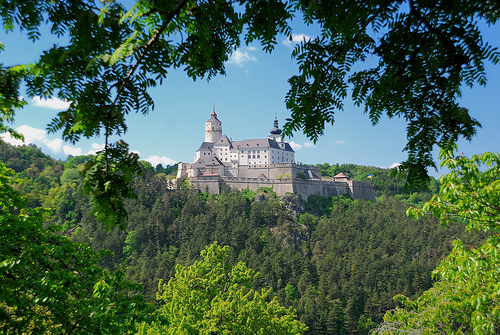
Forchtenstein Castle (Burg Forchtenstein) is a formidable medieval fortress located in the municipality of Forchtenstein in northern Burgenland, Austria, perched atop a steep dolomite rock at 511 meters (1,676 feet) above sea level in the foothills of the Rosaliengebirge mountain range. Coordinates are approximately 47°42′36″N 16°19′50″E. Built in the early 15th century (with some sources citing the 14th century), it is renowned for its impregnable defenses, having never been captured during conflicts like the Turkish Wars, and for serving as the secure treasury of the influential Esterházy family. The castle overlooks the Wulkatal valley and offers stunning panoramic views of the surrounding landscape, including the Rosalia mountains. Today, it functions as a museum showcasing one of Europe's largest private armories and a treasury of art and curiosities, attracting visitors interested in military history, baroque opulence, and family-friendly activities. It remains privately owned by the Esterházy family and draws around 100,000 visitors annually, blending historical preservation with modern tourism.
Early Origins: Lords of Mattersdorf/Forchtenstein (14th–Mid-15th
Century)
Construction began in the 14th century (with the core
completed in the early 15th century) by the Lords of Mattersdorf (also
known as the Nagymartoni family), a noble family from the region who
later adopted the name Lords of Forchtenstein. The first major structure
was a massive 50-meter (160 ft) high keep (Bergfried) and an adjoining
great tower—elements still visible today. The castle was designed as a
defensive Höhenburg (hill castle) with stout, tiered walls and towers to
control the surrounding territory and protect against invasions.
The
early fortress earned a grim reputation as the “Castle of Fear.” A tower
known as the Black Tower (originally lined with black rock, later
stripped) contained a 12-meter-deep pit used as a death prison.
According to legend, Rezallia (or similar spelling in some accounts),
wife of Lettus of Forchtenstein, frequently condemned prisoners to
horrific fates there—starvation, hanging upside down, or other
tortures—until her husband returned from campaigns and sentenced her to
the same fate.
By around 1450, the male line of the Lords of
Forchtenstein died out without a male heir. The castle passed to the
House of Habsburg, specifically the Lower Austrian Chamber
Administration, which held it for approximately 170 years. During this
period it was leased or pledged to families such as the Counts of
Weissbriach and Hardegg, and briefly formed part of a small Habsburg
principality under Archduke Albrecht VI. Little major construction
occurred; the building gradually fell into partial disrepair but
retained its defensive role.
Habsburg to Esterházy Transition and
Fortification (1622–Mid-17th Century)
In 1622, Emperor Ferdinand II
granted the partly ruined castle to Nikolaus Esterházy (1568–1645),
founder of the western Hungarian line of the Esterházy family, in
exchange for services and loyalty. Nikolaus received the title of Count
along with the fortress. He immediately began extensive fortifications
and refurbishments to turn the crumbling structure into a modern
defensive stronghold.
Work involved Italian master builders: Simon
Retacco (Vienna-based, 1630–1634) and Domenico Carlone (from 1643
onward). Construction crews were largely Italian, and stone came from
the imperial Kaisersteinbruch quarry—supplied by masters such as
Ambrosius Petruzzy, Pietro Maino Maderno, and Mathias Lorentisch. This
high-quality stone was used for main portals, fountains (including a
notable Neptune fountain), cannonballs, and other features, transported
by six-ox wagons.
The castle proved its worth during the Ottoman
wars. It resisted multiple Turkish incursions (including the 1529 siege
context and later campaigns) and was never captured, thanks to its
steep, winding access roads, natural defenses, and strategic location.
In 1624, Nikolaus and his sons Ladislaus and Paul triumphed over Ottoman
forces; many weapons, bows, arrows, quivers, bridles, and other trophies
displayed today originated as battlefield loot or diplomatic gifts from
these victories.
Baroque Golden Age under Paul I Esterházy (Late
17th Century)
Paul I Esterházy (1635–1713), Nikolaus’s son and later
the first Prince of the line, oversaw the most transformative phase.
Using architect Domenico Carlone’s plans, he expanded and ornamented the
castle into a full Baroque high castle (Barockburg). Interior artistic
elements, frescoes (including the largest secco wall paintings north of
the Alps in the inner courtyard), and princely apartments were added.
After the permanent expulsion of the Ottomans from the region, the
castle’s role shifted from active fortress to princely residence and
secure repository.
Paul I established the famous Esterházy Treasure
Chamber (Schatzkammer), Europe’s last intact Baroque Kunst- und
Wunderkammer in its original location. Access was via a secret passage
with a door requiring two different keys (one held by the prince, one by
his treasurer). It housed clocks, gemstone carvings, ivory works, exotic
animal preparations, machines, archives, and “marvels.” A legendary
“dragon” constructed from hundreds of stuffed animals and bones hung
from the ceiling to cast terrifying shadows in candlelight; other
curiosities included a unicorn horn, miniature dragons (taxidermied
martens with added wings), and a crocodile once displayed to deter
invaders.
The castle also became home to one of Central Europe’s
largest private weapons collections (armory/Zeughaus), spanning three
centuries: 30 Years’ War flintlocks, pikes, and halberds; Ottoman
trophies (including a magnificent Ottoman tent exhibit); and later
Napoleonic-era pieces. Ancestor portraits in the gallery sometimes
featured creative or fabricated lineage extensions—including full-body
depictions of Vlad the Impaler (Dracula) and connections to figures like
Attila the Hun or Charlemagne—to bolster the family’s prestige.
18th–20th Centuries: Repository, Division, and Preservation
In the
second half of the 18th century, master builder Johann Ferdinand
Mödlhammer carried out minor expansions: the roof truss was raised and
interiors renovated. The castle continued primarily as a secure storage
site for the Esterházy family’s military equipment, treasures, and
archives rather than a primary residence (the family’s main seat shifted
to Schloss Esterházy in Eisenstadt).
After the 1921 separation of
Austria and Hungary, Esterházy lands were divided; financial and some
archival records remained at Forchtenstein, while family documents went
to the Hungarian State Archives in Budapest. In 1919, during the
short-lived Hungarian Soviet Republic, about 280 treasure-chamber
objects were confiscated and taken to Budapest—many remain there under a
disputed loan agreement, with the Esterházy foundation still seeking
full restitution as of recent decades.
The treasure vault stayed
undiscovered and intact throughout World War II and the subsequent
occupation period. From 1954 to 1983, the castle hosted annual
Burgspiele Forchtenstein theater performances.
Today: A Living
Museum of Esterházy Heritage
Forchtenstein Castle is still owned by
the Esterházy Private Foundation and operates as a major tourist and
cultural site, drawing over 100,000 visitors annually. Guided tours
reveal the Baroque interiors, armory, treasure chamber (opened to the
public around 2005), and rotating exhibitions on topics like “Heroes –
Treasures – Loot,” wartime history, strong women in art, and the
1918–1921 seizures. It stands alongside Schloss Esterházy in Eisenstadt
as a chronicle of one of Europe’s most powerful aristocratic families.
Medieval Foundations (Late 13th–Early 15th Century)
Construction
began in the late 13th or early 14th century (with major early work in
the early 15th century) under the Lords of Mattersburg, who later styled
themselves the Lords of Forchtenstein. The core of the original castle
was a massive Bergfried (keep or donjon)—a 50-meter (164 ft) tall tower
known as the Black Tower (Schwarzer Turm). This served dual purposes as
a watchtower for surveillance across the landscape and the ultimate last
line of defense in sieges. Originally clad in dark rock (hence the
name), the cladding has since been stripped, leaving the tower
light-colored today. A notorious feature inside the tower is a 12-meter
(39 ft) deep pit prison, used for those condemned to death—a grim
reminder of medieval justice.
The early structure emphasized
fortification typical of late medieval Austrian hill castles: thick,
tiered defensive walls with bastions (multi-level projecting
fortifications), a single western gate protected by a drawbridge, and an
enclosed complex designed for regional control. Its elevated, steep
position made it nearly impregnable, helping it withstand threats like
the Ottoman sieges of Vienna in 1529 without major damage. During the
Habsburg period (after ~1450, when the Forchtenstein male line died
out), the castle was leased and saw minimal structural changes for about
170 years, though it gradually fell into disrepair.
Esterházy
Era: Fortification and Baroque Transformation (17th Century)
In 1622,
Emperor Ferdinand II granted the crumbling castle to Nikolaus Esterházy
(founder of the Forchtenstein branch of the family) in exchange for
other properties, elevating him to Count. This marked the beginning of
its most transformative phase. Nikolaus prioritized military upgrades,
commissioning Italian-influenced builders to convert it into a modern
fortress amid the turbulent Thirty Years’ War era.
Key architects
and craftsmen included:
Viennese master builder Simone Retacco
(contracts 1630–1634).
Italian architect and polier Domenico Carlone
(from 1643 onward, whose plans guided major expansions).
Master
masons from the imperial Kaisersteinbruch quarry: Ambrosius Petruzzy,
Pietro Maino Maderno, and Mathias Lorentisch.
A standout material
was Kaiserstein, a durable hard limestone quarried locally and
transported by ox-drawn wagons. It was used for robust main portals,
fountains (including the prominent Neptune fountain in the courtyard),
cannonballs, and other structural accents—providing both strength and
elegant detailing.
Nikolaus’s son, Paul I Esterházy, continued the
work in the second half of the 17th century, shifting emphasis toward
artistic and residential refinement while maintaining defensive
integrity. Under Carlone’s guidance, the castle gained ornate Baroque
portals adorned with religious and allegorical sculptures, an equestrian
statue of Paul, and elaborate interior ornamentation. These changes
transformed the medieval fortress into a full Barockburg (Baroque
castle) in its current form, blending militaristic solidity with
princely splendor.
Key Architectural Features and Layout
Though no public detailed floor plans are widely available (the complex
evolved organically through additions), the layout follows a classic
hill-castle organization: concentric defensive enclosures around a
central inner courtyard, with the prominent keep integrated into the
fabric. The single western approach leads through fortified gates and
walls into the core.
Defensive Elements: Multi-tiered bastioned
walls and ramparts encircle the site, creating layered protection. The
western gate (now without the original drawbridge) remains the primary
entry. The overall silhouette—visible from afar—features stout stone
walls, towers, and roofs that convey enduring strength.
Inner
Courtyard (Innenhof): One of the castle’s most striking features, this
open space is adorned with some of the largest secco (dry-plaster)
frescoes north of the Alps. These vibrant, large-scale wall paintings
depict religious and political themes, covering extensive surfaces on
the surrounding buildings. A central statue (often of a mythological or
allegorical figure) and Kaiserstein fountains add to the Baroque
elegance. Modern visitor adaptations include a glass-steel bridge for
access without disrupting the historic fabric.
Baroque Chapel:
Located within the complex, this intimate space features rich stucco
work and frescoed ceilings/walls in typical Baroque exuberance.
Historically reserved for Esterházy family weddings and noble
ceremonies, it exemplifies the family’s patronage of sacred art and is
now open for public events.
Treasure Chamber (Schatzkammer /
Wunderkammer) and Armory (Zeughaus): These are architectural highlights
in function and security. The treasure vault—Europe’s last preserved
Baroque Kunst- und Wunderkammer in its original location—features a
secret passage leading to a heavily secured door that required two
distinct keys (one held by the Count, one by the treasurer). Original
glass-paned cabinets (themselves artistic masterpieces) house priceless
collections. The adjacent armory is one of Europe’s largest private
collections of weaponry and military trophies. These spaces underscore
the castle’s role as the family’s “Tresor” (safe).
Interiors and
Roofs: Baroque refinements include ornate rooms with frescoes, stucco,
and period furnishings. In the second half of the 18th century, master
builder Johann Ferdinand Mödlhammer made minor expansions: raising the
roof truss (Dachstuhl) for more space and renovating interiors for
improved livability.
Later Modifications and Modern State
Post-Paul Esterházy, the castle’s military/residential role shifted
toward storage for weapons, archives, exotic curiosities, and family
portraits. No major 19th–20th-century overhauls occurred, preserving its
historic character through both World Wars (the treasure chamber
remained undiscovered and intact). Today, owned by the Esterházy family,
it functions as a museum showcasing its own architectural evolution
alongside treasures. Restorations have focused on wall repairs and
accessibility while respecting the original fabric.
Current Use and Ownership
Still owned by the Esterházy family, Forchtenstein Castle operates as a cultural heritage site and museum under the Esterházy Privatstiftung foundation. It hosts exhibitions, guided tours, and events, including family-oriented activities like treasure hunts, knight stories, crafts, fire shows, and magic performances. The site is used for private events, such as weddings and corporate gatherings, and features the Grenadier restaurant serving Austrian cuisine with Esterházy wines. Ongoing preservation ensures its historical integrity, with no major recent structural changes noted as of 2025.
Visiting Forchtenstein Castle: Accessibility and Tips
As of 2025, the castle is open year-round with seasonal variations:
April to September, daily from 10:00 a.m. to 6:00 p.m. (last entry 5:00
p.m.); October to March, weekends, public holidays, and bridge days from
10:00 a.m. to 5:00 p.m. (last entry 4:00 p.m.). Ticket prices start at
€12–€19 for adults (exact figures vary; free with
Niederösterreich-Card), €8.50–€10 for children (6–15) and students, and
reduced rates for seniors/pupils; reptile zoo add-on is €8.50 for
children, €14.50 for adults. Tickets include access to exhibitions and
audio guides in multiple languages (e.g., German, English, Hungarian).
Guided tours (about 60 minutes) are available in German and Hungarian;
private English tours can be arranged via email (e.g.,
barbara.cacao@vienna-unwrapped.com or the official site). Family tours
with interactive elements occur twice daily at 10:00 a.m. and noon. The
castle is partially wheelchair and stroller accessible, with a café,
parking, and suitability for inclement weather.
Accessibility: From
Vienna, drive ~1 hour via A23 and A3 highways to the Forchtenstein exit.
By public transport, take the Railjet from Vienna Central to Graz,
switch at Wiener Neustadt to the Sopron train, alight at Mattersburg,
then a 12-minute taxi ride. Private day tours from Vienna (starting
~€490) include the castle, wineries, and Lake Neusiedl.
Tips:
Allocate 2–3 hours; visit weekends for reptile feeding (check Covid
restrictions); wear comfortable shoes for the uphill path; book tours in
advance via https://esterhazy.at/en/forchtenstein-castle. Combine with
nearby attractions like the reptile zoo or Esterházy Palace in
Eisenstadt.
Unique Aspects and Significance
Forchtenstein's unconquered status underscores its engineering prowess, making it a rare intact fortress in a region scarred by invasions. Its collections highlight the Esterházy's eccentricity, with faked genealogies and curiosities reflecting baroque whimsy. The armory and treasury provide unparalleled insights into European military and artistic history, while the reptile zoo adds a quirky modern twist. As a living testament to 600 years of Austrian-Hungarian nobility, it connects visitors to the Esterházy legacy, offering both educational depth and scenic allure in Burgenland's rolling hills.