Location: Tyrol Map
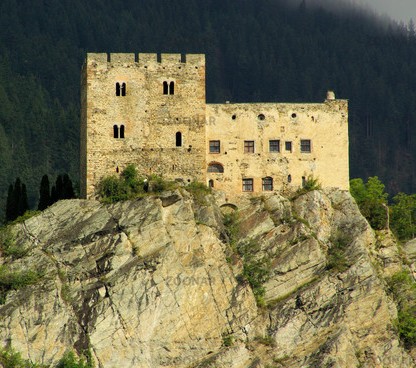
Burg Laudegg, also known as Laudegg Castle or Laudeck Castle, is a restored medieval castle ruin located on a rock spur at an elevation of 1,176 meters (3,858 ft) above the Oberinntal valley in the village of Ladis, within the Serfaus-Fiss-Ladis holiday region of Tyrol, Austria. Perched at the foot of the Samnaun Alps along an ancient Roman road, it overlooks the scenic Upper Inn Valley and serves as a prominent landmark in the Bezirk Landeck district. Originally built as a guard tower and administrative stronghold, the castle exemplifies Tyrolean medieval architecture and reflects the region's feudal history. Today, it is privately owned and partially integrated with modern hospitality through the adjacent Refugio Laudegg hotel, blending historical preservation with contemporary tourism in one of Austria's premier alpine destinations.
Early Origins (Early Middle Ages to 13th Century)
The core of the
castle, a substantial residential tower (Wohnturm or Bergfried), dates
back to the Early Middle Ages, likely around 1200. It was first
documented in 1239 as Castrum Laudekke. Even earlier, in 1232, a local
Ministeriales (unfree knightly) family named "von Laudeck" appears in
records from the court of Duke Otto von Andechs in Innsbruck.
These
ministeriales were lower nobility serving higher lords, often managing
local administration and defense. The castle was constructed as a
typical high-medieval hill castle (Höhenburg) for control of the
strategically important Oberinntal valley route.
Medieval Role as
Administrative Center
Throughout the Middle Ages and into the early
modern period, Burg Laudegg served as the seat of the Oberes Gericht
(Upper Court or Laudeck Court), the main administrative and judicial
center for the Upper Inn Valley. It oversaw legal matters, local
governance, and defense.
In 1259, Count Meinhard II of Tyrol granted
the castle to his wife Elisabeth as a dower (Wittum, or widow's
residence), underscoring its importance within Tyrolean comital
holdings.
The layout included:
A tall (about 21m), rectangular
residential tower with Romanesque features (bifora windows, regular
masonry with reddish tuff cornerstones).
An attached palas
(residential building) to the northeast.
A chapel.
A Zwinger
(bailey/enclosure) and outer Vorburg with a gatehouse.
Defensive
elements like arrow slits and later modifications.
15th Century:
Destruction and Partial Recovery
In 1406, during the Appenzell Wars
(part of the broader peasant uprisings), the people of the Upper Inn
Valley joined forces led by Ital Reding the Elder. The village of Ladis
was burned, and both Laudegg Castle and its forward defense (Vorwerk) at
Burg Steinegg were heavily damaged or destroyed by fire.
Repairs in
the following years were minimal. Under Emperor Maximilian I (who had
personal interest in the region, including the nearby Oblader Sauerbrunn
mineral spring), some expansion and rebuilding occurred, though promised
funding was never fully delivered. A castle pond (Burgsee) used for fish
is mentioned in Maximilian's records.
16th–17th Centuries:
Decline
By the mid-16th century, the castle's administrative role
waned. In 1551, the keeper (Pfleger) of Laudeck already resided at the
more comfortable Schloss Sigmundsried (built from 1471). The castle was
increasingly used only as a storage facility or armory.
The court
eventually moved to Ried im Oberinntal, accelerating the decline. Some
17th-century renovations occurred, but the structure became desolate.
Ownership shifted: it was pledged to Johann Freiherr von Spaur for
25,000 gulden. After his death in 1689, it passed to his daughter Maria
Ursula and her husband Guidobald (or Guidobaldo) Graf von Welsperg in
1693.
18th–19th Centuries: Ruin
With the loss of its
administrative function, the castle fell into serious disrepair and
became a romantic ruin, typical of many Tyrolean fortifications no
longer needed in the gunpowder age.
20th Century: Restoration and
Private Ownership
In 1940, the future film director Harald Reinl and
his brother Kurt bought the ruin (each half for 1,000 Reichsmark) and
began initial repairs.
In 1964, musicologist Willi Apel purchased it
for 46,000 Deutsche Marks and undertook more comprehensive restoration,
stabilizing walls, renewing battlements (e.g., the tower crenellations
in 1956), and rebuilding parts of the residential building while
preserving medieval features.
After Apel's death, the castle passed
to the von Moeller family, who own it today (as of recent records). It
is a protected historic monument.
Overall Layout and Structure
Laudegg follows a classic, compact
medieval castle plan adapted to its dramatic rocky spur site. It is not
a large sprawling complex like many lowland castles but a functional,
defensible core with later additions.
Key components include:
Central Keep (Bergfried / Residential Tower) — the dominant and
best-preserved element.
Palas (Residential Wing) and Chapel attached
to the northeast side of the keep.
Ring Wall (Curtain Wall) enclosing
the northern side.
North Tower (a projecting residential building).
Gate Tower / Entrance on the western side.
Outer Bailey (Vorburg) and
a small Zwinger (narrow defensive corridor) for added protection.
The
southern and eastern sides rely heavily on the steep natural rock cliff
for defense, so there are fewer artificial structures there.
The
entire complex sits tightly on the rock outcrop, making efficient use of
the terrain.
The Main Residential Tower (Keep)
This is the
architectural centerpiece and one of the most impressive features.
Dimensions: Approximately 21 meters (69 ft) high, with a rectangular
footprint of about 11 × 14 meters.
Wall Thickness: 1.7 to 2 meters
(5.6–6.6 ft), providing excellent defensive strength.
Construction:
Carefully layered, regular masonry using local slate and stone. Corners
are reinforced with distinctive reddish volcanic tuff blocks
(Eckquader), which alternate with the main stonework for structural
stability and visual contrast.
Architectural Style: Strong Romanesque
character. The western façade (most vulnerable to attack) features large
Romanesque bifora windows (twin-arched openings divided by a central
stone column/mullion made of tuff). These are a standout decorative and
functional element.
Defensive Features: The western side is mostly
solid with narrow arrow slits (Schießscharten) and a later-added small
loophole in the basement. An arched portal on the southeast side leads
into a vaulted gallery inside the tower.
Original Function: Built as
a residential tower (Wohnturm) around 1200, it served both living
quarters and defense. It likely had multiple floors, with the upper
levels offering living space and observation points.
The tower
remains exceptionally well-preserved compared to the rest of the
complex.
Palas, Chapel, and Secondary Buildings
Palas
(Residential Palace): A smaller wing attached to the northeast of the
keep, dating primarily to the 13th century. It provided additional
living space for the castle's inhabitants and administrators.
Chapel:
Integrated or adjacent to the palas. In the early 16th century, some
chambers were converted or adapted into a chapel, indicating ongoing
religious use.
North Tower: A tower-like residential building
projecting from the ring wall northward. It includes a 15th-century
pointed-arch secondary exit framed in tuff stone — a later
Gothic-influenced addition.
Defensive and Enclosing Elements
Ring Wall: Encloses the castle area to the north, creating a protected
inner courtyard.
Gate Tower: Houses the main entrance, part of the
western defenses.
Zwinger: A small outer defensive corridor north of
the keep that strengthens the outer bailey.
The design is relatively
simple and functional, typical of many Tyrolean castles that prioritized
strategic location over lavish ornamentation.
Materials and
Construction Techniques
Primary material: Local slate and stone,
well-suited to the rocky site.
Accents: Volcanic tuff for corners,
window columns, and arch framing — providing both durability and
aesthetic highlights.
Masonry: High-quality, regularly coursed
stonework, especially visible on the keep.
Roofs and upper elements:
Original medieval roofs are gone (as it is a ruin), but restorations
have stabilized the structure.
Historical Architectural Evolution
Early Phase (c. 1200–1239): Construction of the main residential tower
in Romanesque style.
13th–15th Centuries: Additions of palas, chapel,
ring wall, and outer structures.
1406: Destroyed during the Appenzell
Wars; later rebuilt.
16th–17th Centuries: Declined in residential
importance; used more as storage/arsenal. Some interior modifications
(e.g., chapel).
20th Century–Present: Partial restorations starting
in 1964. The castle is privately owned but stabilized and accessible
seasonally. It retains its authentic medieval character without heavy
romantic reconstruction.
Architectural Significance
Laudegg is
a textbook example of a Tyrolean medieval administrative and defensive
seat — compact, terrain-adapted, and focused on a powerful residential
keep. Its Romanesque bifora windows and tuff detailing give it a refined
yet sturdy appearance. Compared to grander castles, it feels austere and
military, but the quality of the keep’s construction is exemplary.
The castle’s silhouette — especially the tall, battlemented tower rising
dramatically from the rock above Ladis and its pond — makes it a
striking landmark in the Serfaus-Fiss-Ladis region.
Current State and Use
Burg Laudegg is a well-preserved ruin, having undergone partial
restoration since 1964 to prevent further decay. It remains privately
owned by the family of Prof. Apel and is protected as a historical
monument. While the castle itself is not inhabited, limited areas—such
as the kitchen, chapel, and staircase—are accessible during guided
tours. Proceeds from visits support cultural preservation. No guided
tours are scheduled for 2025, though this may change; historically, it
has been open once a week in summer.
The site integrates with modern
tourism through the Refugio Laudegg, a boutique hotel offering 4 themed
suites and 9 double rooms, designed in collaboration with heritage
authorities. This facility emphasizes Tyrolean tradition with
contemporary amenities like saunas, gardens, and a restaurant serving
local cuisine, including vegetarian options and game dishes. It caters
to active travelers, supporting activities such as skiing, hiking, and
cycling in the Serfaus-Fiss-Ladis region.
Visiting Information (as of 2025–2026)
Access to the interior is
restricted because it is private property. The castle is generally only
open to the public during the summer months (typically July and August)
via guided tours, often held once a week (commonly on Wednesdays).
Check current dates: Look on the official Serfaus-Fiss-Ladis tourism
website (serfaus-fiss-ladis.at) — they usually list specific tour dates
under the castle page. You may need to book or inquire at the local
tourist office in Ladis, Serfaus, or Fiss.
Tickets: Historically very
affordable (around €2–5 for adults; children often free or reduced).
Expect modest pricing.
Tour duration: Typically 30–60 minutes,
covering the history of the castle, Ladis village, and key features like
the keep (residential tower), chapel, palace remnants, ring walls, and
outer bailey.
Exterior viewing: The castle and its scenic
surroundings (including the pond) are accessible year-round for photos
and short walks. No ticket needed for exterior views and grounds at the
base.
Note: Some older reports mention it being inaccessible in
recent years, so always verify ahead via the tourism office (+43 5476
6239 or info@serfaus-fiss-ladis.at) or their website, especially if
planning a trip months in advance.
How to Get There
Location:
Schlossweg 18, 6532 Ladis, Tyrol. Ladis sits on a sunny high plateau
(~1,200m elevation) overlooking the Oberinntal valley.
By car: Easy
access from the A12 Inntal Autobahn. Plenty of parking in Ladis village
(some free spots near the pond). The climb to the castle is short but
steep in parts.
Public transport: Buses from Landeck or Innsbruck.
The SFL region has excellent summer and winter transport links
(including free guest buses with the holiday pass).
From nearby
villages: Short walk or bike from Serfaus/Fiss (the whole area is very
walkable and bike-friendly).
What to Expect on a Visit
Highlights: Impressive 13th-century keep, defensive walls, chapel, and
panoramic views over Ladis, the Inn Valley, and surrounding Alps. The
setting is more atmospheric and intimate than grand — perfect for
history lovers and photographers.
Terrain: Rocky outcrop with some
uneven paths and stairs. Good footwear is recommended. Not ideal for
those with severe mobility issues.
Best time for photos: Morning or
late afternoon for golden light on the stonework and reflections in the
pond. Sunny days in summer are ideal.
Practical Visiting Tips
Book or confirm in advance — tours have limited spots (often max 25–35
people per group).
Weather preparedness — Tyrol mountain weather can
change quickly. Bring layers, rain jacket, and sun protection in summer.
Best season: July–August for interior access. Shoulder seasons (June,
September) are quieter for exterior views. Winter offers beautiful snowy
vistas but no interior tours.
Nearby amenities: Refugio Laudegg (at
the foot of the castle) offers modern accommodation and dining. Ladis
has restaurants, shops, and a relaxed village atmosphere.
Family-friendly: Short tours and scenic setting make it suitable for
most ages. Kids usually enjoy the "castle adventure" feel.
Photography: Drones may be restricted; stick to ground-level shots. The
pond reflections are a highlight.
Accessibility: Limited due to the
historic site and elevation. Exterior views are the easiest option for
those with mobility concerns.
Etiquette: Respect private property
boundaries outside tour times. Stay on marked paths.