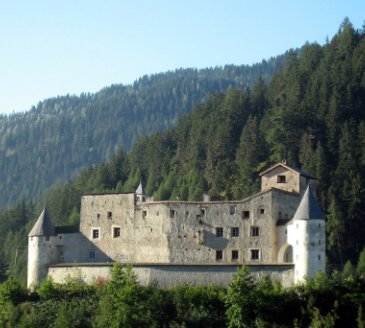
Location: Schloss Naudersberg Nr. 1, Tyrol Map
Tel. 0043 (0) 664 321 70 32
Email: info@schloss-nauders.com
Constructed: 14th century
Schloss Naudersberg, also known as Naudersberg Castle, is a medieval hilltop fortress located on a prominent hill overlooking the town of Nauders in the Oberinntal valley of Tyrol, Austria, at an elevation of approximately 1,370 meters above sea level. Situated near the Reschen Pass on the border with Italy and Switzerland, the castle has historically served as a strategic judicial and defensive stronghold in the region. Built in the early 14th century, it exemplifies Gothic architecture with later Renaissance additions, and its imposing structure—featuring a tall keep, battlements, and fortified walls—reflects its role in controlling the valley and administering justice for centuries. Today, it blends historical preservation with modern tourism, functioning as a museum, restaurant, and accommodation venue while offering visitors a glimpse into medieval life, imprisonment, and local craftsmanship.
Early History and Construction (12th–14th Centuries)
Construction
on the site likely began in the late 12th or early 13th century, though
the castle was first documented in 1325 as a landesfürstliche
Gerichtsburg (sovereign princely court castle). It served as an
administrative and judicial seat for the Habsburg rulers (or their
predecessors in Tyrol).
The oldest parts form a rectangular core with
a southeastern palas (main residential building) and a square bergfried
(keep) to the west. These early structures reflect typical medieval
defensive design for a hilltop site. The southern ring wall includes a
round-arched main gate with iron-clad wings from the 14th century,
topped by a 16th-century manhole (small pedestrian entrance).
15th–16th Century: Destruction, Rebuilding, and Expansion
In 1499,
during the Swabian War (also known as the Engadine War), troops from the
Engadin (Graubünden, Switzerland) plundered and burned the castle. This
event was part of broader conflicts involving Habsburg territories.
Rebuilding in the following decades transformed it into its current
form. Key additions included:
A zwinger (outer defensive wall) in the
second half of the 15th century, with double rows of keyhole and mouth
embrasures and two round towers.
In the second quarter of the 16th
century, a large southern outer bailey (Vorburg) with a bastion tower
for enhanced artillery defense.
The keep was raised in the early
16th century to six stories. Its upper levels include two heated prison
cells (Arresträume) with iron doors, peepholes, and box locks—tangible
reminders of its judicial role.
Interior features from this era
include:
A late 15th-century coffered ceiling in the former
courtroom.
Late Gothic paneling in the prince’s room (later
overpainted in Empire style around 1806–1809).
A net-rib vaulted
chapel on the second floor with a 1465 bell.
Judicial Role and
Later Use (17th–19th Centuries)
From the post-rebuilding period
through 1919, the castle primarily functioned as a seat for state
authorities, including the district court (Bezirksgericht). It combined
residential, administrative, and punitive roles. The prison cells,
prison kitchen, and courtroom highlight its darker history as a place of
justice and detention.
20th Century to Present: Private Ownership
and Restoration
After 1919, its official judicial function ended. In
1980, it passed into private ownership (now held by the Laurent family).
Since then, it has undergone continuous restoration and is open to
visitors.
Today it features:
A museum on the upper floors
showcasing medieval history, the castle’s past, regional craftsmanship,
the Via Claudia Augusta trade route, and items like torture devices and
period furniture.
Holiday apartments in the palas.
A
café/restaurant near the inner gate.
Overall Layout and Historical Development
The castle has a
rectangular core with later expansions. Its architectural evolution
spans from the early 14th century to the 16th century, reflecting
medieval defensive needs, Renaissance-era fortifications, and later
judicial functions.
Earliest Core (early 14th century): The
foundational structure consists of a southeastern palas (main
residential building) and a square bergfried (keep) on the west side. It
was first documented in 1325 as a sovereign court castle
(landesfürstliche Gerichtsburg).
Late 15th century expansions: After
being plundered and burned by Engadine forces in 1499, it was rebuilt
and enlarged. The ring wall (Ringmauer) and palas were heightened with a
cloak wall (Mantelmauer) and loopholes (Schießscharten). A zwinger
(outer defensive area) with a double row of keyhole and mouth slits and
two round towers was added.
16th century: The southern outer bailey
(Vorburg) with a fortified bastion tower (Basteiturm) was constructed.
The keep was raised, and additional residential wings with pitched or
monopitch roofs (Pultdächer) were built, shrinking the original wide
courtyard into a small central courtyard.
The castle served as a
judicial seat, prison, and administrative center until 1919. Since 1980,
it has been privately owned, renovated, and now functions partly as a
museum, with holiday apartments in the palas and a restaurant near the
gate.
Key Architectural Elements
Bergfried (Keep):
Square
plan, six stories tall under a modern saddle roof.
Upper floors added
in the early 16th century.
Features a battlement (Wehrplatte) and
contains two heated prison cells (Arresträume) with wooden paneling
(Leistengetäfel), heavy iron doors, peepholes, and box locks from the
16th century. These highlight its grim use as a prison.
Palas
(Residential Building):
Three stories under a monopitch roof.
Eastern side shows bricked-up battlements (Zinnen) and some original
light slits; regular window rows date to the 16th century.
Ground
floor: Medieval beamed ceiling supported by a chamfered wooden pillar.
Interiors feature simple paneling and coffered ceilings from the
16th–17th centuries.
Defensive Features:
Southern ring wall
with a 14th-century round-arched castle gate (rundbogiges Burgtor) with
original iron-studded doors and a 16th-century manhole (Mannsloch)
above.
Zwinger gate: Chamfered round-arched portal with iron-bound
wings and a pedestrian door.
Later additions include loopholes, cloak
walls, and round towers for enhanced defense.
Notable Interiors
Former Courtroom (Gerichtssaal): Located on the second upper floor.
Features a magnificent diamond-patterned, richly profiled coffered
ceiling (Felderdecke) from the late 15th century — one of the castle’s
architectural highlights.
Princely Chamber (Fürstenzimmer): Late
Gothic wooden paneling (spätgotisches Leistengetäfel), later overpainted
with Empire-style decorations (1806–1809).
Chapel (Burgkapelle): On
the second upper floor, with net rib vaulting (netzrippengewölbt). It
was later incorporated into a corridor. The entrance is a round-arched
portal from around 1800. It has a small bell turret with a bell dated
1465.
Other spaces include prison kitchen areas, torture chambers
(now part of the museum), and rooms with medieval furniture and regional
artifacts.
Style and Materials
Naudersberg exemplifies
medieval Tyrolean castle architecture with strong Gothic influences
(especially late Gothic in interiors like paneling and vaults) and
practical defensive adaptations. Thick stone walls, functional rather
than ornate exteriors, and adaptive reuse characterize it. Expansions
show a shift toward more comfortable residential and administrative use
while maintaining fortifications. Materials are primarily local stone,
wood for ceilings and paneling, and ironwork for doors and fittings.
The castle’s preserved medieval character, combined with 19th–20th
century restorations, gives it a romantic yet authentic historical feel.
It blends defensive ruggedness with refined interior details like the
coffered ceilings and Gothic paneling.
Today, visitors can explore
the museum exhibits on judicial history, torture devices, and local lore
(including the sorcerer Florian Scheibenstock), while parts remain
private accommodations. Its hilltop position offers commanding views of
the surrounding Ötztal Alps.
What to Expect on a Visit
Architecture and Highlights: You’ll see
a well-preserved bergfried (square keep), palas (main residential
building), late Gothic elements, a castle chapel, court chambers, and a
picture gallery. The museum on the upper floors covers the “dark Middle
Ages,” prison cells (with their oppressive atmosphere), a former prison
kitchen, agricultural implements, 18th-century items in the attic, and
works by local Nauders artists in the old armoury.
Atmosphere: It’s
an authentic, atmospheric site rather than a fully polished tourist
castle. Expect a mix of historical exhibits and lived-in private spaces.
Tours: Visits are often self-guided or during limited guided/open hours.
Some reviews mention pleasant self-paced exploration when quiet. Staff
may primarily speak German.
Opening Hours and Admission (as of
2025–2026)
Hours are seasonal and quite limited — this is not a daily
tourist attraction like larger castles. Always double-check closer to
your visit:
Summer (e.g., June–October): Often open Tuesdays &
Thursdays at 4 PM (guided or open access). Schloss Café may also be
open.
Winter (e.g., January–March): Fridays 4–7 PM.
Last entry is
typically 60 minutes before closing.
Admission (approximate,
confirm on-site):
Adults: €10
Children 11–15: €5
Children up to
10 (with parents): Free
Contact: +43 664 3217032 or
info@schloss-nauders.com. Official site: www.schloss-nauders.at.
Tip:
Plan around these hours. It’s best combined with other activities in
Nauders rather than a dedicated day trip unless you’re staying nearby.
How to Get There
By Car: Easiest option. Nauders is reachable via
the Reschen Pass (from Italy) or from Landeck/Innsbruck direction. The
castle is signposted and sits directly above the village (address:
Nauders 1, 6543 Nauders). Parking is available nearby or at the castle
area.
Public Transport: Bus services connect Nauders to surrounding
towns (e.g., from Landeck or Mals in Italy). It’s a short uphill walk
from the village center.
Location Perks: Excellent base for the
region. Nearby attractions include Reschensee (Lake Resia) with its
famous submerged church tower, Altfinstermünz fortress, and ski areas in
winter.
Practical Visiting Tips
Best Time to Visit: Late
spring through early autumn for better weather and longer daylight.
Summer evenings (around 4 PM openings) offer nice light for photos.
Winters can be magical but colder and with shorter hours.
Duration:
1–2 hours is sufficient for a thorough visit.
Accessibility: Expect
stairs, uneven historic floors, and some steep sections. Not ideal for
severe mobility issues; prison cells and upper areas involve climbing.
Weather and Clothing: Dress in layers — it can be chilly inside stone
walls year-round. Good walking shoes recommended for the grounds and
village paths.
Language: German primary; English/Italian may be
limited. Bring a translation app or join when others are present for
context. An audio guide app (e.g., VoiceTour) may be available for some
self-guided context.
Photography: Allowed in most areas (confirm
rules). Great panoramic views over Nauders and the Alps from the
grounds.
With Kids: Children often enjoy the “dungeon” feel of prison
cells and the castle setting, but supervise closely on stairs.
Crowds: Usually quiet and uncrowded due to limited hours — a big plus
for an intimate experience.
Café: A Schloss Café operates during open
hours — perfect for a post-visit drink or snack.
Nearby and
Extended Stay Options
The castle offers holiday apartments inside the
historic building — a unique way to immerse yourself (modern comforts in
a medieval setting, ski-to-door access in winter). Check availability
via the official site or Booking.com.
Combine with:
Hiking/biking
in the surrounding Alps.
Visiting Reschensee (about 10–15 min drive).
Day trips to Switzerland or South Tyrol (Italy).
Nauders ski resort
in winter.