Location: Senj, Lika-Senj County Map
Constructed: 1553- 58 by Ivan Lenkovic
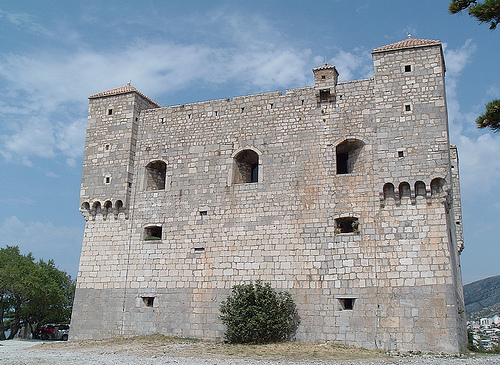
Nehaj Castle (Tvrđava Nehaj in Croatian), perched imposingly on a 45-meter-high hill overlooking the Adriatic Sea in the coastal town of Senj, Croatia, is a formidable 16th-century fortress that epitomizes the rugged spirit of the Uskoks—the anti-Ottoman guerrilla warriors who defended the Habsburg frontier. Built between 1553 and 1558, this square bastion served as a military stronghold, pirate lair, and symbol of unyielding resistance, embodying Senj's claim as the only Croatian territory never conquered by the Ottoman Empire. Constructed from local limestone quarried from nearby Velebit mountains, the castle's stark, fortress-like silhouette—rising 30 meters with walls up to 3 meters thick—dominates the Kvarner Bay skyline, offering panoramic vistas of the sea, islands, and mainland. Today, it houses the Senj Museum, a repository of Uskok artifacts, weapons, and maritime relics, drawing history buffs and adventurers to its echoing halls. As a cornerstone of Lika-Senj County's heritage, Nehaj stands amid Senj's medieval tapestry, a town founded by Romans as Senia in 23 BCE, blending coastal allure with inland wildness in a region that bridges the Adriatic and Dinaric Alps.
Historical Context: Ottoman Threats and the Rise of the Uskoks
In the 15th and 16th centuries, the Ottoman Empire's expansion
dramatically reshaped European defenses. The fall of Constantinople
in 1453, followed by the conquests of Bosnia (1463) and key Adriatic
strongholds like Klis (1537), brought Ottoman forces to the walls of
Senj. Traditional irregular fortifications proved inadequate against
advancing artillery, prompting a shift toward lower, thicker,
geometrically planned strongholds resistant to cannon fire.
Senj,
with roots in Roman times, became a critical outpost in the Habsburg
Vojna krajina (Military Frontier). The Senj Captaincy was
established in 1469 to guard the Littoral against Ottoman
incursions. After the fall of Klis in 1537, waves of Christian
refugees—known as uskoci (Uskoks, meaning "those who jumped in" or
escapees)—fled Ottoman-occupied lands in Bosnia, Herzegovina, and
Serbia. These hardy fighters, initially led by figures like Petar
Kružić at Klis, regrouped in Senj under Croatian captains. They
served as irregular soldiers and privateers, launching guerrilla
raids by land and sea against Ottoman territories while also
clashing with Venetian shipping (which they viewed as complicit or
rival). Their fast boats exploited the strong bura (northeasterly
wind) for hit-and-run tactics. Though Habsburg-backed for border
defense, their piracy strained relations with Venice.
Construction (1551–1558)
In 1539, experienced military leader
Ivan Lenković—captain of Senj and later general of the Croatian
Military Frontier—took command. He inspected Senj's outdated
defenses and petitioned Emperor Ferdinand I (Habsburg ruler) for a
modern fortress on the strategic Nehaj hill to counter artillery
threats from both land (Ottomans) and sea (Venetians). Funding was
secured around 1551, and construction began under Lenković's direct
supervision, with assistance from Captain Herbart VIII von Auersperg
Turjaški.
To prevent enemies from using extramural structures as
cover or bases during sieges, Lenković ordered the systematic
demolition of all churches, monasteries, houses, and other buildings
outside Senj's city walls. The stone—processed limestone blocks,
spolia (reused architectural fragments like inscriptions, reliefs,
window lintels, and carved elements)—was repurposed for the new
fortress. This included ruins of the Church and Monastery of St.
Peter and the Templar Monastery of St. George (with its early
Romanesque church dating to the 11th–12th century, burned by
Ottomans in 1520). Foundations of the St. George church were later
uncovered on the fortress ground floor, along with other antiquities
embedded in the walls.
The fortress was completed in 1558.
Estimates suggest over 3,400 cubic meters of material (roughly 7,500
tons of stone, sand, and lime) went into its construction. Three
distinct layers of stonework are visible in the facades, reflecting
the phased use of local karst limestone and repurposed monastic
blocks.
Role as Uskok Stronghold and Military Operations
Nehaj immediately became the primary base and symbol of the Senj
Uskoks. From its heights, guards maintained constant vigilance,
using smoke and light signals from coastal outposts and islands
(such as Rab, Krk, Cres, and Prvić) to coordinate defenses and
raids. It protected Senj from Ottoman land assaults while enabling
Uskok naval operations against Ottoman and Venetian targets.
The
fortress proved highly effective. Prior to its completion, Senj
endured three unsuccessful Ottoman sieges (post-1547 peace treaty),
during which outlying structures were burned. Afterward, major
attacks failed, including a significant 1592 Ottoman offensive led
by Bosnian forces. Nehaj and Senj earned a reputation as unconquered
territory—"no Venetian lion nor Ottoman horse tail ever flew over
Nehaj."
Uskok raids brought plunder that indirectly benefited
Habsburg coffers, but escalating conflicts with Venice culminated in
the Uskok War (1615–1617). The 1617 Treaty of Madrid forced the
Habsburgs to disband the Uskoks, burn their boats, and relocate most
inland (e.g., to Otočac) as regular frontier troops. Ivan Lenković
himself died in 1569, but the fortress outlasted the Uskok era as a
military outpost.
Later History and Restorations
After the
Uskoks' dispersal in the early 17th century, Nehaj saw reduced use
as Ottoman threats waned and Habsburg policies shifted toward
diplomacy. It remained a minor military site through the 18th–19th
centuries and saw limited activity in the Napoleonic Wars and
Austro-Hungarian period. A lightning strike in 1856 destroyed the
northwest turret, which stood missing for nearly 70 years until
restoration in 1924.
Significant 20th-century restorations
occurred between 1964–1975 (with some sources noting 1965–1974 or
1977), stabilizing the structure, roof, and walls under the City
Museum of Senj. Further works addressed WWII-era damage and added
modern protections (e.g., lightning rods). The 450th anniversary in
2008 highlighted its cultural importance.
Today: Museum and
Cultural Landmark
Nehaj Fortress is now a protected cultural
monument managed by the Gradski muzej Senj (Senj City Museum). It
houses permanent exhibitions on the history of the Senj Uskoks, the
Coastal Captaincy, Senj's churches, and noble coats of arms.
Displays include Uskok weapons, costumes, cannons, household
artifacts, drawings, and models. The upper levels feature a
reconstructed battery and host summer music events and medieval
festivals with Uskok reenactments (including horseback marches to
the fortress).
From the battlements, visitors enjoy panoramic
views of the Adriatic Sea, Senj harbor, nearby islands (Rab, Krk,
Cres, etc.), and the Velebit and Učka mountains—testament to its
original strategic purpose. It remains open to the public seasonally
and serves as a major tourist attraction tied to Senj's identity
(and even featured in children's literature like The Red Zora and
Her Gang).
Overall Form and Dimensions
The fortress is a compact, cube-shaped
(square-plan) keep measuring approximately 23–23.5 m on each side and
standing 18 m high. It is precisely oriented toward the four cardinal
directions, with its thick walls rising directly from the natural karst
bedrock of the hill. The walls taper inward from a base thickness of
about 3.2–3.3 m to 2–2.5 m at the top, creating a stable,
load-distributing profile that also helped deflect projectiles. This
tapering, combined with the elevated, cliff-sided location, made the
structure exceptionally resistant to artillery of the era.
Five small
reinforcing corner turrets crown the structure (four at the main corners
and a fifth integrated with the entrance defense system, featuring a box
machicolation). The parapet is crenellated for defensive firing
positions. There is no moat—the hard rock of the hill made one
impractical and unnecessary.
Materials and Construction
(1551–1558)
Construction was supervised by Ivan Lenković, captain of
the Senj Uskoks (Christian irregular fighters and privateers allied with
the Habsburgs). Materials were sourced pragmatically: roughly 3,400 m³
(estimated 7,500 tons) of stone came from demolished churches,
monasteries, and unprotected buildings outside Senj’s city walls (with
papal approval from the Vatican to deny shelter to potential invaders).
The facades show three distinct layers:
Lower base: local rough
karst limestone.
Middle section: regularly hewn stones from a
demolished monastery.
Upper section: mixed stones of varying types
and shapes.
This reuse of spolia (reclaimed architectural
fragments) is visible throughout—profiled lintels, inscriptions, and
reliefs are embedded in the walls. Foundations rest directly on the
bedrock, seamlessly incorporating the ruins of an 11th–12th-century
Early Romanesque Church of St. George (Sveti Juraj) on the southern
side, including rare Glagolitic stone fragments discovered during
20th-century restorations.
The design reflects
late-medieval-to-Renaissance frontier fortification principles:
geometric regularity, thick battered walls for artillery resistance, and
maximal use of terrain for observation and enfilading fire.
Defensive Features
Loopholes and Embrasures: More than 100 small
loopholes (puškarnice) for handguns and small arms, plus 11 large cannon
embrasures positioned to provide overlapping fields of fire.
Towers
and Battlements: The five corner turrets offered elevated vantage points
and additional firing angles; each contains small internal rooms at
different levels.
Entrance: Highly defensible—accessed via external
stone staircases leading to a wooden (draw)bridge and a narrow double
gate. A projecting box machicolation above the entrance allowed
defenders to drop stones or fire downward. The north-side entrance tower
integrates with mural stairs.
Observation and Signaling: The rooftop
platform served as a strategic lookout and signaling station (using
smoke or light signals to communicate with coastal outposts and
islands).
Interior Layout and Organization
The interior is
organized vertically around a small central square courtyard that
functions as the structural and logistical core. A rainwater cistern
beneath a central well collected water via pipes running down two
courtyard corners from the roof—essential for self-sufficiency during
sieges.
Ground Floor (Prizemlje): Partitioned into approximately
eight rooms arranged around the courtyard in a grid-like (“tic-tac-toe”)
layout. These housed garrison quarters, kitchen, dining, social areas,
an arsenal, and a large fireplace. Gun ports pierce every room. Remnants
of the earlier St. George church and spolia (inscribed stones, lintels)
are visible. Today it contains museum exhibits and adapted spaces.
First Floor: Larger room(s) plus smaller chambers used for garrison and
captain’s quarters. Vertical circulation occurs via internal stairways
(with some vaulted or open-beam ceilings).
Second Floor: Originally
the main artillery battery platform with positions for the 11 heavy
cannons.
Upper Levels and Rooftop: Soldiers’ quarters with a sloping
garret roof in some reconstructions. Mural stairs (between the northwest
tower and north entrance tower) lead to the battlements and observation
platform. A solitary projecting garderobe (latrine) extends from the
battlements on one side.
Historical architectural drawings (e.g.,
ground plan and cross-section by G. Pieroni, 1639) confirm this
multi-level layout with minimal changes over centuries.
Heraldry
and Symbolic Elements
Above the entrance (visible from the courtyard
area) is a triple coat of arms:
Center: Habsburg archduke (Ferdinand
I or the administrator of Senj).
Left: Ivan Lenković’s arms,
including the year 1558 and initials “H.L.”.
Right: Arms of his
successor, Herbard VIII Auersperg of Turjak.
This ensemble
underscores the fortress’s role in the Habsburg Military Frontier.
Nehaj Castle is more than a ruin—it's the beating heart of Uskok
lore and Senj's indomitable identity, symbolizing Croatia's
unyielding border spirit. As the Uskoks' nerve center, it
facilitated over 500 raids, blending holy war with privateering to
safeguard Christendom, though its piracy strained alliances,
culminating in the 1615 Peace of Madrid that dissolved the band.
Architecturally, it represents a pivot from medieval castles to
gunpowder-era forts, influencing Habsburg defenses across the
Frontier. Its survival intact—unlike razed peers—offers unparalleled
insights into 16th-century military life, with artifacts like Uskok
swords and Ottoman banners illuminating cultural clashes.
Culturally, Nehaj anchors Senj's heritage: the annual Alka at Sinj
(a UNESCO-listed knightly tournament) echoes Uskok valor, while the
castle hosts summer reenactments and folklore festivals, drawing
20,000 visitors yearly. The museum's collections—Uskok documents,
17th-century globes, and Velebit shepherd tools—bridge maritime and
mountain worlds, fostering regional pride in Lika-Senj's
multi-ethnic past (Croat, Italian, Vlach). For scholars, it yields
studies on frontier ethnography; for locals, it's a touchstone of
resilience, commemorating the 1990s war through exhibits. Amid
Croatia's tourism boom, Nehaj promotes sustainable narratives,
countering coastal glitz with introspective history, and inspires
art—from 19th-century Romantic paintings to modern eco-installations
on Velebit winds.
As of September 17, 2025, Nehaj Castle remains impeccably maintained
under the Senj Museum and Croatian Ministry of Culture, with no
disruptions from recent Adriatic weather; a minor 2024 exhibit refresh
added digital Uskok maps. Fully accessible year-round, it's open daily 9
AM–7 PM (summer; 10 AM–5 PM winter, closed Mondays off-season), entry €5
adults (€3 students/children, free under 7), including museum access.
Guided tours (€7, 45 minutes, English/Croatian) via senj.hr bookable
on-site.
Perched at Ulica Nehaja 4, it's a 10-minute uphill walk from
Senj's bus station (Rijeka–Zadar lines, €5) or harbor; parking (€1/hour)
at the base. Allow 1–2 hours: climb ramparts for Kvarner views, explore
casemates, and browse 2,000+ artifacts like pirate flags. Spring
(April–June) or autumn (September–October) offers mild temps (15–25°C)
and fewer crowds than July–August peaks (30°C+). The site is partially
wheelchair-friendly (ground floor, ramps added 2023), but upper levels
require stairs—staff assist (+385 53 881 023). TripAdvisor (4.6/5)
praises its "haunting exhibits" and "epic panoramas," noting the on-site
cafe for rakija toasts. Pair with Senj's Glagolitic Alley or Velebit
hikes for a full-day immersion.