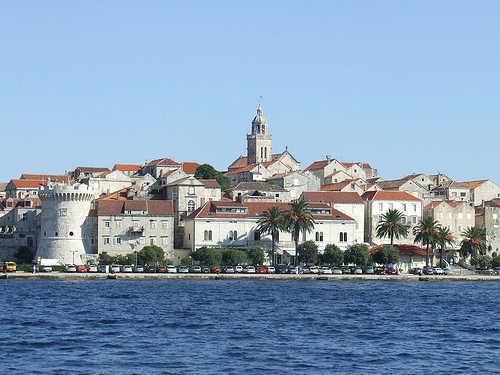
Location: Adriatic Sea Map
Area: 279 km2 (107.7 sq mi)
Korcula Island is situated in the South Croatia in central Dalmatian archipelago. The island is not very large covering only 279 km2 (107.7 sq mi). Largest settlement on the island is Korcula town that is allegedly a birth place for famous Italian traveler and explorer Marco Polo. The legend states that the Korcula Island was first settled by Trojan refuges under leadership of Antenor in the 12th century BC. He is also responsible for founding of Padua in Italy. So the guy was pretty busy settling so many lands. Either that or Romans who took possession of the island after Illyrian Wars of 220- 219 BC really wanted to justify their conquest. Romans believed their ancestors are Trojans. In truth however the island was first inhabited by Mesolithic and Neolithic people that crossed a narrow Peljesac strait that separates Korcula Island from Peljesac Peninsula. Artifacts of their existence here were found in Vela Spila (Big Cave) in the Western part of the Island near Vela Luka and Jakas Cave near village of Zrnovo, just outside of Korčula town. Illyrians overtook the settlements in 1000BC and ruled these lands until mentioned Romans did not arrive here. This was followed by the Avar and Slavic tribes during early Medieval period. In the 12th century the island was incorporated into a Venetian Republic thanks to military campaigns of Pepone Zorzi. This gave a reason for Korcula resident to claim their island as a birth place for Marco Polo.
Saint
Mark's Cathedral rises over Korčula's old-town square as the
island's finest Gothic-Renaissance church, built mainly in the
15th and early 16th centuries from local limestone by Korčulan
stonemasons with help from Italian masters. The west portal by
Bonino da Milano frames Adam and Eve beside guardian lions,
while Marko Andrijić finished the rose window, the tall
campanile with its lantern and moon-phase disk, and the carved
ciborium over the high altar dedicated to St Mark. Inside, twin
limestone colonnades lift a soaring nave that holds Tintoretto's
Three Saints and Annunciation, a bronze St Blaise by Ivan
Meštrović, and later Croatian sculpture in the baptistery; the
Chapel of St Rocco was added after the 1570 plague. Once the
seat of the Diocese of Korčula until 1828, the compact basilica
still dominates the stone streets and rewards a slow look at
facade reliefs, bells, and the view from the tower over the
Pelješac Channel.
Marco Polo Tower stands a short walk from
the cathedral in a late-medieval house that local tradition, not
firm proof, links to the explorer's family. Most historians
place Marco Polo's birth around 1254 in Venice, yet Korčula
documents record a Depolo or Polo lineage, shipyards, and
property, and he was captured near the island in the 1298
Venetian-Genoese battle before dictating his travels in a
Genoese prison. The present house is later than the 13th
century, so the claim is a cherished legend rather than a
documented birthplace; visitors climb the modest tower for a
wide panorama of tiled roofs, walls, and the strait. Treat it as
a story-rich viewpoint and a reminder that Dalmatian sailors and
Venetian merchants shared the same Adriatic world.
Veliki
Revelin Tower is the massive southern land gate of Korčula's
walled town, a square 15th-century fortification (often dated
1485, with earlier 13th-14th century phases) that once
controlled the only land approach and guarded the harbor and the
lost Governor's Palace. Thick limestone walls, crenellations,
and machicolations speak of Venetian military engineering; the
facade still shows the winged lion of St Mark and a 1925 plaque
marking a thousand years since King Tomislav's coronation. A
wooden drawbridge gave way in the 18th century to the broad
stone stair that now funnels visitors into the old town from Trg
kralja Tomislava. Climb or pause on the terrace for views of the
Pelješac Strait, the remaining circuit of walls, and the compact
streets that open just beyond the gate.
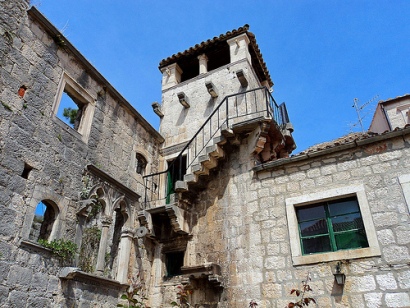
Church of the Assumption of the Blessed Virgin in Korcula
The Church of the Assumption of the Most Holy Mother of God in
Korčula is the main and largest Orthodox church on the island of
Korčula. It is dedicated to the Assumption of the Most Holy
Mother of God, and belongs to the Diocese of
Zahumlje-Herzegovina and Primorska. It was built around 1220, it
is the endowment of Nemanjić.
History
With the
founding of the Diocese of Hum by St. Sava, the Church of the
Assumption of the Most Holy Mother of God was built on Korčula
around 1220. At that time, there were a large number of Orthodox
Serbs on the island, mostly merchants (over 500!) Who helped
build this church in the Serbian-Byzantine style. The church was
richly donated by the Nemanjićs.
By 1350, the number of
Orthodox Serbs was growing; since then there has been a decline.
With the conquest of Korcula, Venice turned this temple into a
Catholic one, dedicating it to Saint Barbara. It was run by a
Catholic convent. Over time, the church declined and became
poorer, passing from hand to hand, and came into possession of
the city. The municipality of Korcula gave the temple to the
state fund (erara) after 1880. With the liberation of Dalmatia
in 1918, the temple remained in state possession. The president
of the Korčula municipality, Dr. J., drew the attention of
Orthodox people who began to immigrate to the island to him.
Arneric. The descendant of the old respectable Korčula family
knew well the history of that now very dilapidated building. The
Serbian Orthodox on Korčula soon organized themselves into a
church community, and asked the state to return the Serbian
church.
When the state ceded the temple to the Orthodox,
its repair and supply began. Its old appearance and purpose were
restored, and the consecration was supposed to be especially
solemn, but the death of King Alexander hindered that. With the
abundant support of Catholics, the temple was completed and
consecrated in November 1934, by B. Mitrovic and Ilarion
Mijatovic. At the ceremony, the national anthem was performed by
the Adriatic Guard Orchestra, and the Sokol Choir from Orebić,
which consisted exclusively of Catholics, responded to the
Litany in the church. The act of consecration was attended by
many Catholics, with their clergy, led by Archbishop O.
Bodulićem. A new Orthodox priest from Korčula was appointed that
day.
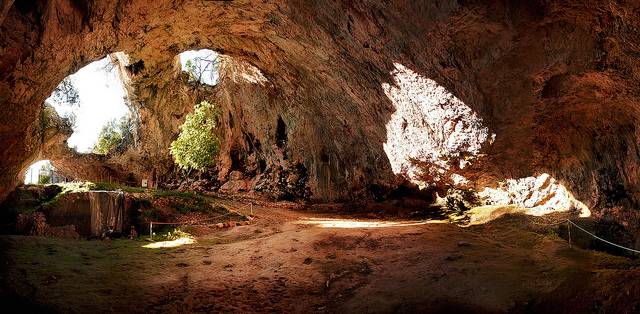
Vela Spila (Big Cave) opens on Pinski Rat hill about 130 m above Vela Luka, an oval hall some 40 m long and 17 m high with two natural skylights in the dome. Layers from the Late Upper Palaeolithic through the Bronze Age record seasonal hunting, shellfish gathering, and later farming as sea level rose and drowned the plains around what is now Korčula. Finds include rare fired-clay figurines from about 17,500-15,000 years ago, Mesolithic child burials, Neolithic adults nicknamed Baba and Dida, and pottery of the Hvar and later cultures; only part of the floor has been excavated since the 1950s. A short uphill walk from town leads to one of the Adriatic's richest cave sequences, best paired with the archaeological collection in Vela Luka's cultural center.
Korčula has no airport and no bridge to the mainland. You reach
it by plane plus ferry, by road plus a short crossing from Pelješac,
or by ship from Split, Dubrovnik, Rijeka, Hvar or Lastovo. The
Pelješac Bridge has made the drive from Dubrovnik and the south much
simpler: you no longer need to enter Bosnia at Neum.
By plane
The closest useful airports are Split and Dubrovnik. Zagreb is a
longer overland option if you already have a car.
Split Airport
Kaštela (Zračna luka Sveti Jeronim, IATA: SPU) sits between Split
and Trogir, about 24 km west of Split ferry port. After landing,
take the airport shuttle (around 30-45 minutes, roughly €8-10), a
taxi or private transfer to Split harbour, then continue by
catamaran or car ferry to the island. In high season allow extra
time: popular catamarans sell out.
Dubrovnik Airport (DBV) works
well if you are staying on the eastern end of Korčula or combining
the trip with Pelješac. From the airport go into Dubrovnik, then
take a passenger catamaran to Korčula Town (about 2 hours, typically
around €25 one way in season) or drive across the Pelješac Bridge to
Orebić and board the short car ferry.
By road
From Germany
and Austria the usual route is the Tauern Autobahn toward Villach,
then either the Karawanken Tunnel or the Pyhrn Autobahn to Ljubljana
or Maribor. Continue via Zagreb onto Croatian motorway A1 as far as
Ploče. From Switzerland a cheaper option is often
Verona-Trieste-Rijeka, then south along the coast or inland
motorways.
From Ploče you can still take the Ploče-Trpanj ferry
onto Pelješac, then drive to Orebić. The faster modern route is to
stay on the motorway and use the Pelješac Bridge, then follow the
peninsula road to Orebić. The old Jadranska magistrala (Adriatic
Highway) is slower and more winding but scenic.
From Orebić a
15-20 minute car ferry crosses the narrow Pelješki kanal to Dominče,
about 3 km from Korčula Town. That is the standard way to bring a
car from the Dubrovnik direction.
You can skip Pelješac entirely
and load the car in Split. Jadrolinija car ferry line 604 runs
Split-Vela Luka (west Korčula), often continuing to Ubli on Lastovo.
Crossing Split-Vela Luka takes about 2.5-3.5 hours. In summer there
are usually two sailings a day; in winter one or two depending on
the day. Approximate 2026 fares Split-Vela Luka: adult about €8-11,
standard car about €56-74 depending on season. Vela Luka is then a
40-50 minute drive (about 40 km) east to Korčula Town on the
island’s main road.
By boat
Foot passengers have more
choice than drivers. Catamarans do not take cars.
Main
connections:
Car ferry 634 Orebić-Dominče (Korčula). 15-20
minutes. Year-round and very frequent: roughly 14 crossings a day
off-season, more in summer (up to around 18-22 in peak). High-season
2026 snapshot: adult about €4.40, standard car about €16.20. Dominče
is the vehicle terminal, not the old-town passenger quay. Foot
passengers who want Korčula Town itself often prefer the separate
passenger boat.
Passenger line 614 Orebić-Korčula Town. Short
crossing for people without cars. High season around €3.40,
off-season around €2.30.
Car ferry 604 Split-Vela Luka-Ubli
(Lastovo). Best if you have a vehicle and are heading to the west of
the island or onward to Lastovo.
Passenger catamaran / line 9604
Split-Hvar-Vela Luka-Ubli. Faster than the car ferry for foot
passengers going to the west end. Journey Split-Vela Luka is often
around 2 hours.
Fast catamarans Split-Hvar-Korčula Town (Krilo /
Kapetan Luka, TP Line and others). The most popular option for
visitors staying in Korčula Town. About 2.5-3 hours, daily
year-round, extra departures in summer. Tickets typically €20-32.
Book ahead in July-August.
Catamaran Dubrovnik-Mljet-Korčula
Town. About 2 hours, mainly April-October, around €25 one way.
There are also seasonal or less frequent passenger services from
Rijeka and other Dalmatian ports. Always check current timetables on
jadrolinija.hr, krilo.hr / krfrpribord.hr, tp-line.hr and
gv-zadar.com, because frequencies change by season and weather.
Around the island
A single main state road, D118, runs the
length of the island from Korčula Town in the east, through Žrnovo,
Pupnat, Čara, Smokvica and Blato, to Vela Luka in the west. The
island is about 47 km long and 8 km wide. Korčula Town to Vela Luka
is roughly 40 km and 40-50 minutes by car. Side roads drop to
Lumbarda, Račišće, Brna, Prižba and other bays.
Local buses
(Arriva) follow D118 between Korčula Town and Vela Luka, with
limited extra runs to Lumbarda and Račišće. Off-season the timetable
thins out. A car or scooter is useful if you want southern-coast
beaches, inland wine villages or accommodation outside the two main
towns. Roads are generally two-lane and in good condition; traffic
is light except around Korčula Town in July and August. The old town
itself is pedestrian only.
Hunter-gatherers (20,000 years ago), clay figurines
The most
important archaeological site on the island is the cave Vela Spila (also
Vela špilja), which was first mentioned in 1853. It has been studied
since the early 1950s, first by Marinko Gjivoje, Boris Ilakovac and
Vinko Foretić, whose publication in 1951 prompted Grga Novak to take a
more systematic approach to the cave. However, systematic excavations
did not begin until 1974. After Novak's death, Božidar Čečuk continued
the work together with Dinko Radić from 1986. By 2005, the Upper
Paleolithic horizon was reached. The layers 8-1 correspond to the Epochs
Upper Paleolithic (Epigravettia), Mesolithic, Early, Middle- Late
Neolithic, Eneolithic, Early Bronze Age, Late Bronze Age.
Thus,
the cave was the oldest site on the central Croatian islands next to
Kopačina on Brač, although the rock was still not reached. The oldest
finds at a depth of 7.45 m were dated to the period between
18,000–16,700 and 13,500–12,600 BC, i.e. to the Würm glacial period. At
that time, the sea level was more than 100 m lower than today, the
current islands were hills in one plain. The inhabitants were hunters
(especially deer and horses) and collectors. They brought flint, an
important raw material for their tools, from Mala Palagruža to their
hill. in 2012, 36 figurines and fragments were discovered, which were
created between 17,500 and 15,000 BP. They are the only Paleolithic clay
figurines in southeastern Europe, apart from Klisoura. About 2500 to
3000 years later, this locally developed technique seems to have been
lost again.
Fischer (from the 8th millennium BC)
During the
Mesolithic, the sea level rose, so that Korčula was now an island.
Residents switched to seafood and fish. The primacy of tuna and
swordfish indicates deep-sea fishing. Flint processing no longer reached
the Upper Paleolithic level. In the back of the cave there were four
small graves surrounded by stone circles for children who were between a
few months and three and a half years old. In 2009, these four
children's skeletons discovered in the late 1980s were dated to more
than 9000 years ago.
However, these fishermen of the 8th
millennium BC did not stay during the entire Mesolithic. Thus, the cave
remained unused for some time before the Neolithic.
Peasant way
of life, Neolithic settlement, Copper Age (6th-4th millennium BC)
The
earliest farmers of the Neolithic had the typical pottery, the
impressoware (cardiac or impressoculture). The settlement now remained
without interruption, the influence of neighboring cultures, such as the
Hvar culture is demonstrable. However, until 2021, only cave finds from
this period were known.
This year, underwater archaeologists
began to open up a settlement off the east coast of the island, which
existed around 4000 BC. The islands of the region probably traded in
obsidian from Lipari, but also sourced flint from Monte Gargano in
Puglia. In 2021, the now submerged island of Soline was discovered by
archaeologists led by Mate Parica from the University of Zadar. In 2023,
a section of road discovered at a depth of about 4-5 m was uncovered,
which was dated to 4900 BC. On the other side of Korčula, in the Bay of
Gradina, located near Vela Luka, the same excavation team found a
similarly old settlement.
The site Nakovana, which gave the name
to the Nakovana culture, is located on Pelješac. Two of the three cave
finds of the Copper Age known up to 1970 were located on Hvar, so they
also spoke of the Hvar culture. Many archaeologists believed that any
deviation from the locally known was an influence of the higher cultures
of the eastern Mediterranean or the rest of the Balkans. However, it
turned out that the Nakovana culture has been independent since the late
Neolithic. In 2010, for the first time, idols were found at Nakovana in
Dalmatia, which could be attributed to the Copper Age. On one of the
graves there was a depiction of an Apulian vehicle, which was dated to
the period between the 7th and the 5th century BC. Probably, the
transition from the Neolithic to the Copper Age occurred after 4200 BC
and before 3650 BC.
It is possible that the Corcyrians from the island now called Corfu
founded the colony Kórkyra Mélaina, the 'Black Korkyra', already between
590 and 580 BC. This assumption is supported by finds of Corinthian
vases of the 6th century BC on Korčula. According to legend, the first
settlers are said to have come from Knidos in Asia Minor, according to
another tradition, even Trojans under Antenor founded the colony.
In a (possibly) second wave, inhabitants of the island of Vis
founded the settlement of Lumbarda. An inscription from the 3rd century
BC, known as the Pséphisma of Lumbarda, dates from this epoch, which
formed the basis for the division of the country between native
Illyrians and immigrant Greeks. In the Greek poleis, a resolution passed
by a majority of votes was called a psephisma. The names of 200 Greek
heads of families can be found on the tablet. The fragments of the
monument were discovered from 1877, its significance was recognized only
in 1898; further fragments were found in 1967/68. However, attempts to
archaeologically prove a Greek settlement in this area have largely
failed, except for vessel fragments.
During an excavation
campaign in the years 2012 to 2016, a number of graves were discovered
near Blato in the settlement of Kopila. The findings prove that the
Greeks by no means dominated the island, but that Illyrians and Greeks
lived side by side while maintaining their material culture.
A Roman war fleet from central Italy subjugated the islands of Melite
(Mljet) and Corcira Nigra (Korčula) in 34 BC; the inhabitants were
partly killed, partly enslaved, the ships were confiscated for the
purpose of "eradicating piracy". This was done as part of a purposeful
conquest. Thus, after three war campaigns under Octavian, later
Augustus, in the years 35 to 33 BC, the entire coastal region and its
hinterland finally became Roman.
However, the Pannonian Uprising
took place during his reign between 6 and 9 AD. After this all-out
uprising, which Tiberius suppressed, the territory was divided into
provinces. The island of Corcira Nigra belonged to the province of
Illyricum superius, the later province of Dalmatia. A number of rural
villas were built, which formed the core of Roman land use. At the same
time, Roman provincials immigrated. There were two legions in the
hinterland until the middle of the 1st century, after that only 2000
auxiliary troops remained. The establishment of colonies also secured
the coastal rim of Dalmatia.
Christianization began at the latest
in late antiquity, in Salona probably already in the 2nd century.
Marcellinus and his nephew Julius Nepos ruled from there in the late 5th
century (until 480). In the 4th/5th century, a church dedicated to St.
Nicholas was built on the small island of Majsan. The church dedicated
to St. Maximilian, which gave the island its name.
Lumbarda is a
Roman discovery complex at the Sutivan site, which dates back to a
settlement of the 4th to 7th centuries. It may have been some kind of
small bath complex, but fish utensils, a forge, as well as the
processing and trade of olive oil and wine have also been proven. Other
archaeological sites are the island of Majsan opposite the island's
capital, Sutvara, located 5 km to the southeast, as well as Lucnjak and
Gubavac.
After a short intermezzo of Ostrogothic rule in Dalmatia
– in 504 the province came to the Ostrogoths under Theodrich – Dalmatia
came back to Ostrom in 535, after it had been conquered by the army
master Mundus. For the 6th and 7th centuries, a continuous settlement on
the island can be documented on the basis of coins, including one of the
emperor Phokas († 610). However, the population in Dalmatia had been
declining sharply since the middle of the 6th century, as in most
regions of the empire. In addition, the region was threatened by Avars
and Slavic groups.
In a complex process of land acquisition, Southern Slavs also
reached the mainland area opposite Korčula in the late 7th, early
8th centuries. The island, probably settled a little later by
Narentans, belonged for a time to the kingdom of Tomislav, who was
crowned king in 925. The inhabitants not only worked as farmers and
shepherds, but also as fishermen and pirates. The town of Korčula,
at that time called Krkar, still existed in the 10th century,
although many country houses had fallen into disrepair. The
immigrants founded their own villages, as can still be seen from the
name.
In 997-998, Venice conducted the first successful
campaign against the Narentans. By 1000, the islands of Korčula and
Lastovo, considered as hiding places for pirates, were captured. But
soon Byzantium, which for a long time could not assert its claim to
power, reasserted its influence. At the end of the 11th century, the
Byzantine supremacy waned again, around 1125 the Patrician Zorzi
(Poppone Zorzi) began to assert Venetian influence. Venice assumed
the role of a protecting power, to which the island submitted in
1129. In 1180/1184, the imperial supremacy, which had been recurring
for a few decades for the last time, gave way to the overlordship of
Béla III, the Hungarian-Croatian king.
But with the Fourth
Crusade, Venice returned as the dominant power from 1202 onwards. It
focused on the expansion of its trading empire, in which Curzola
played only a minor role. In addition, under the influence of
Venice, the rule was strongly written down, the expression of which
is the Korčula Statute of 1214, the oldest in Dalmatia. This
regulated a number of rights and obligations, including
shipbuilding, trade, the peasant economy, but it also contained
building regulations and those for the protection of forests. The
fact that Korčula is one of the few islands in the Mediterranean
with dense forests is attributed to these protective measures. In
addition, the administration, starting from the main town, left
numerous traces in the language of the non-Venetian inhabitants – so
183 Romanic terms from seafaring and fishing could be proven, which
color the dialect to this day, of which 164 alone come from the
Venetian.
The changeable power relations ended in Venice in 1254, when the
Comes Marsilius Zorzi 'took the island under his protection'. From 1256
this title even became hereditary. At first there was resistance to the
return of the Zorzi, but then an agreement was reached on April 13,
1265. The comunitas ac universitas populi et insualae Curzoli, i.e. the
island community of Curzola, was granted extensive autonomy by
corresponding statutes. This she kept until 1358, when the island fell
to Hungary. However, the permanent return of the Zorzi rule turned out
to be a legend.
On September 8, 1298, the naval battle of Curzola
was fought near the island between the fleets of Venice and Genoa. In
the process, Andrea Dandolo fell into the captivity of the Genoese. But
in 1299 peace was concluded with Genoa, as well as with Byzantium in
1302.
In Venice, a group of the local patriciate managed to gain
a monopoly-like position in politics and, above all, trade, which had an
impact on the island insofar as a similar demarcation between the ruling
families and the rest of the population prevailed there in 1387. In
addition, a separate bishopric was established on the island as early as
1300 (until 1828).
The economic use of the island was based on a
tripartite division until well into the Venetian period. The Doge had
been informed of this threefold division in 1441: "sumus informati illam
insulam per tres partes esse diuisam, unam pro seminationibus, unam pro
pasculis animalium et unam pro plantationibus uinearum et ita esse
statutum per ordines antiquos" – Francesco Foscari, the Doge of Venice,
thus now knew that one third of the island was for land development,
another for shepherding and finally one third for viticulture was
planned. All this had already been determined by old statutes. Since
paths led across the island, but no main road connected the places along
the entire length of the island, each village needed a lake access in
order to be able to participate in the trade. Therefore, Korčula had
several dozen ports and landing places.
Venice's rule was less endangered by the Ottomans or Genoese, but
rather by the dispute with the influential Šubić family. After an
uprising in Zadar supported by them, the Venetian Comes Giovanni Zorzi
asked for help in November 1315 against families who had fled the island
and who were now threatening the islands as pirates. Venice saw its
trade routes threatened by the Anjou, who ruled both in southern Italy
and in Hungary. Thus, Venice secured the rule over Rab in 1320, followed
by Šibenik and Trogir (1322), Split (1327) and Nin (1329), as well as
Cres and Osor (1330/1333). in 1345, the Hungarian king besieged Knin,
and from 1345 to 1346 Zadar rebelled against Venice. In 1348, the plague
reached the Adriatic region, and from 1350 to 1355 there was a
full-scale war between Genoa and Venice.
On Curzola they resisted
the obligation to shipbuilding and crew. In 1352, the Korčulans and
Giovanni Zorzi accused each other of violating their rights. Venice
intervened and forced a new act of submission after that of 1265,
without the conflict calming down. finally, in 1354, a Genoese fleet
invaded the Adriatic Sea and destroyed Curzola and the neighboring
island of Lesina. But already in 1356, as four years earlier, disputes
about the same topics arose again.
in 1358, the whole of Dalmatia came to Hungary, to which it belonged
until 1409. In contrast to Ragusa, which gained its independence against
tribute payments and became the most important trading stage in the
Adriatic trade, Korčula was sidelined. In addition, the king of Hungary
gave the island to Ragusa, to which it belonged until 1390.
In
1370, a new wave of plague reached the island. Many fled to the
countryside. The ruins of the houses of the dead, which were burned down
to protect them from the further spread of the plague, shaped the image
of the island until they were given to the dispossessed or immigrants at
the beginning of the 15th century.
During the Chioggia War,
numerous refugees from Lastovo reached the island. Soon the alliance of
Genoa with Hungary, Ragusa and Padua became a threat to the existence of
Venice. It was not until the Peace of Turin, which ended the war, that a
peace was concluded in August 1381. Genoa was also divided, and after
1402 the expansion of the Ottoman Empire came to a standstill for a
decade.
During this time, Venice managed to regain many of the
previously lost bases, especially Corfu in 1386. On behalf of the King
of Hungary, Ladislaus of Naples, the Bosnian king Stjepan Tvrtko I
Kotromanić conquered a number of cities in Dalmatia, finally also
Korčula, which he subordinated to his deputy in Dalmatia, namely Hrvoje
Vukčić Hrvatinić. He maintained his possessions until 1397.
After
his defeat in the crusade against the Ottomans (1396), Sigismund of
Luxembourg, who was soon in the struggle with Ladislaus of Naples for
the Hungarian crown, faced an opposition from Hungarian nobles. In order
to relieve himself in Dalmatia, he ceded the island of Đurađ to II
Balšić, as well as Hvar. In June 1401 Hrvoje asked the islanders to
submit to Ladislaus. In the autumn of 1401, they actually rebelled
against Đurađ II Balšić, who was also supported by Venice, and, like
Ragusa, Split, Hvar and Brač, continued to emphasize their affiliation
with Sigismund and Balšić. The Great Council of Korčula gathered in
November 1402 to start negotiations with Hrvoje and the fleet of Naples,
which had already captured some cities. In March 1403, Korčula finally
submitted to Ladislaus under this pressure.
After that, for a
short time the island was in the hands of the Tsarist patrician Ludovik
de Matafaris. Between September 1403 and August 1405, the island was
even independent and managed itself between all the pretenders. Now,
however, it came into the focus of Ragusa, but from 1405 to 1413 it was
again controlled by Hrvoje, whom Ladislaus had appointed deputy regent
over Dalmatia and Duke of Split. In 1408, Hrvoje, with the cities of
Nin, Šibenik, Trogir and Split, as well as the Krajina and the islands
of Brač, Hvar and Korčula, switched to the side of Sigismund, against
whom Ladislaus was ultimately unable to prevail.
Korčula refuses Ragusa, formally again Hungarian (1417), voluntary subordination to Venice (1420)
On July 9, 1409, Venice bought Dalmatia back from Ladislaus for
100,000 ducats. In the spring of 1409, Ladislaus' fleet had tried in
vain to strengthen the negotiating position of Naples by conquering
Hrvoje's territories, because Ladislaus had originally demanded 300,000
ducats. Ragusa had sent a separate fleet in July, which had defeated
Ladislaus' fleet off Korčula on 13 July. For his part, Sigismund now
tried to prevent the takeover by Venice. in 1413 there was a truce. On
25. In June 1414, Sigismund confirmed the rule of Ragusa over Korčula,
Hvar and Brač, after Hrvoje had sided with the Ottomans. On May 29,
1416, the Venetian fleet defeated the Ottoman fleet off the Dardanelles,
after which their land army advanced to the Adriatic coast.
Meanwhile, Korčula refused to obey the Ragusans, so that in 1417 there
was a formal return of Korčula under Hungarian suzerainty. However, the
islanders had given two mutton to the Venetian fleet commander Pietro
Loredan after his victory at Gallipoli in the spring of 1416. After
further gifts, an embassy from Korčula went to Venice in the summer of
1418, and at the beginning of 1420 another embassy offered to submit to
Venice. On 24. April Pietro Loredan, the commander of the two galleys
lying in the harbor, asked some Korčulan patricians to raise the banner
of the Republic of St. Mark. While Trogir and Split surrendered only
after a short resistance in July 1420, 47 Korčula patricians and the
entire island of Venice surrendered. On September 12, Korčula was also
formally incorporated into the Venetian Stato da mar, the territory of
its maritime dominion.
Due to the voluntary submission to Venetian rule, Venice was content
with sending only a single administrator. The 53 councilors of the Grand
Council elected Ser Gabriel de Nosdagna from Zadar as the first Comes
under the new overlordship. In contrast to the nationalist
historiography that has dominated for a long time, this was by no means
a break. Life on the island changed only in small steps. Because Venice
recognized on 12. September 1420 the statutes, privileges and legal
customs of the island, the islanders had access to Venice's appellate
instances. In return, the Korčulans took an oath of allegiance and
recognized the Venetian Comes as the head and supreme judge. However,
the patricians passed over the Populares, who did not gain political
participation rights.
Initially, the local, leading families were
taken into account in this. The second coming was Hieronymus Georgi
(1421-1423), whose ancestors had already controlled the island from 1254
to 1358. He was succeeded in office by Pancratius Zorzi, a relative.
This was followed by Mateo Foscarini in office at the beginning of 1426
at the latest, then Venice again followed the proposal of the Great
Council of the island, and Pancratius Zorzi approved a second term of
office. However, he died, so his son Franciscus succeeded him until the
new incumbent Tommaso Michiel reached the island.
Until 1442, the
Korčulans chose their Comes, who did not bring any personnel with him –
which the island patricians strictly paid attention to – that is, from
the patriciate of the island or Venice, which the doge recognized
afterwards. From that moment on, Venice's Grand Council appointed the
official. Requests for revision, such as in 1464, were rejected by
Venice. The Comes can not be considered as an official, but rather as a
mediator, moderator and representative of Venetian interests on the
island. His competences ranged in an unclear delimitation of powers to
the treasury, public works, military and fleet, as well as
representation.
His closest associate was the cancellarius
communis, a kind of head of the narrow public administration, which
nevertheless reached all the residents. His term of office could be
extended every two years by the Grand Council. From 1444 he became the
archivist of the island, assisted by a vice-chancellor from 1475. The
administration was served by the two Plazarii appointed at the beginning
of Comes, who had to read out countless resolutions and decisions
publicly. These, in turn, were recorded in their own Libri Praeceptorum.
They were appointed by the Great Council from 1466. The larger villages
chose their own plazarii, which they paid for themselves.
Around
1420 there were about 60 men in the Grand Council, in 1449 Korčula
counted up to 72, in 1461 up to 75 and in 1480 up to 88 voting members
of the Council. They also elected the six judges every six months. The
jurisprudence was based on the statutes from pre-Venetian times. Also
every six months, the Camerarius communis was elected, who watched over
the financial fortunes of the island. As a chamberlain, he was
responsible for the external ability to act and internal organization.
The Advocati communis, elected every six months, upheld the rights of
the commune in relation to the Comes.
Meanwhile, the external
conditions changed. The dispute with Sigismund could be temporarily
settled in 1433, until it became meaningless, while the Ottomans were
getting closer and closer to Dalmatia.
In addition to wine, olives, figs, almonds and cheese, the island,
with its perhaps 6000 inhabitants, also produced ships to a limited
extent in the 15th century, which were sold to Corfu, Venice and Puglia,
and lumber. They won stones and bad luck.
The free islanders,
mostly of Slavic language, were in wage relations with wealthy
patricians, many of whom in turn came from Venice. Their languages were
Venetian and Latin, and they lived mostly in the cities. The payment was
usually made in the form of harvest shares, or for shepherds who
delivered wool, milk, cheese or young cattle, in return for money,
barley or animal skins under herding contracts. These herding contracts
came into force every year on 15 August, the day on which the flocks
were also handed over. The agreements, for example on the number of
animals, were recorded on tesserae, which were broken, whereby the
patronus received the larger piece. These tesserae were fully valid
legal documents. In this way, pastoral communities could also be created
with a head shepherd, a celnich, who was sometimes responsible for the
entire livestock of a patrician family. In 1417, a comprehensive set of
rules was established. Any resident could conclude such contracts,
however, non-residents of the island needed the approval of the Grand
Council. Nevertheless, the island suffered from grain shortages again
and again, so that wheat had to be imported from Puglia and Sicily.
in 1426 there was a first conflict over tax issues between the local
patricians and the Comes from Venice, but especially in 1428, when the
patricians had fled to the villages from the plague. The Comes refused
to allow them to return to their city, and above all, he left the
protection of the city to non-islanders. Soon the Populares, who
insisted on their customary rights and even sent their own delegations
to Venice, also spoke up. This strengthened the village communities, but
Venice could not resolve the conflicts. The shepherds on the island, in
turn, kept up with the urban patricians, which set the villages against
the shepherds. These disputes reached their peak in 1441-1444. In 1442,
the Great Council in Venice demanded that Comes should work for the
welfare and peace on the island, but also that justice should be done to
the oppressed poor.
Regardless of internal conflicts, the island
became an outpost of the Adriatic trade and information system. The
Comes regularly reported to Venice about the complex events. During the
war between Naples and Venice (1449-1450), Korčula merchants also fell
into captivity, the trade with Apulia broke off, the island had to have
its own galley ready. With their help, piracy and smuggling were to be
prevented, compliance with the fishing limits against Ragusa was to be
controlled. The situation at the Neretva Delta and in the Krajina was
similarly complicated. There, Korčula patricians leased trade duties,
where they traded mainly with salt, animals, agricultural products and
goods brought by caravans from the Balkans. However, local pirates also
attacked Korčula fishermen there.
In the 15th century, the island was divided into five administrative
units, which were called districtus or territory. One of these units
formed the capital itself, the rest accounted for the rural areas. So
there was a "districtus Blate", one called "Kzare", then "Smoquize" and
finally "Xernoue". This structure also corresponded to the old statutes,
as was expressly stated.
On the other hand, the immediate legal
districts of these main villages were called casale. These, even if they
had to comply with the Comes at last instance, formed their own legal
districts. The village communities were responsible for crimes on their
territory, for example, in terms of reparations. The Comes moved through
the villages again and again, making them temporary administrative
centers and places of higher jurisdiction for the duration of his stay.
The local officials were elected by the Grand Council.
At the
latest since the first half of the 14th century, the villages had one
judge, one lawyer and four law enforcement officers each. These posts,
with the permanent rule of Venice, were elected by the Grand Council and
confirmed by the Comes. This also applied to the total of 20 Gastald,
who were also referred to as "inquisitores maleficiorum" and had more
executive functions – for example, in cattle or crop theft. The majority
of them were non-Patricians.
Their own pudarii were elected as
guardians over the agricultural areas or village guardians; in the years
1461 to 1463, these were 102 men, of whom only eleven were patricians.
60 to 80 posticii, assigned to the districts, not the villages, guarded
the grain fields. This was mainly about damage caused by animals. But
they also appreciated the expected amount of harvest - a central
question on an island chronically suffering from wheat deficiency. Until
Venetian times, the enclosed plantations of the commune were only
allowed to be grazed by certain animals – also monitored here, namely by
Gaiarii. This function was taken over by the Pudarii and Posticii.
The church properties, including those of the four village churches,
were administered and monitored separately. Even before 1410, the
community also hired a "Joannes Luithecich" as a barber and surgeon. He
was allowed to leave the island only for a short time, received his own
estate for living and a fee.
A teacher was also on the payroll,
but he also received school fees. The reasoning was written according to
the humanist Vergerius, which presupposes the patricians' access to
corresponding ideas. But many farmers also had access to writing and
education, so that, as in northern Italy, there was widespread access to
pragmatic writing – countless pieces of paper circulated in order to
manage and calculate, but also to be able to cope with communication
within the administration.
In April 1454, Venice managed to reach a peace agreement in northern
Italy as well as with the Ottomans, but in 1457 another plague wave hit
the island. Venice provided the Comes with executive personnel for a
short time, from 1456 to 1458, but then returned to the previous state;
a characteristic of the Venetian rule on Korčula, as well as the
comparatively strong role of the village communities.
After the
Coming of the middle of the century, the conflicts there found a new
focus, namely the bishop. He was also a Venetian. When Bishop Luca Leon
took over the church property, there was a real uprising. This action
was opposed not only by patricians and some citizens, but also by the
shepherds, whose existence was threatened by increased levies. In
October 1457, the Comes prevented the departure of a delegation of
complaints. A year later, the bishop tore the clothes of a clergyman, as
the latter had refused the dues. The Comes, Domenico Leon, a relative of
the bishop, was now investigating rebellious islanders. When researching
the late medieval conditions, the decisions of the local council, which
are located in the Zadar State Archive, turn out to be one of the most
important source collections in the entire colonial empire of Venice –
they include about 400 boxes – and therefore they allow a deep
microhistory of the island.
Meanwhile, the situation in the Balkans escalated to such an extent
that Venice was at war with the Ottomans from 1463 to 1479. Soon Ottoman
units were in sight of the island. This changed the relationship with
Venice, which was now perceived more strongly as a patroness. In 1474,
the galley of Korčula supported the Venetians off Skadar, but a whole
ship's crew fell victim to the Ottomans there. Venice concluded a losing
peace in 1479.
But when the Ottomans landed in Apulia, Venice
soon came into conflict with Naples again. In 1483, the Korčulans, led
by their coming Zorzi Viaro, managed to repulse a Neapolitan fleet of 35
ships. The next year, the islanders under their Comes Bernardo Canal
defended the island again with success against a fleet of Naples, until
Venetian ships arrived. in 1499, Ottoman units again appeared on the
nearby mainland, carrying thousands of prisoners with them.
However, it was not until 1571, in the run-up to the naval Battle of
Lepanto, that an Ottoman fleet managed to plunder the island, which
nevertheless remained part of the Venetian maritime Empire. Rumors
already knew about the fleet led by the Algerian viceroy Uluz-Ali and
the commander of Valona on August 2, which appeared in front of the city
on August 15. Their defense was led by Archdeacon Rozanovic. Due to a
rising storm and the attacks of the islanders, the attackers are said to
have lost almost 400 men. But now the attackers destroyed Lumbarda and
carried the survivors with them. The battle is commemorated by the
Moreska dance, the moreška, which is still being performed.
Numerous men from the island also took part in the Candia War between
Venice and the Ottoman Empire, at the end of which Venice finally lost
its most important colony of Crete in 1669. Among them was Jakov Arneri,
who fought under the Venetian admiral Leonardo Foscolo. However, in 1669
Venice still prohibited the Korčulans from building larger ships.
On the island, in addition to the group of the nobili (patriciate)
and the popolo, a third group arose, that of the borghesi, the
commoners, a group of wealthy and merchants. They managed to evade the
obligations of the popolo, such as rowing service on the galleys. This
system of three classes prevailed in the 17th century. In addition,
Croatian prevailed over Venetian as a language around this time, in the
middle of the 19th century, Venetian was practically no longer
understood by anyone, except for the leadership group from Venice.
Already in the middle of the 16th century. By the beginning of the
twentieth century, only the leading groups in the Dalmatian cities had
adapted the Venetian customs. A few decades earlier, Croatian had become
the language and script of education. In Curzola, many people still
spoke Venetian in the main town, while Croatian prevailed in the
countryside.
In the 18th century, the shipbuilding industry grew
strongly, so that a company of shipbuilders was established there with
the Banca di San Giuseppe. In 1776, Venice even moved its local arsenal
from Hvar to Korčula. Now also larger warships with 20 to 40 guns were
built. Thus, the largest shipbuilding industry of the eastern Adriatic
was located on the island, which, as it were, merged with Ragusa into a
larger shipbuilding region.
Austria (1797-1806), Russia (1806/07)
and France (until 1813), Great Britain (until 1815)
With the end of
the Republic of Venice in 1797, the island changed hands several times.
First, the island came to Austria in the Peace of Campo Formio, then in
1806 to France, like the territory of the entire former Republic of
Venice.
As a result, Korčula also got into international
conflicts. In April 1806, the Russian fleet shelled Korčula. The French
had to withdraw after two days. But they returned after a few weeks,
ended up at the cave of Racisce. After two days, two large Russian ships
and a frigate again forced the French to retreat. Finally, in late
summer, the French occupied the island with 900 soldiers on numerous
ships. But after a battle, Russians and Montenegrins captured Korčula
again. It was only after the Peace of Tilsit in July 1807 that the
Russians handed over the island to France. These remained until February
1813.
British units took over the island and remained until 1815.
A new port complex was built under the command of Peter Lowen, then the
semicircular terrace with stone benches was created on the newly built
road to Lumbarda. Also, among the British, the round tower forteca was
built on the hill of Sveti Vlaho. After the Congress of Vienna, the
British handed over the island to the Austrians on July 19, 1815.
In the 1830s, people in Vienna assessed the situation on the islands
as rather backward and undeveloped. At the same time, the then governor
reported for the first time from his own experience – earlier reports
had been made from the files – and minutely about the economic
conditions that he had encountered on his travels in the years 1832 to
1834. In doing so, he perceived the sparseness of the islands, whose
inhabitants had supposedly cut down the forests in order to make it
difficult for the Turks to find shelter (p. 70), but he also recognized
the development opportunities of Dalmatia and the economic benefits for
the monarchy. For example, he found a very important quarry on "Curzola
[...] and also employed many stonemasons in the work" (p. 146), the
total value of exports from the island amounted to 40,780 guilders (p.
157). In the west of the island, he describes a lake between Vela Luka
and Blatta, which occasionally dried up, which made grain cultivation
possible – otherwise there would be plenty of fish in the lake, "which
is flooded every year by underground gullies that gush out the water and
also by the confluence of the water from the nearby mountains, sometimes
more, sometimes less" (p. 85). Commendably, he highlights Curzola, where
the levels would be "beautifully and diligently worked" (p. 98), roads
were also laid out there (103), as he praises the economic activity of
the Curzolans in general (105), as well as the large pine forests (131).
He did not see the jackals he had heard of (138). There were no more
deer, roe deer, wild boar, as the whole people in Dalmatia were armed
and hunting would be allowed all year round (137). The praetor on
Curzola at that time was Francesco Ulm (p. 204, note. 837). In response
to complaints from Curzolans, the governor arranged for the fishermen to
receive better saline salt; He also had the smuggling of salt prevented
by "war vehicles" (p. 272).
However, Austria hindered trade
through new customs barriers, introduced the Austrian instead of the
Venetian system of weights and measures only in 1856, and rural
conditions continued to tend to semi-feudal conditions. Fishing and the
extraction of stone also stagnated. Only shipbuilding and seafaring
continued to prosper. Therefore, the residents relied on self-help and
founded appropriate associations. Thus, the Cassa di mutuo credito was
founded on Curzola in 1864 to enable local lending. This credit and
deposit savings Bank existed until 1921.
The Austrians encouraged
Italian immigration, so that in 1910 416 Italians lived on the island,
but almost exclusively in the main town, which at that time had 2,157
inhabitants. As early as 1880, of the 1646 inhabitants of the city, 472
were Italians alone.
The autonomous party supported remaining
with Austria and refused to join Croatia. Her supporters were officers
and administrative officials. The Illyrian People's Party, on the other
hand, was characterized by nationalist ideas. In 1841, Ljudevit Gaj, the
founder of the Croatian writing system, visited the island to leave some
books there. Matija Kapor, at that time podestà of the island, gave him
a copy of a chronicle. In the 1860s, the movement for the annexation to
Croatia strengthened. The representatives of this people's Party faced
the party of Autonomists. From 1863, regular newspaper news in the
language of the People's Party began to appear on the island.
When in 1870 the People's Party won the majority in the parliament of
Dalmatia, the Sabor, and after the islanders helped defeat the Italian
fleet at Vis in 1866, the climate changed. The mayor of the first
Croatian community on Korčula, at the same time the leader of the
People's Party, Rafo Ameri, welcomed the emperor on the island in
Croatian language in 1875. Further publications were published on the
occasion of this trip. According to one of these publications, the main
town had an "under-realgymnasium, 2 elementary schools and a poorhouse".
Opposite the town, on the cliff of La Badia, there was a Franciscan
monastery, built between 1393 and 1420. The town at that time had 4,763
inhabitants, of whom 1,992 lived in the town, the rest "in 4 villages
with 4 Catholic churches. Curatstationen und 2 Volksschulen“. The Pečeno
wine was highlighted. The municipality of Blata counted "5,804
inhabitants, of which 3,415 in the mentioned locality, the rest in 3
villages with 4 kath. Curatstationen und 5 Volksschulen“. Another one
also mentions only Curzola as the home of "the famous slav. Lyrikers
Pietro Kanavelić“, but otherwise corresponds almost exactly to the other
publication. Kanavelić (1637-1719), who was born on Korčula, was
considered the most important poet in the Croatian language, but wrote
just as well in Italian; in addition, he represented his community in
Venice from 1673. A school in the main town was named after him.
The Peljesac Maritime Company in Orebić (Associazione Marittima di
Sabioncello), founded in 1865, brought international recognition to the
local shipbuilding industry. But a poor industrial infrastructure, in
addition to plant diseases such as the tobacco blue mold coming from
America, severely damaged viticulture. It was only with the
Austro-Italian agreement of 1902 that the customs duties fell, so that
wine, especially from Vela Luka, could now be exported again.
The
Brockhaus gives exactly 16,160 inhabitants for the year 1890; the "mule
breeding" is given as significant, also the jackal still lived there. By
1900, the island already had 17,377 inhabitants, most of whom lived in
the municipality of Curzola (6,485 inhabitants) or the market Blatta
(7,337 inhabitants).
When the first hotel, the De la Ville, was
opened in 1912, the development of tourism, which had already begun at
the end of the 19th century, accelerated. Shortly before the First World
War, the first travel guide appeared. Until the beginning of the war,
numerous passenger ships from Trieste, Rijeka and Venice landed in the
port of Korčula. In 1912, Italian lost its status as a legal language.
In 1925, there were only 140 Italians, of whom only 41 were from Italy.
After 1943, almost no Italians remained on the island. In 2011, only
five residents declared Italian as their mother tongue.
After the First World War, Curzola, along with its neighboring
islands, came to Italy on November 15, 1918 (until November 12, 1920),
then again came to the Kingdom of Yugoslavia for two decades. Already in
1935, a pro-fascist government was formed in Yugoslavia. In order to
defuse the opposition between Serbs and Croats, the Croatian Banschaft
was founded in 1939.
During the Second World War, partisan
fighting also occurred on Korčula. Due to the German Balkan campaign,
the country and thus the islands had become completely dependent on the
fascist regime in 1941. This year the islands fell to Italy under
Mussolini. The island became Italian again for three and a half years
from April 6, 1941 to September 13, 1944.
In November 1942, on
Mussolini's orders, two internment camps for Jewish refugees from
Italian-occupied Croatia were established on Korčula, namely in Curzola
and Vallegrande (Vela Luka). Already at the end of December 1941 there
were 1095 prisoners on the island, but the internees lived under "free
confination". The high number of refugees was due to the fact that the
Italian territories in the Balkans, in contrast to the Germans, were
considered comparatively safe. Even when all the assembly camps were
disbanded between May and July 1943, only the camp on Korčula continued
to exist. On November 20, 1941, the first 50 Jews had arrived on the
island, they were distributed to private houses, as well as the total of
740 Jews counted on December 15, 1941. It is unclear how many people
remained there until the Italian surrender. From November 1942, the
rules became stricter, at night the prisoners had to be in the camp. In
January 1943 there were 534 internees, in August 1943 there were still
506 Jews imprisoned there; until November 1942, they supported the
residents in Valgrande with agricultural work. Overall, the island
remained "a remarkable oasis of safety in Europe", as Bojan Aleksov
noted in 2021.
The painter Richard Ziegler had already fled to
the island with his wife in 1933. In the following years, an artist
colony was established there with authors such as Antonio Eger and Leo
Glauss or Alexander Sacher-Masoch, but also by painters such as Walter
Höffner, Eduard Ehrental and Maria Strauss or the writer Dinah Nelken
and her husband Heinrich Ohlenmacher. However, the Nazi propagandist
Douglas Chandler also lived on the island for seven years from 1933 to
1940. In 1937, a fishing school was established in Vallegrande for Jews
who were to pursue the corresponding trade in Palestine. The
representative of the Jewish community of Curzola was Heinrich Levi, who
came from Sarajevo; in Vallegrande this task was taken over by Josef
Maestro, who came from the same city. When the Italian authorities tried
to stop supplies for the partisans, only the Jewish boat was allowed to
sail, so that the local students could earn money with crossings. The
Sephardic Jews from Serbia and Bosnia were culturally very different
from the Ashkenazi Jews from Austria, Germany and Czechoslovakia. Among
the numerous musicians of the island was Bruno Bjelinski, who composed
most of the partisan songs. The musicians were especially important
because radios had been confiscated and the music connected the socially
and culturally very different people. The mail boats from Split came
daily and their arrival was a central event of the day. The news of the
extermination of the European Jews also reached the island in this way.
Despite German and Croatian pressure, the provincial government in Zadar
refused to deport the island's Jews.
At the beginning of 1942,
partisans began attacking the Italian occupiers. Especially the
Sephardim from Vela Luka supported them, the first of them was Mirko
Rosenberg, a student from Osijek. Those who remained behind were
deported to the main town. However, while Curzola was considered safe,
3000 Jews were taken to Rab to protect against persecution. The Jews on
Curzola knew little about the partisans, except that one of their
leaders was Moše Pijade. In March 1943, when the partisan activities
were intensified, the Italians also proceeded to executions, about four
men in Lumbarda including the sculptor Ivo Lozica. For four months,
attacks and counterattacks followed. Viktor Morpurgo assured the police
commander Giuseppe Gaetano of the internees' loyalty. He promised to
protect them as long as they remained neutral. When seven carabinieri
were killed, the Italians shot ten countrymen and three young Jews in
return (June 23-25, 1943). But the escalation ended provisionally with
the fall of Mussolini.
Four days after the surrender of Italy on
September 8, 1943, the partisans took over the island on September 12,
and this was welcomed by the internees. Even some soldiers - the rest
had been allowed to leave the island without their weapons – now
supported the partisans. When it became clear that Hitler had also
planned to conquer the island, the Jews were to be brought to safety. On
one ship for 100 passengers, 280 people were accommodated.
Now
partisans destroyed numerous works from the Venetian period, especially
the St. Mark's Lions, even if art historians tried to prevent this.
Eduard Ehrenthal and his wife, who had become wealthy in shipbuilding,
also became victims of partisan rage.
In November 1943, the
German troops began to gather on the Pelješac Peninsula. The partisans
brought 3,000 people to safety in southern Italy. In December, there
were only 84 Yugoslav and four Austrian Jews left on the island,
including Sacher-Masoch and Milica Leitner. It was only when the Germans
captured the capital on 23 December 1943 that they too fled to Italy. 22
of the evacuated Jews joined anti-fascist units in Bari (15 of them died
in battle). Already in November other Jews had been brought to the
island as partisans.
The German occupiers tried to dissuade the
population of the island from supporting their opponents by burning down
the olive groves. In the course of operations "Autumn Thunderstorms I
and II" from October 23 to December 1943, the SS Volunteer Mountain
Infantry Regiment 13 initially attacked the partisans on the islands,
with fierce fighting occurring especially on the Pelješac Peninsula. In
the second operation, those partisans on Korčula who had survived the
first operation were to be killed. During the fighting, 500 partisans
from the island died, and another 600 who had come from outside. Of
these, 220 were executed alone. The 392nd (Croatian) Infantry Division
was also used to fight the partisans in 1944. In addition, a massacre by
Italian soldiers of about 30 civilians occurred in July 1943. Now
another 5,000 islanders fled to the south of Italy to be taken from
there to the Sinai, where they stayed until March 1946. The Jews of
Korčula were divided between Israel and America, some stayed in Italy.
At the beginning of 1944, new partisan units advanced over the west
of the island, supported by Allies, against the occupiers and captured
the island. In April 1944, the 450 to 500 men of the garrison were
captured.
After the war, a hospital for several hundred injured
partisans was built at the Franciscan Monastery. The leadership was held
by seven men, including several Jews. They procured medicines from
Switzerland. A total of 987 inhabitants of the island died during the
war. Of the 37 Jews who fought as partisans, only 10 survived. After
all, about 700 Jews survived the genocide thanks to the island and its
inhabitants.
In the years 1963 to 1974, an internationally
acclaimed unorthodox-Marxist conference was held on Korčula once a year
with the "Summer School" of the Praxis Group.
Korčula is one of the largest and most clearly structured islands in
the southern Dalmatian archipelago. It lies in the Adriatic Sea off the
Croatian coast, immediately southwest of the Pelješac Peninsula, from
which it is separated by the narrow Pelješki kanal (about 1.2–1.27 km at
its narrowest). Hvar and Šćedro lie to the northwest, Vis farther west,
and Lastovo and Mljet to the south and southeast. Geographically it
belongs to the Southern Dalmatian Archipelago and the Outer Dinarides.
Approximate coordinates run from 42°53' to 42°59' N and 16°38' to 17°12'
E. The island is a classic elongated Dalmatian island aligned east–west
(the so-called Hvar strike). Length is 46.8–47 km. Width varies from 5.3
km (between the bays of Ripna and Teklina) to 7.8 km (between the Ratak
peninsula and Prigradica bay), averaging about 6 km. Area is most often
given as 279 km², making Korčula the sixth-largest island in the
Adriatic; some cadastral figures use 271.47 km². Mean elevation is about
145 m. Population in 2021 was 14,594, concentrated in a few towns and
inland villages.
Relief and morphostructure
The island is
hilly rather than truly mountainous, but a clear spine of rugged, often
dolomitized limestone peaks runs west–east across its center. From this
axial high ground, karst depressions and poljes descend toward both the
eastern and western ends. The highest point is Klupca (also written
Klupica), 568–569 m. Other notable elevations include Kom (about 510 m)
and, in the west, Hum (376–377 m). The landscape is a repeating pattern
of ridges, rolling hills, closed or semi-closed karst fields (poljes),
dry valleys, and steep coastal slopes.
The two main ridge systems
follow Dinaric (northwest–southeast) and Hvar (east–west) directions.
The interior from Žrnovo westward toward Vela Luka is dominated by a
continuous dolomite zone; rudist limestone belts form much of the
northern and southern flanks and the far east around Lumbarda.
Morphological depressions are more developed on the eastern and western
thirds of the island. Important poljes include Blatsko polje in the west
(the largest and most agriculturally significant), Lumbardsko polje in
the east (notable for Quaternary sands), and smaller fields such as
those near Čara, Smokvica, and Žrnovo.
Geology and soils
Korčula is built almost entirely of Mesozoic carbonates of the Adriatic
Carbonate Platform, mainly Upper Cretaceous (roughly 145–70 million
years ago) limestones and dolomites deposited in a shallow, turbulent
tropical sea. Locally there are Upper Jurassic rocks near Brna on the
south coast and some Paleogene clayey limestones. Quaternary cover
includes terra rossa, breccias, and aeolian and colluvial sands,
especially in Lumbarda, parts of Smokvica, Blatsko polje, and Prapratno
near Čara.
The island is an asymmetric anticline, heavily fractured
and karstified. Karstification is deep and irregular, typical of the
Outer Dinarides. There are no permanent surface rivers. Rainwater sinks
rapidly into the carbonate mass; the only notable permanent
drinking-water spring is of small capacity. Soils form a mosaic of
calcocambisols on limestone and dolomite, red soils (crvenica / terra
rossa), colluvium, reddish-black soils, and deep anthropogenic rigosols
on terraces and in poljes. Terracing is extensive and is one of the most
visible human signatures on the landscape.
Coastline and
surrounding waters
The coastline is 182–190.7 km long and strongly
indented (indentedness coefficient about 3.3), with roughly 96 bays and
capes. The northern shore is generally lower, more accessible, and more
densely settled, with a gentler drop to depths of around 60 m. The
southern shore is steeper and more exposed to the open sea, with
tectonic cliffs reaching 10–20 m (and locally higher) from Ripna
eastward toward Pržina in Lumbarda. The western south coast is milder
and sheltered by a string of islets. The large, well-protected Velolučki
zaljev (Vela Luka bay) opens on the west.
About 48 islets and reefs
surround the main island. Named examples include Badija, Vrnik
(inhabited), Proizd, Ošjak, Planjak, Majsan, Sestrica Vela and Mala,
Sutvara, and others. Sea depths just off the outer edges commonly fall
to 65–100 m. Salinity is typically 37.2–38.4‰; it is slightly lower
along the north and northwest coasts because of freshwater influence
from the Neretva River on the mainland side of Pelješac. Summer
sea-surface temperatures usually range from 21–24 °C and can reach 28 °C
in sheltered bays.
Climate
Korčula has a classic Mediterranean
climate of Köppen type Csa: long, hot, dry, sunny summers and short,
mild, wetter winters. Autumn is warmer and wetter than spring. Average
January temperatures are around 9–10 °C (Korčula town about 9.8 °C);
July averages about 26–27 °C. Annual mean is roughly 16–17 °C. Extremes
rarely drop below -2 to -4.5 °C or exceed 34 °C. Annual precipitation is
about 1,100 mm in many summaries, but there is a clear east–west
gradient: the east (Korčula station) receives more rain (often cited
around 950 mm or higher) than the west around Vela Luka (around 720 mm).
Rain is concentrated in the cool season; summers are arid. Sunshine
exceeds 2,700 hours per year in places such as Vela Luka, among the
highest values in Croatia. Dominant winds are the bora (bura) in winter,
the sirocco (jugo) and maestral in the warmer months.
Vegetation
and landscape character
Korčula is one of the most forested of the
larger Adriatic islands. Two bioclimatic belts are distinguished: a
steno-Mediterranean belt on the hotter, drier southern slopes (wild
olive alliance, often with Aleppo pine) and a eu-Mediterranean belt on
the northern slopes dominated by holm oak (Quercus ilex) forest and
maquis (Myrto-Quercetum ilicis). Aleppo pine, stone pine, cypress,
strawberry tree, myrtle, sage, rosemary, lavender, carob, and laurel are
characteristic. Forests and woodland cover a large share of the island
(on the order of 60 percent in some land-cover accounts). Fire risk
rises where abandoned terraces revert to dense maquis.
The overall
geographic personality of Korčula is therefore that of a long,
relatively narrow karst island with a central limestone-dolomite ridge,
fertile poljes at both ends, a sheltered and accessible north coast, a
cliffed and more exposed south coast, a dense Mediterranean forest
cover, and a water regime entirely dependent on groundwater and cisterns
rather than surface streams. That combination of compact size, strong
east–west elongation, and sharp north–south contrast in coast and
vegetation is what gives the island its distinctive physical geography.
Korčula is one of the most forested islands in the Adriatic. About 61
percent of its surface is covered by woods and dense macchia, which is
why the ancient Greeks called it Korkyra Melaina - Black Korčula. The
vegetation is classically Mediterranean, split between a hotter, drier
southern (stenomediterranean) belt dominated by Aleppo pine and wild
olive, and a slightly cooler, more humid northern (eumediterranean)
slope where holm oak forests and high macchia prevail. More than 1,060
vascular plant taxa have been recorded on the island itself, plus dozens
more on the surrounding islets. Around 38-40 of them are
Illyrian-Adriatic endemics.
Forests and macchia
The signature
tree is holm oak (Quercus ilex, locally crnika or česmina). Old, tall
stands survive in the special forest reserve of Kočje near Žrnovo, where
century-old oaks, laurel, black ash and a humid microclimate support
thick mosses, liverworts and ferns such as Polypodium and Asplenium.
Elsewhere the holm oak is usually reduced to dense macchia.
Pines are
ubiquitous: Aleppo pine (Pinus halepensis) on the south and lower
slopes, stone pine (Pinus pinea) near settlements and on Badija, and the
more montane Dalmatian black pine (Pinus nigra subsp. dalmatica) on the
highest ridges. Cypress, carob, wild olive and bay laurel complete the
canopy.
Typical macchia shrubs include strawberry tree (Arbutus
unedo), tree heather (Erica arborea), mastic and terebinth pistachios,
myrtle, Phillyrea latifolia, Viburnum tinus, Phoenician and prickly
junipers, and Christ’s thorn. Climbers such as smilax (Smilax aspera),
ivy and honeysuckle bind the thickets together.
Aromatic and
medicinal plants scent the air in spring and summer: sage, rosemary,
lavender, immortelle (Helichrysum italicum), oregano, marjoram, mint and
thyme. Abandoned vineyards and olive groves produce edible wild greens
and several mushroom species in autumn. Orchids are surprisingly rich -
recent inventories list 35 to 44 taxa, including Orchis quadripunctata,
Ophrys species and Limodorum abortivum.
Introduced ornamentals thrive
around towns and villages: palms, eucalyptus, oleander, bougainvillea,
agave, various cacti and wisteria.
Protected plant sites
Kočje
special forest reserve (1962): the island’s botanical jewel, with old
holm-oak woodland, ferns and a cave-like microclimate.
Badija
significant landscape: one of the finest remaining examples of southern
Adriatic macchia.
Hober Forest Park and the 450-year-old cypress in
Čara.
Several Natura 2000 sites covering holm-oak forests (habitat
9340), Mediterranean endemic pine woods (9540) and juniper macchia
(5210).
Smaller islets in the Korčula archipelago (Majsan, Gojak,
etc.) add coastal endemics such as Limonium dictyophorum, Carduus
micropterus subsp. micropterus and Adriatic swallow-wort.
Fauna
Korčula supports one of the highest densities of non-flying terrestrial
mammals among Adriatic islands - eleven species. The two most
distinctive are the golden jackal (Canis aureus, locally čagalj), which
howls on winter nights, and the introduced small Indian mongoose
(Herpestes auropunctatus), released in the early 20th century for snake
control and now well established. Wild boar roam the interior, European
hare and stone marten are present, and fallow deer were introduced to
Badija. Hedgehogs, several mice and shrews, and two dormice complete the
list. Mouflon have been reported on the western part of the island in
some sources.
Reptiles are typical of Dalmatian islands:
Dalmatian wall lizard (Podarcis melisellensis) and sharp-snouted rock
lizard (Dalmatolacerta oxycephala) are the commonest lizards.
Turkish
gecko is frequent on walls after dark.
Hermann’s tortoise (Testudo
hermanni) occurs in low numbers.
European glass lizard (Pseudopus
apodus) is occasionally seen.
Snakes include the protected leopard
snake (Zamenis situla), Balkan whip snake, four-lined snake, and the
venomous nose-horned viper (Vipera ammodytes, poskok).
Amphibians
are limited by the scarcity of permanent fresh water: green toad,
European tree frog and marsh frogs in seasonal pools and cisterns.
Birds are abundant year-round. Songbirds, blackbirds, jays, kestrels,
sparrowhawks and various swifts (including the Adriatic pallid swift)
are regular. Swallows nest in Korčula town. Pheasant and mallard have
been introduced. Raptors and the occasional short-toed snake-eagle pass
through. The island and nearby channel are part of a larger Important
Bird Area.
Butterflies number at least 53-60 species, a high total
for an Adriatic island; rarities include Iolana iolas.
Marine
life
The surrounding sea is clear and relatively unpolluted.
Posidonia oceanica seagrass meadows (a priority Natura 2000 habitat)
cover large areas, especially off the west coast (Proizd, Privala,
Poplat to Vrhovnjak) and around Badija and the eastern islets. These
meadows shelter fish, octopuses, squid, crabs, sea urchins and the
endangered noble pen shell (Pinna nobilis). Roughly 200 fish species
occur in the Adriatic; the waters around Korčula support a typical
Mediterranean assemblage. Loggerhead turtles forage here. Mediterranean
monk seals are extremely rare but have been recorded historically in
Croatian waters; any sighting today would be exceptional.