Location: South Moravia Region Map
Constructed: 12th century
Vranov nad Dyjí is a picturesque market town in the South Moravian Region of the Czech Republic, nestled in the valley of the Dyje (Thaya) River near the Austrian border. With a population of approximately 791 residents as of 2025, it spans 13.47 km² and serves as a gateway to the Podyjí National Park, offering stunning natural landscapes, historical architecture, and recreational opportunities that make it a favored tourist destination. The town's elevation is about 312 meters, with its highest point at Býčí hora (536 m), and it features a temperate climate ideal for outdoor activities.
The area around Vranov nad Dyjí has been inhabited since
prehistoric times, with the Dyje River supporting early settlements.
The first written mention dates to 1100 in the Chronica Boemorum,
referencing a border fortress. In 1323, King John of Luxembourg
exchanged the estate with Jindřich of Lipá. By the 15th century, the
Lichtenburg family owned it, building a Gothic castle with defensive
features like towers and a chapel. Ownership changed frequently in
the 16th century, including families like Boskovice and Pernštejn.
During the Thirty Years' War, the castle withstood a Swedish
siege in 1645 but was damaged. A major fire in 1665 led to further
decline until the Althann family reacquired it in 1680 and
transformed it into a Baroque chateau under architect Johann
Bernhard Fischer von Erlach. The Althanns added the Hall of
Ancestors (1687–1695) and Chapel of the Holy Trinity (1699–1700). In
the late 18th century, Classicist elements were incorporated, and
the estate passed to the Mniszek and Stadnicky families in the 19th
century. From 1790 to 1882, the town hosted an earthenware
manufactory producing Wedgwood-style ceramics. The name changed from
Vranov to Vranov nad Dyjí in 1986. Post-World War II, the chateau
became state-owned.
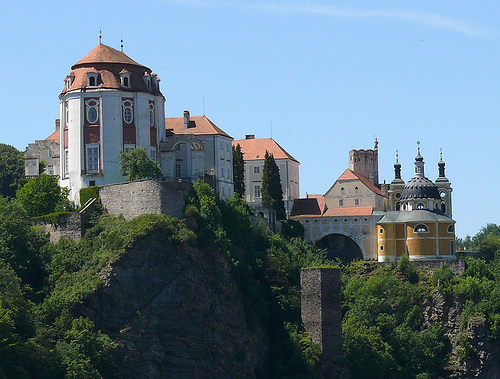
The crown jewel of Vranov nad Dyjí is its Baroque chateau, perched
dramatically on a cliff overlooking the river, often described as one of
Central Europe's most impressive secular Baroque structures. Rebuilt
from a medieval castle, it features the monumental Hall of Ancestors
with an oval dome, frescoes by Johann Michael Rottmayr, and stucco work,
alongside lavishly furnished 18th- and 19th-century interiors showcasing
noble life and local earthenware. The Chapel of the Holy Trinity
includes a family vault and thematic paintings. Guided tours, including
Christmas ones from December 27–31, are available during the tourist
season.
Other notable sites include the Church of the Assumption of
the Virgin Mary with its remarkable interior, the Vranov Dam (completed
1934, 60m high), and the Vranov Reservoir, the 10th largest in Czechia,
ideal for swimming, boating, and cruises to nearby Bítov Castle. The
ruins of Nový Hrádek Castle are a national cultural monument. The Podyjí
National Park offers hiking trails like Clary’s Circle (6 km) and
cycling routes (e.g., 36 km to other castles).
Vranov nad Dyjí's culture revolves around its historical heritage and natural beauty, with events tied to the chateau and reservoir. The town features a tourist information center at Náměstí 47, providing details on activities. Cultural aspects include guided castle tours highlighting Baroque art and noble history, as well as seasonal events like chateau Christmas tours. The area's Polish influences from 19th-20th century owners add a layer of multicultural history. Local cuisine and accommodations cater to visitors, enhancing its appeal as a summer resort.
The economy is primarily driven by tourism, supported by the chateau, national park, and reservoir activities. Historically, the earthenware manufactory was significant, but today, services like boat cruises, campsites, and restaurants dominate. Accessibility via buses from Znojmo and Uherčice, or by car, facilitates visits. The town's low population density and preserved historical charm contribute to a peaceful, community-oriented lifestyle focused on heritage preservation and eco-tourism.