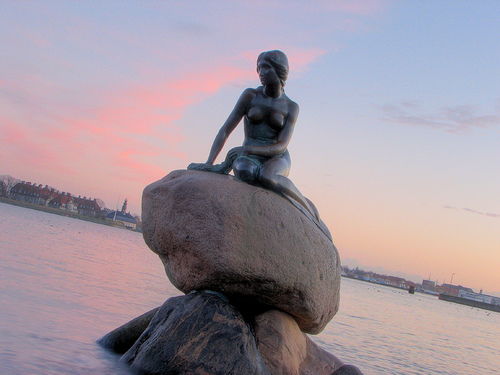
Location: Langelinie, Copenhagen
Bus: 1A, 15, 19, 26
The Little Mermaid (Den Lille Havfrue) is a small bronze statue by Danish sculptor Edvard Eriksen, unveiled on August 23, 1913, in Copenhagen, Denmark. It depicts a mermaid in transition from sea to human form, inspired by Hans Christian Andersen’s 1837 fairy tale. Despite its modest size (1.25 meters tall, 175 kg), it has become one of Copenhagen’s most iconic symbols and a major tourist attraction.
Origins and the Fairy Tale
Hans Christian Andersen published The
Little Mermaid in 1837. The story follows the youngest daughter of the
Sea King who falls in love with a human prince, sacrifices her voice and
tail for legs, and endures great pain and tragedy in her quest for an
immortal soul. The tale explores themes of longing, sacrifice,
unrequited love, and transformation.
The statue draws directly from
this narrative, showing the mermaid seated on a rock, gazing wistfully
toward the sea (or the harbor, in its placement).
Commission and
Creation (1909–1913)
In 1909, Carl Jacobsen—son of the founder of
Carlsberg Breweries and a major arts patron—attended a ballet
performance of The Little Mermaid at Copenhagen’s Royal Theatre. He was
deeply moved and commissioned Edvard Eriksen to create a statue as a
gift to the city.
The Model: Jacobsen and Eriksen approached
prima ballerina Ellen Price, who danced the lead role, to model the
face. She agreed for the face but refused to pose nude.
The Body:
Eriksen’s wife, Eline Eriksen, modeled the body. This blend gives the
statue its distinctive, graceful yet modest appearance.
Eriksen
completed the bronze statue, cast in 1913. It sits on a granite rock at
Langelinie Pier (promenade) in Copenhagen’s harbor, near Kastellet
fortress and the Gefion Fountain. The location evokes the mermaid’s
longing as she watches ships and the sea.
The statue was unveiled on
August 23, 1913, and quickly became a symbol of Danish culture and
Copenhagen.
Edvard Eriksen, the Sculptor
Edvard Eriksen
(1876–1959) was a Danish-Icelandic sculptor. The Little Mermaid remains
his most famous work, though he created other pieces. His choice of
bronze gave the statue durability while allowing fine detail in the
mermaid’s hair, expression, and form.
Physical Description and
Placement
The statue is small and intimate rather than monumental,
which adds to its charm (and sometimes disappoints first-time visitors
expecting something grander). She sits with her tail curled, one leg
beginning to form, arms resting, and a contemplative expression. The
granite rock base integrates with the waterside setting.
Cultural
Significance and Popularity
The Little Mermaid symbolizes Copenhagen
and Denmark’s maritime heritage, fairy-tale tradition, and romantic
longing. It attracts millions of visitors annually and has been
replicated worldwide (including versions in other cities). In 2010, the
original traveled to Shanghai for Expo 2010, the first time it left
Copenhagen.
It features in literature, films (distinct from Disney’s
version), tourism campaigns, and Danish identity. Locals sometimes view
it with mild amusement due to its touristy status and history of pranks,
but it remains a cherished landmark.
Vandalism and Resilience: A
Turbulent History
Since the mid-1960s, the statue has faced repeated
attacks, often for political or activist reasons, yet it is always
restored. Notable incidents include:
1964: Head sawn off by
Situationist artists (including Jørgen Nash). A new head was cast.
1984: Right arm sawn off by two young men; returned two days later.
1990: Attempted decapitation left a deep cut.
1998: Head severed
again; returned anonymously.
2003: Explosion damaged the statue,
requiring retrieval from the harbor.
Other defacements: Painted red
(anti-whaling protest), dressed in burqa, painted with Russian flag
colors (2023), and “racist fish” graffiti (2020, during BLM protests—an
odd accusation given the statue’s origins).
Each time,
authorities and experts restore it meticulously. This resilience has
added to its lore, symbolizing endurance.
Controversies and
Modern Context
Feminist and Cultural Critiques: Some view the statue
as embodying passive female sacrifice or outdated gender roles from
Andersen’s tale.
Artistic Reinterpretations: Other mermaid statues
(e.g., a larger “Big Mermaid”) have sparked debates about aesthetics and
objectification.
Tourism: Visitors often note it feels smaller in
person, but the harbor setting and story connection compensate.
Legacy
Over 110 years later, The Little Mermaid endures as a quiet,
poignant figure watching over Copenhagen’s harbor. It represents the
intersection of literature, art, commerce (via Jacobsen’s patronage),
and public symbolism. Its small scale invites personal reflection rather
than awe, mirroring the fairy tale’s intimate emotional core.
Sculptor and Creation
Sculptor: Edvard Eriksen (Danish,
1876–1959), a prominent sculptor of the period.
Commission: 1909 by
Carl Jacobsen (son of the Carlsberg brewery founder), inspired by a
ballet performance of Hans Christian Andersen’s 1837 fairy tale at the
Royal Danish Theatre.
Unveiled: August 23, 1913.
Models: The face
was modeled after ballerina Ellen Price (who performed the lead role but
refused to pose nude). The body was modeled after Eriksen’s wife, Eline
Eriksen.
Dimensions and Physical Characteristics
Height: 1.25
meters (about 4.1 feet) — surprisingly small, which contributes to its
intimate, almost fragile presence.
Weight: Approximately 175 kg (385
lb).
Material: Bronze, cast using the traditional lost-wax technique
for fine detail. Over time, it has developed a characteristic green
patina from exposure to the marine environment.
The statue
depicts the mermaid in the transitional moment from sea creature to
human: she sits on a rock with a fish-like tail still visible, but with
human legs forming. Her posture is contemplative and melancholic — head
turned slightly to the side, gaze directed toward the sea, hands resting
on her legs or the rock. This captures the emotional core of Andersen’s
tale: longing, sacrifice, and transformation.
Architectural and
Site Integration
The statue is not on a conventional pedestal but is
directly integrated with the natural and built environment at Langelinie
Promenade (Langelinie Pier) along Copenhagen’s harbor:
Base/Rock:
She sits atop a large, rough-hewn granite boulder (or cluster of rocks)
that emerges from the water’s edge. The granite provides a rugged,
natural contrast to the smooth, polished bronze of the figure. This
choice emphasizes harmony with the maritime setting rather than formal
monumentality.
Positioning: The rock is placed right at the
shoreline, so the statue appears to rise directly from the sea,
especially at high tide. This creates a powerful visual metaphor
aligning with the fairy tale.
Surroundings: The site is part of a
broader landscaped promenade with walking paths, lawns, and views across
the harbor. Nearby landmarks include the Gefion Fountain and Kastellet
fortress. The low-key setting enhances the statue’s quiet, introspective
quality rather than overpowering it with grand architecture.
The
overall “architecture” of the monument is minimalist and site-responsive
— typical of Scandinavian design sensibilities of the era, favoring
restraint, natural materials, and integration with the landscape over
ornate neoclassical or baroque excess.
Artistic Style
Eriksen
worked in a late Romantic / early modernist realist style. The sculpture
shows:
Careful anatomical detail blended with stylized elements (the
flowing hair and tail).
Expressive, emotional modeling of the face
and body that conveys narrative depth.
No heavy base or elaborate
plinth — the rock itself serves as the primary support, reinforcing
themes of nature and myth.
The patina evolution adds another
layer: the shifting greens and browns make the statue appear alive and
responsive to weather and light, changing dramatically from sunrise to
sunset or in different seasons.
Cultural and Historical Context
It was a gift to the city of Copenhagen and quickly became a national
symbol.
Its small scale was intentional — it was never meant to be a
grand civic monument but a poetic, personal tribute.
The statue has
faced vandalism and political protests over the decades (head removed
multiple times, painted, etc.), yet it endures as one of the most
visited and photographed sites in Denmark.
Best Time to Visit
Early morning (7–9 AM): Best for fewer crowds,
great light for photos, and a serene experience. Sunrise can be magical.
Golden hour (sunset): Beautiful lighting and often fewer people than
midday.
Season: Spring to early autumn offers milder weather and
longer days. Summer is busiest; shoulder seasons or winter (with
possible snow) feel more atmospheric and less crowded.
Avoid
midday (especially 10 AM–4 PM) in peak season when tour groups dominate.
How to Get There
Address: Langelinie Promenade, 2100 Copenhagen Ø
(near Indre Østerbro).
Walking: Pleasant 1.5–2 km (15–25 minutes)
from Nyhavn or Kongens Nytorv. Stroll along the harbor for scenic views.
Public Transport:
Metro or S-train to Østerport Station (then
15-minute walk).
Bus 27 stops nearby at Indiakaj.
Bike:
Copenhagen is very bike-friendly with excellent paths—rent a city bike
for a relaxed ride.
Harbor/Canal Cruise: Many tours pass by (you’ll
see it from the water, often from the back/side). Great way to combine
with other sights.
Hop-on Hop-off Bus: Convenient stop nearby.
Limited street parking is available, but public transport or walking
is recommended.
Visiting Tips
Crowd Management: Go early or
late. Even during busier times, you can usually get a clear photo with
patience.
Photography:
Low-angle shots from the promenade work
well.
Avoid climbing on slippery rocks for “unique” angles—they are
notoriously uneven and dangerous. Many visitors slip.
Best light:
Morning or sunset. Bring a wide-angle lens if you want both the statue
and harbor.
Accessibility: The promenade is mostly flat and
accessible, but getting very close to the statue involves some uneven
surfaces.
Safety: Watch your step near the water. No on-site
facilities, but restrooms, cafes, and shops are nearby.
What to
Bring: Comfortable shoes for walking, a jacket (harbor winds can be
cool), and water. No need for tickets.
Duration: Plan 15–45 minutes
for the statue + time for the promenade.
Nearby Attractions (Make
a Day of It)
Turn your visit into a scenic half-day:
Kastellet
(The Citadel): Beautiful star-shaped fortress and park right next
door—great for walks and views.
Kastellet, Copenhagen - Wikipedia
Gefion Fountain and St. Alban’s Church.
Langelinie Promenade and
Park: Lovely waterfront path with views, sculptures, and green space.
Amalienborg Palace (a bit further, royal residence with changing of the
guard).
National Gallery of Denmark (SMK) or other Østerbro sights.
Is It Worth Visiting?
Opinions vary: Some call it a “tourist
trap” due to its size and crowds, while others love the fairy-tale
connection, harbor setting, and quick iconic photo. Most recommend going
if you’re in Copenhagen, especially as part of a walk rather than a
dedicated trip. It’s a classic “been there” moment.
Practical
Info
Cost: Free.
Restrooms/Food: Nearby in Langelinie area or
further toward the city center.
Weather Note: Dress for wind; it can
feel colder by the water.