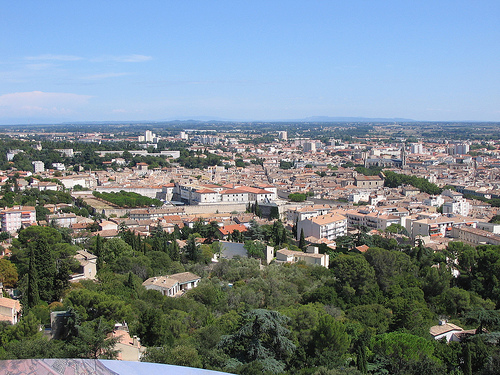
Nîmes is a commune in the south-east of France,
prefecture of the Gard department in Occitan region. Located between
the Mediterranean Sea and the Cévennes mountains , the city is on
the busy axis connecting the lower Rhone valley to the Languedoc
plain . With a population of 151,001 inhabitants 1st January 2016,
the city of Nîmes knows during the summer period a notable influx of
tourists come to visit its monuments and participate in its ferias
and festivals.
The foundation of Nîmes dates back to antiquity. From the Roman
period , Nîmes preserves monuments such as arenas , the Maison
Carrée or the Magne tower at the foot of which is the site of the
sanctuary of the fountain . This rich ancient past earned him the
nickname "French Rome". City both Roman, Camargue , Cévennes,
Languedoc, Provence and Hispanic stronghold protesting since the xvi
th century and center fabric production from the xviii th century,
including the famous denim canvas, Nîmes has a rich culture and
history and remains a city with a strong identity.
The enhancement of its historical, cultural and architectural
heritage has enabled the city to obtain the label of City of Art and
History . Since 2012 , date of registration on the French indicative
list , Nimes working its bid on "Nimes, Antiquity to the Present"
for the registration of the two thousand year old city at the World
Heritage of UNESCO.
By Plane
Nîmes is accessible via air with regular
flights connecting to major hubs like Paris and several European
destinations, including budget-friendly low-cost carriers. The primary
airport serving the area is Nîmes-Alès-Camargue-Cévennes Airport (IATA:
FNI, also known as Nîmes-Garons Airport), located at 30800 Saint-Gilles.
Contact details include phone +33 4 66 70 49 49 and fax +33 4 66 70 91
24. As of early 2026, commercial flights are somewhat limited, primarily
operated by Ryanair, with routes to cities such as London, Brussels,
Fez, Marrakech, and seasonal services to Ajaccio starting in mid-2025.
Flight frequencies vary by season, so checking Ryanair's schedule or
sites like Skyscanner is recommended for the latest deals, sometimes
starting as low as €20-€50 for European hops.
For more flight options
and potentially cheaper fares, many travelers opt for nearby larger
airports like Marseille-Provence (MRS, about 1-1.5 hours away by bus or
train) or Montpellier (MPL, roughly 45 minutes by bus). From MRS, direct
buses via FlixBus or BlaBlaCar Bus run multiple times daily, costing
€8-€16 and taking around 1 hour 15 minutes. Airport shuttles, such as
the Tango service, provide convenient transfers from FNI to Nîmes city
center, train station, or hotel areas, timed to align with flight
arrivals and departures—fares are typically €6-€7 per person.
By
Train
Situated at a key intersection of rail networks and elevated
above the surrounding streets, Nîmes station acts as a bustling hub for
high-speed and regional services. High-speed TGV trains offer efficient
connections primarily from Paris (Gare de Lyon, journey time about 3
hours) and northern France, with frequent departures—often every 1-2
hours during peak times—making it a flexible and scenic option. The
station's proximity to the TGV line's endpoint adds convenience for
southern routes.
For mid-distance travel, Intercités trains link
Nîmes to other southern French cities like Bordeaux (around 4-5 hours),
Toulouse (2-3 hours), Montpellier (30 minutes), Marseille (1 hour), and
even Clermont-Ferrand (3-4 hours), though occasional delays can occur
due to network issues. Local TER Languedoc-Roussillon services cater to
nearer destinations, combining train and coach options for places such
as Le Grau-du-Roi (beach access, 45 minutes), Narbonne, Alès, Mende, and
beyond the region to Avignon (20-30 minutes, fares around €10), Arles,
or Marseille. Tickets can be booked via SNCF's app or website, with
prices starting from €5-€10 for short TER trips and €30-€60 for TGV from
Paris, often cheaper if reserved in advance.
By Car
Driving to
Nîmes is straightforward thanks to well-maintained highways converging
on the city. If approaching from Montpellier or the Rhône Valley
(including Lyon via A7), use the A9 motorway, which offers smooth,
multi-lane travel with rest areas and tolls averaging €20-€30 for medium
distances. From Provence regions like Arles or Marseille, the A54
provides a direct link. Additionally, national roads such as the
N106—from the Cévennes and Massif Central—feature sections with 2x2
lanes for faster progress.
The drive from Paris is approximately 700
km and takes 6-7 hours, mostly on tolled autoroutes (total tolls around
€60-€70). Expect electronic toll systems (télépéage) for quicker
passage, and note that fuel stops and EV charging are plentiful along
these routes. Traffic can peak during summer holidays, so apps like Waze
or ViaMichelin are useful for real-time updates. Once in Nîmes, parking
is available in city lots or garages, with rates starting at €1-€2 per
hour.
By Coach
Multiple bus operators run services to and from
Nîmes throughout the day, offering affordable and eco-friendly
alternatives to driving or flying. EdGard remains a key provider for
regional routes, with timetables and fares obtainable at the bus station
(located just behind the SNCF train station) or directly from drivers.
In addition, popular long-distance companies like FlixBus and BlaBlaCar
Bus connect Nîmes to major cities across France and Europe—examples
include Paris (7-8 hours, from €15), Marseille (1.5 hours, €5-€10), or
Montpellier (1 hour, €5).
For even more budget options, ridesharing
platforms like BlaBlaCar are widely used, often costing €10-€20 for
shared rides from nearby areas. Comprehensive comparisons on sites like
Kombo or Rome2Rio can uncover deals as low as €1 for promotional
tickets. The bus station serves as a central hub, with amenities like
waiting areas and info counters for planning onward travel.
By Car
Attention to drivers who prefer personal
vehicles: the city center's traffic system is undergoing major
overhauls, and in the coming years, automobiles might face significant
restrictions there. This is due to ongoing efforts to reduce traffic
congestion and air pollution. As of 2025, Nîmes has implemented a Low
Emission Zone (ZFE), requiring vehicles to display a Crit'Air sticker
(minimum class 5 for private cars) to enter certain areas.
By Bus
The Tango network features numerous urban bus lines (including
high-service trambus routes labeled T1 to T5) and suburban lines, with
varying frequencies typically ranging from 10 to 30 minutes. These
services connect all neighborhoods and key attractions in Nîmes. Since
most museums and landmarks are concentrated in the city center, buses
are primarily useful for traveling to or from your accommodation.
Tickets valid across the entire network include a single journey pass
for €1.60 (valid for 1 hour, with refills at €1.30), a day pass for
€3.90 (€3.60 refill), and other options like multi-trip passes. Note
that during major events like ferias, many routes bypass the city center
with extensive detours in place. Route maps are posted at bus stops in
the center and at the SNCF train station, and you can seek guidance from
inspectors or drivers.
Additionally, the high-level service trambus
lines have expanded since their introduction, offering dedicated lanes
and priority at intersections. Park-and-ride facilities are available,
along with bike rental options through VéloTANGO.
By Bike
While Nîmes hasn't fully developed an extensive network of bike lanes
yet, improvements are ongoing as part of city infrastructure upgrades
and initiatives like the Tour de France Cycle City label. Cycling
remains feasible thanks to the city's diverse terrain, which suits
various skill levels. VéloTANGO provides rental services for city bikes,
folding bikes, and electric bikes, available for periods from one day up
to a year.
On Foot
Exploring the historic city center by
walking is highly advisable (and often the best choice). All major
points of interest are within a compact area, allowing for thorough
visits without much fatigue. For enthusiasts, inline skating can serve
as an enjoyable alternative.
By Trambus
If you'd rather avoid
driving into Nîmes, consider parking at one of the park-and-ride lots
(such as Costières-Parnasse or A54) and hopping on a trambus line. The
first line, T1, launched in 2012, and the network has since grown to
include T2, T3, T4, and T5 (with T5 added in 2025 and T4 extended in
2027). These trambuses operate mostly in dedicated lanes with traffic
light priority, similar to trams, enabling quick trips—for example, T1
links the Nîmes-center highway exit to the city core (near the arenas)
in about 12 minutes, with departures every 5 to 8 minutes on average.
T1 serves around 22 stops, including A54 Caissargues, Mas de Vignolles,
Costières-Parnasse, Nemausa pool, Liberté, Camargue, Dhuoda lycée,
Montcalm, and the arenas, among others. This makes it an efficient
option for navigating the often congested downtown. Vehicles accommodate
up to 135 passengers, with 29 seats, 4 spots for people with reduced
mobility (PRM), 2 wheelchair areas, security cameras, route maps on
screens, and audio announcements.
For more details, contact Tango at
388 Avenue Robert Bompard, +33 970 818 638 (toll-free). Operating hours:
Monday to Wednesday from 5:20 a.m. to 10 p.m., Thursday to Saturday from
5:20 a.m. to 12:40 a.m., and Sundays from 7 a.m. to 10 p.m. Single fares
start at €1.60 for 1 hour. Wi-Fi access may be limited, and while
designed for accessibility, some features are optimized for PRM users.
Pont du Gard
Located just northeast of Nîmes, the Pont du Gard stands as a remarkable
ancient Roman aqueduct bridge, constructed in the 1st century AD to
transport water across the Gard River as part of a 50-kilometer system
supplying the city of Nîmes. This UNESCO World Heritage Site is the
tallest Roman aqueduct bridge in existence, reaching 49 meters in height
and spanning 275 meters in length with three tiers of arches. Built
under the direction of Agrippa, it functioned for about five centuries,
demonstrating exceptional Roman engineering prowess with precisely cut
stones assembled without mortar. Today, it's surrounded by 165 hectares
of protected natural landscape, home to wildlife like Bonelli's eagles,
herons, and beavers. Visitors can explore an on-site museum covering
2,500 square meters with exhibits, a cinema, workshops, and temporary
displays on Roman hydraulics and daily life. For a full experience,
allocate at least half a day to walk the 1.4-kilometer Mémoire de
Garrigue trail through olive groves and vineyards, swim in the nearby
Gardon River beaches (supervised in summer), or enjoy nighttime
illuminations from mid-May to late August. It's easily accessible by car
or tours from Nîmes, about 35 minutes away, and remains one of France's
most visited ancient monuments.
Nîmes ranks among France's most
abundant cities in terms of protected or listed historical landmarks,
with structures from multiple periods starting from ancient times. While
many can be explored, some remain closed to visitors. For an exhaustive
inventory, consult the roster of Nîmes' historic monuments.
Roman-Era Sites in Nîmes
Arènes de Nîmes – A combined entry pass
allows access to this amphitheater, the Maison Carrée, and the Tour
Magne. Widely recognized as one of the finest surviving Roman arenas
globally, it was erected toward the close of the 1st century AD and
exemplifies the advanced skills of Roman builders in planning and
erecting such grand venues. Open for tours every day except during
events like Pentecost and the Harvest Festival, it includes audio guides
in various languages. Dedicated exhibits focus on the traditions of
bullfighting and gladiatorial combat, housed in niches beneath the outer
arches. This elliptical structure, built around 70 BC and
contemporaneous with Rome's Colosseum, originally accommodated crowds
for spectacles and later served as a fortified medieval neighborhood
with housing inside its walls—cleared during the Napoleonic era.
Measuring about 133 meters long and 101 meters wide, it can seat up to
23,000 people today and continues to host modern events like concerts,
bullfights, and the annual Féria de Nîmes festival featuring parades and
corridas.
La Maison Carrée – Designated as a protected French
historical site, this Roman temple was commissioned by Emperor Augustus
to commemorate his grandsons, Lucius and Gaius Caesar. It's the only
fully intact ancient Roman temple in the world, constructed around 19
BCE with a design inspired by Rome's temples of Apollo and Mars Ultor,
incorporating Corinthian columns and a portico. Visitors can enjoy a
short film inside detailing Nîmes' history. Open year-round, it's
situated in a lively square redesigned by architect Norman Foster, ideal
for viewing from nearby café terraces.
The Tour Magne – A safeguarded
French historical landmark perched on a hill with sweeping vistas over
Nîmes, this Roman tower originates from Augustus's reign and stands 32
meters tall. As the sole remaining tower from the city's ancient
fortifications, it requires climbing 140 steps for panoramic views. Part
of the original 6-kilometer ramparts reinforced by 14 towers, it's
accessible via a hike through the Jardins de la Fontaine and offers
insights into Roman defensive architecture.
Porte Auguste (Porte
d'Arles) – Listed as a French historical monument, this former gateway
formed part of Nîmes' Roman enclosure walls. Built during Augustus's
time, it's one of two surviving gates from the era (alongside Porte de
France), symbolizing the city's fortified boundaries and imperial
grandeur.
Castellum Divisorium of Nîmes (Roman Water Tower) –
Protected as a French historical site, this structure marked the
endpoint of the Nîmes aqueduct—directly linked to the Pont du Gard—where
water was distributed throughout the city via lead pipes and channels.
It's a rare surviving example of Roman hydraulic engineering, showcasing
how the system supported public fountains, baths, and homes.
Jardins
de la Fontaine – Recognized as a French historical monument and a
notable garden, these grounds were first landscaped during Roman times
near the Tour Magne, around natural springs that fed the city's water
supply. Developed into one of Europe's earliest public parks in the 18th
century, they encompass Gallo-Roman ruins like the Temple of Diana
(remnants of an aqueduct junction) and the embankments of the spring
laid out between 1738 and 1755. The gardens climb the slope of Mont
Cavalier, offering serene walks amid fountains, statues, and greenery.
Cathedral of Notre-Dame-et-Saint-Castor de Nîmes – A
protected French historical landmark, this Provençal Romanesque
cathedral was dedicated by Pope Urban II in 1096, with roots tracing
back to a 7th-century structure on a site possibly occupied since Roman
antiquity. Blending Romanesque and Gothic elements, it honors Saint
Castor of Apt, a local figure, and has undergone renovations, including
during the 17th century when Nîmes prospered and rebuilt many
structures.
Fontaine Pradier – Classified as a French historical
monument, this grand fountain sits in Nîmes' central Esplanade
Charles-de-Gaulle square, positioned between the train station and the
arenas. Crafted by renowned sculptor James Pradier in the 19th century,
it features allegorical figures representing the region's rivers and is
surrounded by statues evoking Roman icons like the arena and Maison
Carrée, making it a focal point for visitors.
Saint-Paul de Nîmes
Church – A listed French historical site, this mid-19th-century church
exemplifies neoclassical architecture from the period, contributing to
Nîmes' diverse ecclesiastical heritage amid its Roman-dominated
landscape.
Muséum d'Histoire Naturelle – This natural history
museum showcases collections on local flora, fauna, geology, and
ethnography, providing educational exhibits that complement Nîmes'
archaeological focus.
Musée de la Romanité – Located at 16 Boulevard
des Arènes, contact +33 4 48 210210. Open daily from 10 a.m. to 7 p.m.
Admission for self-guided tours: adults €8, ages 7-17 €3, under 7 free;
guided tours: adults €12, ages 7-17 €6, under 7 free. This modern
specialty museum, designed with contemporary architecture facing the
ancient arena, delves into Nîmes' evolution from Celtic roots through
the Roman era to the Middle Ages. It houses artifacts like mosaics,
frescoes, sculptures, and household items from excavations, offering
immersive experiences, a rooftop restaurant with city views, and
insights into the region's Roman legacy.
Nîmes hosts two prominent annual festivals that draw crowds with
their vibrant traditions and lively atmosphere: the Féria de Pentecôte
and the Féria des Vendanges.
The Féria de Pentecôte, established in
1952 and inspired by Spanish bullfighting customs, typically takes place
over Pentecost weekend in May or June, extending for about a week with
events kicking off midweek, such as on Wednesday or Thursday. This
celebration features Andalusian influences and Camargue regional
elements, including a grand opening pégoulade—a colorful costumed parade
with floats, dancers, and music winding through the streets—followed by
corridas (bullfights) in the historic Roman Arena, abrivados (bull
releases into the streets), and various cultural performances. The event
attracts over a million visitors each year, filling the city with street
dancing, live bands (bandas), and a festive spirit that blends Roman
heritage with Hispanic flair.
Families with energetic or less engaged
kids can enjoy a funfair along the broad Avenue Jean Jaurès, complete
with carousels, games, and food vendors offering treats like French
fries and paella. However, it's wise to check food hygiene standards, as
there have been increasing reports of foodborne illnesses in recent
editions—opt for reputable stalls or bring your own snacks to avoid any
issues.
A hallmark of the feria is the abundance of sangria booths
and bars scattered throughout the city, operating well into the early
morning hours. While the vibe starts joyful, some inebriated attendees
can turn unpredictable or confrontational without clear reason, so it's
best to steer clear of heated exchanges or anyone trying to pull you
into one; this could otherwise lead to an unwanted visit to the hospital
or local authorities.
Parking in the city center becomes a major
hassle during the event, with towing services on high alert to clear any
obstructing vehicles. Instead, take advantage of the efficient,
complimentary shuttle buses run by the local transit company, which
connect peripheral park-and-ride lots at the city's edges directly to
the heart of the festivities— a smooth and stress-free option that works
reliably every time.
By following these practical suggestions at the
appropriate moments, you'll ensure the celebration remains enjoyable and
safe for everyone.
The Féria des Vendanges, by contrast, occurs in
September to mark the grape harvest season and is confined to a single
weekend, usually mid-month (for instance, from September 18 to 21 in
2025). Though more compact than its spring counterpart, it still pulses
with energy through bullfights, Camargue-style bull runs, parades, and
plenty of wine and sangria flowing freely, honoring the region's
viticultural roots alongside traditional Provençal and Spanish elements.
Activities often include novilladas (fights with young bulls), corridas
de rejon (mounted bullfights), and street parties, making it a lively
end-of-summer highlight.
The University of Nîmes, located on Rue du Docteur Georges Salan, stands as one of France's newest universities, officially established in 2007 as the evolution of the earlier Nîmes University Center for Training and Research founded in 1999. It offers a diverse array of programs across bachelor's, master's, and PhD levels—totaling over 50 courses—in disciplines such as law, economics, management, psychology, literature, languages, history, sciences, arts, design, and sports sciences (STAPS). Structured into three main departments (Law, Economics, and Management; Psychology, Letters, Languages, and History; and Sciences and Arts), it emphasizes interdisciplinary approaches and maintains strong ties with local and international partners. Notable offerings include specialized diplomas like one in Genealogy and Family History through the History Department.
The markets in southern France, particularly in Nîmes, are vibrant hubs teeming with energy, drawing in both residents and visitors alike. Known for their fresh produce, local crafts, and lively atmosphere, these spots offer a glimpse into daily life in this historic city. Nîmes boasts a variety of markets, each with its own charm and specialties. For instance, the iconic Les Halles de Nîmes, located at Rue Général Perrier, is a covered market hall dating back to 1884, inspired by the famous Baltard architecture from Paris. It's open every day and features stalls brimming with regional cheeses, olives, wines, and seafood – perfect for food enthusiasts. You can contact them at +33 466 21 52 49 or via email at halles@ville-nimes.fr. This market is often hailed as one of the finest in France, where young chefs source ingredients for innovative dishes. Other notable ones include the Beausoleil Market at 5c Rue Guynemer, which offers a full range of shops; the West Nîmes Market, also comprehensive; the Valdegour Market with various vendors; the Chemin Bas d'Avignon Market for everyday essentials; the Jean Jaurès Market, focusing on farmers' produce alongside flea market finds; the Mas de Mingue Market, specializing in vegetables, bazaars, and groceries; and the Costières Stadium Market, held every Monday and featuring flowers and textiles. These markets not only provide shopping opportunities but also reflect Nîmes' Mediterranean vibe, with seasonal events and street performers adding to the excitement during peak tourist seasons.
Nîmes' culinary scene shines with its signature dish, brandade – a creamy puree of salt cod, olive oil, and potatoes that's a staple of Provençal cuisine. The renowned Brandade Raymond factory leads the pack, with multiple outlets scattered downtown where you can sample or purchase this delicacy, often paired with local wines for an authentic taste. Beyond that, the city center and outskirts are dotted with numerous street stands and small eateries offering quick bites like savory pastries or regional snacks. Kebab shops have surged in popularity, especially during the famous ferias (bullfighting festivals), earning a loyal following among fans of Middle Eastern flavors with their flavorful meats, fresh veggies, and spicy sauces. For those seeking fast and fuss-free meals, a plethora of fast-food chains line the city streets and the southern peripheral boulevard, including international favorites like burgers and pizzas. If you're craving something more refined, check out La Locanda at 12 Rue de la Maison Carrée (+33 4 11 83 34 67), which serves Italian and Mediterranean fare with prices ranging from €8 to €18 – think fresh pasta, seafood risottos, and herb-infused salads in a cozy setting. Other standout spots include Le Ganesh at 32 Rue Porte de France, an intimate Indian restaurant with affordable, flavorful curries and naan in a warm, music-filled ambiance (reservations are a must due to its small size for a guaranteed exotic escape); and Le Hànồi at 1 Place Saint-Charles, specializing in Vietnamese delights like pho soups and spring rolls at budget-friendly prices, with takeout options available. Nîmes' food culture is further enriched by its proximity to the Cévennes mountains and Mediterranean coast, ensuring ultra-fresh ingredients year-round.
Like many towns in the Occitanie region, Nîmes is peppered with bars and cafés throughout its streets, offering ideal spots to unwind despite the bustling traffic on major boulevards. Terrace seating is a highlight, where you can savor your preferred beverage – from refreshing aperitifs to steaming coffees – perhaps accompanied by a light meal of tapas-style plates. Even along Avenue Jean Jaurès, starting from the picturesque Jardins de la Fontaine, establishments buzz with local reputation, as any resident will attest. Recommended haunts include O'Flaherty's at 21 Boulevard Amiral Courbet, a haven for beer aficionados with an Irish twist, boasting a wide selection of drafts and a youthful, local vibe that transports you across the Irish Sea. Then there's L'Instant-T at 2 Rue Racine (behind the Carré d'Art, +33 4 66 21 79 93), more of a beer bar than a traditional pub, attracting a laid-back crowd with Garrigues brews on tap, charcuterie platters, and occasional weekend concerts for a relaxed evening. For a unique experience, visit Prolé at 20 Rue Jean Reboul (+33 4 66 21 67 23), a community café linked to the Communist Party – its unassuming interior belies the shady respite under two mulberry trees, perfect for a quiet drink. If tropical vibes appeal, El Cuba Libre at 5 Rue Jean Reboul (+33 4 66 28 92 32) delivers with welcoming hosts, an extensive cocktail menu featuring hits like Pink Frozen or classic Mojitos, infusing your night with sunny, Latin flair. For entertainment, cinemas remain a draw: the central Le Sémaphore at 25 Rue Porte de France (conveniently near Le Ganesh) and Kinepolis Forum at 3 Rue Poise offer indie and blockbuster films, while the larger Kinepolis multiplex in the southern Mas des Abeilles district (130 Rue Michel Debré, near shopping zones and accessible by public transport) provides a modern movie experience visible from the A9 highway. Night owls can head to discotheques scattered around Nîmes and nearby southern towns, especially coastal areas, where weekend crowds flock for dancing until dawn. Additionally, seasonal funfairs erupt around Saint-Michel in September and October, transforming the northern stretch of Avenue Jean Jaurès (from Jardins de la Fontaine to Place Séverine) into a carnival wonderland with rides, fries, waffles, and games – though exercise caution with crossing traffic and keep an eye on kids amid the excitement. Nîmes' nightlife pulses especially during ferias, blending Roman heritage with modern festivities.
Hotels
Visitors exploring Nîmes' Roman legacy will find a diverse array of hotels suiting various budgets and preferences. Upscale options cluster in the city center for easy access to landmarks like the Arena, while chain hotels often sit near highway exits for convenience. On the affordable end, the Nîmes Youth Hostel (La Cigale) at 257 Chemin de l'Auberge de Jeunesse (+33 4 66 68 03 20, nimes@hifrance.org) nestles in a secure botanical park with a stunning terrace amid olive trees – an ideal, budget-friendly base affiliated with Hostelling International, blending tranquility with the city's vibrant feria energy. In the mid-range category, Hotel Kyriad Nîmes Centre at 10 Rue Roussy (just a 10-minute walk from the train station and Arena) offers comfortable, modern rooms with amenities like free Wi-Fi and breakfast. Similarly, the 2-star Hôtel de l'Amphithéâtre in the heart of town provides charming stays steps from the Arena, emphasizing local hospitality. For more luxury, consider spots like the Imperator hotel, which houses acclaimed dining by chef Pierre Gagnaire, adding a gourmet touch to your Roman adventure.
Managing the day to day
The routine governance of Nîmes is handled through its city hall, located at Place de l'Hôtel de Ville, which can be contacted at +33 4 66 76 70 01. Additionally, the broader metropolitan area is managed by Nîmes Métropole, situated at 3 rue du Colisée, reachable via +33 4 66 02 55 55. As the prefecture of the Gard department in the Occitanie region, Nîmes spans 161.85 square kilometers and had a population of around 150,444 in 2022, yielding a density of about 930 people per square kilometer. The city is segmented into several cantons, including Nîmes-1 through 4 and Saint-Gilles, and operates under the intercommunal structure of CA Nîmes Métropole. The current mayor, Jean-Paul Fournier of The Republicans party, has been in office since 2020 and is set to serve until 2026. Historically, administration evolved from feudal systems involving bishops, civil authorities in the ancient amphitheater, and consuls based in the Maison Carrée. Modern infrastructure supports this, with Nîmes-Alès-Camargue-Cévennes Airport offering flights to destinations like London and Marrakech via Ryanair, major motorways such as A9 and A54 connecting to nearby cities, high-speed rail links to Paris and Marseille, and a bus network centered near the railway station. A new TGV station at Nîmes-Pont-du-Gard opened in 2019 as part of the Contournement Nîmes-Montpellier line.
Nîmes, originally known as Nemausus after the Celtic deity associated
with a local sacred spring, served as the capital for the Volcae
Arecomici tribe and fell within the influence of ancient Massilia
(modern Marseille). Evidence of early settlement dates back to Neolithic
times around 4000–3500 BCE, with semi-nomadic communities practicing
cultivation, and includes artifacts like the menhir of Courbessac from
circa 2500 BCE and Bronze Age hut villages. The Warrior of Grezan
represents one of the oldest indigenous sculptures in southern Gaul. By
the Iron Age, an oppidum on Mt. Cavalier featured defensive walls and a
dry-stone tower that later became part of the Tour Magne. In 121 BCE,
the Romans seized control, integrating it into the province of Gallia
Narbonensis. Emperor Augustus elevated it to colonia status in 27 BCE
(Colonia Augusta Nemausus), attracting settlers including Egyptian
veterans from Mark Antony's forces. By 149 CE, following a fire in Narbo
(Narbonne), Nemausus likely assumed the role of provincial capital. The
city flourished through the late 2nd century CE, boasting a population
of about 25,000, grand architecture emblematic of Gallo-Roman
prosperity, and a strategic position along the Via Domitia trade route.
It operated a significant mint and featured enduring landmarks like the
massive amphitheater (one of the largest in the Roman Empire, now used
for concerts and bullfights), the castellum divisorium for water
distribution, the nymphaeum once misidentified as the Temple of Diana
(possibly a library in the Fontaine Sanctuary dedicated to Augustus),
the iconic Pont du Gard aqueduct 20 kilometers northeast (spanning the
Gardon River between Uzès and Remoulins), the well-preserved Maison
Carrée temple (a blend of Etruscan and Greek styles dedicated to Roma
and Augustus), and the Porte d'Auguste gate. The 6-kilometer city walls,
built from the 3rd century BCE and reinforced by Romans, included the
Tour Magne as a key fortification. Other structures encompassed a civil
basilica, curia, gymnasium, and potential circus. Notable Romans linked
to Nîmes include Emperor Antoninus Pius, born there in 138 CE, and
Constantine, who constructed baths in the early 4th century. A 2024
archaeological find revealed Roman glassware, including strigils, ornate
vases, ceramics, lamps, and funerary fragments, underscoring the city's
ancient craftsmanship.
In late antiquity, Nîmes hosted a synod in
396 CE and established itself as a bishopric, with the first documented
bishop in 506 CE. The Visigoths overtook the city in 472 CE, maintaining
control over Septimania against Frankish incursions until the early 6th
century, though urban life adapted while preserving Roman elements.
Saracen forces captured it in 725 CE, but Frankish leader Charles Martel
reclaimed and devastated it in 737 CE, severely damaging sites like the
amphitheater. The city recovered briefly before falling to Pepin the
Younger in 752 CE, marking its full integration into the Frankish
Empire. Local rule shifted to vicecomites (vicomtes) under the dukes of
Septimania, who gained independence as counts by the 10th century.
Norman raids sacked Nîmes in 859 CE. It became a frequent battleground
among the Counts of Toulouse, Carcassonne, Béziers, and the King of
Aragon, who claimed suzerainty. French King Louis VIII conquered it in
1226, and James I of Aragon ceded it to Louis IX in 1259. During the
Hundred Years' War, it changed hands multiple times: to the Duke of
Anjou in 1378, the English in 1417, and Dauphin Charles VII in 1420.
Medieval commerce thrived in textiles, industry, and stock-breeding,
with authorities operating from historic sites like the amphitheater and
Maison Carrée until royal power solidified under St. Louis in the 13th
century.
By the 16th century, Nîmes emerged as a major Huguenot
center, resisting persecution and establishing a Protestant university
under Marguerite of Navarre's influence. Deep divisions between
Catholics and Protestants fueled violent clashes, such as the 1567
Michelade massacre. The revocation of the Edict of Nantes in 1685
intensified oppression, leading to the Camisard revolt in the Cévennes
(1702–1705), during which the cathedral suffered repeated destruction.
Tensions persisted into the revolutionary era, escalating in 1791, and
culminated in the 1815 White Terror under the Bourbon Restoration, where
Catholic "Bandes Verdets" led by figures like Trestaillon terrorized
Protestants with killings and arson until quelled by the Duke of
Angoulême. An 1830 uprising by Catholic supporters of Charles X after
the July Revolution was swiftly suppressed, and cholera struck in 1835.
Despite these upheavals, including plagues and epidemics during the
French Wars of Religion, the city saw economic growth from the 18th
century onward through manufactory-based textile production—notably
"Serge de Nîmes" (denim), originally dyed blue and linked to Genoa and
Lahore. Viticulture expanded profitably after railway connections and
the Canal du Midi facilitated trade. The 17th century brought urban
renewal, with population rising from 21,000 to 50,000, slum clearances,
reconstruction of Notre-Dame-Saint-Castor cathedral and the Bishop's
palace, elegant mansions, and the creation of the Quais de la Fontaine
(France's first civic gardens, 1738–1755) around Roman thermae ruins,
enhancing the area around the Maison Carrée and amphitheater.
In
World War II, German forces occupied Nîmes from 1942 to 1944 under Vichy
France. On April 22, 1943, the Wehrmacht executed Maquis resistance
fighters Jean Robert and Vinicio Faïta. Allied bombings targeted
marshalling yards on May 27 and July 12, 1944, in preparation for
Operation Dragoon, resulting in 271 deaths, 289 injuries, 443 destroyed
homes, and damage to about 5,000 others, primarily in the eastern
districts. Liberation by Resistance troops was unique, with three German
defectors who had fought alongside the French in the Cévennes Maquis
leading the celebratory procession. Post-war, Nîmes became the garrison
for the 2nd Foreign Infantry Regiment (2e REI) of the French Foreign
Legion since 1983, a motorized infantry unit that remains stationed
there today.
Today, Nîmes is celebrated as the most Roman city
outside Italy, with cultural highlights including the Musée de la
Romanité, the Feria de Nîmes bullfighting festival (attracting hundreds
of thousands twice yearly), the World Archery Indoor World Cup, and
sports teams like Nîmes Olympique football club and RC Nîmes rugby. It
has hosted major cycling events, such as stages of the 2017 Vuelta a
España and frequent Tour de France appearances. Population has
fluctuated, peaking at 123,292 in 1968 before stabilizing around
148,000–150,000 in recent years. Notable figures include actress
Bernadette Lafont, Olympic swimmer Yannick Agnel, and mathematician
Joseph Gergonne, who published his journal there from 1810–1822. The
city maintains twinships with places like Verona, Italy, and Preston,
UK, and is linked to asteroid 51 Nemausa. Modern concerts at the Arena,
such as recordings by Rammstein and Metallica, highlight its vibrant
cultural scene.
Nîmes is the prefecture of the Gard department in the Occitania
region of Southern France. It is strategically positioned between the
Mediterranean Sea to the south and the Cévennes mountain range to the
north, approximately 40 km (25 mi) inland from the coast. The city's
geographic coordinates are 43°50′18″N 04°21′35″E, placing it in a
transitional zone where the flat alluvial plains meet rolling hills and
higher elevations. This location has historically made Nîmes a key hub
for trade and culture, earning it the nickname "French Rome" due to its
rich Roman heritage tied to the landscape. The commune spans an area of
161.85 km² (62.49 sq mi), with a population of around 148,561 as of
2019, resulting in a moderate urban density that reflects its blend of
city and surrounding natural spaces.
Topography and Terrain
The topography of Nîmes is diverse, featuring a mix of low-lying plains
and modest hills that create a varied landscape. The city is built
primarily on the alluvial plain of the Vistrenque River, which provides
fertile ground but also historically posed flood risks. Elevations
within the commune range from a low of 21 m (69 ft) in the flatter
southern areas to a high of 215 m (705 ft) on the surrounding hills,
with an average elevation of about 39 m (128 ft). Key hills include Mont
Duplan to the northeast, Montaury to the southwest, Mt. Cavalier to the
west (site of ancient settlements and the iconic Tour Magne), and the
knoll of Canteduc. These elevations transition northward into the more
rugged Cévennes mountains, which form a natural barrier and influence
local weather patterns. The terrain is characterized by limestone
formations, evident in prehistoric sites like the menhir of Courbessac
(a over 2 m tall monolith dating to around 2500 BCE) and Neolithic
remnants at Serre Paradis (4000–3500 BCE), highlighting the area's
ancient geological stability. Overall, the topography supports
agriculture in the plains while the hills offer scenic viewpoints and
have been integrated into urban development, such as parks and
historical sites.
Climate
Nîmes experiences a humid
subtropical climate (Köppen classification: Cfa), bordering on a
hot-summer Mediterranean climate (Csa), with hot, somewhat humid summers
and cool, mild winters. Its inland southern position amplifies summer
heat, making it one of the warmest cities in France. Average annual
temperature is around 15.6°C (60.1°F), with July and August often seeing
highs above 34°C (93°F) and occasional peaks reaching 44.4°C (111.9°F),
as recorded in recent heatwaves influenced by African air masses.
Winters are cooler, with nighttime lows frequently dipping below 0°C
(32°F) from December to February, and an average of 2.4 snowy days per
year; the record low is -14.0°C (6.8°F). Precipitation totals about
734.4 mm (28.91 in) annually, spread over 64.8 rainy days, with heavier
falls in autumn due to Mediterranean influences. The city enjoys
abundant sunshine—2,679.8 hours per year (59% of possible)—and moderate
humidity at 65.8%. Winds like the Mistral, a cold northerly flow from
the Rhône Valley, can occur year-round but are less frequent in summer,
sometimes bringing a föhn-like warming effect. Storms average 23.6 days
annually, and fog is rare at 10.6 days. This climate supports
viticulture and tourism but increases vulnerability to heatwaves and
occasional flooding.
Hydrology and Water Features
Hydrology
plays a central role in Nîmes' geography, shaped by rivers, springs, and
ancient water management. The Vistrenque River forms the alluvial plain
underpinning much of the city, contributing to soil fertility but also
historical flooding, mitigated today by embankments like the Quais de la
Fontaine (built 1738–1755 as France's first civic gardens). Nearby, the
Gardon River flows to the northeast, famously crossed by the Pont du
Gard aqueduct (20 km away), a Roman engineering marvel that once
supplied water from northern springs to Nîmes via a 50 km network with
precise gradients. The city's origins are linked to a sacred healing
spring dedicated to the deity Nemausus, around which a nymphaeum and
sanctuary were built. Modern water features include canals and fountains
integrated into urban spaces, reflecting ongoing adaptations to the
semi-arid Mediterranean influences.
Natural Features and
Environmental Aspects
Nîmes' natural environment combines
Mediterranean flora with prehistoric and Roman-era landmarks embedded in
the landscape. The area features limestone karst formations, supporting
diverse ecosystems from scrubby garrigue on hills to wetlands in the
plains. Ancient sites like the oppidum on Mt. Cavalier (from the 3rd–2nd
centuries BCE) and Bronze Age hut villages underscore the region's long
human-nature interaction. Environmentally, the proximity to the Cévennes
provides biodiversity, including protected areas for birds and plants,
while urban expansion balances with green spaces. Climate change
amplifies risks like extreme heat (e.g., the 2019 record of 45.9°C
nearby) and variable rainfall, but the region's resilience is evident in
its historical adaptations. Overall, Nîmes' geography fosters a
harmonious blend of natural beauty, historical significance, and modern
livability.