Location: Savoie Map
Area: 1,250 km²
Official site
Vanoise National Park is the first French national park that was created on 1963. It protects area of two majestic Tarentaise and Maurinne valleys in the French Alps. Vanoise National Park is located in Rhône-Alpes Province on the French- Italian border it continues to Italian Gran Paradiso National Park. The area of the natural reserve covers 1,250 km² and it is virtually unpopulated. Some of the villages include Champagny-le-Haut, Champagny-le-Bas, La Chiserette, La Cuaz, Le Bois, Friburge and Séez. Animals in the region include Alpine ibex, Chamois, Alpine Marmot, Eurasian Lynx, Mountain Hare, Stoat and many others.
Best Time to Visit
Summer (mid-June to mid-September): Prime
hiking season. June offers wildflower blooms; July–August brings stable
weather but more crowds and potential afternoon thunderstorms. Higher
trails may have snow until early July.
Shoulder seasons: Late
May/early June or September for fewer people, but check snow conditions
and refuge openings. Many services close after August.
Winter: Great
for skiing, snowshoeing, and cross-country in the surrounding areas, but
the core park has limited access and requires specialized
gear/experience.
Weather is variable: warm days, cold nights, and
sudden changes at altitude. Always check forecasts.
How to Get
There
By air: Nearest major airports are Geneva (GVA) and Lyon (LYS),
~2–3 hours away. Smaller options include Chambéry (CMF) or Grenoble.
By train/bus: Train to Moûtiers, Bourg-Saint-Maurice, or Modane, then
local buses/shuttles (e.g., Altibus) to gateways like
Pralognan-la-Vanoise, Tignes, Val d’Isère, or Champagny-en-Vanoise.
By car: Recommended for flexibility. Rent a car from airports or major
towns. Roads lead to valley bases; parking is available at trailheads
(some paid in season).
Within the park: Trails start from
villages/resorts. Some shuttles or lifts help shorten approaches in
summer.
A car is ideal for day trips; public transport works but is
less convenient outside peak season.
Access and Fees
Entry is
free year-round with no gates. The park has a core protected zone
(heart) and a peripheral area. Signs mark entrances and remind visitors
of rules. Use IGN topographic maps or the park’s resources for
boundaries.
Key Rules and Regulations
Respect these to protect
the fragile ecosystem:
Dogs: Strictly prohibited in the core zone
(even on leash), except service dogs. They can disturb wildlife or
livestock.
No picking: Plants, flowers (e.g., edelweiss), fruits,
rocks, or insects.
Stay on trails: Avoid trampling vegetation or
causing erosion.
No fires, camping (except bivouac in designated
spots near refuges), or littering.
Wildlife: Observe quietly from a
distance; do not feed or approach animals.
Bivouac: Allowed in
limited areas, usually near refuges, from sunset to sunrise.
Check
the official site (vanoise-parcnational.fr) for the latest regulations
before your trip.
Wildlife and Nature
Home to chamois, Alpine
ibex (bouquetin), marmots, golden eagles, bearded vultures, and more.
Spot them at dawn/dusk in meadows or rocky areas. Flora includes
edelweiss, gentians, and rhododendrons at higher elevations.
Be
quiet, use binoculars, and respect breeding seasons.
Top
Activities and Hiking Tips
Hiking dominates. Trails suit all levels:
Easy/family-friendly: Lac Blanc de Termignon, Refuge du Fond des Fours
(near Val d’Isère), or short loops from Pralognan-la-Vanoise. Look for
themed walks for kids.
Moderate: Col de la Vanoise (popular but
crowded in peak season; go early), Lac des Vaches via historic salt
road.
Multi-day: Tour of the Vanoise (GR5/Via Alpina sections) —
hut-to-hut circuits of 4–11 days around glaciers and passes. Popular
highlights include Refuge du Col de la Vanoise and views of Mont Blanc.
Other activities: Mountain biking (limited in core), horseback
riding, via ferrata, or winter sports in adjacent resorts (Trois Vallées
area).
Hiking tips:
Trails are well-marked (yellow/red/white
signs).
Use apps like “Rando Vanoise” or geoportail.gouv.fr maps.
Book refuges (mountain huts) in advance — they offer meals, dorms, and
sometimes private rooms. Many serve local/organic food.
Start early
to avoid crowds and storms.
Physical prep: Acclimatize to altitude;
build fitness for elevation gain.
Accommodations
Base towns:
Pralognan-la-Vanoise (great for families/day hikes), Val d’Isère,
Tignes, Modane, or Champagny.
Refuges: Authentic experience for
multi-day hikes (book weeks ahead).
Hotels/chalets/camping: In
valleys. Camp only in authorized sites.
Bivouac: Limited wild camping
options.
Rent a car or stay centrally for day hikes.
Safety
and Practical Tips
Weather/altitude: Pack for changes — layers,
waterproof jacket/pants, sun protection, warm hat/gloves even in summer.
Packing essentials: Sturdy hiking boots (worn-in), trekking poles,
headlamp, first-aid kit, water filter/bottles (refill at refuges),
map/compass/GPS, snacks, cash (some refuges limited cards), binoculars.
Health: Stay hydrated; watch for fatigue at altitude. No major large
predators like bears, but respect ibex/chamois.
Emergencies: Mountain
rescue available; carry a phone with offline maps. Inform someone of
your plans.
Crowds: Popular spots like Col de la Vanoise get busy —
hike mid-week or off-peak.
Additional Advice
Visit the
official Vanoise National Park website (vanoise-parcnational.fr) for
maps, refuge info, live conditions, and educational resources.
Local
tourist offices (e.g., Pralognan) provide maps and advice.
Combine
with nearby attractions: Trois Vallées ski resorts or Italian border
areas.
Sustainability: Follow "Leave No Trace" — the park’s
protection depends on visitors.
Prehistory and Early Human Presence
Human activity
in the Vanoise region dates back thousands of years. Archaeological
evidence includes cup-shaped niches carved into rocks at altitudes up to
3,000 meters, suggesting Neolithic-era use. Other finds include
engravings of Christian crosses, human figures, animals, and tools. A
notable site is the Pierre aux Pieds (Rock of Feet), an ancient monument
featuring 82 engraved small feet, likely representing women or children.
Later, the area supported pastoralism, quarrying of calcium and gypsum
rocks for building alpine chalets, and traditional mountain livelihoods.
A historic salt route (part of cultural heritage since the Bronze Age)
traverses parts of the massif.
19th–Early 20th Century: Decline
of Wildlife and Early Protection Efforts
The modern conservation
story centers on the Alpine ibex (Capra ibex, or bouquetin in French),
the park’s emblem. Widespread hunting with firearms from the 16th
century onward drastically reduced ibex populations across the Alps. By
the early 20th century, only small pockets survived in remote,
high-altitude areas of the Vanoise massif.
On the Italian side, King
Victor Emmanuel II created a royal hunting reserve in 1856 in the Gran
Paradiso area (becoming a national park in 1922), which helped stabilize
ibex numbers there. French conservationists, including members of the
French Alpine Club (CAF) and the Touring Club de France, drew
inspiration from this model.
In 1943, a nature reserve was
established in the Vanoise under pressure from hunters, alpinists, and
naturalists concerned about the near-disappearance of ibex and chamois.
A key figure was Dr. Marcel Couturier (1897–1973), a physician,
mountaineer, and hunter who advocated for a sanctuary to allow
repopulation from the Italian side. However, his image was somewhat
tarnished by a poaching conviction.
1950s: Converging Projects
and the Push for a National Park
Three distinct initiatives converged
in the 1950s:
Wildlife protection — Led by Couturier and others,
focused on creating an ibex sanctuary.
Cultural and human
preservation — Gilbert André (1927–2018), mayor of Bonneval-sur-Arc,
promoted a “cultural national park” to protect Alpine traditions, combat
rural exodus, and preserve agropastoral ways of life. He submitted
reports in the mid-1950s, gained support from local politicians across
parties, and founded a committee for French parks.
Scientific and
mountaineering interests — Proposals for a smaller, stricter reserve
near the Italian border.
Urban architect Denys Pradelle
(1913–1999), involved in ski resort development, was tasked with
synthesizing these into a cohesive plan. He designed a core zone
(strictly protected for nature) and a peripheral/buffer zone (allowing
limited human activity and tourism). This model influenced the 1960
French national parks law.
Local support was strong: the Savoie
General Council voted unanimously in favor in 1955, and various chambers
endorsed it. The park was inaugurated in 1963 as France’s first national
park, with Joseph Fontanet as its first president and Maurice Bardel as
first director.
Early Years (1960s–1970s): Establishment and
Challenges
The park’s first years focused on staffing (36
garde-moniteurs initially), trail building, refuge restoration, ibex
re-establishment, and visitor infrastructure. It quickly became a
pioneer in balancing conservation with mountain life.
The “Affaire de
la Vanoise” (1969–1971) was a pivotal crisis. A major developer proposed
expanding ski infrastructure (including on the Chavière glacier) into
the core zone for a new international resort (linked to Val Thorens).
This threatened the park’s inviolability. Scientists, environmentalists,
and locals mobilized in a high-profile battle. Prime Minister Jacques
Chaban-Delmas initially approved aspects, but President Georges Pompidou
ultimately rejected the core-zone development. The episode is often seen
as a founding moment for France’s political ecology movement.
In
1972, Vanoise was officially twinned with Gran Paradiso, forming one of
Western Europe’s largest protected areas (over 1,250 km² combined).
Later Developments and Modern Era
Tourism boom: Visitor numbers
far exceeded expectations (hundreds of thousands annually), leading to
expanded guided programs, refuges (about 40), and educational efforts.
2006 Law on National Parks: Introduced a new governance model with a
“charter” for the adhesion area. After negotiations, only two communes
(Peisey-Nancroix and Saint-Martin-de-Belleville) initially adhered in
2015, reflecting ongoing local tensions over regulations versus
tourism/development.
Ongoing challenges: Balancing strict core-zone
protection with surrounding ski resorts (e.g., Les Trois Vallées,
Tignes-Val d’Isère), wolf reappearance and livestock conflicts, climate
change impacts on glaciers, and sustainable tourism.
Significance
Vanoise National Park represents a milestone in French and European
conservation. It successfully revived ibex populations (now France’s
largest colony), protects diverse flora and fauna (including chamois,
marmots, golden eagles, and rare plants), and preserves cultural
heritage. Its creation marked a shift from purely utilitarian or
hunting-focused reserves to integrated national parks emphasizing
biodiversity, landscapes, and (to varying degrees) human presence.
Size, Boundaries, and Zones
Core zone (strictly
protected heart): Approximately 535 km² (about 130,565 acres).
The
park includes a surrounding "zone d’adhésion" (adhesion zone) where
human activities like villages and some tourism are more integrated,
making the broader area much larger (often cited over 2,000 km² in total
influence).
Altitudinal range in the core: From about 1,280 m
(lowest) to 3,855 m at the summit of La Grande Casse (highest point).
The park lies roughly at coordinates 45°20′N 6°50′E, in a transitional
position in the northern French Alps.
Topography and Landscape
Features
The Vanoise Massif features a classic high-Alpine landscape
dominated by rugged, glaciated peaks, deep valleys, and high plateaus.
It contains over 100–107 peaks above 3,000 m, with many exceeding this
threshold.
Key peaks include:
La Grande Casse (3,855 m) — the
iconic highest summit, with steep faces and glaciers.
Grande Motte
(3,853 m)
Mont Pourri (3,779 m)
Other notable summits like
Bellecôte and the Aiguille de la Vanoise.
The terrain transitions
from:
High crystalline peaks (often sharp, rocky ridges and cirques)
in the central massif.
Softer sedimentary borders (limestone and
other rocks) creating contrasts in relief.
Broad, U-shaped glacial
valleys, hanging valleys, and wide mountain passes (cols) that are
relatively accessible.
Lush alpine meadows (pastures) at
mid-elevations, rocky scree slopes, and vast areas of permanent snow/ice
at the highest levels.
The park is notably glaciated for its
latitude — one of the most heavily glaciated regions in France alongside
Mont Blanc and Écrins. Glaciers carve the central rugged terrain,
feeding valleys below.
Hydrology: Numerous high-altitude lakes
(including glacial lakes), streams, and rivers originate here. Glacial
meltwater sustains rivers like the Isère and Arc. Peat bogs and wetlands
add to the diversity. Glaciers act as natural reservoirs, releasing
water slowly in summer.
Geology
The geology is exceptionally
diverse and complex due to the Alpine orogeny (mountain-building). Rock
types include:
Metamorphic rocks: gneiss, micaschists, schists,
quartzites.
Sedimentary: limestones, gypsums, sandstones.
A mix
reflecting over a billion years of geological history, with folding,
faulting, and uplift during the formation of the Alps.
This variety,
combined with the wide elevation range and climatic influences, creates
rich microhabitats.
Climate
Sheltered from oceanic influences
by the Pre-Alps and Belledonne range, the massif has a relatively dry,
sunny, continental high-mountain climate. Precipitation is moderate
(more in summer thunderstorms or winter snow), with cold winters and
cooler summers at higher elevations. Snow cover persists long into the
year on higher slopes, supporting glaciers.
Glaciers and Ice
Features
The park hosts dozens of glaciers (reports mention around 89
in associated areas). These include valley glaciers and smaller cirque
glaciers descending from peaks like La Grande Casse. They shape the
landscape through erosion, creating sharp arêtes, cirques, and moraines.
Climate change is causing retreat, affecting hydrology and ecosystems.
Visual Character
The landscape offers dramatic contrasts:
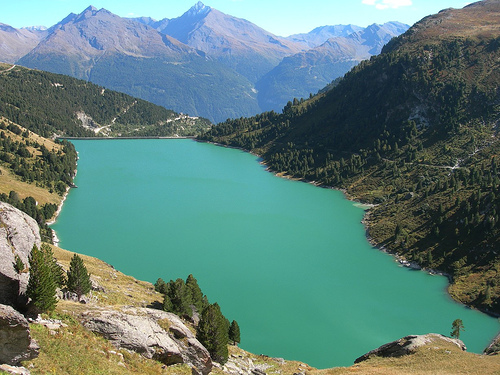
snow-capped peaks against green valleys, turquoise glacial lakes,
rhododendron thickets, and flower-filled meadows in summer. It feels
wild and pristine in the core, with refuges, trails (over 400–600 km
marked), and limited infrastructure.
Vanoise National Park (Parc national de la Vanoise), established
in 1963 as France’s first national park, lies in the Savoie
department in the French Alps between the Tarentaise and Maurienne
valleys. Its core protected zone covers about 535 km² (with a larger
peripheral area), featuring high peaks over 3,000 m, glaciers,
valleys, lakes, and forests. It borders Italy’s Gran Paradiso
National Park, forming one of Western Europe’s largest protected
alpine areas.
The park’s biodiversity stands out due to extreme
altitudinal gradients (from ~1,200 m to over 3,800 m), varied
exposures, geological diversity (different rock and soil types), and
its position at the crossroads of climatic influences. This creates
a mosaic of habitats: forests, alpine meadows, rocky scree,
wetlands, glaciers, and high peaks.
Flora: Exceptional Plant
Diversity
The Vanoise massif hosts approximately 1,700 vascular
plant species — roughly one-third of France’s total flora — in less
than 0.5% of the country’s territory. Estimates of protected species
range from 65 to over 100, with many rare or endemic.
Key
factors driving this diversity:
Wide temperature variations by
altitude.
Differences in sun exposure (north- vs. south-facing
slopes).
Varied geology and soils (acidic to calcareous).
Glacial history preserving arctic-alpine relicts, plus influences
from eastern, southern, and Mediterranean species.
Notable
plant communities and species:
High-altitude specialists:
Edelweiss (Leontopodium nivale or alpinum), various saxifrages
(Saxifraga spp.), gentians (deep blue species like Gentiana spp.,
including swollen calyx gentian Gentiana utriculosa), and mountain
primroses.
Iconic alpine flowers: Pasqueflowers (Pulsatilla
alpina and vernalis), rock jasmines (Androsace spp., including the
Alps-endemic Androsace alpina), moss campion (Silene acaulis),
alpine butterwort (carnivorous Pinguicula), cinquefoils
(Potentilla), eightpetal mountain-avens (Dryas octopetala), and
dwarf willows (Salix reticulata).
Shrublands and meadows:
Rhododendrons (pink blooms), alpine roses, and juniper.
Other
highlights: Bohemian snowdrop (Gagea bohemica), northern androsace
(Androsace septentrionalis), columbines, moonwort fern (Botrychium
lunaria), and various primulas and violas.
The flora shifts
dramatically with elevation: lower valleys feature mixed forests
transitioning to subalpine conifers, then to colorful alpine meadows
in summer, and finally sparse high-alpine and nival zones with
cushion plants and lichens adapted to extreme cold and wind. Many
species are protected and should not be picked.
Fauna: Rich
Alpine Wildlife
The park supports a wide array of animals, with
strong populations of large mammals and birds thanks to decades of
protection (originally focused on saving the ibex). It is home to
hundreds of animal species across mammals, birds, amphibians,
reptiles, insects, and more.
Mammals:
Iconic ungulates:
Alpine ibex (Capra ibex, or bouquetin) — the park’s emblem and
largest French population (estimates around 1,800–3,000
individuals). Chamois are abundant (thousands). Red deer and roe
deer also present.
Rodents and small mammals: Alpine marmot (very
common, often seen whistling in meadows), mountain (variable) hare
(changes color seasonally), snow vole, collared field mouse, and
others.
Carnivores: Fox, Eurasian badger, pine marten, stone
marten, ermine (stoat), weasel. Wolf and Eurasian lynx occur but are
rarer and harder to spot.
Others: Bats (e.g., common pipistrelle,
northern long-eared), water shrew.
Birds (over 100–125
nesting species):
Birds of prey: Golden eagle, bearded vulture
(Gypaète barbu, reintroduced and impressive with ~2.8 m wingspan),
Eurasian eagle-owl, peregrine falcon, griffon vulture.
Mountain
specialists: Rock ptarmigan (lagopède alpin), black grouse
(tétras-lyre), rock partridge, wallcreeper (on cliffs), black
woodpecker, three-toed woodpecker, nutcracker, choughs, Alpine
accentor, rock thrush.
Other vertebrates:
Amphibians and
reptiles: Alpine newts, common frogs, grass snakes, natterjack
toads.
Insects: Notable species include the Apollo butterfly.
Habitat notes:
Ibex and chamois favor rocky ridges and steep
slopes.
Marmots thrive in alpine meadows.
Birds of prey soar
over cliffs and valleys.
Many species are more visible in summer
(post-hibernation) or at dawn/dusk. Winter brings challenges like
deep snow, with some animals descending in elevation.