Location: Vasilssis Soflas and Rizari, Illsia, Athens
Tel.
210 725 2975
Subway: Evangelismos
Tram train: 3, 7, 8, 13
Open: 9am- 2pm Tue- Sat, 9:30am- 2pm Sun
Closed: public
holidays
Official site
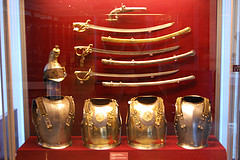
The War Museum in Athens, officially known as the War Museum of Athens (Πολεμικό Μουσείο in Greek), is a prominent institution dedicated to preserving and showcasing the military history of Greece. Established to honor those who fought for the nation's freedom, it collects, preserves, and exhibits a wide array of war relics, memorabilia, weapons, uniforms, aircraft, artifacts, and works of art that span from antiquity to the present day. The museum's mission emphasizes stimulating national memory, promoting historical continuity, and documenting the Greeks' struggles for independence and unity across millennia. It serves as a key cultural and educational site in the heart of Athens, attracting history enthusiasts, military buffs, and tourists interested in Greece's storied past.
The idea for the War Museum originated in 1964 when the Greek
government decided to create a dedicated space to commemorate
the country's military heritage and the sacrifices made in
various conflicts. The museum was officially inaugurated on July
18, 1975, under the auspices of the Hellenic Armed Forces. Its
establishment was part of a broader effort to foster national
pride and educate the public on Greece's role in regional and
global wars. Over the years, the museum has expanded its scope,
incorporating branches in other cities like Thessaloniki,
Nafplio, Tripoli, Chania, Kalamata, and Chalkida, with recent
additions including the House of General Napoleon Zervas in 2022
and new branches in 2023. As of 2025, the museum continues to
evolve, with ongoing efforts to digitize collections and offer
virtual experiences, marking milestones like its 50th
anniversary in recent years.
The museum's narrative ties into
Greece's long military tradition, covering periods from the
Bronze Age through ancient classical eras, Byzantine times, the
Ottoman occupation, the Greek War of Independence (1821-1830),
the Balkan Wars, World Wars I and II, the Greek Civil War, and
modern conflicts up to the Cyprus invasion in 1974. It plays a
significant role in preserving Hellenic identity, highlighting
themes of resistance, heroism, and national unity.
The War Museum is housed in a striking modernist building
designed by architects Thoukididis Valentis and Konstantinos
Dekavallas. Constructed in the 1970s, the structure features a
bold, rectangular facade clad in yellow travertine stone, with
cantilevered upper levels that give it a monumental yet austere
appearance. The design reflects mid-20th-century Brutalist
influences, emphasizing functionality and symbolism—evoking
fortifications or bunkers while integrating open spaces for
outdoor exhibits.
Located at the intersection of Vassilissis
Sofias Avenue and Rizari Street in central Athens (coordinates:
37° 58′ 31.66″ N, 23° 44′ 43.69″ E), it sits near the Byzantine
and Christian Museum and the National Garden, making it easily
accessible via public transport (Evangelismos Metro Station on
Line 3). The outdoor area is a highlight, featuring a spacious
courtyard with displays of artillery pieces, tanks, torpedoes,
and aircraft from various eras, including Hellenic Air Force
jets like the F-5 Freedom Fighter and F-84 Thunderjet. This
open-air section provides a dramatic introduction to the museum,
blending the building's architecture with historical hardware.
The museum's collections are vast and chronologically organized,
spanning over 4,000 years of Greek military history. Exhibits
are spread across four levels (including a basement, ground
floor, and two upper floors), with some sources noting a
two-floor main display area for core narratives. The layout
guides visitors through thematic rooms, using dioramas,
interactive displays, maps, and multimedia to immerse them in
historical events.
Key sections include:
Ancient and
Byzantine Periods: Artifacts from the Bronze Age, Classical
Greece (e.g., hoplite armor, weapons from the Persian Wars and
Peloponnesian War), and Byzantine era, featuring swords,
shields, and engravings depicting battles.
Ottoman Rule and
Independence: Engravings, lithographs, paintings, maps, and
weapons from the Frankish and Ottoman periods, focusing on
leaders of the 1821 Revolution like Theodoros Kolokotronis.
Notable items include flags, uniforms, and personal effects from
philhellenes (foreign supporters of Greek independence).
Modern Wars (19th-20th Century): Extensive coverage of the
Balkan Wars (1912-1913), World War I (including the Asia Minor
Campaign), World War II (Greco-Italian War, Battle of Crete,
resistance against Axis powers), the Greek Civil War
(1946-1949), and the Korean War. Highlights include captured
enemy weapons, medals, photographs, and models of
fortifications.
Aviation and Naval Exhibits: A dedicated area
for aircraft models, engines, and memorabilia from the Hellenic
Air Force and Navy. Indoor displays complement the outdoor
planes, with items like WWII fighter plane parts and submarines.
Special Collections: The museum houses rare items such as a
Ottoman cannon from the Siege of Constantinople, personal
archives of military figures, and artworks by Greek painters
depicting battles. Temporary exhibitions often rotate, focusing
on specific anniversaries or themes, such as the 50th
anniversary of the Cyprus events.
The presentations are
generally well-curated, with English labels alongside Greek,
dioramas recreating battle scenes, and some interactive
elements. The basement level includes storage and a library with
over 17,000 books on military history, accessible to researchers
by appointment.
Hours: Typically open Tuesday to Sunday from 9:00 AM to 7:00 PM
(summer) or 9:00 AM to 5:00 PM (winter), closed on Mondays and
major holidays. Confirm via the official site as hours may vary.
Admission: General entry is around €6 for adults, with reduced
fees (€3) for students, seniors, and groups. Free for children
under 6 and on certain international museum days.
Accessibility: The museum is wheelchair-accessible in most
areas, with elevators and ramps. Guided tours are available in
English upon request.
Additional Features: A gift shop sells
books, replicas, and souvenirs. The site offers 3D virtual tours
for remote visitors, and event spaces host conferences,
exhibitions, and presentations. Photography is permitted without
flash.
Visitors often praise the museum for its comprehensive coverage and engaging displays, noting it's a must-see for those interested in military history, though some find the focus heavily on Greek perspectives. Reviews highlight the outdoor aircraft as a favorite, especially for families, and the chronological flow as educational. As of 2025, it remains a vital repository of Greek heritage, with no major controversies reported, though it emphasizes national narratives that align with official historiography. For a deeper dive, combining a visit with nearby sites like the National Historical Museum enhances the experience.