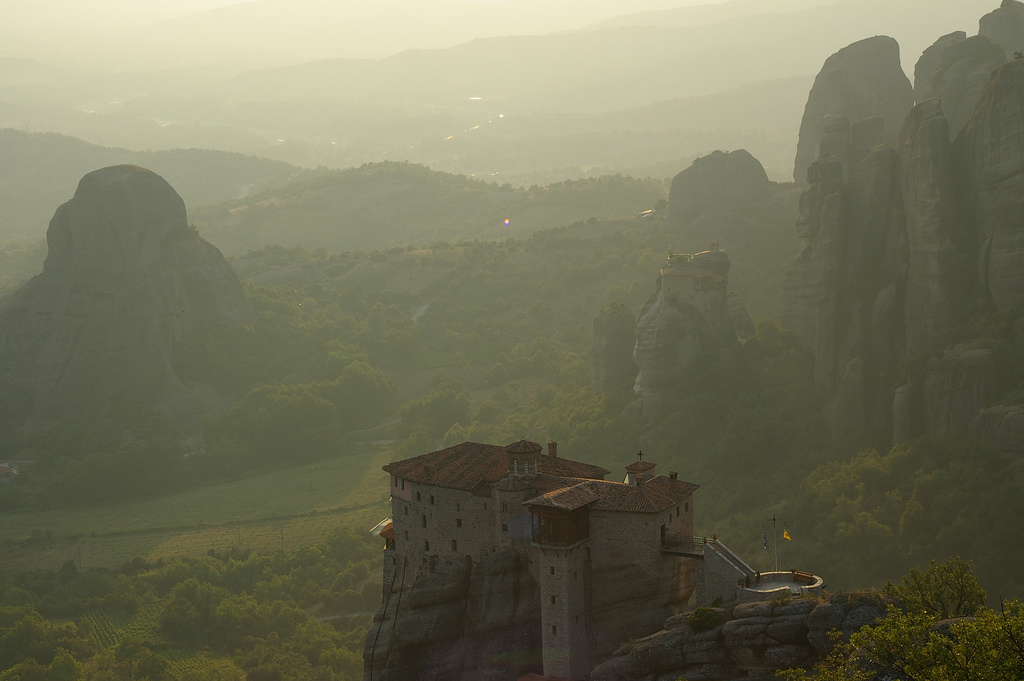
Location: Plain of Thessaly, near Kalambaka Map
Meteora (Greek: Μετέωρα, meaning "suspended in the air" or "in the heavens above") is a stunning rock formation and monastic complex in central Greece, located in the Thessaly region near the towns of Kalambaka and Kastraki, at the northwestern edge of the Plain of Thessaly by the Pindus Mountains and the Pineios River. It consists of immense natural sandstone pillars and boulders rising up to 550 meters (1,800 feet) above the ground, topped by Eastern Orthodox monasteries built between the 14th and 16th centuries. Recognized as a UNESCO World Heritage Site since 1988 for its unique blend of natural beauty and cultural significance, Meteora meets multiple criteria for its outstanding universal value, including its artistic achievements in monastic architecture and post-Byzantine frescoes, as well as its representation of the eremitic (hermitic) ideal. The site features six active monasteries (out of an original 24), making it the second most important monastic center in Greece after Mount Athos. As of 2025, Meteora attracts around 200,000 visitors annually, drawn to its dramatic landscapes, spiritual heritage, and activities like hiking, rock climbing, and cultural tours. The area spans about 271 hectares (670 acres) in the core zone, with a buffer zone of 1,884 hectares (4,660 acres), and is part of the Natura 2000 network for its biodiversity.
All six surviving monasteries of Meteora remain open to the public
(with seasonal hours that vary by site) and exemplify classic
Athonite-style Byzantine architecture. Built directly into or atop
dramatic sandstone pinnacles, they feature domed katholika (main
churches), monk cells, refectories, multiple chapels, and sturdy
defensive walls that blend seamlessly with the natural rock formations.
Inside, visitors can admire priceless 14th- to 18th-century frescoes,
revered icons, illuminated manuscripts, and sacred relics. Below is a
closer look at each monastery, including their history, distinctive
features, and atmosphere.
Great Meteoron (Megalo Meteoro or
Monastery of the Transfiguration)
The oldest, largest, and most
prominent of the group, founded in 1356 by Saint Athanasios the
Meteorite on the second-highest rock pinnacle. Its grand katholikon
boasts exceptional 16th-century frescoes depicting biblical scenes with
vivid colors and intricate detail. The complex includes a well-curated
museum displaying holy relics, ancient artifacts, and ecclesiastical
treasures; a historic kitchen with a massive dome and original hearth; a
former hospital; and several smaller chapels. A small, active monastic
brotherhood still resides here, maintaining the contemplative rhythm of
monastic life amid the breathtaking landscape.
Varlaam Monastery
The second-largest monastery, constructed between 1517 and 1541 by two
brothers, monks Theophanes and Nektarios, who rebuilt upon the ruins of
a 14th-century hermitage. Dedicated to All Saints, it stands out for its
elegant bell tower, panoramic terraces with sweeping views of the
valley, and dramatic access via a modern bridge that replaced the
original rope-and-basket system. The museum holds rare treasures
including saints’ bones, precious manuscripts, embroidered liturgical
vestments, and finely crafted silver vessels. The interiors feature
well-preserved frescoes that reflect the Post-Byzantine artistic
tradition.
Rousanou (Roussanou) Monastery
A charming and
compact nunnery founded around 1545 and dedicated to Saint Barbara.
Perched picturesquely on a mid-level rock outcrop, its striking
red-tiled roofs and whitewashed walls create one of Meteora’s most
photogenic silhouettes. The interior is renowned for its vibrant,
colorful frescoes covering nearly every surface. Today it is inhabited
and run by a community of nuns who maintain a serene environment. Its
relatively accessible location and intimate scale make it especially
popular with visitors seeking a peaceful spiritual experience.
Holy Trinity Monastery (Agia Triada)
Constructed in the late 15th
century (circa 1475–1476) atop a dramatically isolated pinnacle, this
monastery is instantly recognizable for its long, winding stone
staircase carved into the rock face—a scene famously featured in the
1981 James Bond film For Your Eyes Only. Dedicated to the Holy Trinity,
it offers some of the most spectacular 360-degree vistas over the
Thessalian plain. The complex includes a beautiful katholikon with fine
frescoes and a tranquil courtyard that heightens the sense of spiritual
elevation and seclusion.
St. Nicholas Anapafsas Monastery
One
of the earliest and smallest monasteries, founded in the late 14th
century and dedicated to Saint Nicholas (“Anapafsas” translates to
“restful” or “the one who gives rest”). Its narrow rock foundation
results in a fascinating multi-level, compact layout where stairs and
terraces connect the various spaces efficiently. The artistic highlight
is the outstanding series of 1527 frescoes by the renowned Cretan
painter Theophanes the Cretan, considered masterpieces of late Byzantine
art for their expressive figures and rich narrative detail.
St.
Stephen Monastery (Agios Stefanos)
A nunnery with roots in the 14th
century (the current katholikon was rebuilt in 1798). It enjoys the
easiest access among the monasteries via a short, modern bridge from the
main plateau, making it particularly convenient for visitors. The
complex features a peaceful atmosphere, an interesting museum housed in
the old refectory displaying icons and artifacts, and active embroidery
workshops where nuns create traditional ecclesiastical textiles. Its
open layout and scenic position provide a calming, welcoming environment
with excellent views of the surrounding rock formations.
Best Time to Visit
Shoulder seasons offer the ideal balance: late
February to early June (avoiding Easter week) and late October to
mid-December. Expect mild weather (comfortable for hiking), fewer
crowds, and good monastery access.
Spring (March–May): Fresh
greenery, wildflowers, crisp mornings, and pleasant hiking temps. Crowds
are lower outside Easter (mid-April 2026). Longer opening hours start in
April.
Autumn (late Oct–Nov): Golden light, fewer tourists after Oct
28 (Ohi Day), and harvest-season vibes in villages. Still mild but
cooler.
Summer (June–Aug): Hot and crowded; visit early mornings or
late afternoons for relief. Long days but midday heat limits activities.
Winter (Dec–Feb): Quiet, atmospheric (mist, possible snow), shorter
hours, and dramatic photography, but some trails may be slippery and
monasteries have reduced schedules.
Avoid peak summer crowds and
Easter if seeking peace. Check 2026 events like the FIFA World Cup
(June–July), which may slightly ease European crowds.
Getting
There
From Athens: ~4–5 hours by direct train (Hellenic Train from
Larissa Station; book ahead) or car (E65 highway). Buses also available.
From Thessaloniki: Similar train/bus options (~3–4 hours).
Local
transport: Rent a car for flexibility (parking near monasteries, though
limited). Local buses run seasonally from Kalambaka/Kastraki to the rock
circuit. Taxis are affordable for short hops. Guided tours simplify
everything (recommended for first-timers).
Pro tip: Stay
overnight (at least 1–2 nights) rather than day-tripping from Athens—the
sunrises, sunsets, and quieter early/late hours are magical.
Where to Stay
Kalambaka: Larger town with train station, more
amenities, hotels, and restaurants. Good base for logistics.
Kastraki: Smaller, charming village at the base of the rocks—closer to
trails, quieter, with cliff views from many guesthouses. Many prefer
this for immersion.
Options range from budget guesthouses to
boutique hotels. Book early for peak times.
The Six Monasteries:
Practical Details (2026 Summer Schedule, April–Oct)
Each requires
stairs (some steep); entry is ~€5 per person (cash, kids under 12 often
free; Grand Meteoron may be €5, others €3 in some reports—confirm
on-site). No photos inside churches. Hours vary seasonally and can
change—always verify locally.
Summer hours (approx.):
Great
Meteoron (largest, most visited): 9:30–15:00, closed Tuesdays.
Varlaam: 9:00–16:00, closed Fridays.
Roussanou (nunnery, scenic):
9:00–16:30, closed Wednesdays.
Holy Trinity (dramatic views, steep
access): 10:00–16:00, closed Thursdays.
St. Stephen (easiest access,
nunnery): 9:00–13:30 & 15:30–17:30, closed Mondays.
St. Nicholas
Anapafsas (steep, compact): 9:00–17:00, closed Fridays.
Winter
hours are shorter with more closures. Plan around days off—it's
impossible to see all six in one day without rushing.
Dress code
(strict, enforced): Women—long skirt below knees (no pants; wraps often
available to borrow/buy). Men—long pants, covered shoulders (no shorts
or sleeveless). Respect active religious sites: modest, quiet behavior.
Visiting strategy:
Aim for 3–4 per day. Start early (before 9–10
AM) or late afternoon to dodge tour buses.
Logical loop by car/road:
Combine nearby ones (e.g., Great Meteoron + Varlaam).
Guided half-day
tours are efficient, especially for history and timing.
Sunset from
viewpoints (e.g., west-facing spots) or early morning for fewer people.
Hiking and Viewpoints
Meteora shines beyond the monasteries—over
100km of trails wind through rocks, forests, and hermit caves. Use apps
like AllTrails, Maps.me, or meteoratrails.com for GPS (some paths poorly
marked).
Popular options:
Short loops from Kalambaka/Kastraki to
monasteries or viewpoints (30–60 min).
Longer circuits (e.g., to
Ypapanti or Grand Meteoron pilgrim paths): 4–7+ hours, moderate with
elevation.
Trails to hidden caves or panoramic spots for solitude and
folklore.
Wear sturdy shoes, bring water, and consider a guided
hike for safety/stories. Trails suit most fitness levels but can be
steep/uneven.
Practical Tips
Crowds & timing: Tour buses peak
mid-morning to afternoon. Visit difficult-access spots (e.g., Holy
Trinity) early. Parking is limited—tours or early arrival help.
Essentials: Cash for fees/snacks, water, sun protection (exposed areas),
comfortable shoes. No pets (except service).
Photography: Golden hour
magic; drones restricted near monasteries.
Accessibility: Limited due
to stairs—St. Stephen is easiest.
Food: Try local Vlach/Thessalian
dishes (pies, lamb, trout, wild herbs) in Kalambaka/Kastraki tavernas.
Some spots offer views or vegetarian options.
Sustainability &
respect: Follow a "code of ethics"—leave no trace, support locals, honor
the spiritual site. Avoid loud behavior.
Health/Safety: Watch for
drops on viewpoints; snakes possible in warm months (keep distance).
Geological Origins (c. 60 Million Years Ago)
The story of Meteora
begins deep in geological time during the Paleogene period, about 60
million years ago. What is now the Thessalian plain was once a seabed or
lake edge where a river delta deposited layers of sand, mud, gravel, and
stones. These sediments compacted over millions of years into a thick
layer of sandstone and conglomerate rock. Tectonic forces—linked to the
formation of the Pindus Mountains and the broader Alpine
orogeny—uplifted the seabed, creating a high plateau fractured by
vertical faults. Subsequent erosion by wind, rain, rivers, earthquakes,
and temperature extremes sculpted the plateau into isolated, pillar-like
formations rising 200–550 meters (660–1,800 feet) above the plain. These
are not volcanic plugs but exhumed sedimentary remnants with remarkably
uniform composition, giving them their distinctive, otherworldly shapes.
This geological drama set the stage for human activity and later
monastic isolation, as the pillars proved nearly inaccessible.
Prehistoric and Ancient Human Presence
Human presence in the Meteora
area dates back tens of thousands of years. The nearby Theopetra Cave
(about 4 km from Kalambaka) reveals continuous occupation from the
Mid-Paleolithic era (~130,000–50,000 years ago) through the Neolithic
period. Excavations have uncovered a 23,000-year-old stone wall (one of
the oldest known man-made structures in Greece, built during the last
Ice Age), tools, pottery, animal bones, and human remains. A Mesolithic
woman's skeleton (~10,000 years old), nicknamed "Avgi" (Dawn), was found
there, highlighting early farming transitions in Thessaly as Anatolian
agriculturalists arrived around 10,000 years ago.
In classical
antiquity, the region formed part of ancient Thessaly (once called
Aeolia or Pelasgia). Nearby settlements like Aiginion (modern Kalabaka's
precursor) and Trikki (Trikala) appear in Homer's Iliad and were linked
to Mycenaean heroes, including Asclepius (god of medicine). Thessaly's
famed cavalry played key roles in Hellenistic wars under Philip II and
Alexander the Great. The area resisted but eventually fell to Rome after
the Battle of Cynoscephalae (197 BC) and later annexation (c. 168 BC).
Despite this long history, the dramatic rock pillars themselves are
rarely mentioned in ancient Greek myths or literature— their spiritual
significance emerged later.
Early Christian Hermits and the Rise
of Monasticism (9th–13th Centuries)
Christian ascetics began seeking
solitude in Meteora's caves and fissures as early as the 9th–11th
centuries CE, drawn by the isolation that mimicked the desert fathers'
ideals. These hermits lived in small groups or individually, supported
by local communities, and gathered occasionally for worship. By the late
12th century, a rudimentary ascetic community (skete) formed around the
Church of the Panagia Doupiani (or "Skete") at the base of one pillar,
serving as a central meeting point for Sunday services and discussions.
This marked the transition from pure eremitism to a more organized
eremitic state.
Political instability in the late Byzantine period—
including raids and the Ottoman expansion—drove more monks from places
like Mount Athos to these "columns of the sky" for refuge.
Founding of the Monasteries (14th–15th Centuries)
Organized
monasticism exploded in the 14th century amid Thessaly's turmoil under
Serbian and later Ottoman influence. In 1344, Saint Athanasios
Koinovitis (Athanasios the Meteorite), a scholar-monk from Mount Athos,
arrived with followers and founded the first major monastery: the Holy
Monastery of the Great Meteoron (Transfiguration of Christ) on the
"Broad Rock" (Platys Lithos), the highest and largest pillar.
Construction (1356–1372) included a church, cells, and support
buildings, built with immense difficulty—materials were hauled up via
scaffolds, ropes, nets, and baskets. Local Serbian ruler Simeon Uroš
(who proclaimed himself Emperor of Serbs and Greeks in 1356) provided
protection and patronage, as did his son John Uroš (who later retired
there as monk Joasaph).
Other early foundations followed: Varlaam
(mid-14th century by hermit Varlaam, rebuilt 1517), St. Nicholas
Anapausas (late 14th century), Holy Trinity (1475–1476), and others. By
the late 15th century, 24 monasteries crowned the peaks, each featuring
Athonite-style architecture—cross-in-square churches (katholikons),
refectories, hospitals, cisterns, and cells—adapted to the extreme
terrain. Access remained perilous until the 20th century; monks and
pilgrims were winched up in nets or climbed ladders.
Golden Age
and Cultural Flourishing (15th–17th Centuries)
The 15th and
especially 16th centuries marked Meteora's zenith, coinciding with the
Ottoman conquest of Thessaly (mid-15th century). Monasteries thrived as
bastions of Orthodox Christianity, offering refuge to Greeks, scholars,
and rebels while preserving Byzantine traditions. Imperial and private
donations funded expansions. Renowned artists like Theophanes the Cretan
(who painted St. Nicholas Anapausas in 1527) and Frangos Katelanos
created masterful frescoes that defined post-Byzantine art, blending
Paleologan styles with Italian influences. These wall
paintings—depicting saints, biblical scenes, and monastic themes—remain
a highlight of the surviving monasteries.
Decline and Challenges
(17th–19th Centuries)
Prosperity waned after the 17th century due to
bandit raids, Ottoman taxes, earthquakes, and shifting priorities. Many
monasteries were abandoned, looted, or fell into ruin; only a handful
survived intact. Thessaly joined the modern Greek state in 1881, but
monastic life continued to dwindle.
Modern Era: War, Restoration,
and Tourism (20th Century–Present)
The 20th century brought both
destruction and revival. During World War II (1940–1944), German forces
bombed and looted the monasteries, suspecting them of sheltering
resistance fighters. Access improved dramatically in the 1920s (steps
carved into rocks) and 1960s (roads and bridges), transforming Meteora
into a major tourist destination.
Restoration efforts intensified
from the 1960s–1970s, with ongoing conservation of frescoes, buildings,
and structures by the Greek Ministry of Culture, monks/nuns, and
European funding. In 1988, UNESCO recognized the site for its
architectural innovation, artistic significance (especially 16th-century
frescoes), historical role in monasticism, and exceptional natural
beauty.
Today, six monasteries survive: Great Meteoron
(largest/oldest, monks), Varlaam (second-largest, monks), Rousanou
(nuns), St. Nicholas Anapausas (monks), Holy Trinity, and St. Stephen
(nuns, the only convent). Four are active with small communities; the
others are preserved as museums or historic sites. They house relics,
manuscripts, and artifacts while welcoming pilgrims and tourists
(hundreds of thousands annually). Challenges persist: earthquakes,
rockfalls, tourism pressure, and climate impacts. Yet Meteora remains a
living spiritual center and symbol of human resilience and faith.
Location and Regional Context
Meteora lies at the northwestern
edge of the expansive Thessaly Plain, nestled between the town of
Kalambaka (Kalabaka) to the south and the village of Kastraki to the
north. It sits in the Pineiós (Peneios or Penios) River valley, east of
the Pindus (Píndos) Mountains and near the southwestern foothills of the
Antichassian Mountains.
Geographic coordinates center around
39°42′51″N 21°37′52″E. The site occupies a relatively compact core area
of roughly 7 square kilometers (with a UNESCO property of about 272
hectares and a larger buffer zone), yet its visual impact extends across
the flat Thessalian plain, creating a surreal contrast of towering rock
amid agricultural lowlands and forested slopes.
Geological
Formation and Rock Composition
The Meteora pillars formed through a
multi-million-year process tied to the region’s tectonic and sedimentary
history. During the Late Oligocene to Early Miocene (roughly 30–10
million years ago, part of the broader Paleogene-Tertiary timeframe),
sediments—including sand, mud, stones, and gravel—accumulated in a
deltaic environment at the edge of an ancient lake or sea within the
Mesohellenic trough. These compacted into layers of sandstone and
conglomerate (a coarse sedimentary rock with pebbles cemented together),
known locally as the Pentalophos Formation or Meteora Conglomerates.
Around 60 million years ago, major tectonic uplift (linked to the
broader Alpine-Hellenic orogeny) thrust the seabed and delta deposits
upward, forming a high plateau riddled with vertical fault lines.
Subsequent weathering by water (rain and river action), wind,
temperature extremes, and seismic activity eroded the softer materials
along these faults, sculpting the isolated, pillar-like formations we
see today. Unlike volcanic plugs elsewhere, these are purely sedimentary
and lack igneous origins.
The pillars vary widely in shape—some
smooth and cylindrical like funnels or steamship stacks, others jagged
like shark fins or saddle horns—reaching heights of 200–400 meters on
average (with some up to 550 meters or 1,800 feet) and widths up to 300
meters. They emerge precipitously from the valley floor, creating an
otherworldly “forest” of stone.
Topography and Landscape Features
Meteora’s topography is defined by extreme verticality amid horizontal
plains. The pillars stand in sharp relief against the flat Thessaly
Plain to the east and south, with the Pindus range providing a rugged
western backdrop. Slopes at the bases are densely vegetated,
transitioning into sheer cliffs that support sparse but tenacious plant
life in crevices. The overall relief creates a labyrinth of valleys,
gorges, and isolated summits, many of which hosted hermitages and
monasteries historically.
The area integrates with the broader
Antichassia range, part of the Pindus system’s foothills, and features
micro-topographic variations such as caves (e.g., nearby Theopetra Cave
with paleoclimatic evidence) and talus slopes from ongoing erosion.
Hydrology and Climate
The Pineiós River and its tributaries
dominate the hydrology, flowing through the valley and contributing to
the original deltaic sediments. Riverine forests of Oriental plane
(Platanus orientalis) line the waterways, while moisture trapped in rock
fissures sustains cliff vegetation even on seemingly barren faces. Small
seasonal streams and springs feed the base areas.
The Pineiós River
winds through lush, forested valleys near the rock formations,
illustrating the hydrological contrast between the arid-looking pillars
and the verdant lowlands.
Meteora experiences a hot-summer
Mediterranean climate (Csa), moderated by its inland and mountainous
position: hot, dry summers; mild, wetter winters with occasional snow on
higher pillars; and microclimates where shaded valleys retain moisture
longer than exposed summits. Tectonic activity and wind patterns further
influence local conditions.
Ecosystems: Flora and Fauna
Despite the rocky dominance, Meteora supports rich biodiversity and is
part of the Natura 2000 network (site GR1440003). Forested hills and
river valleys feature deciduous broad-leaved trees including oaks,
maples, and planes, with endemic plants such as Centaurea lactifolia and
Centaurea kalambakensis. Vegetation clings to rock cracks thanks to
seepage water.
Fauna is equally diverse: over 163 bird species (120
nesting), including raptors like Egyptian vultures and hawks that soar
on thermals along the cliffs. Mammals include 18 bat species (e.g.,
European free-tailed bat), otters along the river, and larger carnivores
such as brown bears, wolves, and wildcats in the surrounding forests.
The remote pillars provide safe nesting and roosting sites.
Autumnal
forested slopes and valleys around the pillars showcase the ecological
richness, with vibrant vegetation contrasting the gray rock.