Via Duomo 147
Tel. + 39 081 44 90 97
Open: 8:30am- 1:30pm,
2:30- 8pm
The Naples Cathedral, officially known as the Cathedral
of the Assumption of Mary (Cattedrale di Santa Maria Assunta) or
commonly referred to as the Duomo di Napoli and the Cathedral of San
Gennaro, is a Roman Catholic cathedral and the principal church of
Naples, Italy. It serves as the seat of the Archbishop of Naples and is
dedicated to the Assumption of Mary, while also honoring Saint Januarius
(San Gennaro), the city's patron saint. Constructed in the 13th century
in Angevin Gothic style, the cathedral is renowned for its blend of
architectural influences, rich artistic heritage, and the famous
"Miracle of the Blood" of San Gennaro, where a vial of the saint's blood
is said to liquefy three times a year. This phenomenon draws pilgrims
and tourists alike, symbolizing divine favor for the city. The cathedral
incorporates elements from earlier paleo-Christian basilicas and ancient
Greek and Roman structures, reflecting Naples' layered history. As one
of the city's most important religious and cultural landmarks, it
exemplifies the fusion of faith, art, and history in southern Italy.
The Naples Cathedral is centrally located in the historic heart of Naples, at Via Duomo 147, in the Campania region of southern Italy. Its coordinates are approximately 40°51′09″N 14°15′35″E. Situated along the bustling Via Duomo, it is easily accessible from major transport hubs, including Napoli Centrale train station (about 1.5 km away) and the Naples Metro (Lines 1 at Cavour or Museo stations, and Line 2). Nearby landmarks include the National Archaeological Museum to the north and the historic center's Spaccanapoli street. The cathedral's urban placement makes it a focal point for both locals and visitors, with convenient bus access via lines E1, R2, and CS.
Ancient Foundations and Early Christian Basilicas (4th–13th
Centuries)
The site’s history predates Christianity. Archaeological
excavations beneath the cathedral reveal Greek and Roman layers: a
stretch of Greek road on an inclined plane, a Greek wall in opus
reticulatum (likely from a temple to Apollo), the peristyle of a late
imperial Roman domus, and sections of a Roman aqueduct.
The first
major Christian structure here was the Basilica of Santa Restituta,
Naples’ earliest cathedral, built in the 4th century (possibly around
330s CE under Emperor Constantine the Great). Originally dedicated to
Christ the Savior (like Rome’s Lateran Basilica), it was rededicated in
the 8th century to Saint Restituta, an obscure African martyr. This
paleo-Christian basilica became Naples’ principal church and remains
partially incorporated into the modern cathedral as a side chapel.
Adjacent to it, in the late 5th or early 6th century, Bishop Stephanus
constructed the Basilica Stefania (named after him). It stood on the
ruins of the probable Apollo temple but was later demolished to make way
for the medieval cathedral.
One of the most extraordinary survivals
is the Baptistery of San Giovanni in Fonte (adjacent to Santa
Restituta), claimed as one of the oldest baptisteries in the Christian
West. Likely built in the mid-to-late 4th century by Bishop Severus, its
5th-century mosaics predate full Byzantine influence and depict
baptismal themes: the Samaritan woman at the well, the Wedding at Cana,
scenes possibly of the multiplication of loaves and fishes or Peter
walking on water, the Traditio Legis (Christ giving the Law to Peter),
evangelist symbols, a central staurogram (Tau-Rho Christ symbol) in a
starry sky with alpha and omega, the Hand of God, and an upside-down
phoenix symbolizing resurrection. Large sections are lost, but the
preserved ceiling mosaics remain among the earliest and most important
early Christian artworks in Italy.
Construction of the Medieval
Angevin Cathedral (Late 13th–Early 14th Centuries)
The present
cathedral was commissioned in the late 13th century by King Charles I of
Anjou (r. 1266–1285), founder of the Angevin dynasty in Naples, to
symbolize royal power and replace the outdated early Christian complex.
Some sources date the start to around 1272 or 1294. Construction
continued under his son Charles II (r. 1285–1309) and was completed in
the early 14th century (around 1313) under Robert of Anjou (“the Wise,”
r. 1309–1343). French and Italian architects, possibly including members
of the Pisano family, designed it in the distinctive Angevin Gothic
style (gotico angioino)—tall, soaring arches with a blend of French
Gothic and local Italian elements.
The new cathedral incorporated the
surviving Basilica of Santa Restituta as a lateral chapel (later
Baroque-remodeled in the 17th–18th centuries by Arcangelo Guglielmelli)
while completely demolishing the Basilica Stefania. It was dedicated to
the Assumption of Mary in 1314. Traces of the paleo-Christian
foundations remain visible today, and ongoing excavations under the apse
and crypt continue to uncover ancient layers.
Later Centuries:
Earthquakes, Baroque Flourishing, and the Cult of San Gennaro
The
cathedral suffered repeated damage from earthquakes, notably in 1349 and
1456, which necessitated repairs and alterations. Further modifications
occurred in the 16th–18th centuries, shifting the interior toward
Baroque opulence while retaining Gothic bones.
In the late 15th
century, Cardinal Oliviero Carafa commissioned the Cappella del Succorpo
(crypt), an elegant Renaissance space designed by Tommaso Malvito, to
house relics of San Gennaro. The saint’s bones and blood vials were
solemnly transferred to Naples from Montevergine in 1497, elevating the
cathedral’s status.
The most spectacular addition is the Royal Chapel
of the Treasure of San Gennaro (Cappella del Tesoro di San Gennaro or
Tesoro), built between 1608 and 1646 (with later completions). It was a
direct response to crises: a vow by Neapolitans after the 1527 plague,
during Spanish rule and amid conflicts, volcanic threats, and sieges.
Designed by Francesco Grimaldi and featuring contributions from Cosimo
Fanzago (bronze railing and porch), it is a Baroque masterpiece. The
dome features frescoes by Giovanni Lanfranco; altarpieces and works
include those by Domenichino, Jusepe de Ribera (Ribera), Massimo
Stanzione, and Francesco Solimena. It houses the saint’s silver
reliquary bust (containing his skull), a 14th-century French reliquary,
and the famous vials of his dried blood.
The miracle of the blood—the
liquefaction of the saint’s congealed blood into liquid three times a
year (first Saturday in May, September 19 on his feast day, and December
16)—has been documented since the 14th century and remains a central
civic ritual. Failure to liquefy is traditionally seen as an omen of
disaster for Naples. Scientific hypotheses suggest a thixotropic gel or
iron oxide suspension, but the phenomenon continues to hold profound
religious and cultural meaning. The blood even liquefied spontaneously
during Pope Francis’s 2015 visit.
Other notable interior elements
include the 14th-century Minutolo Chapel (with frescoes by Montano
d’Arezzo, referenced in Boccaccio’s Decameron), paintings by Luca
Giordano, Perugino’s Assumption, works by Vasari and others, and the
18th-century restoration of the main chapel with a Baroque relief by
Pietro Bracci.
19th–20th Centuries: Neo-Gothic Restoration and
Modern Archaeology
The façade was extensively reworked in the late
19th century (1877–1905) by architect Errico Alvino in a Neo-Gothic
style, incorporating earlier elements like the 15th-century portal with
sculptures by Tino da Camaino and Antonio Baboccio da Piperno. This gave
the cathedral its present dramatic exterior.
The structure suffered
further damage during World War II bombings and underwent post-war
restorations. In the 1960s–1970s and later, excavations beneath Santa
Restituta and the main church uncovered more Greek, Roman, and early
Christian remains, now accessible to visitors via the archaeological
area and museum.
Enduring Significance
Today, the Duomo
complex—encompassing the main Gothic-Baroque-Neo-Gothic nave, Santa
Restituta chapel, ancient baptistery, San Gennaro crypt and treasure
chapel, and archaeological zones—embodies Naples’ layered identity:
pagan roots, early Christianity, Angevin royal ambition, Spanish Baroque
piety, and modern scientific curiosity. It remains the spiritual heart
of the city, where faith, art, history, and folklore converge around the
blood of San Gennaro.
Historical Construction and Architectural Evolution
Commissioned
around 1272–1294 by King Charles I of Anjou (with work accelerating
under Charles II and completing in 1313–1314 under Robert of Anjou), the
cathedral was designed primarily in French-influenced Angevin Gothic
style (gotico angioino) by a mix of French and Italian architects,
including contributions from Giovanni and Nicola Pisano. It replaced or
incorporated two earlier structures on the site of the ancient insula
episcopalis (episcopal complex) in Greco-Roman Naples: the 4th-century
Basilica of Santa Restituta (Naples' first cathedral, traditionally
linked to Emperor Constantine) and the Basilica Stefania (built over a
possible Roman temple to Apollo).
Over centuries, earthquakes
(notably 1456, 1688), wars, bombings (including WWII Allied damage), and
deliberate renovations transformed it. Interiors and the apse saw
Baroque updates in the 17th–18th centuries; the facade received a full
Neo-Gothic overhaul by architect Enrico Alvino (Errico Alvino) between
the 1870s and 1905. This evolution makes it one of Italy's most
magnificent Gothic churches while showcasing stylistic fusion.
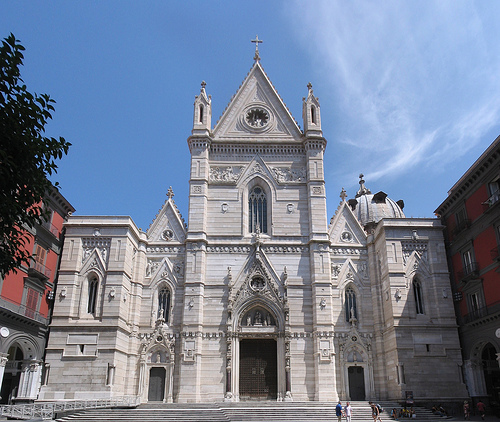
The
Neo-Gothic facade (completed ~1905) dominates the exterior on Via Duomo.
Crafted in marble with three bronze portals (the central one retains
15th-century elements, including sculptures by Tino da Camaino such as
the Virgin and Child flanked by lions), it features intricate carvings,
statues of saints, a prominent central rose window, and a gabled design
with pinnacles. Two incomplete bell towers flank it. The cathedral lacks
a grand standalone piazza, appearing nestled among surrounding buildings
and 19th-century porticoes, though Via Duomo was widened in the 1860s
for better visibility.
Overall Plan and Structural Features
The cathedral follows a Latin cross plan with a central nave and two
side aisles, approximately 100 meters (328 feet) in length and rising to
about 35–48 meters (115–157 feet) in height depending on the section.
The three naves are divided by pillars (often cited as incorporating or
faced with 16–110 elements of African granite, some reused from
antiquity) supporting tall, pointed Gothic ogival arches. These create
soaring verticality typical of Gothic design, originally supporting a
truss-beam roof (later modified).
The interior feels grand yet
layered: clerestory windows flood light into the space, while the raised
transept and apse add depth. The counter-facade holds Angevin royal
tombs (including Charles I of Anjou and Carlo Martello), and the
transept features varied bas-reliefs and monuments from multiple eras.
The interior central nave showcases the striking 17th-century gilded
coffered wooden ceiling, added during Baroque renovations. It contains
five large painted panels (primarily by Girolamo Imparato and Luca
Giordano) depicting evangelical scenes from the lives of Christ and the
Virgin Mary. This ornate ceiling contrasts with the relatively austere
Gothic walls and arches, creating a dramatic visual effect. Luca
Giordano also contributed frescoes along the walls depicting apostles,
Church doctors, and Naples' patron saints.
The high altar features a
monumental Baroque sculpture of the Assumption (1739) by Pietro Bracci,
echoing Bernini's style in St. Peter's Basilica in Rome (the cathedral's
dedication is to Santa Maria Assunta).
Key Chapels and
Architectural Highlights
The cathedral's side chapels are
architectural gems in their own right, often asymmetrical and altering
the flow of the Latin cross layout.
Royal Chapel of the Treasure of
San Gennaro (Cappella del Tesoro di San Gennaro, right aisle): Built
1608–1637 (or extended to 1646) as a Baroque thanksgiving after the 1527
plague, designed by Francesco Grimaldi. This octagonal or
Greek-cross-plan space features a magnificent double-shell dome frescoed
with heavenly imagery (including Paradise by Giovanni Lanfranco). Richly
decorated with multicolored marbles, a bronze railing by Cosimo Fanzago,
altarpieces by Domenichino, Jusepe de Ribera, and Massimo Stanzione, and
a high altar by Francesco Solimena. It houses San Gennaro's relics
(including blood ampoules and silver busts of 53 patron saints/bishops)
and serves as the focal point for the annual liquefaction miracle.
Basilica of Santa Restituta (left aisle): A preserved 4th–5th-century
paleo-Christian basilica incorporated into the structure (with its
facade partially truncated for the new cathedral). It has five naves
(outer ones converted to chapels), supported by 27 antique Corinthian
columns (reused from the Temple of Apollo). Features include mosaic
floor remnants and 17th-century harmonization by Arcangelo Guglielmelli.
Attached is the Baptistery of San Giovanni in Fonte (one of the oldest
surviving in the Western world, late 4th–early 5th century), a
square-plan structure with a dome on pendentives (Roman-Eastern
influence) and exquisite early Christian mosaics depicting biblical
scenes (e.g., the Samaritan Woman at the Well, Wedding at Cana) and
allegories of nature/grace.
Minutolo Chapel (Cappella Capece
Minutolo): Retains pure 13th–14th-century Gothic architecture with
original flooring, 14th-century frescoes (including by Montano
d'Arezzo), and family tombs.
Chapel of the Illustrissimi: Fully
frescoed Gothic space with 14th-century elements like a Tree of Jesse
painting (attributed to Lello da Orvieto).
Succorpo Chapel
(Renaissance crypt/chapel beneath or near the main altar, 1497–1508):
Commissioned by Cardinal Oliviero Carafa for San Gennaro's relics.
Designed primarily by Lombard architect Tommaso Malvito (with possible
Donato Bramante influence), it is a rectangular three-nave hall with
seven altars, coffered marble ceiling, inlaid floors, and sculptural
details (including a praying cardinal statue possibly by or after
Michelangelo).
Underground and Archaeological Layers
The crypt
(also by Malvito) and excavations reveal the site's deep history: Greek
walls in opus reticulatum (from the Temple of Apollo), a late-imperial
Roman domus peristyle under the apse, sections of Roman aqueduct, and an
ancient Greek road. These are accessible via guided or small-fee tours
and underscore the cathedral's role as an architectural archive.
The interior is lavishly decorated, blending austerity with opulence. The 17th-century gilded ceiling features five paintings of evangelical scenes. Walls display paintings of the Apostles, Doctors of the Church, and over 50 patron saints of Naples, with depictions of the first 16 bishops between arches. The high altar includes a sculpture of the Assumption inspired by Bernini. The Basilica of Santa Restituta preserves 4th-century mosaics in its baptistery (the oldest in the Western world), early medieval fresco fragments, 15th-century floor tombstones, and a 700-year-old Byzantine-style mosaic of the Madonna enthroned with Child and saints. The Royal Chapel of the Treasure of San Gennaro is a Baroque masterpiece with frescoes by Domenichino and Giovanni Lanfranco (depicting San Gennaro's life and a "Paradise" dome), altarpieces by Domenichino, Massimo Stanzione, and Jusepe Ribera, a high altar by Francesco Solimena, and a bronze railing by Cosimo Fanzago. The Minutolo Chapel contains 14th-century frescoes referenced in Boccaccio's Decameron. Other highlights include an Assumption by Pietro Perugino and canvases by Luca Giordano.
The cathedral's most famous relic is the vial containing the dried blood of Saint Januarius, housed in the Royal Chapel and displayed during the "Miracle of the Blood" on the first Saturday in May, September 19 (feast day), and December 16. The blood's liquefaction is interpreted as a sign of good fortune for Naples; scientific explanations suggest a thixotropic substance like hydrated iron oxide. The Succorpo crypt holds San Gennaro's bones and a statue of Cardinal Carafa. The chapel also features 51 silver busts and sculptures of Naples' co-patron saints, a jeweled necklace and mitre for San Gennaro, and sacred vestments in the adjacent Treasure Museum. Artifacts from excavations include Greek and Roman items visible in the crypt.
The cathedral is a cornerstone of Neapolitan identity, embodying the city's devotion to San Gennaro and its historical resilience. The blood miracle reinforces cultural traditions, blending faith with folklore—failure to liquefy is seen as an omen of disaster. As a UNESCO World Heritage site within Naples' historic center, it attracts pilgrims, scholars, and tourists, highlighting the interplay of religion, art, and history in southern Italian culture.
As of August 25, 2025, the Naples Cathedral remains an active place of worship and a major tourist attraction, with ongoing maintenance to preserve its historical layers. It is open daily from 8:30 AM to 7:30 PM, including during Masses (held at 9 AM and 6:30 PM Monday-Saturday; 9 AM, 11 AM, 12:30 PM, and 6:30 PM on Sundays/holidays). Entry to the main cathedral and Basilica of Santa Restituta is free, but the excavations under Santa Restituta require a small cash-only fee (not always open). The Royal Chapel of the Treasure of San Gennaro and Treasure Museum cost a fee (combined ticket with timed slots every 30 minutes, including audio guides in multiple languages). Free guided tours (45 minutes, in Italian/English) are available via registration at the information desk; MUDD project guides are highly recommended for their expertise. Visitors must dress modestly (covering knees, midriff, and shoulders) and respect services—avoid approaching the altar during Mass. The site is moderately accessible, though uneven floors may challenge those with mobility issues. Average visitor rating is 4.5/5 based on thousands of reviews, with praises for its ornate interior and historical depth, though some note restricted access to paid areas. Best visited mid-morning to avoid crowds; combine with nearby sites like the National Archaeological Museum.