/00%20000.JPG)
Location: Regio VII
Insula 2
Area: 196 square meters
Rooms: 8
The House of the Bear, also known as Casa dell'Orso
Ferito or the House of the Wounded Bear, is a well-preserved ancient
Roman residence located in the archaeological site of Pompeii,
Italy. Situated at insula VII.2.45 along Via degli Augustali, it is
a compact domus (private townhouse) covering approximately 196
square meters with around eight rooms. This house is renowned for
its exquisite mosaics, frescoes, and garden features, offering
insights into the daily life, artistry, and beliefs of Pompeii's
inhabitants before the catastrophic eruption of Mount Vesuvius in 79
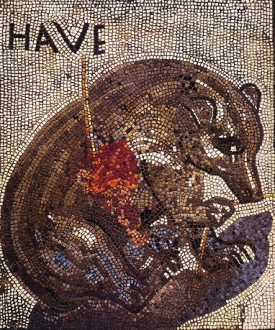
CE. The name derives from a striking mosaic in the entrance
vestibule depicting a bear wounded by a spear, which served as an
apotropaic symbol—a protective emblem intended to ward off evil and
safeguard the household, reflecting the ancient Romans' integration
of art, magic, and spirituality in domestic spaces. The house was
connected to an adjacent property at VII.2.44, which functioned as a
taberna (tavern or bar) called Taberna Hedones, suggesting the owner
may have had commercial interests intertwined with their residential
life.
/house%20of%20the%20Bear%20-%20plan.jpg)
Historical Context and Excavation
Excavated initially in 1865 and further in 1868, the House of the Bear provides a snapshot of Pompeian life in the first century CE. Historical documentation includes 19th-century photographs and lithographs, such as an undated image by Amodio titled "Pompei maison de l'ours" and an 1875 lithograph, which capture the site's early post-excavation state. Archaeological evidence indicates the house was unoccupied at the time of the eruption, implying that the owners, their family, and servants may have fled or attempted to escape the disaster. Conclusions about the residents are drawn from election-related graffiti found across Pompeii, suggesting the owner was a wealthy individual of notable social status, possibly involved in local politics or commerce, though specific identities remain speculative. The house's connection to the taberna, evidenced by a graffito (CIL IV 1679) on a pilaster advertising drinks—"Hedone says: You can get a drink here for only one coin. Two coins for a better drink, four for Falernian wine"—highlights its dual residential and entrepreneurial role.
Architectural Layout
Overall Architectural Layout
The house follows the classic
Pompeian domus plan but on a modest, somewhat irregular scale,
suggesting phased construction and possible post-62 AD earthquake
repairs. There is no grand peristyle colonnade; instead, a small
rear garden (viridarium) provides the outdoor space. The sequence
is:
Street entrance → short fauces/vestibule → atrium
(central light well with impluvium) → tablinum (formal reception
room) → small garden with nymphaeum.
Rooms open off the sides
of the atrium (west, east, and north), and a staircase indicates an
upper story (common in Pompeii for additional living or storage
space). A doorway connects it to the neighboring property
(VII.2.44), which may have included a taberna (tavern), as suggested
by nearby graffiti advertising drinks.
The walls are built in
typical Pompeian opus incertum or reticulatum techniques, with later
repairs visible in places. Floors throughout feature high-quality
mosaics blending black-and-white geometric patterns (common in the
1st century AD) with opus sectile inserts (cut marble or colored
stone) and occasional polychrome emblems. Wall decorations are
predominantly in the Fourth Style—characterized by bright reds,
yellows, blacks, and whites, architectural illusions (columns,
balconies, perspective), candelabra, garlands, and mythological
panels—indicating at least two phases of decoration, largely
pre-dating the 79 AD eruption.
Entrance: Fauces and Vestibule
The narrow entrance corridor (fauces) leads directly from the street
into the atrium. Its floor is the highlight: a black-and-white
mosaic with a central polychrome emblema of the wounded bear framed
in a square. The bear is realistically rendered, dynamic, and
positioned as the first thing visitors see—an intentional protective
and welcoming motif. Walls here were painted (fragments survive
showing decorative schemes). A wide threshold with “pelta”
(crescent-shaped shield) motifs appears in related flooring nearby.
Atrium
The central atrium is a rectangular, roofed courtyard
open to the sky via a compluvium (opening), with a rectangular
impluvium (shallow basin) below to collect rainwater feeding the
cistern. The floor is a sophisticated black-and-white geometric
mosaic with opus sectile panels and borders; a notable wide
threshold with pelta motifs runs along the west wall.
Rooms
open off all sides:
West side: A narrow cubiculum (bedroom) with
a central mosaic emblema; an adjacent room containing the staircase
to the upper floor (wooden stair outlines visible on walls in old
photos); and another small room with high windows onto the street.
East side: Three sequential rooms from north to south—a triclinium
(dining room) in the northeast corner, a central cubiculum, and
another triclinium in the southeast. The northeast triclinium is
especially fine, with Fourth Style paintings on a white ground:
Narcissus (north wall) and Danae with the infant Perseus (south
wall, Zeus as golden rain). A window in the tablinum’s east wall
looks into this room.
North side: Additional small room(s).
The atrium’s walls had painted decoration (Fourth Style
architectural motifs and panels). Views across the impluvium toward
the tablinum and garden emphasize the axial symmetry typical of
Roman houses, designed for impressive reception.
Tablinum and
Transition to Garden
The tablinum, directly opposite the
entrance, served as the master’s formal office/reception space. It
has preserved mosaic flooring (geometric with borders) and frescoed
walls. A threshold leads north into the small garden. A glass
walkway now protects the floors for visitors.
Garden
(Viridarium) and Nymphaeum
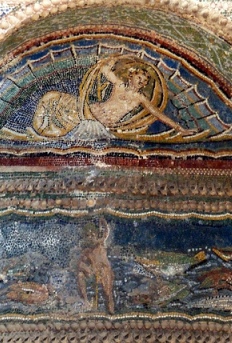
The rear garden is modest but
spectacularly ornamented. Against the north wall stands an
aedicule-style nymphaeum (shrine-like fountain), one of Pompeii’s
finest small examples. It is a polychrome mosaic “grotto”
constructed with glass-paste tesserae, natural shells, lava pieces,
and limestone for a shimmering, cave-like effect. The lunette
(curved upper section) depicts a vibrant seabed with fish and marine
flora; below are figures of Venus reclining in a shell and Neptune
amid the waves—symbolizing water, fertility, and luxury. Water would
cascade or spray from the structure, creating both visual and
auditory delight.
The walls behind and around the fountain
feature Fourth Style garden frescoes: illusionistic architecture
combined with a fantasy landscape including a wild boar and wolf
flanking a tree, plus birds and other animals. This blends real
plants in the garden with painted greenery for an immersive,
paradisiacal effect. The garden floor includes opus sectile
pavements.
Architectural Significance
Though modest in
scale compared to grand villas like the House of the Faun, the House
of the Bear showcases how even mid-tier Pompeian homes invested
heavily in decorative luxury to signal status, hospitality, and
protection. The integration of apotropaic mosaic, refined mosaics,
mythological frescoes, and a sophisticated nymphaeum creates a
harmonious blend of function (daily living, reception, dining) and
sensory delight (water sounds, colorful illusions, mythological
narratives). Its irregular plan and two decoration phases reflect
the dynamic urban evolution of Pompeii in the decades before 79 AD.
Scholarly studies (e.g., by Wolfgang Ehrhardt) highlight the
interplay of construction materials, plaster layers, and stylistic
evolution.
/Bear00%20000%20(1).JPG)
Notable Decorations and Features
The house is celebrated for its artistic elements, which exemplify
Pompeian decorative styles from the first century CE.
Mosaics: The vestibule's floor mosaic of the wounded bear,
accompanied by the Latin inscription "HAVE" (meaning "hail" or
"welcome"), is the house's signature feature. This colorful
depiction, showing the bear pierced by a spear, is divided from the
rest of the hallway by a black-and-white geometric pattern. The
atrium floor includes intricate patterns, such as pelta
(crescent-shaped shield motifs) on thresholds, and the cubiculum
features a central emblema (decorative panel) in its mosaic
flooring.
Frescoes: The entrance corridor and vestibule walls are
adorned with fourth-style frescoes—characterized by illusionistic
architecture, red and yellow panels, and motifs over a red
decorative frieze. The atrium's west wall displays painted
decorations between doorways, while the cubiculum's walls (south,
west, and north) feature vivid paintings, adding to the house's
opulent atmosphere.
Garden and Fountain: The garden, visible from
the tablinum, houses a nymphaeum (fountain) that serves as a serene
focal point. This elegantly decorated feature includes brightly
colored tesserae (mosaic tiles) and shells, with gables above an
arched niche from which water flows through a small rectangular hole
into a semicircular pool. It provided both aesthetic beauty and a
cooling, contemplative space, underscoring the Pompeians'
appreciation for water features in domestic gardens.
/House%20of%20the%20Bear%20-%20fauces.JPG)
/Bear00%2000%202.JPG)
Artifacts and Discoveries
Key finds include a box containing 118 pieces of silverware in the basement, now displayed in museums, indicating the owner's wealth. The connected taberna's graffiti offers a glimpse into commercial activities, with prices for wines reflecting social stratification in consumption. These artifacts, combined with the house's decorations, suggest it belonged to a prosperous merchant or entrepreneur.
Cultural and Historical Significance
The House of the Bear exemplifies how Pompeian homes blended functionality, artistry, and symbolism. The bear mosaic not only welcomed visitors but invoked protection, illustrating the role of images in ancient beliefs. Its preservation allows modern visitors to experience the elegance of Roman domestic life, with features like the fountain evoking tranquility amid urban bustle. As part of Pompeii's UNESCO World Heritage site, it contributes to understanding social dynamics, architecture, and the abrupt end of a vibrant city.