/23421.jpg)
The Herculaneum Gate, known in Italian as Porta Ercolano or Porta Herculanea, is one of the seven principal city gates of ancient Pompeii, situated on the northwestern perimeter of the city's walls at the northern end of Via Consolare. This gate served as the primary northern exit from Pompeii, leading along the Via dei Sepolcri (Street of Tombs) toward Herculaneum and further to Naples and Rome via the Via Domitiana, making it a vital artery for trade, travel, and military movement. Historically referred to as the "Salt Gate" (veru sarinu in Oscan or Porta Saliensis in Latin) due to its proximity to nearby salt flats, it exemplifies Roman urban planning and fortification, blending functionality with monumental grandeur. The visible ruins today represent its Flavian-era reconstruction (post-62 CE earthquake), crowning Pompeii's efforts to rebuild and monumentalize its infrastructure before the catastrophic eruption of Mount Vesuvius in 79 CE.
Historical Background
The origins of the Herculaneum Gate trace back to Pompeii's pre-Roman
fortifications. The city's earliest defensive walls date to the 6th-5th
centuries BCE, during the Oscan period, with the gate likely forming
part of the Samnite fortifications expanded in the 4th-3rd centuries
BCE. An important artifact supporting this is a limestone commemorative
inscription in Oscan from the late 3rd or early 2nd century BCE, now
housed in the Naples Archaeological Museum (inventory 2546/110671). It
mentions aediles (magistrates) P. Matius and Nimsius Maraius, who
delimited the Via Salina (Salt Road), specifying its width in perticae
(Roman rods of about 10 feet). This road passed through the gate,
underscoring its role in regional commerce.
After Pompeii became a
Roman colony following the Social War in 89 BCE and the conquest by
Sulla in 80 BCE, the gate underwent modifications to accommodate
increasing traffic and urban development. The structure visible today
largely represents its Flavian-era reconstruction (circa 69-79 CE),
rebuilt as a monumental arch after devastating earthquakes in the 60s
CE, including the major one in 62 CE that damaged much of the city. This
rebuild emphasized grandeur over pure military utility, aligning with
Roman imperial aesthetics. The gate was in use until the catastrophic
eruption of Mount Vesuvius in 79 CE, which buried Pompeii under layers
of ash and pumice, preserving the site remarkably intact.
Near the
gate, excavations revealed a stratum with votive offerings, including
small terracotta vases and figurine fragments, linked to a now-vanished
religious sacellum (small shrine) dedicated to Venus or Minerva. This
shrine was associated with the Samnite-era gate and persisted through
its history until the post-earthquake reconstructions, highlighting the
site's religious significance alongside its practical functions.
Architecture and Layout
Architecturally, the Herculaneum Gate stands out as Pompeii's most
monumental entrance, resembling a triumphal arch rather than a purely
defensive portal. It features three fornices (arches): a wide central
roadway (approximately 5-6 meters wide) open to the sky for wheeled
traffic like carts, flanked by two narrower pedestrian passageways
covered by barrel vaults. The central vault has partially collapsed, but
the overall design includes an exterior portcullis and an interior
double-leaf gate, forming an open courtyard plan intended to trap
potential attackers—though access to an upper level for defense was
limited, emphasizing its ceremonial over military role.
Constructed
primarily from tuff stone, the gate integrates with the city's
Samnite-era walls, which include a great staircase with tuff steps on
the north side for access to the walkway. To the south, it is flanked by
an inn and stable, while the north features the staircase, rather than
symmetrical parapets as some reconstructions propose. This layout
addressed urban congestion from demographic growth, with wider passages
accommodating increased traffic compared to narrower earlier gates.
Beyond the gate lies the Via dei Sepolcri, lined with the Necropolis of
Porta Ercolano, Pompeii's largest and best-known burial ground. Tombs
here date from the 1st century BCE onward and include diverse types:
semi-circular scholae (benches) for distinguished citizens like the
priestess Mamia (inscribed around 29 CE); altar-shaped tombs on high
podiums, such as that of Naevoleia Tyche and Munatius Faustus with
symbolic ship reliefs; aedicula (small shrine-like) tombs; exedrae
(semi-circular niches); and enclosures with altars. The necropolis
integrates with suburban villas, like the Villa delle Colonne a Mosaico,
blending funerary, residential, and commercial spaces.
Excavations and Discoveries
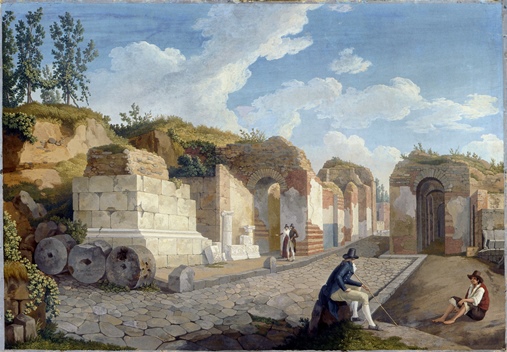
Excavations of the Herculaneum Gate began in the 18th century, with the gate itself uncovered in 1763, making it one of the earliest explored areas of Pompeii. The necropolis was excavated between 1763 and 1838, revealing tombs that gained European fame through 1789 publications and early 19th-century drawings, such as those by A. Zuccagni Orlandini (1845) and paintings like "Entrée de Pompei du Cote d’Herculaneum" (pre-1824). Key finds include the Oscan inscription, votive offerings from the shrine, and siege marks on the walls. Archaeologist Amedeo Maiuri (mid-20th century) attributed strata near the Tomb of M. Cerrinius Restitutus to the vanished sacellum. Modern studies, including those by V. Kockel (1983) on grave buildings and conservation efforts documented in works like Kastenmeier (2020), have focused on the gate's environment, including protective coverings for preservation. Historical visits, such as Mussolini's in 1927, are captured in press photos, highlighting its enduring cultural draw.
The Associated Necropolis
Immediately outside the Herculaneum Gate lies Pompeii's largest
necropolis, the Necropolis of Porta Ercolano, in use from the mid-1st
century BCE until 79 CE. Roman law forbade burials within city walls, so
this area along the Via dei Sepolcri became a prominent burial ground
for the elite, featuring elaborate tombs that offer glimpses into
Pompeian society, economy, and beliefs. Excavated between 1763 and 1838,
it is the best-known of Pompeii's necropoleis and was popularized in
Europe through 1789 etchings by Francesco Piranesi, son of Giovanni
Battista Piranesi.
Key tombs include:
Tomb of C. Calventius
Quietus: Belonging to an Augustalis (priest of the imperial cult),
honored for his public generosity with a bisellium (reserved theater
seat).
Tomb of C. Munatius Faustus: Features a relief of a sailing
ship, symbolizing safe passage in death or commercial success, and
another of a ship entering port; Faustus and his wife Naevoleia Tyche,
both with bisellium rights, reflect middle-class aspirations.
Tomb of
Priestess Mamia: A semicircular bench for funerary banquets, praised by
Goethe in 1787 for its scenic views of the sea and sunset.
Tomb of
the Libella: A solid travertine structure with a lengthy inscription
honoring public priestess Alleia Decimilla's husband (an aedile,
duumvir, and quinquennial praefect) and son (a decurion).
Hemicycle
Tomb (Schola Tomb): A rare intact example with a vaulted roof,
pilasters, arabesque paintings, and stucco; nearby is the Tomb of the
Glass Amphora, containing a blue glass vessel with Dionysian motifs
discovered in 1837.
Tomb of the Garlands: Decorated with Corinthian
pilasters, flower festoons, and acanthus leaves.
These tombs,
often with inscriptions, reliefs, and enclosures, illustrate social
hierarchies, with motifs like ships and banqueting benches emphasizing
themes of legacy, commerce, and the afterlife. Unfinished tombs and
nearby villa ruins (possibly linked to Cicero, though unconfirmed) add
to the site's intrigue.
Significance
The Herculaneum Gate holds immense significance as a well-preserved exemplar of Roman gateway architecture from the 4th century BCE fortifications, illustrating the transition from defensive to symbolic structures in a prosperous colony. It reflects Pompeii's social stratification through its necropolis, where tombs served as sites of memory and honor, integrating civic life with the afterlife in Roman tradition. As part of the UNESCO World Heritage Site encompassing Pompeii, Herculaneum, and Torre Annunziata, it provides insights into urban planning, trade routes, and religious practices, drawing scholars and tourists to explore its layered history from Samnite origins to Roman imperial splendor. Today, it remains a highlight for visitors, with ongoing conservation ensuring its legacy amid Pompeii's ruins.