/greco-romain-pompei-rue-de-abondance.jpg)
The ancient streets of Pompeii form a well-planned grid system, reflecting the city's evolution from its early Samnite origins to its Roman integration. The layout consists of east-west streets known as decumani (with the Via dell'Abbondanza as the primary decumanus maximus, serving as the main commercial artery) and north-south streets called cardines (such as Via Stabiana). This grid was largely established by the late 4th century BC, with expansions incorporating more regular, Hippodamian-inspired patterns, and was mostly complete by the time of Sulla's conquest in 89 BC. The streets connected key areas like the Forum—the civic, religious, and commercial heart of the city—to gates, ports, and salt pans, facilitating daily life, trade, and movement. Unlike some Roman cities, Pompeii's streets varied greatly in design, from broad thoroughfares to narrow alleys, adapting to the hilly terrain and urban needs.
Roman street
/graffiti1.jpg)
Materials and Construction
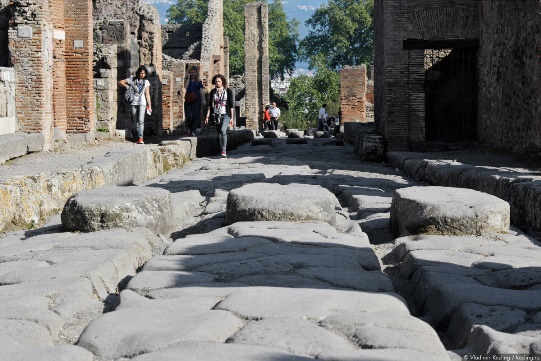
Pompeii's streets were paved with large, irregularly shaped slabs of basalt lava quarried from nearby Mount Vesuvius, creating a durable, even surface that has remarkably endured for over 2,000 years. These blocks were meticulously fitted together, showcasing Roman engineering prowess, with some streets underlain by water conduits for basic infrastructure. The pavements (sidewalks) flanking the streets were typically raised about 30 cm high, constructed from a mixture of broken terracotta and lime cement, though much of this has eroded over time due to modern foot traffic. In narrower alleys, streets might consist of simple dirt paths, while major routes demonstrated advanced construction, including holes for tethering horses outside shops.
Width, Traffic, and Ruts
Street widths ranged from 2.5 to 4.5 meters, with about 80% being single-lane to accommodate the city's compact design. Broader streets allowed two-way cart traffic, while narrower ones were often one-way or restricted to pedestrians, as evidenced by the absence of wheel ruts in some areas. Deep ruts—up to 15 cm (6 inches)—worn into the stone by iron-rimmed cart wheels reveal traffic patterns, with some streets showing purposeful cuts to guide vehicles between high kerbs. These ruts, created by two- or four-wheeled carts transporting goods, indicate directional flow and highlight the bustling commercial activity. Iron stains from wheels remain visible on some kerbstones, underscoring the materials used in ancient transport.
/c70392dbfddff73bf0e41a48b55d3cd6.jpg)
Pedestrian Features and Stepping Stones
One of Pompeii's most distinctive features is its abundance of stepping stones—large, ovoid or rectangular lava blocks placed across streets at the same height as the sidewalks. The city boasts 316 such crossings, 20 times more than in any other known Roman city, allowing pedestrians to cross without stepping into the often filthy roadways. These stones were spaced to permit cart wheels to pass through, with gaps adjusted to standard axle widths, demonstrating thoughtful urban planning. High kerbs (over 30 cm) further separated pedestrians from the street level, protecting sidewalks from flooding.
Water Management and Sanitation
Pompeii lacked a comprehensive underground sewer system, so streets doubled as drainage channels for rainwater, wastewater, and overflow from about three dozen public fountains fed by the aqueduct. Streets were slightly crowned (raised in the center) to direct water into side gutters, though this was often ineffective, leading to frequent flooding for cleaning purposes. Residents and shop owners commonly dumped waste directly into the streets, contributing to unsanitary conditions that necessitated the stepping stones and high sidewalks. This constant water flow may explain the exceptional number of crossings, as streets were perpetually wet or muddy.
Nighttime Visibility and Other Details
To aid nighttime navigation, small white stones were embedded in the lava paving, reflecting moonlight like ancient "cat's eyes" and glowing faintly under lamplight. These were also used in home entryways and raised walkways for visibility. Along the streets, buildings were densely packed, with ground-floor shops (often rented out) and upper apartments for residents, creating a vibrant urban environment where commerce thrived amid the grid.
House
The traditional Roman house, known as a domus, represents the primary residential architecture for affluent families in ancient Pompeii. Preserved remarkably well due to the eruption of Mount Vesuvius in 79 AD, which buried the city under layers of ash and pumice, these structures offer unparalleled insights into Roman daily life, social hierarchy, and building techniques. Unlike modern homes, the domus was inward-facing, with few external windows to maintain privacy and security in the densely packed urban environment. The design evolved over time, incorporating elements from earlier Italic traditions and Hellenistic influences from Greece, resulting in a standardized yet adaptable layout by the 1st century AD. Houses varied in size—from modest single-atrium dwellings to expansive complexes occupying entire city blocks (insulae)—but most followed an axial plan centered around open courtyards for light, ventilation, and rainwater collection. Pompeii's domus examples, such as the House of the Faun or House of the Vettii, highlight how architecture blended functionality with displays of wealth through elaborate decorations like frescoes, mosaics, and sculptures.
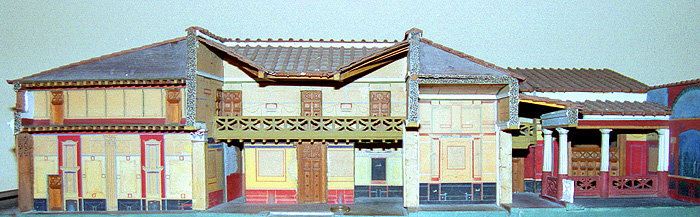
Lobby Atrium Tablinum Peristyle around the garden
This is a model of a standard ancient Roman hous. Although of course there were many variations. But here we look at the general view of the Roman house. First, a guest from the street got into the lobby. It was a hallway. From there you could walk into an atrium. This is such a lounge for visitors. In the center was usually impluvium or a small pool of water. Water got there from a square or rectangular hole in the roof.
Exterior and Entrance Features
From the street, a Pompeian domus presented a modest, fortified
facade to deter intruders and minimize noise and dust from the bustling
urban surroundings. Walls were typically constructed of local materials
like tuff stone, brick, or opus incertum (irregular stones set in
mortar), often plastered and painted in simple colors. Windows were rare
and small, placed high up if present at all, to prioritize internal
orientation. Many houses incorporated street-facing shops (tabernae)
rented out for commercial purposes, such as bakeries or wine sellers,
providing income for the owner while separating public commerce from
private living spaces.
The main entrance, called the vestibulum or
fauces (meaning "jaws" due to its narrow, corridor-like form), was a
transitional space leading from the street into the home's interior. It
was often flanked by benches for waiting clients or guards and secured
by sturdy wooden doors reinforced with iron. Above the door, a small
transom or inscription might display the owner's name or protective
symbols. This entrance aligned axially with the home's core spaces,
emphasizing symmetry and creating a visual line of sight that
underscored the owner's status upon entry.
The Atrium: The Public Heart of the Home
Upon entering, visitors immediately encountered the atrium, the
central hall and social hub of the domus. This rectangular space was
open to the sky through a roof aperture called the compluvium, which
allowed natural light and fresh air to flood the interior while
channeling rainwater into a shallow basin below known as the impluvium.
The impluvium not only collected water for household use (stored in an
underground cistern) but also served as a reflective surface to amplify
light. Atria varied in design based on size and wealth:
Tuscan
atrium: The simplest and most common, with no supporting columns; the
roof sloped inward directly to the compluvium.
Tetrastyle atrium:
Featured four columns around the impluvium for structural support in
larger homes.
Corinthian atrium: More elaborate, with multiple
columns in ornate styles, often seen in grander residences.
Surrounding the atrium were key rooms arranged symmetrically. On either
side were alae (open alcoves or wings) used for storage, display of
ancestral masks (imagines), or informal meetings. Flanking these were
cubicula (bedrooms), small and multifunctional spaces for sleeping,
storage, or private retreats, often with raised platforms for beds and
minimal furnishings. At the far end of the atrium, opposite the
entrance, stood the tablinum, a reception room or study where the
paterfamilias (head of the household) conducted business, received
clients (salutatio rituals), and displayed family records or valuables
in cabinets or strongboxes. The atrium also housed the lararium, a small
shrine to the household gods (lares and penates), emphasizing the
religious dimension of domestic life.
The atrium functioned as a
semi-public space, blending family privacy with social obligations. Its
floors were often paved with mosaics depicting geometric patterns or
mythological scenes, while walls were adorned with frescoes in vibrant
reds, yellows, and blacks, evolving through four Pompeian styles:
incrustation (imitating marble), architectural (illusionistic
structures), ornamental (fantastical motifs), and intricate (complex
narratives).
The Peristyle and Private Quarters
Beyond the atrium, a short passageway or the tablinum itself led to
the more private rear section of the house, centered around the
peristyle—a colonnaded courtyard garden that represented Hellenistic
influences on Roman design. This open-air space, surrounded by a portico
of columns (often Doric or Ionic), provided a tranquil retreat with
fountains, statues, flower beds, and sometimes small fish ponds
(piscinae). It served as the family's leisure area, promoting relaxation
and connection with nature in an urban setting.
Encircling the
peristyle were intimate rooms:
Triclinium: The dining room, named for
its three couches (klinai) where guests reclined during meals. Wealthier
homes had multiple triclinia for different seasons—summer ones open to
the garden for breezes, winter ones enclosed for warmth. Tables were low
and portable, with elaborate frescoes enhancing the ambiance.
Oecus:
A larger reception or living room for entertaining, sometimes used for
banquets or intellectual gatherings.
Culina: The kitchen, typically
small and smoky, equipped with brick ovens, hearths for cooking over
fire, and storage for amphorae (jars). Slaves prepared meals here, with
ventilation through small windows.
Additional cubicula and storage:
More bedrooms or utility rooms, plus latrines (often communal and
flushed by water from the atrium system).
Some grand domus
featured private baths (balnea) with hypocaust heating (underfloor hot
air systems) or even small libraries. Upper floors, if present (though
rare in Pompeii due to volcanic preservation focusing on ground levels),
might house servants or additional storage, accessed by narrow stairs.