/3448582000_0f63cfca48[1].jpg)
/House%20of%20the%20Mosaic%20Atrium%20-%20facade.JPG)
/House%20of%20the%20Mosaic%20Atrium%20-%20plan.jpg)
The House of the Mosaic Atrium (Casa dell'Atrio a Mosaico), located
at Insula IV.1-2 in Herculaneum (modern Ercolano, Italy), is one of
the largest and most impressive domestic structures in the
archaeological site, spanning approximately 1,200–2,150 square
meters on the lower floor alone. Buried under pyroclastic flows and
mud during the eruption of Mount Vesuvius on October 24, 79 CE, it
was likely formed by merging three or four smaller houses,
reflecting urban adaptations in this affluent seaside town. The
house derives its name from the distinctive black-and-white
chessboard mosaic flooring in the atrium, a hallmark of its
Third-Style decorations, though the floor is now buckled and uneven
due to earthquake tremors and volcanic heat. Built in the mid-1st
century CE, it belonged to a wealthy and important individual, as
indicated by its scale and features like sea-facing rooms with
panoramic views of the Bay of Naples. Post-62 CE earthquake
renovations are evident in reconstructed walls and floors, with
ongoing alterations at the time of the eruption.
Excavation
began with Bourbon tunnel explorations in 1738, which removed some
frescoes and caused damage, followed by systematic open-air digs in
1933–1934 under archaeologist Amedeo Maiuri, who documented its
features in his 1971 work Ercolano. I Nuovi Scavi. The house's
preservation under mudflows allowed for intact mosaics and
carbonized wood, but volcanic heat warped floors, and early
excavations destroyed some small paintings in the veranda. Today, as
part of the Parco Archeologico di Ercolano, it is accessible to
visitors, who appreciate its grandeur but note the uneven floors and
ruined upper levels; it is rated 4/5 on platforms like Tripadvisor
for its historical intrigue.
/House%20of%20the%20Mosaic%20Atrium%20-%20view%20from%20entrance%20fauces%20(by%20SaraLeeBranch).JPG)
/House%20of%20the%20Mosaic%20Atrium%20-%20mosaic%20paving.JPG)
The House of the Mosaic Atrium develops over two levels, with the
lower floor featuring a narrow fauces (entrance corridor) leading to
a central atrium, surrounded by rooms and extending to a large
colonnaded garden with a central basin. The layout is axial,
emphasizing the atrium as a reception hub, with service areas
(kitchen, latrine) to the north and luxurious sea-facing rooms on
the south, including a terrace overlooking the Bay of Naples. The
garden is colonnaded on three sides, creating a peristyle, and the
house incorporates a wooden veranda paved with mosaics. Upper
floors, accessed by stairs, included private quarters, but they are
largely ruined.
Architectural elements include opus reticulatum
masonry for walls, with tufa in thresholds and jambs from earlier
phases. The atrium has a central impluvium decorated with a rosette
of colored marble, and floors show undulations from seismic
activity. Drainage systems fed cisterns, and large windows in south
rooms maximized sea views. The garden's columns have interleaved
patterns of colored stones, enhancing aesthetic appeal. Linked to
adjacent properties (IV.1 and IV.3), it may have formed a larger
complex.
The house includes approximately 15–20 spaces, with labels from
archaeological documentation (e.g., Maiuri's plans).
Entrance
Fauces: Narrow corridor from Cardo IV Inferiore, paved with intact
black-and-white mosaic extending to the atrium; remains of steps to
the pavement. Leads south to the atrium; decorated in Third Style.
Atrium: Central reception space with chessboard-patterned mosaic
floor of white, black, and colored marble; central impluvium with
rosette of colored marble. Surrounding rooms decorated in Third
Style; west side has a small room with white panels, architectural
motifs, red zoccolo with plants/animals, and opus signinum floor
with white tesserae.
Tablinum: East of atrium, owner's office;
painted decorations on north, east, and south walls in Third Style,
with details from upper center of east wall. Large hall with two
small naves paved with colored marble, resembling a small basilica.
Room South of Atrium: South side; east, south, and west walls
painted in Third Style.
Room West of Atrium: West side; north,
west, and south walls in Third Style.
Room North of Atrium: North
side; east, north, and west walls in Third Style.
Kitchen and
Latrine: Northwest of atrium; kitchen with hearth, latrine in
northwest corner.
Corridor to Lower Level: Southwest of atrium;
leads to lower level rooms.
Lower Level Rooms: South-west, south,
west, north, east, north-east, south-east; utilitarian, with views
in various directions.
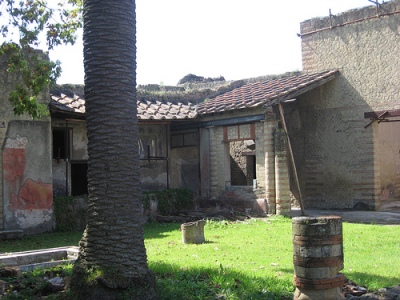
Garden/Peristyle: Large colonnaded garden
on three sides with central basin; wooden veranda paved with mosaic
and adorned with mythological frescoes.
Sea-Facing Rooms: South
side; large hall with terrace; white mosaic floors with black
frames, frescoes on white backgrounds.
Upper Floors: Private
quarters; ruined, but inferred from stairs.
/00%2000%201b.JPG)
/00%2000%201h.JPG)
Decorations feature Third-Style frescoes in atrium rooms (white
panels, architectural motifs, red zoccolo with plants/animals) and
mythological scenes in veranda (destroyed during excavations).
Floors include chessboard mosaics in atrium/fauces, opus signinum
with tesserae in rooms, colored marble in tablinum. Sea rooms have
white mosaics with black frames, classic Pompeian red walls
elsewhere.
Artifacts include a charred table and small wooden
cradle (empty, suggesting a child; now in museum), highlighting
family life.
/00%2000%201%20(1).JPG)
/00%2000%201.JPG)
/00%2000%201f%20(1).JPG)
/00%2000%201r.JPG)
/House%20of%20the%20Mosaic%20Atrium%20-%20peristyle.JPG)
/00%2000%201n.JPG)